To respond to a friend's good news well, react with real, active enthusiasm: ask about it, let it land, and show you are glad. Research on sharing good news finds that people get an extra lift in daily well-being when the listener responds actively and constructively, and not passively or destructively [1]. A flat or distracted reaction can quietly cancel the benefit of sharing.
When a friend tells you good news, how you respond to a friend's good news is not a small thing. It shapes how much that news is worth to them, and it shapes how close the two of you feel afterward. Researchers call the act of telling others about a good event capitalization, and the main finding is simple: active, enthusiastic responses help, and flat or distracted ones can quietly take the shine off. This article covers what that research found, where its limits are, and what to do when what you feel is envy.
A caution about scope. Much of this research comes from lab experiments and from couples, and one recent study used strangers. So the findings are best read as how people in close relationships tend to work, not as a guarantee about any one friendship. The tips at the end are our own reading, not tested instructions.
What happens when we share good news
A set of four studies looked at what happens when people seek out others after something good happens. Two of them found that telling others about a personal positive event went with increased daily positive affect and well-being, beyond the impact of the event itself and of other things that happened that day. The benefit was larger when the person felt others responded actively and constructively, and not passively or destructively. The other two studies looked at close relationships and found that when a partner typically responds to good news enthusiastically, the relationship scored higher on well-being, including intimacy and daily marital satisfaction [1].
Two points are worth holding on to. The abstract describes these findings as associations, so they show what goes with what. And the close-relationship studies were about partners, so for friends we are borrowing a pattern, not citing a friendship study. It is a reasonable bet that it carries over, since the mechanism is about how people respond to each other, but it is a bet.
Why your reaction matters to a friend
A later set of four experiments and one daily diary study asked why. It tested two ideas. The first was that sharing good news makes the event feel more valuable, especially when the other person responds enthusiastically. The second was that enthusiastic responses build trust and a prosocial orientation toward the responder. Both received consistent support, in conversations with strangers and in everyday close relationships [2].
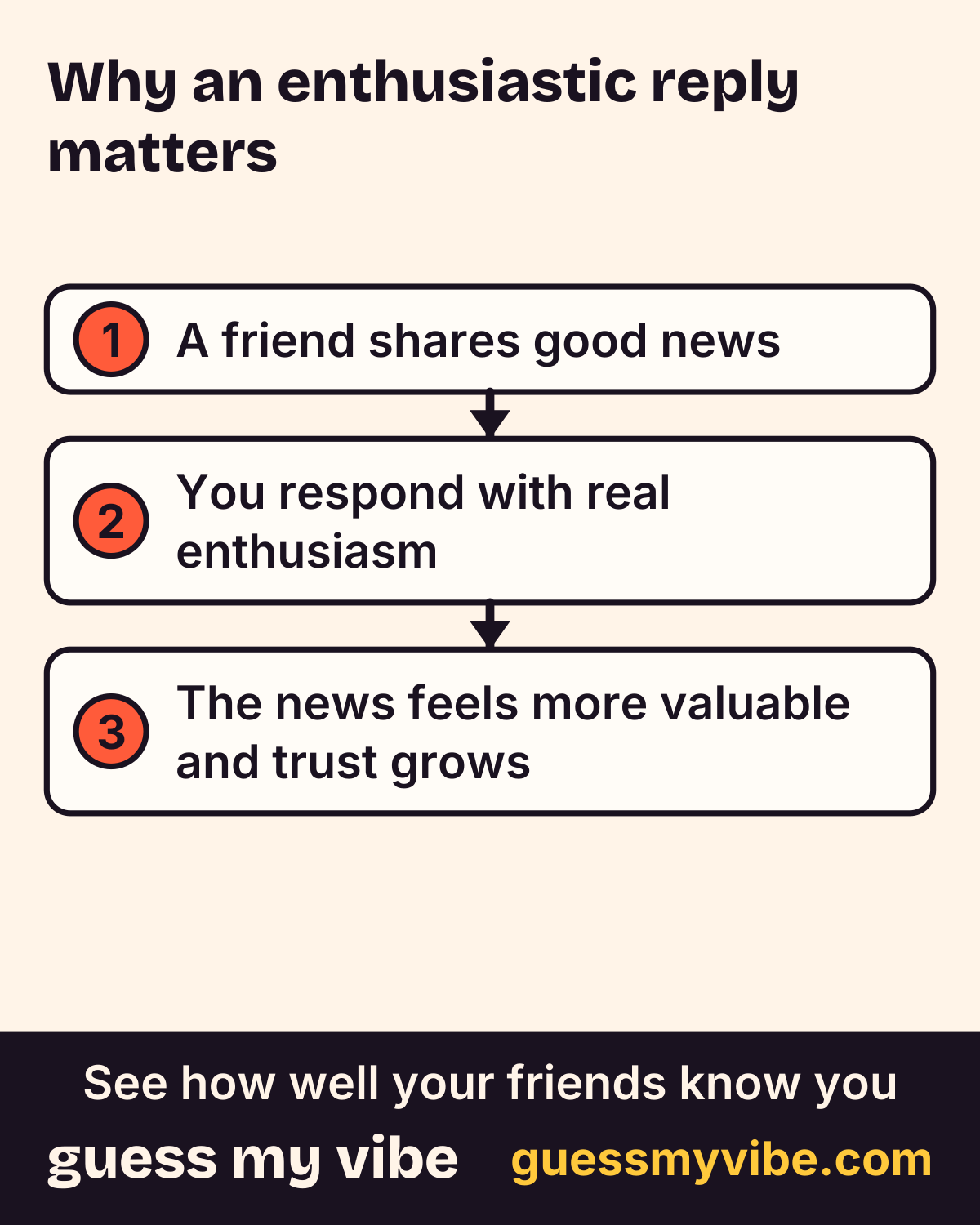
Put plainly, your reaction does two jobs. For your friend, it is a kind of mirror: the good news feels more valuable when you are enthusiastic. For the friendship, it is a deposit: trust grows when you are the person who is glad for them, and the studies link it to a more prosocial orientation toward you. The cost is small, and the studies suggest the payoff is real.
What a good response looks like, in the research's terms, is active and constructive: enthusiastic and supportive, with real interest. The opposite is passive and destructive, meaning disinterested and unsupportive [3]. Those labels cover more than words. A phone glance, a change of subject or a quick but flat well done is a low-effort response, though the studies did not test those exact behaviors.
Cite this figure
Figure: "Why an enthusiastic reply matters." Guess My Vibe (guessmyvibe.com). https://guessmyvibe.com/learn/how-to-respond-to-a-friends-good-news#figure-good-news-loop
Curious how your friends would answer?
Free. Answer 10 quick questions about you, then send your link. Friends play in their browser, no app needed.
Start freeFeeling glad with them beats analyzing them
A 2026 study looked at what sits behind a good response. It had 103 stranger dyads (N = 206) talk about a meaningful positive event, then watch the recording and rate their own and each other's emotions moment by moment. Moments in which both people felt positive emotion at the same time were the key predictor of how the sharer perceived the response. More shared positive feeling went with more active-constructive responses and fewer passive-destructive ones, even after accounting for each person's own positive and negative feelings, how deep the disclosure was and other kinds of empathy. The authors conclude that feeling positive emotions with someone, more than understanding or caring for their emotions, is associated with effective responses to shared good news [3].
Two caveats apply. These were strangers talking in a lab, and the measure is how the sharer perceived the response, not a record of what happened later in the friendship. Still, the direction is useful. Responding well to good news is less about saying the perfect line and more about letting yourself feel pleased while the friend is telling it.
When a friend's good news stings
Sometimes a friend's good news lands with a pinch of envy, particularly when it is in an area you care about. Envy research is useful here. Three studies, in the Netherlands, the United States and Spain, found that envy comes in two distinct experiences. Benign envy leads to a moving-up motivation aimed at improving your own position, while malicious envy leads to a pulling-down motivation aimed at damaging the other person's position [4].
That gives you something to do with the sting. Feeling it does not make you a bad friend; it is a common human reaction. What matters is which way it points. If you notice a pull to quietly cut the friend down, that is the malicious kind, and it is worth pausing before you respond. If the feeling is more like I want that too, it can become motivation for your own goals. You can be honest with yourself about the envy and still be glad for your friend, because both can be true at once. Our article on competitive friends covers the self-evaluation side of this.
Putting it into practice
- Stop and give the news your attention. Put the phone down, or if you are texting, reply with something specific to what they said rather than a one-word reaction.
- Ask a follow-up question. How did you find out, what was the best moment, what happens next. Questions show interest and let the friend relive the good part, which is the point of sharing.
- Let your feeling show. The 2026 study points at shared positive feeling, so say that you are glad, and mean it, instead of editing your reaction into something neutral.
- Keep your own news out of it for a minute. Matching their story with yours right away can look like taking the spotlight. Save it for after they have had theirs.
- If envy is in the mix, be glad first and handle the envy later. You can say congratulations and still privately work out what you want for yourself.
- Be a person your friends come to with good news. Over time, how you respond may shape whether friends keep telling you. That is our inference, not a finding.
How Guess My Vibe fits in
Guess My Vibe is a good excuse to share something light with a friend, and to see how each of you reacts when the other nails a guess. It is a small, low-stakes way to practice being glad together.
Key takeaways
- Telling someone good news was linked to more daily positive feeling and well-being beyond the good event itself, and the boost was bigger when the listener was perceived to respond actively and constructively [1].
- In four experiments and a daily diary study, enthusiastic responses made good events feel more valuable and promoted trust and a prosocial orientation toward the responder, with strangers and in everyday close relationships [2].
- In conversations between strangers, more moments of shared positive feeling went with more enthusiastic and supportive responses and fewer disinterested ones, which suggests that feeling glad with someone matters more than analyzing their feelings [3].
- Envy has two kinds, benign envy that pushes you to improve and malicious envy that makes you want to pull the other person down, so feeling a sting at a friend's news is common and not a final verdict on you [4].
- This isn't therapy, a diagnosis, or a substitute for professional care.
Questions people ask
How should you respond when a friend shares good news?
Respond actively and constructively: show interest, ask a follow-up question and let your gladness show. In studies of sharing good events, people felt a bigger lift when listeners responded that way than when they responded passively or destructively [1].
What is capitalization in psychology?
It is the term researchers use for telling others about a good event so that you get more out of it. Sharing good news was linked to higher daily positive feeling and well-being beyond the event itself [1].
Why do I feel jealous when my friend gets good news?
It is common, and it often comes with caring about the same thing. Researchers separate benign envy, which motivates you to improve your own position, from malicious envy, which motivates you to pull the other person down [4]. Noticing which one you feel is more useful than judging yourself for feeling it.
Does celebrating a friend's success make friendships stronger?
The evidence points that way, with caveats. Enthusiastic responses to shared good news promoted trust and a prosocial orientation toward the responder in experiments and diary data [2], but much of the research is on strangers or couples, not friends specifically.
What if I don't feel excited about my friend's news?
You can still respond with interest, and care often follows attention. The 2026 study found that moments of shared positive feeling went with better responses [3], so staying engaged with their story is a good way to get there. Faking big excitement isn't the goal; being present is.
See how well your friends know you.
Free. Answer 10 quick questions about you, then send your link. Friends play in their browser, no app needed.
Start freeReferences
- [1] Gable, S. L., Reis, H. T., Impett, E. A., & Asher, E. R. (2004). What do you do when things go right? The intrapersonal and interpersonal benefits of sharing positive events. Journal of Personality and Social Psychology, 87(2), 228–245. PubMed: 15301629 (opens in a new tab)
- [2] Reis, H. T., Smith, S. M., Carmichael, C. L., Caprariello, P. A., Tsai, F.-F., Rodrigues, A., & Maniaci, M. R. (2010). Are you happy for me? How sharing positive events with others provides personal and interpersonal benefits. Journal of Personality and Social Psychology, 99(2), 311-329. PubMed: 20658846 (opens in a new tab)
- [3] Depow, G. J., Gordon, A. M., Gu, Y., & Oveis, C. (2026). Build better relationships: Positive empathy and capitalization. Emotion. PubMed: 42490261 (opens in a new tab)
- [4] van de Ven, N., Zeelenberg, M., & Pieters, R. (2009). Leveling up and down: The experiences of benign and malicious envy. Emotion, 9(3), 419–429. PubMed: 19485619 (opens in a new tab)
How we find and check these sources: how we write. Spotted an error? Report a correction.
Related
- Competitive Friend: The Psychology Behind the Sting
- Envy vs Jealousy: The Real Difference, With Friend Examples
- How to Be a Good Friend, According to Research
- Active Listening: What Research Says It Actually Does
- Social Comparison: Why We Measure Ourselves Against Others
- How to Thank a Friend (It Lands Better Than You Think)
Cite this article
- Title
- How to Respond to a Friend's Good News (Research-Backed)
- Publisher
- Guess My Vibe
- Updated
- URL
- https://guessmyvibe.com/
learn/ how-to-respond-to-a-friends-good-news
Copy this citation
Guess My Vibe. (2026, October 7). How to Respond to a Friend's Good News (Research-Backed). Guess My Vibe. https://guessmyvibe.com/
To point at one section, add that section's anchor (the # link on its heading) to the URL.