Say it plainly and say what they did. In three experiments, people who wrote gratitude letters underestimated how positive the recipients would feel and overestimated how awkward it would be [1], and across five studies people also underestimated the effect of their compliments [2].
Want to take it for real? Make a friendship quiz for a friend as a thank-you
If you are wondering how to thank a friend without it being awkward, the research has a clear and slightly surprising answer: the awkwardness is usually overestimated. People who express thanks guess that the other person will feel more uncomfortable and less pleased than they actually do. This article covers what the studies found, what they didn't test, and a few simple ways to word a thank-you to a friend.
Scope matters here. The experiments on how people misjudge a thank-you used written gratitude letters and compliments, often in one-time situations. The studies of what thanks does for relationships mostly looked at couples or a sorority, not friendships over time. Where we apply them to friends, that is our own reading, and we say so.
We expect it to be awkward, and it's usually less so
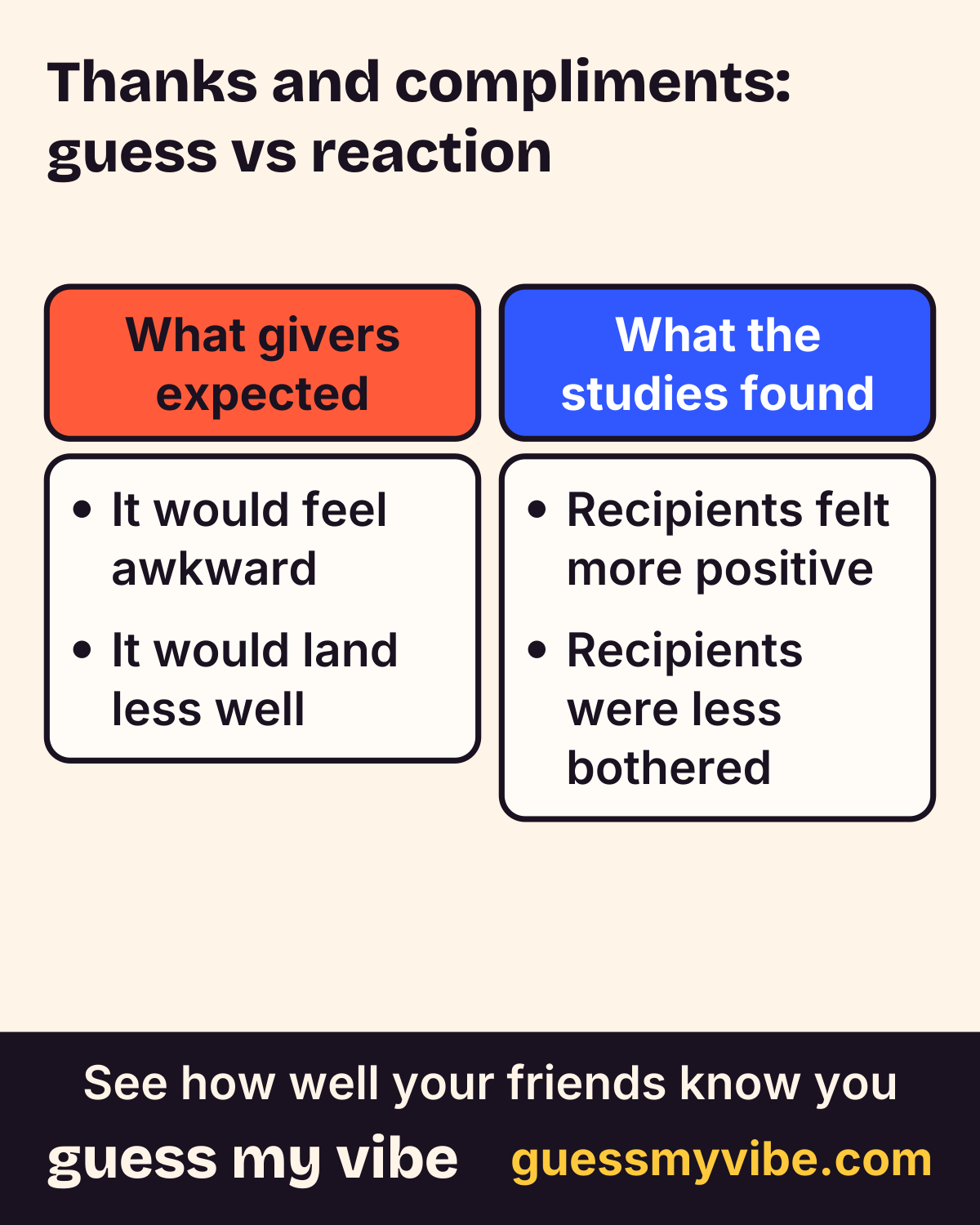
In three experiments, participants wrote gratitude letters and then guessed how surprised, happy and awkward the recipients would feel. The recipients then reported how they actually felt. The people who wrote the letters underestimated how surprised the recipients would be about why they were grateful, overestimated how awkward recipients would feel, and underestimated how positive recipients would feel. How awkward writers expected it to be, and how good they expected the recipient to feel, were both tied to how willing they were to send one [1].
The practical lesson is that your own gut sense of this will be off in a predictable direction. If it feels like it might be a bit much, that feeling is not a reliable guide. This was a study of letters, so it does not tell us whether a text, a voice note or saying it in person would show the same gap, though nothing in it suggests the pattern would flip.
The same goes for compliments
A second set of studies looked at compliments, the small cousin of a thank-you. Across five studies, people giving compliments underestimated how positively the recipient would feel and overestimated how bothered or uncomfortable the recipient would feel. They did so even in hindsight, and it affected how likely they were to give one. The researchers traced the misjudgment to the givers' own anxiety and concern about whether they would do it well; outside forecasters who weren't giving the compliment were accurate. And the givers, despite their nerves, felt better after they had done it [2].
That finding is a kind reminder that the nervous feeling comes from the person speaking, not from the person listening. A friend hearing you say I love how you always remember the small stuff is not grading your delivery.
Cite this figure
Figure: "Thanks and compliments: guess vs reaction." Guess My Vibe (guessmyvibe.com). https://guessmyvibe.com/learn/how-to-thank-a-friend#figure-expected-vs-actual
What a thank-you does for a relationship
Beyond the awkwardness, what does thanking actually do? Here the evidence is more modest and comes from other kinds of relationships. In a study of a college sorority during a week of gift-giving from older to new members, new members who saw their benefactor as responsive felt more gratitude, and gratitude during that week was linked to later relationship outcomes, both at the end of the week and a month later [5]. In an experiment with strangers, people who received a note thanking them were more likely to give the sender their contact information, apparently because the thanks signaled warmth [6]. Both findings fit the idea that thanks can help a connection form or continue, though the sorority study was correlational and one experiment with a note is not a friendship.
None of this proves that thanking a friend will make you closer. It shows that thanks tends to be received as warmth, and that warmth tends to be welcomed.
Curious how your friends would answer?
Free. Answer 10 quick questions about you, then send your link. Friends play in their browser, no app needed.
Start freeMake it about them, not just the favor
What makes a thank-you work? One study looked at conversations in which one member of a couple expressed gratitude to the other, recorded on video (n = 370, across an original study and a replication). Gratitude is sometimes described as an other-praising emotion, and the researchers examined the thanker's other-praising behavior. The more of it there was, the more the listener felt that the thanker was responsive, the better they felt in general, and the more loved they felt in particular [3].
In everyday words, our reading of that is this: thanks that praises the person lands better than thanks that is only about you. Compare thanks for the ride with thanks for driving me, you always show up when it counts. The second tells your friend something about who they are to you. That wording is our translation of the study's idea, and the study was of couples, so treat it as a good bet and not a rule.
Don't make it a chore
There is a caveat that is easy to miss. In a month-long experiment, couples were randomly assigned to express gratitude or to a different relationship activity. The effects of the gratitude condition on well-being were modest. The people who gained the most were those whose partners seemed especially responsive when they first expressed thanks, and the authors raised concerns about how well artificial doses of gratitude work when the other person seems unresponsive [4].
The lesson for friendship is not to turn gratitude into a mandatory ritual. Thanks that is real and specific seems to be the useful kind, and how the other person responds matters as well. That fits our broader sense that a friendship is a two-way thing, not a performance, though this is couples evidence.
How to word a thank-you to a friend
The studies tell you whether to say it, and hint at what makes it land, but they do not test scripts. The options below are our suggestions, built from those findings.
- Say it soon. The gap between how awkward it feels and how it lands is the finding, and in our reading, waiting only gives the nerves more time.
- Name what they did. A specific detail, like you stayed on the phone with me while I was sorting that out, shows you noticed.
- Say what it says about them. Add a line about the person, such as you are the friend I can count on for this. This is our reading of the other-praising idea.
- Keep it short. You do not need a paragraph. A sentence or two said sincerely is a fine place to start.
- Pick a channel that suits the friendship. The studies do not compare texts, calls and notes, so go with what you both usually use. Writing it down, as in the letter studies, is one option.
- Don't ask for anything in the same message. Thanks that arrives with a request is harder to read as thanks. That is common sense, not a finding.
- Let it be one-sided. You don't need a thank-you back. If your friend is awkward about it, a smile and moving on is fine.
When it feels off
The research describes averages. Some friends really are uncomfortable with praise, and some friendships have a style, such as teasing, in which a sincere thank-you feels out of place. If that is your friend, go with their style: a joking thanks with one real line in it can work. And if you find yourself thanking someone constantly because you feel you owe them, that is a different thing from gratitude, and may be worth a conversation with the friend, not another thank-you.
How Guess My Vibe fits in
Playing someone's Guess My Vibe link is a small gift of attention: a friend spends a few minutes thinking about how you would answer. After they play, a thank-you that names something specific you noticed in their guesses is an easy, low-pressure place to practice saying a kind thing out loud.
Key takeaways
- People who wrote gratitude letters underestimated how surprised and positive recipients would feel and overestimated how awkward it would be, and those expectations were tied to how willing they were to express gratitude [1].
- Across five studies, compliment givers underestimated how good recipients would feel and overestimated how bothered they would be; the givers' own anxiety about doing it badly drove the misjudgment, and they felt better afterward [2].
- In a study of conversations between couples, thanks that included more praise of the other person went with the listener feeling the thanker was more responsive and with more good feelings [3].
- In an experiment with couples, asking people to express gratitude had modest effects on well-being, and the benefit depended on how responsive the partner seemed, so forced thanks may not help [4].
- This isn't therapy, a diagnosis, or a substitute for professional care.
Questions people ask
Is it awkward to thank a friend?
Less than you expect. In three experiments, people writing gratitude letters overestimated how awkward recipients would feel and underestimated how positive they would feel [1]. The studies tested letters, so the exact gap for a text or in person is not known.
What should I say to thank a friend?
Name what they did and add a line about what it says about them. In recorded conversations between couples, thanks with more praise of the other person went with the listener feeling the thanker was more responsive and loving [3]. That is couples research, so treat the wording as a good bet, not a rule.
Do compliments make people uncomfortable?
Usually much less than the giver fears. Across five studies, givers underestimated how good recipients would feel and overestimated how bothered they would be, and they felt better after giving the compliment [2].
Does saying thank you make a friendship stronger?
There is some evidence that gratitude helps relationships form and continue. In a sorority study, gratitude during a week of gift-giving was linked to later relationship outcomes [5], and a note of thanks made a stranger more likely to share contact details [6]. The evidence is correlational or from short experiments, not a guarantee for any one friendship.
Can you thank someone too much?
We did not find a study on friends. A month-long couples experiment found modest benefits that depended on how responsive the partner seemed, and raised concerns about artificial gratitude when the partner seemed unresponsive [4]. Real, specific thanks seems to be the safest kind.
See how well your friends know you.
Free. Answer 10 quick questions about you, then send your link. Friends play in their browser, no app needed.
Start freeReferences
- [1] Kumar, A., & Epley, N. (2018). Undervaluing gratitude: Expressers misunderstand the consequences of showing appreciation. Psychological Science, 29(9), 1423-1435. PubMed: 29949445 (opens in a new tab)
- [2] Boothby, E. J., & Bohns, V. K. (2021). Why a Simple Act of Kindness Is Not as Simple as It Seems: Underestimating the Positive Impact of Our Compliments on Others. Personality and Social Psychology Bulletin, 47(5), 826-840. PubMed: 32856538 (opens in a new tab)
- [3] Algoe, S. B., Kurtz, L. E., & Hilaire, N. M. (2016). Putting the "You" in "Thank You": Examining Other-Praising Behavior as the Active Relational Ingredient in Expressed Gratitude. Social Psychological and Personality Science, 7(7), 658-666. PubMed: 27570582 (opens in a new tab)
- [4] Algoe, S. B., & Zhaoyang, R. (2016). Positive Psychology in Context: Effects of Expressing Gratitude in Ongoing Relationships Depend on Perceptions of Enactor Responsiveness. The Journal of Positive Psychology, 11(4), 399-415. PubMed: 27800009 (opens in a new tab)
- [5] Algoe, S. B., Haidt, J., & Gable, S. L. (2008). Beyond reciprocity: gratitude and relationships in everyday life. Emotion, 8(3), 425-429. PubMed: 18540759 (opens in a new tab)
- [6] Williams, L. A., & Bartlett, M. Y. (2015). Warm thanks: gratitude expression facilitates social affiliation in new relationships via perceived warmth. Emotion, 15(1), 1-5. PubMed: 25111881 (opens in a new tab)
How we find and check these sources: how we write. Spotted an error? Report a correction.
Related
Cite this article
- Title
- How to Thank a Friend (It Lands Better Than You Think)
- Publisher
- Guess My Vibe
- Updated
- URL
- https://guessmyvibe.com/
learn/ how-to-thank-a-friend
Copy this citation
Guess My Vibe. (2026, October 7). How to Thank a Friend (It Lands Better Than You Think). Guess My Vibe. https://guessmyvibe.com/
To point at one section, add that section's anchor (the # link on its heading) to the URL.