To reconnect with an old friend, send a short, specific message and skip the apology for the gap. Across a series of preregistered experiments, the researchers documented a robust underestimation of how much others appreciate being reached out to, and found evidence compatible with the idea that receivers are more focused on the surprise of it than senders are [1].
If you're wondering how to reconnect with an old friend, the research is more encouraging than your gut is. The usual feeling goes something like this: it's been too long, a text out of nowhere will be awkward, and they have probably moved on. Studies that test exactly this feeling find the sender is typically too pessimistic. People who receive a check-in tend to appreciate it more than the person who sent it expected, so the best evidence-based advice is short and unglamorous: send the message.
This article covers what that research found, why the worry is so persistent, what a good first message looks like, and what to do if the conversation doesn't take off. It's about the first step after a long gap. If you want the bigger picture of why friendships fade in the first place, see our piece on growing apart from friends, and for keeping a friendship going once it's active again, see how to maintain friendships.
What the research found about reaching out
The most direct evidence comes from a 2023 paper in the Journal of Personality and Social Psychology by Liu, Rim, Min and Min. Across a series of preregistered experiments, the researchers looked at what happens when someone reaches out to a person in their social circle, either with a brief message to check in on how they're doing or with a small gift to show they're thinking of them. They compared what the person reaching out expected with how the person on the receiving end actually felt, and they documented a robust underestimation of how much the receivers appreciated being contacted [1].
The paper's explanation for the gap is specific, and it's the useful part. The authors report evidence compatible with an account in which people on the receiving end are more focused on how surprised they feel to be reached out to than the people who initiate. A focus on surprise, in turn, went with greater appreciation [1]. Put plainly, the sender may be thinking about their own risk (will this be weird?), while the recipient is noticing that someone thought of them. The two people can have quite different experiences of the same message.
The authors also tested when the gap should be biggest, and the findings line up with the old-friend situation. The underestimation was magnified when the reach-out came in a more surprising context for the recipient, and when it happened between more socially distant people rather than close ones [1]. A friend you haven't spoken to in years is both: a surprising message from someone who isn't in your daily life. That is the situation where the sender's doubts are least reliable. One honest limit: the abstract describes the pattern across experiments but doesn't report a single headline effect size, so treat this as a consistent direction, not a promise about any particular person's reaction.
Why reaching out to an old friend feels awkward
A second line of research points to the same bias from a different angle. In three experiments, Kumar and Epley asked people to write gratitude letters and then guess how the recipients would feel. The recipients then reported how the letters actually made them feel. The people who wrote the letters underestimated how surprised the recipients would be about why they were thankful, overestimated how awkward the recipients would feel, and underestimated how positive the recipients would feel. Expected awkwardness and expected mood were also tied to how willing people were to express gratitude at all [2].
This is a different task from texting a long-lost friend, so it doesn't prove the same thing for your message. What it adds is the mechanism. Awkwardness is something the sender expects, and the expectation itself can keep the message from being sent. In both lines of research, the senders' expectations were more pessimistic than the receivers' experience. That helps explain why a message that would take thirty seconds to write can sit in a drafts folder for months.
There's also a simpler explanation for the silence than anyone's feelings. A meta-analysis of 277 studies and 177,635 participants found that friendship networks shrink through adulthood, and that life events such as starting a job or becoming a parent show network changes similar to those age-related patterns [4]. A study that tracked entire personal networks across a major life transition found that family relationships and friendships differed strikingly: the decline in friendship quality was reduced by more effort invested in the relationship [3]. So a gap in contact may often reflect ordinary life moving on and nobody doing the upkeep, not a verdict on the friendship.
Curious how your friends would answer?
Free. Answer 10 quick questions about you, then send your link. Friends play in their browser, no app needed.
Start freeHow to reconnect with an old friend: the first message
No study has tested exact wording, so what follows is practical reasoning built on the findings above, not a researched script. If the recipient mostly feels pleasantly surprised, the message's job is simply to be easy to receive. A few principles follow from that.
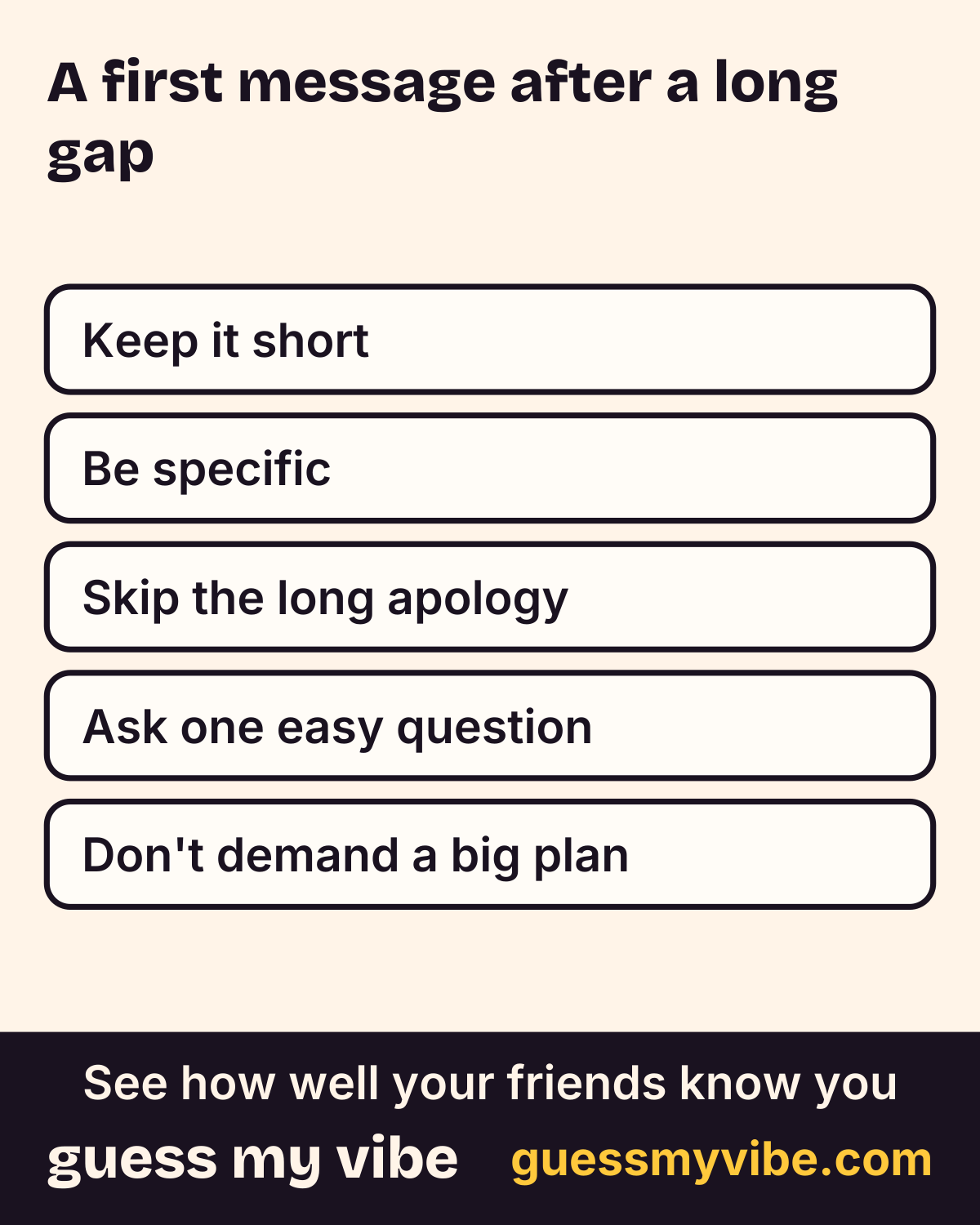
- Keep it short. A message the other person can answer in one line is easier to appreciate than one that feels like homework.
- Be specific. "I walked past the diner we used to go to after practice and thought of you" gives the surprise a reason, which is the very thing the recipients in the gratitude experiments underestimated.
- Skip the long apology. A paragraph explaining why you've been out of touch makes the gap the main topic. A light "it's been way too long" is enough, and it's true for both of you.
- Ask one easy question. Something like "what are you up to these days?" gives them a way in without any pressure to catch up on years at once.
- Don't demand a big plan. A call or coffee can come later. The first message only has to say that you thought of them.
Medium matters less than you might think. The reach-outs in the 2023 experiments included both brief check-in messages and small gifts [1], so reaching out in more than one form counts. Choose whatever feels natural for the two of you, such as a text or a funny photo from your shared past.
Cite this figure
Figure: "A first message after a long gap." Guess My Vibe (guessmyvibe.com). https://guessmyvibe.com/learn/how-to-reconnect-with-an-old-friend#figure-first-message
What to do if the conversation stalls
Sometimes the reply is warm and short, and then nothing happens. That's common and it isn't necessarily a rejection. The same research that shows people appreciate the message says nothing about people being instantly available to resume a friendship, and old friendships don't restart on the same footing they paused on.
Contact is what keeps a friendship alive, so it helps to think in small, repeatable steps instead of one big catch-up. In research on best friends moving from high school to college, proximity did not influence the friendships, but level of communication moderated how much they deteriorated, and people whose best friendship survived reported more positivity, support, self-disclosure and interaction than those whose friendship changed [5]. That study was about a specific life stage, so don't read it as a rule for every reunion. But it fits the practical point: a friendship usually comes back through small, ordinary exchanges, not through one perfect conversation.
- Follow up with something light a week or two later, like a link or a photo that made you think of them.
- Match their pace. If they reply in a day or two, you don't need to send three messages in an hour.
- Offer an easy, low-stakes way to talk, such as a quick game or a short call, instead of a big "we should catch up" that never gets scheduled.
- Accept that some friendships return to a lighter version of what they were. A warm, occasional friendship still counts as a friendship.
When it's okay not to reach out
Nothing here says you should contact every person you've ever lost touch with. The research is about people who are glad to be remembered. Some friendships ended for reasons that still matter, and some contact would be better left alone. If a friendship ended because of something that hurt, you're allowed to weigh that against any pull toward reaching out, and that's a judgment for you to make, not a result a study can make for you. What the studies do say is narrow and useful: if the only thing stopping you is the worry that it will be awkward and unwelcome, that worry is probably bigger than the real thing.
A low-pressure way to start the conversation
The hardest part of reconnecting is often the second message, when there's nothing in particular to say. One way around that is to give the two of you something to do together instead of something to catch up on. Guess My Vibe is a free game where a friend guesses how you'd answer questions about yourself, and you see how close they got. After a long gap it's a gentle way to find out what's the same and what's changed, with a reason to talk built in, and without the pressure of summarizing years in a single message.
Key takeaways
- People robustly underestimate how much others appreciate being reached out to, whether the reach-out is a brief check-in message or a small gift [1].
- The gap is larger when the message is more surprising for the recipient and when the two people are more socially distant, which may describe an old friend you haven't talked to in years [1].
- A related set of experiments found that people who wrote gratitude letters expected the recipient to feel more awkward, and less happy, than the recipients actually reported feeling [2].
- Over a major life transition, friendship quality declined, and more effort invested in the friendship reduced that decline, so a long silence is a common result of life changing, not proof that anything went wrong [3].
- This isn't therapy, a diagnosis, or a substitute for professional care.
Questions people ask
Is it weird to text an old friend out of the blue?
Less weird than it feels. In preregistered experiments, people on the receiving end appreciated being reached out to more than the people reaching out expected, and the gap was bigger when the message was more surprising or came from someone more socially distant [1].
What should I say when reconnecting with an old friend?
Keep it short and specific, mention a real memory or reason you thought of them, skip the long apology, and ask one easy question. The research tested reaching out in general, not exact wording, so this is practical reasoning built on the findings [1].
Why do I feel so awkward about reaching out?
Senders tend to overestimate how awkward the other person will feel. In experiments on gratitude letters, writers expected recipients to feel more awkward and less positive than the recipients actually reported [2].
Do friendships fade on their own if you don't keep in touch?
Often, yes. In a study of personal networks across a life transition, friendship quality declined, and more effort invested reduced the decline, while family relationships differed strikingly [3]. A long silence is often that kind of fade, not a sign of a falling-out.
What if my old friend doesn't reply?
Silence can mean many things, including that the message got buried or life is busy. One gentle follow-up after a week or two is reasonable. If there's still no reply, it's fine to leave the door open without pushing.
See how well your friends know you.
Free. Answer 10 quick questions about you, then send your link. Friends play in their browser, no app needed.
Start freeReferences
- [1] Liu, P. J., Rim, S., Min, L., & Min, K. E. (2023). The surprise of reaching out: Appreciated more than we think. Journal of Personality and Social Psychology, 124(4), 754-771. doi.org/10.1037/pspi0000402 (opens in a new tab)
- [2] Kumar, A., & Epley, N. (2018). Undervaluing gratitude: Expressers misunderstand the consequences of showing appreciation. Psychological Science, 29(9), 1423-1435. PubMed: 29949445 (opens in a new tab)
- [3] Roberts, S. B. G., & Dunbar, R. I. M. (2015). Managing Relationship Decay: Network, Gender, and Contextual Effects. Human Nature, 26(4), 426-450. PubMed: 26489745 (opens in a new tab)
- [4] Wrzus, C., Hänel, M., Wagner, J., & Neyer, F. J. (2013). Social network changes and life events across the life span: A meta-analysis. Psychological Bulletin, 139(1), 53–80. PubMed: 22642230 (opens in a new tab)
- [5] Oswald, D. L., & Clark, E. M. (2003). Best friends forever?: High school best friendships and the transition to college. Personal Relationships, 10(2), 187–196. doi.org/10.1111/1475-6811.00045 (opens in a new tab)
How we find and check these sources: how we write. Spotted an error? Report a correction.
Related
- Growing Apart From Friends: Why It Happens
- How to Maintain Friendships Through Life's Transitions
- Long Distance Friendship: Does It Actually Last?
- How Often Should You See Friends? What the Research Says
- Friendship Breakup: Why Friendships End, Research Says
- How to Ask Someone to Hang Out: Less Risky Than It Feels
- How to Thank a Friend (It Lands Better Than You Think)
Want to try it with your own friends? Make a friendship quiz to play with your friends
Cite this article
- Title
- How to Reconnect With an Old Friend Without It Feeling Weird
- Publisher
- Guess My Vibe
- Updated
- URL
- https://guessmyvibe.com/
learn/ how-to-reconnect-with-an-old-friend
Copy this citation
Guess My Vibe. (2026, October 4). How to Reconnect With an Old Friend Without It Feeling Weird. Guess My Vibe. https://guessmyvibe.com/
To point at one section, add that section's anchor (the # link on its heading) to the URL.