To ask someone to hang out, make the invitation direct, specific and low-stakes, such as "want to grab coffee Thursday after class?", and don't assume the answer is no. No study has tested invitations to hang out, but related research shows people underestimated how willing others were to say yes to a direct request for help [1] and how much others appreciate being contacted [2].
Knowing how to ask someone to hang out mostly comes down to being direct, specific and easy to say yes to, and to not assuming the answer is no. That last part is where research is most useful. Studies on a few related situations find that people consistently guess wrong about how others will respond, and they guess wrong in the pessimistic direction. One caveat up front: no study we found tests invitations to hang out specifically, so what follows is the closest evidence, labeled as such, plus common-sense advice that we flag as our own.
Why asking someone to hang out feels so risky
Most people can name the thought: what if they say no, or say yes out of politeness, or think it's weird that I asked? The fear is understandable, but it doesn't line up with what studies find about other kinds of asking. In a series of studies on requests for help, run both in experiments and in real field settings, people underestimated by as much as 50% the likelihood that others would agree to a direct request [1].
The researchers also looked at why. Putting people in the seat of the person asking or the person being asked was enough to produce the gap. In the final study, help seekers were less willing than potential helpers to appreciate the social costs of refusing, meaning how uncomfortable it is to say no, and focused instead on the cost of saying yes [1]. In plain words, and as our reading rather than a result, when you ask you may picture the other person weighing whether it is worth their time, while they may be thinking about how awkward it would be to turn you down.
The limit matters. Those were requests for help, not social invitations, and the research does not show that the same percentages apply to "want to hang out?" The reasonable reading is that the same pessimism may be at work, not that you can expect a specific rate of yes.
People like being reached out to more than you think
A second line of evidence is about contact itself. Across a series of preregistered experiments, people robustly underestimated how much others appreciate being reached out to, whether through a brief check-in message or a small gift. The evidence fits an explanation in which the person on the receiving end focuses more on how surprising it is to be reached out to, and a focus on surprise goes with greater appreciation. The underestimate was larger when the context was more surprising and when the two people were more socially distant [2].
This is useful for acquaintances and new friends in particular, since social distance made the gap bigger. The caution is again about fit: those studies were about check-ins and gifts, not invitations, so they support the idea that being contacted is welcomed, not that every invitation is [2].
A third piece covers the conversation that comes before the ask. In studies of strangers getting acquainted in the lab, first-year dorm neighbors and members of the public at a workshop, people underestimated how much their conversation partners liked them and enjoyed their company, a pattern called the liking gap that held across conversation lengths and lasted for months among dorm neighbors [3]. If you left a chat thinking it went fine but not great, the finding suggests the other person may have liked it more than you assumed.
The same kind of misjudgment shows up with strangers. Commuters on trains and buses told to connect with a stranger reported a more positive and no less productive trip than those told to stay disconnected, yet separate participants expected the opposite. The researchers traced part of that mistake to underestimating how interested other people are in connecting [4]. Again, this was about a chat with a stranger, not an invitation, but it points the same way.
Curious how your friends would answer?
Free. Answer 10 quick questions about you, then send your link. Friends play in their browser, no app needed.
Start freeHow to ask someone to hang out, step by step
The research above gives us reasons to ask, not a script. The steps below are our own practical suggestions, built around that evidence and ordinary common sense. They haven't been tested as a method.
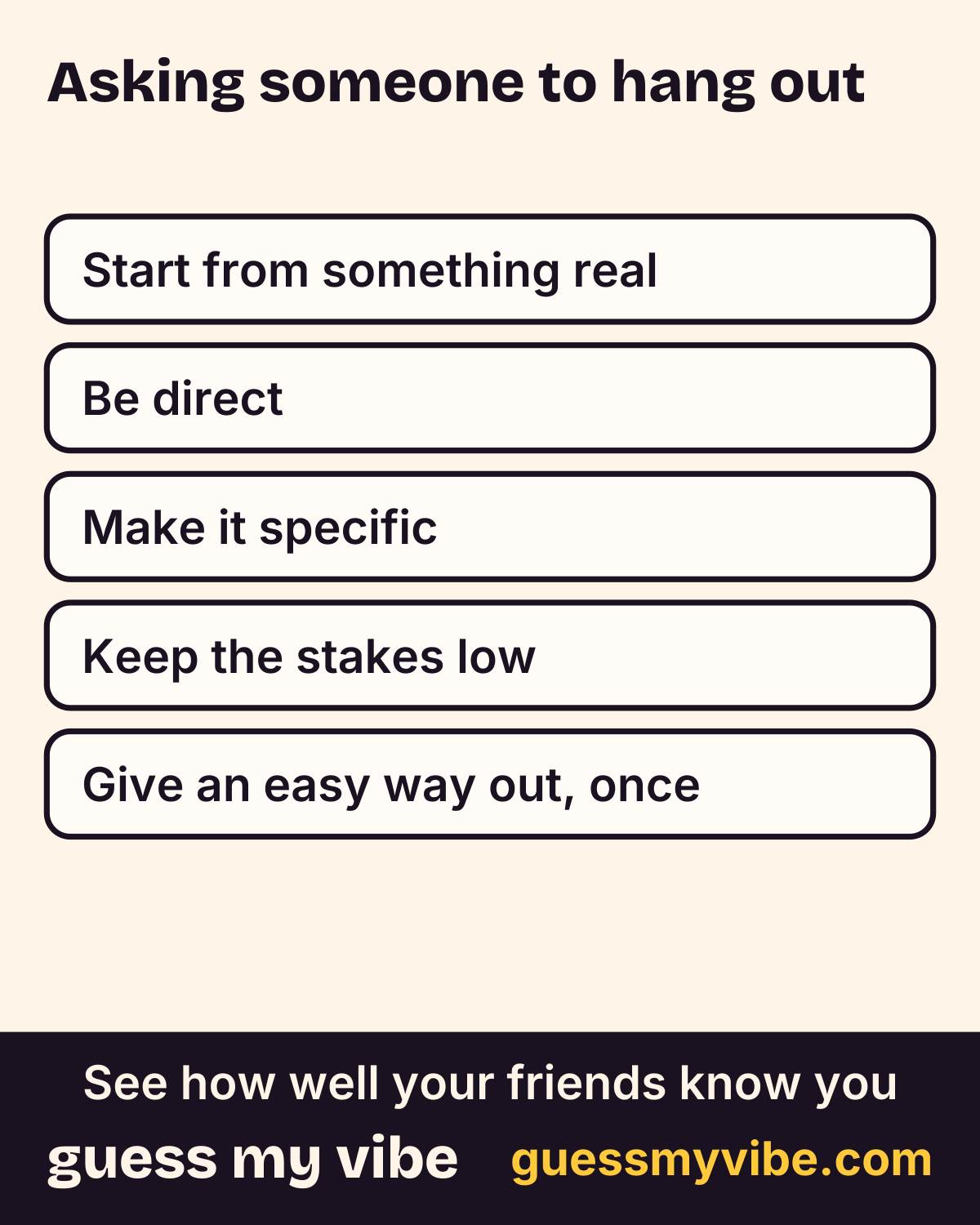
- Start from something real. Pick a link you already have: the class you share, the show you both mentioned, the café they like. It gives the invitation a reason and keeps it from feeling out of nowhere.
- Be direct. Research on direct requests for help found people were more willing to say yes than others expected [1]. A plain "want to get food after class?" is easier to answer than "we should hang out sometime," which asks nothing and gets nowhere.
- Make it specific. Name an activity, a day and roughly a time. A specific plan is easy to accept or decline, and it tells the person you actually mean it.
- Keep the stakes low. Coffee, a walk, studying together, or a shared activity you already planned to do. A short plan with a built-in end feels safer to say yes to than an open-ended evening.
- Give an easy way out, once. "No worries if you're busy, just thought I'd ask" lets the other person decline without awkwardness. Say it once, not three times.
- Send it in the medium you already use. If you've been texting, text. If you see them in person, ask in person. Switching channels adds weight to the ask.
- Have a plan for a maybe. If they say "maybe," suggest a different day once. If it is still vague, let them come back to you.
Cite this figure
Figure: "Asking someone to hang out." Guess My Vibe (guessmyvibe.com). https://guessmyvibe.com/learn/how-to-ask-someone-to-hang-out#figure-asking-steps
Example ways to ask someone to hang out
- A classmate or coworker: "I'm grabbing coffee at 3 on Thursday, want to come? Happy to just talk about the project too."
- Someone you just met: "I really liked talking to you. Do you want to get lunch next week?"
- Someone you've been texting: "I keep meaning to say we should actually do something. Are you free Saturday for a walk or food?"
- A group plan to start: "A few of us are getting pizza Friday. Want to join?" A group event can feel safer for both people than a one-on-one.
None of these has been tested against other versions. They follow the same logic: direct, specific, easy to accept, easy to decline.
A word on the most common version of the problem: the vague line. "We should hang out sometime" feels safe because it costs nothing, but it also gives the other person nothing to say yes to, so it tends to fade without either person deciding anything. That is our observation, not a research finding. A concrete invitation does the opposite. It might get a no, but a no is information, and a yes is a plan. Both are better than another month of wondering whether the other person is interested.
If they say no, or don't answer
Sometimes the answer is no, and the research above doesn't change that. A no usually has many possible reasons, including a busy week, a different stage of life, or not wanting to hang out, and the message alone rarely tells you which. A single no is not evidence about your worth. A reasonable approach is to accept it kindly, and if they say "not this week," offer one more option later rather than chasing. If someone repeatedly declines or doesn't reply, it is fine to stop asking and put your effort where it is returned. That's a judgment call about your own friendships, not a diagnosis of anyone.
It also helps to keep the ask in proportion. The cost of asking is a moment of awkwardness. The cost of never asking is that two people who might have been friends each assume the other isn't interested. Those studies did not measure that outcome, but they do show we can misread how much others like us [3] and how welcome our contact is [2], which makes the second outcome plausible.
A gentler first step if a direct ask feels like too much
If asking for a whole hangout is a big jump, start smaller. Send a quick message about something you noticed, or invite them into something that costs them almost nothing. Guess My Vibe is one low-pressure option: you send a link, they guess how you'd answer a few questions, and you get a reason to talk about what they guessed. It is a light way to find out whether the two of you click before you plan anything bigger.
Key takeaways
- In studies of requests for help, people underestimated by as much as 50% how likely others were to agree to a direct request [1].
- People underestimate how much others appreciate being reached out to, especially when the other person is more socially distant [2].
- After conversations, people systematically underestimated how much their partners liked them and enjoyed their company [3].
- No study has tested invitations to hang out directly, so treat the research as a reason to ask, not a promise of a yes.
- This isn't therapy, a diagnosis, or a substitute for professional care, and a no is still a real possibility.
Questions people ask
How do you ask someone to hang out without making it weird?
Be direct, specific and low-stakes: name an activity and a time, and give them an easy way to say no. Research on direct requests found people underestimated by as much as 50% how likely others were to agree [1], though those were requests for help rather than social invitations.
Will they say no if I ask them to hang out?
Possibly, and no study guarantees a yes. But in those studies people underestimated how willing others were to agree to a direct request for help [1] and how much others appreciate being reached out to [2].
Is it okay to ask someone to hang out over text?
Yes, if that is how you already talk. The studies we cite weren't about channels, so this is practical advice rather than a research finding. A specific, easy-to-answer message works in any medium.
How do I know if they want to hang out with me?
You can't know for certain, and your own guess is likely too pessimistic: in several studies people underestimated how much conversation partners liked them [3]. Asking directly is the clearest way to find out.
What if I'm shy or an introvert?
A written message or a group plan can lower the pressure. The research here wasn't specific to shy people, so we can't say how the percentages apply to you, but the same misreading of others' interest can affect anyone.
See how well your friends know you.
Free. Answer 10 quick questions about you, then send your link. Friends play in their browser, no app needed.
Start freeReferences
- [1] Flynn, F. J., & Lake, V. K. B. (2008). If you need help, just ask: Underestimating compliance with direct requests for help. Journal of Personality and Social Psychology, 95(1), 128-143. PubMed: 18605856 (opens in a new tab)
- [2] Liu, P. J., Rim, S., Min, L., & Min, K. E. (2023). The surprise of reaching out: Appreciated more than we think. Journal of Personality and Social Psychology, 124(4), 754-771. doi.org/10.1037/pspi0000402 (opens in a new tab)
- [3] Boothby, E. J., Cooney, G., Sandstrom, G. M., & Clark, M. S. (2018). The Liking Gap in Conversations: Do People Like Us More Than We Think?. Psychological Science, 29(11), 1742–1756. PubMed: 30183512 (opens in a new tab)
- [4] Epley, N., & Schroeder, J. (2014). Mistakenly seeking solitude. Journal of Experimental Psychology: General, 143(5), 1980–1999. PubMed: 25019381 (opens in a new tab)
How we find and check these sources: how we write. Spotted an error? Report a correction.
Related
Want to try it with your own friends? Make a friendship quiz to play with your friends
Cite this article
- Title
- How to Ask Someone to Hang Out: Less Risky Than It Feels
- Publisher
- Guess My Vibe
- Updated
- URL
- https://guessmyvibe.com/
learn/ how-to-ask-someone-to-hang-out
Copy this citation
Guess My Vibe. (2026, October 4). How to Ask Someone to Hang Out: Less Risky Than It Feels. Guess My Vibe. https://guessmyvibe.com/
To point at one section, add that section's anchor (the # link on its heading) to the URL.