No research has produced a reliable checklist of signs that someone wants to be your friend, and nobody can read minds. What studies do show is that people tend to like those who show they like them, and that after a conversation most people underestimate how much the other person liked them. So if someone makes time for you, shares something personal, and asks follow-up questions, that's encouraging, though it isn't proof.
Signs someone wants to be your friend: what research can and can't say
Here is the honest answer to the question people type into search: there is no validated list of signs that someone wants to be your friend. No study can tell you what a particular person is thinking, and anyone who offers a foolproof checklist is guessing. What research does offer is a handful of patterns that go with liking on average, and one finding that matters more than any sign: most of us read other people's interest in us as lower than it really is. So the better question may be how much to trust your own read, which is what most of this article is about.
First, you probably underestimate how much they like you
Before you look for signs, it helps to know about a well-documented bias. In studies of strangers getting acquainted in a lab, first-year students getting to know their dorm neighbors, and members of the public at a personal development workshop, people systematically underestimated how much their conversation partners liked them and enjoyed their company. The researchers called this the liking gap. It showed up in conversations of different lengths and was still there months later as dorm neighbors developed their relationships [1].
The practical upshot is that a flat-feeling conversation, or a lack of obvious enthusiasm, is weak evidence that someone doesn't want to be friends. In the studies, the other person usually liked the participant more than the participant thought [1]. If you tend to read neutral signals as rejection, you're doing what most people do, and the data says the neutral read tends to be too pessimistic.
Liking tends to be returned
A second finding works in your favor. Psychologists have long studied the reciprocity of liking, the tendency to like people who like us. Two studies tested why. Expressed attraction suggested that the person had benevolent intentions toward the target, and those perceived good intentions helped explain why the feeling was returned. In the second study, affective attraction, simply liking the person, was reciprocated in all cases. Behavioral attraction, like wanting to spend time together, was not reciprocated when the person's stated behavioral intentions didn't match what their expressed attraction implied [2].
Two limits matter. These studies were about interpersonal attraction in general, with an "admirer" and a "target," and they weren't specifically about friendship. And they involved small samples, 52 people in the first study and 173 in the second [2]. The usable idea is modest: showing warmth makes it more likely to be returned. That is reason to be a little braver about showing you're interested.
Behaviors that go with liking, with caveats
If you want a list, here is one, with the strength of the evidence attached. None of these is proof, and each is a pattern across many people, not a verdict on one.
- They share something personal. A meta-analysis found that people disclose more to those whom they initially like, as well as liking people more after disclosing to them [3]. Caveat: the effect depended on the study setup, type of disclosure and gender, and plenty of people are simply open with everyone.
- They keep making time. In two studies, more hours together went with closer friendships, and time spent on shared leisure activities also mattered [4]. Caveat: those studies link time and closeness, not intent, and busy schedules limit anyone.
- They ask follow-up questions. In three studies of live conversations, people who asked more questions, particularly follow-ups, were better liked by their partners [5]. Caveat: that finding runs from asking to being liked. It doesn't show that asking means they like you, and some people ask questions out of habit.
- They show warmth in what they say and do. Expressed liking tends to be returned, and affective liking was reciprocated in all cases in one set of studies [2]. Caveat: warmth is also just good manners.
Notice what is missing from the list: anything about tone of voice, texting speed, or how quickly they reply. We didn't find verified research tying those to wanting to be friends, so we're not going to invent a rule. A slow reply can mean many things, so it's a weak thing to build a theory on.
Curious how your friends would answer?
Free. Answer 10 quick questions about you, then send your link. Friends play in their browser, no app needed.
Start freeLiking you and making time for you are different things
One detail from the reciprocity studies is useful for anyone trying to read mixed signals. The researchers separated affective attraction, which is simply liking someone, from behavioral attraction, such as wanting to spend time together. Liking was reciprocated across the board, but wanting to spend time together was not automatic: it was not reciprocated when the admirer's stated behavioral intentions didn't fit what their expressed attraction implied [2]. In other words, in these studies, how the person on the receiving end responded depended on what the admirer said they actually wanted.
The takeaway for everyday life comes with the earlier caveat that this research wasn't about friendship in particular. It suggests that feeling warm toward someone and wanting to make plans with them are separate responses, and that clear intentions matter for the second one. That is one more reason a single missing signal tells you very little, and why a clear, friendly invitation is better evidence than a pattern you've inferred from silence.
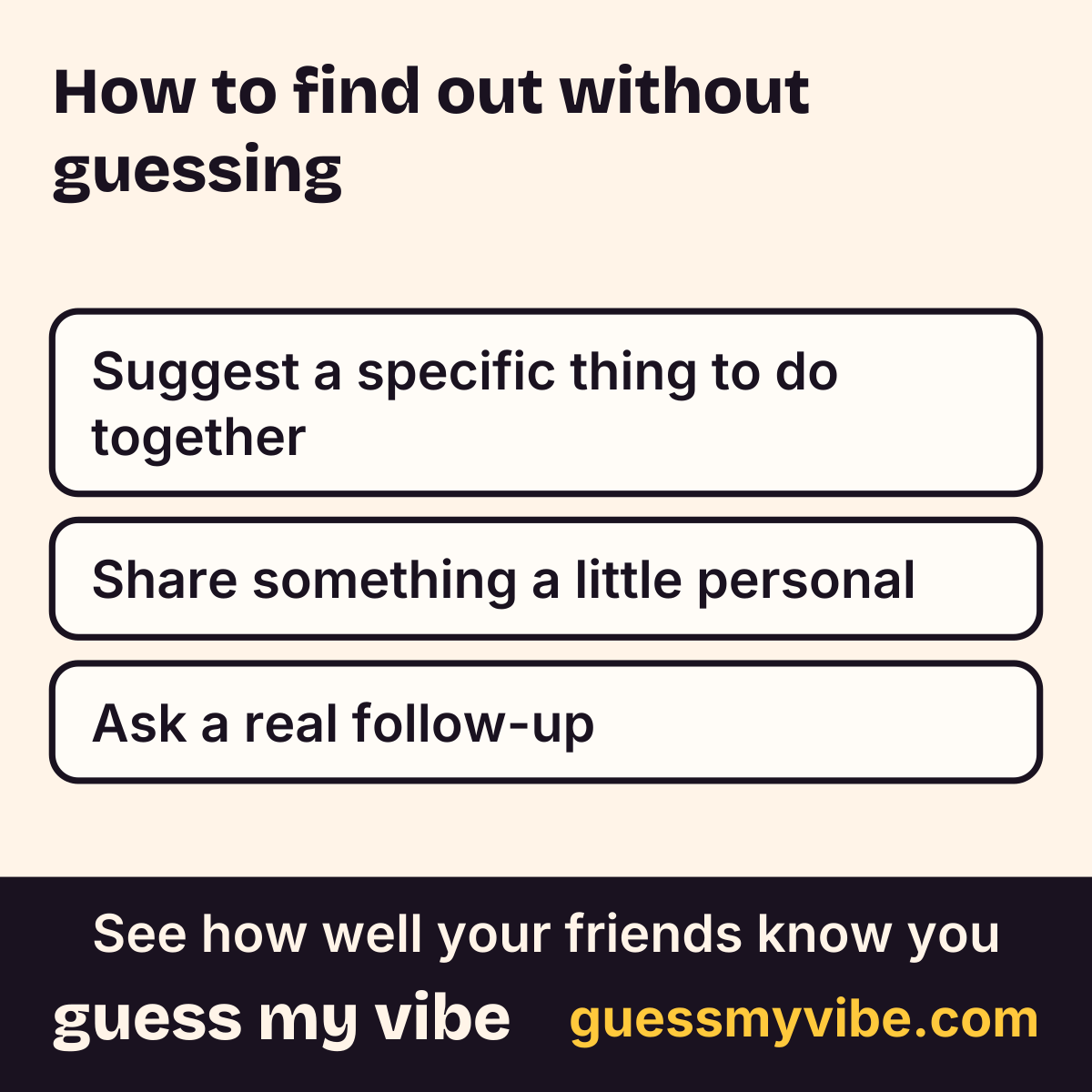
How to find out without guessing
Since signs are weak evidence, the more reliable move is to take a small, low-stakes step and see what comes back. Suggest a specific thing to do together. Share something a little personal. Ask a real follow-up. The research suggests these steps are less risky than they feel: the other person likely likes you more than you think [1], and warmth tends to be returned [2].
If the invitation is turned down once, that is one data point and often a scheduling one. If someone repeatedly doesn't make time, that tells you something about their capacity or interest, and it's reasonable to put your energy elsewhere. Friendships also take time to build, and the research linking hours together to closeness suggests that patience is part of the process [4].
Cite this figure
Figure: "How to find out without guessing." Guess My Vibe (guessmyvibe.com). https://guessmyvibe.com/learn/signs-someone-wants-to-be-your-friend#figure-find-out-without-guessing
If you're the one who wants to be friends
Flip the question around and the research gets more practical. If you want to be someone's friend, the same patterns apply in the other direction. Asking follow-up questions was linked to being liked more, and people didn't expect it to help [5]. Sharing something a bit personal tends to go with liking too [3]. And making time, more than once, goes with closeness growing over the weeks [4]. None of these needs you to be charming. They need you to be willing to go first, which feels risky mostly because we assume we're less liked than we are [1].
Ask the people who know you
The question under all of this is how people really see you, and that is hard to judge from inside your own head. Guess My Vibe lets a friend guess how you'd answer everyday social questions, so you can see how well they already read you, and what they get wrong.
Key takeaways
- After getting to know each other, people systematically underestimated how much their conversation partners liked them and enjoyed their company, which means you may be underreading the interest you've got [1].
- In two studies, expressed attraction implied benevolent intentions, and affective liking was reciprocated in all cases, though acting on it, like wanting to spend time together, depended on the person's stated intentions [2].
- A meta-analysis found people tend to disclose more to those they initially like, so a friendly personal share can be a good sign, on average [3].
- More hours together was linked to closer friendships in two studies, so a person who keeps making time may be investing in the friendship, though the studies didn't measure intent [4].
- This isn't therapy, a diagnosis, or a substitute for professional care; none of these studies can tell you what one specific person is thinking.
Questions people ask
How do you know if someone wants to be your friend?
You can't know for sure, and no study provides a checklist. Encouraging patterns include sharing something personal [3] and making time to hang out [4], but none is proof. A small invitation is a better test than analyzing signals.
Do people like me more than I think?
Often, yes. In several studies, people systematically underestimated how much their conversation partners liked them and enjoyed their company [1].
Does liking someone make them like you back?
It tends to. In two studies, expressed attraction implied benevolent intentions, and affective attraction was reciprocated in all cases, although those studies weren't specifically about friendship [2].
Does asking me questions mean someone likes me?
Not necessarily. People who asked more follow-up questions were better liked by their partners [5], but that shows the effect of asking, not that asking is a sign of liking.
How long does it take for an acquaintance to become a friend?
It takes real time together. In two studies, more hours together went with closer friendships [4].
See how well your friends know you.
Free. Answer 10 quick questions about you, then send your link. Friends play in their browser, no app needed.
Start freeReferences
- [1] Boothby, E. J., Cooney, G., Sandstrom, G. M., & Clark, M. S. (2018). The Liking Gap in Conversations: Do People Like Us More Than We Think?. Psychological Science, 29(11), 1742–1756. PubMed: 30183512 (opens in a new tab)
- [2] Montoya, R. M., & Insko, C. A. (2008). Toward a more complete understanding of the reciprocity of liking effect. European Journal of Social Psychology, 38(3), 477-498. doi.org/10.1002/ejsp.431 (opens in a new tab)
- [3] Collins, N. L., & Miller, L. C. (1994). Self-disclosure and liking: A meta-analytic review. Psychological Bulletin, 116(3), 457-475. PubMed: 7809308 (opens in a new tab)
- [4] Hall, J. A. (2019). How many hours does it take to make a friend?. Journal of Social and Personal Relationships, 36(4), 1278–1296. doi.org/10.1177/0265407518761225 (opens in a new tab)
- [5] Huang, K., Yeomans, M., Brooks, A. W., Minson, J., & Gino, F. (2017). It doesn't hurt to ask: Question-asking increases liking. Journal of Personality and Social Psychology, 113(3), 430–452. PubMed: 28447835 (opens in a new tab)
How we find and check these sources: how we write. Spotted an error? Report a correction.
Related
- The Liking Gap: Why People Like You More Than You Think
- How to Make Friends: What the Research Says
- Signs of a True Friend, According to Research
- How to Make Friends as an Adult
- How Long Does It Take to Make a Friend? What the Study Says
- Reciprocity Psychology: Why We Like People Who Like Us
- How to Ask Someone to Hang Out: Less Risky Than It Feels
Want to try it with your own friends? Make a friendship quiz to play with your friends
Cite this article
- Title
- Signs Someone Wants to Be Your Friend, and What's Known
- Publisher
- Guess My Vibe
- Updated
- URL
- https://guessmyvibe.com/
learn/ signs-someone-wants-to-be-your-friend
Copy this citation
Guess My Vibe. (2026, October 4). Signs Someone Wants to Be Your Friend, and What's Known. Guess My Vibe. https://guessmyvibe.com/
To point at one section, add that section's anchor (the # link on its heading) to the URL.