In reciprocity psychology, reciprocity of liking is the tendency to like people who like us. Two studies suggest one reason: when someone shows they like us, we read it as a sign of good intentions toward us, and that perceived goodwill helps explain why the liking is returned [1]. The catch is that we are poor at knowing whether someone actually likes us, so the effect only works when the liking gets noticed.
Reciprocity psychology has a short, familiar rule at its center: we tend to like people who like us. Social psychologists call it the reciprocity of liking, and it helps explain why a compliment, a warm hello or a message that says "I had fun" can start a friendship. The harder part is not the rule but the knowing. Studies suggest that people often don't realize they are liked, which means the effect depends on whether someone's liking actually gets noticed. This article covers what the effect is, a study on why it happens, what it can't promise, and why the gap between being liked and knowing it matters most.
What reciprocity psychology means by "reciprocal liking"
Reciprocity of liking, sometimes called reciprocal liking, is the finding that if you show a person you like them, they are more likely to like you back. It sounds obvious, and it is, which is why the interesting research is about the details: what exactly is returned, and why. In a paper that tried to give a more complete account, the authors proposed that returning someone's attraction is not one thing but a process with feeling, thinking and behavior parts, and that interdependence theory, a framework for how people's outcomes in a relationship depend on each other, is a good way to understand it [1].
Note that this research studies "interpersonal attraction," and the abstract does not limit it to romantic interest or describe friends specifically. It is a general social finding, which is why it gets applied to friendship, but we can't say the studies were about friends.
Why we return liking: reading it as goodwill
The same paper ran two studies to test one explanation. In the first, with 52 people, expressed attraction from an admirer suggested that the admirer had benevolent intentions toward the person being admired, and those perceived intentions helped account for why both affective attraction (liking) and behavioral attraction (wanting to do things together) were returned [1]. In other words, being liked tells you the other person probably means well by you, and that is a plausible reason to like them back.
The second study, with 173 people, found a difference between the two kinds of attraction. Liking itself was returned in all cases. But behavioral attraction was not returned when the admirer's stated intentions didn't match what their expressed attraction implied [1]. The plain-words version: feeling warmly toward someone who likes you is close to automatic, but agreeing to spend time with them depends on whether what they say they want lines up with the warmth they've shown. Both studies had modest samples, so they are a starting point rather than a final answer.
The loop between sharing and liking
Liking is not only returned in one step. It tends to run in a loop with self-disclosure. A meta-analysis found three significant effects: people who disclose intimately are liked more than people who disclose less, people disclose more to those they initially like, and people like others as a result of having disclosed to them [4]. The authors suggested these effects work together as a dynamic system rather than separate facts [4].
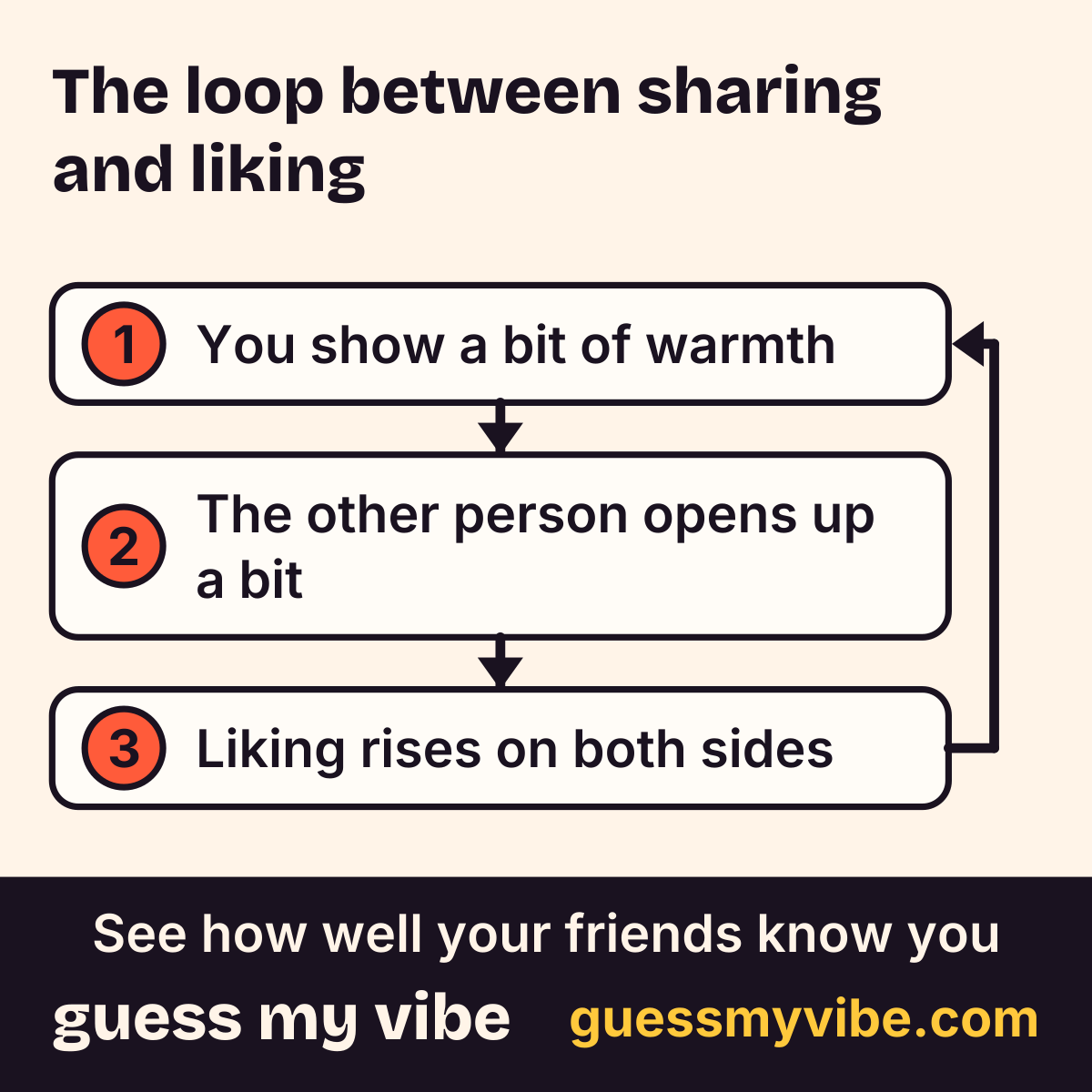
That loop is a more realistic picture of how friendships build than a single moment of attraction. You show a bit of warmth, the other person opens up a bit, and liking rises on both sides. The disclosure-liking relation was moderated by the study paradigm, the type of disclosure and the gender of the discloser [4], so it is not a formula that works the same for everyone.
Cite this figure
Figure: "The loop between sharing and liking." Guess My Vibe (guessmyvibe.com). https://guessmyvibe.com/learn/reciprocity-of-liking#figure-warmth-and-sharing-loop
Curious how your friends would answer?
Free. Answer 10 quick questions about you, then send your link. Friends play in their browser, no app needed.
Start freeThe hard part: knowing you are liked
Reciprocity only helps if you can tell it is happening, and the evidence says we are not good at that. In a set of studies, after strangers got acquainted in a lab, first-year college students got to know their dorm neighbors, and members of the public met at a workshop, people systematically underestimated how much their conversation partners liked them and enjoyed their company. The researchers called it the liking gap. It showed up across conversations of different lengths and lasted for several months among dorm neighbors [2].
A related line of work asks how people know how others see them at all. A review of 8 studies involving 569 people argued that people determine how others view them not from the feedback they receive from others but from their own self-perceptions. Two findings fit that idea: people overestimate how consistently different people see them, and they are better at understanding how others generally view them than how a specific person views them [3]. If you are hard on yourself, you may assume others are too, and a specific person's opinion of you is the thing you are worst placed to guess.
Friendships themselves seem to be a place this plays out. A study of how directionality in friendship ties affects influence found that people are typically poor at perceiving the directionality of their friendship ties, meaning who counts whom as a friend [5]. Reciprocated friendship is not as automatic as it feels, and you can be wrong about who considers you a friend in either direction.
This is why reciprocal liking is better seen as the first step of a friendship than the whole thing. Liking gets a relationship started, and the evidence above suggests it grows through a loop of sharing and responding. Whether it turns into a friendship depends on later things, such as time together and sharing more personal things, which our article on the stages of friendship covers. And because we tend to misjudge both who likes us and which friendships are mutual, it is worth checking your read of a relationship against what the other person actually says and does.
What reciprocal liking can't promise
- It is an average, not a rule. Liking returned in studies on average does not mean any particular person will like you back, and the studies were not designed to tell you what one person feels.
- It is not the same as a friendship. Liking someone and spending time with them are different, as the second study showed [1]. Wanting to spend time depended on what the person said they intended.
- The samples are small. The two studies behind the goodwill explanation had 52 and 173 participants [1], and they were framed around interpersonal attraction rather than friendship.
- Showing liking can fall flat. Nothing here says every kind of expression of liking works; the abstracts we read don't say whether flattery and sincere interest differ in effect, so be wary of treating this as a tactic.
How to use reciprocal liking without overthinking it
Three practical points follow, and they stay close to the evidence. First, if you like someone, tell them in a way that is true and specific. Since people read expressed liking as goodwill [1], a simple "I really liked talking to you" gives them what they most need to hear, and because people underestimate how much they are liked [2], the person may not already know. Second, treat the warmth as an opening to share something small, since disclosure and liking feed each other [4]. Third, when you can't tell whether someone likes you, remember that your own guess is shaped by how you see yourself [3]. A neutral conversation is not good evidence either way.
Guess My Vibe is built around the knowing part. Friends guess how you would answer, so you find out how well they read you, and a friend who got you right on a few questions has told you something about how closely they pay attention, which is a gentler way to learn you are liked than waiting for a sign.
Key takeaways
- Reciprocity of liking is the tendency to like people who like us, and researchers describe it as having feeling, thought and behavior parts [1].
- In two studies, expressed attraction implied benevolent intentions, and those intentions helped explain why liking was returned; behavior such as wanting to spend time together depended on the person's stated intentions [1].
- People underestimated how much conversation partners liked them in studies of strangers, dorm neighbors and workshop participants, a gap called the liking gap [2].
- A review of 8 studies argued that people work out how others see them from their own self-perceptions rather than from feedback, and found they understand how others generally view them better than how a specific person does [3].
- This isn't therapy, a diagnosis, or a substitute for professional care, and reciprocity is an average pattern, not a guarantee that any one person will like you back.
Questions people ask
What is reciprocity of liking?
It's the tendency to like people who like us. Researchers describe returning attraction as a process with feeling, thinking and behavior parts rather than a single reaction [1].
Why do we like people who like us?
One explanation tested in two studies is that expressed attraction suggests the other person has benevolent intentions toward us, and that perceived goodwill helps explain why liking is returned [1].
Does liking someone make them like you back?
On average it makes it more likely, but it is not guaranteed. In one study, liking was returned in all cases, but wanting to spend time together was not returned when the person's stated intentions didn't match what their liking implied [1].
Why don't I know if someone likes me?
People systematically underestimate how much conversation partners like them, a gap called the liking gap [2], and they tend to infer how others see them from their own self-image more than from feedback [3].
Is reciprocal liking the same as mutual friendship?
No. A study of friendship ties found that people are typically poor at perceiving who counts whom as a friend [5], so liking someone and being their friend, or knowing you are theirs, are separate things.
See how well your friends know you.
Free. Answer 10 quick questions about you, then send your link. Friends play in their browser, no app needed.
Start freeReferences
- [1] Montoya, R. M., & Insko, C. A. (2008). Toward a more complete understanding of the reciprocity of liking effect. European Journal of Social Psychology, 38(3), 477-498. doi.org/10.1002/ejsp.431 (opens in a new tab)
- [2] Boothby, E. J., Cooney, G., Sandstrom, G. M., & Clark, M. S. (2018). The Liking Gap in Conversations: Do People Like Us More Than We Think?. Psychological Science, 29(11), 1742–1756. PubMed: 30183512 (opens in a new tab)
- [3] Kenny, D. A., & DePaulo, B. M. (1993). Do people know how others view them? An empirical and theoretical account. Psychological Bulletin, 114(1), 145–161. PubMed: 8346325 (opens in a new tab)
- [4] Collins, N. L., & Miller, L. C. (1994). Self-disclosure and liking: A meta-analytic review. Psychological Bulletin, 116(3), 457-475. PubMed: 7809308 (opens in a new tab)
- [5] Almaatouq, A., Radaelli, L., Pentland, A., & Shmueli, E. (2016). Are you your friends' friend? Poor perception of friendship ties limits the ability to promote behavioral change. PLOS ONE, 11(3), e0151588. PubMed: 27002530 (opens in a new tab)
How we find and check these sources: how we write. Spotted an error? Report a correction.
Related
Want to try it with your own friends? Make a friendship quiz to play with your friends
Cite this article
- Title
- Reciprocity Psychology: Why We Like People Who Like Us
- Publisher
- Guess My Vibe
- Updated
- URL
- https://guessmyvibe.com/
learn/ reciprocity-of-liking
Copy this citation
Guess My Vibe. (2026, October 4). Reciprocity Psychology: Why We Like People Who Like Us. Guess My Vibe. https://guessmyvibe.com/
To point at one section, add that section's anchor (the # link on its heading) to the URL.