There is no research-proven ladder of friendship stages, but the research points to a rough shape: friendships can move from acquaintance toward close friend as people spend time together and share more personal things. In a study that followed 84 first-year students, the more a friendship's interactions became personal, the more that explained how close the friendship was, beyond the sheer amount of contact [1].
The stages of friendship are usually described as a ladder: you start as strangers, become acquaintances, turn into casual friends, then close friends, and for a few people, best friends. That picture is useful, but it is a description, not something researchers have measured as a fixed sequence. What studies do show is a pattern. Friendships tend to deepen gradually, and at some point the thing that separates a friend from an acquaintance stops being how often you see each other and starts being how personal the time is. This article walks through what that research found, how acquaintance vs friend gets drawn, and what seems to move a friendship forward.
What the stages of friendship look like
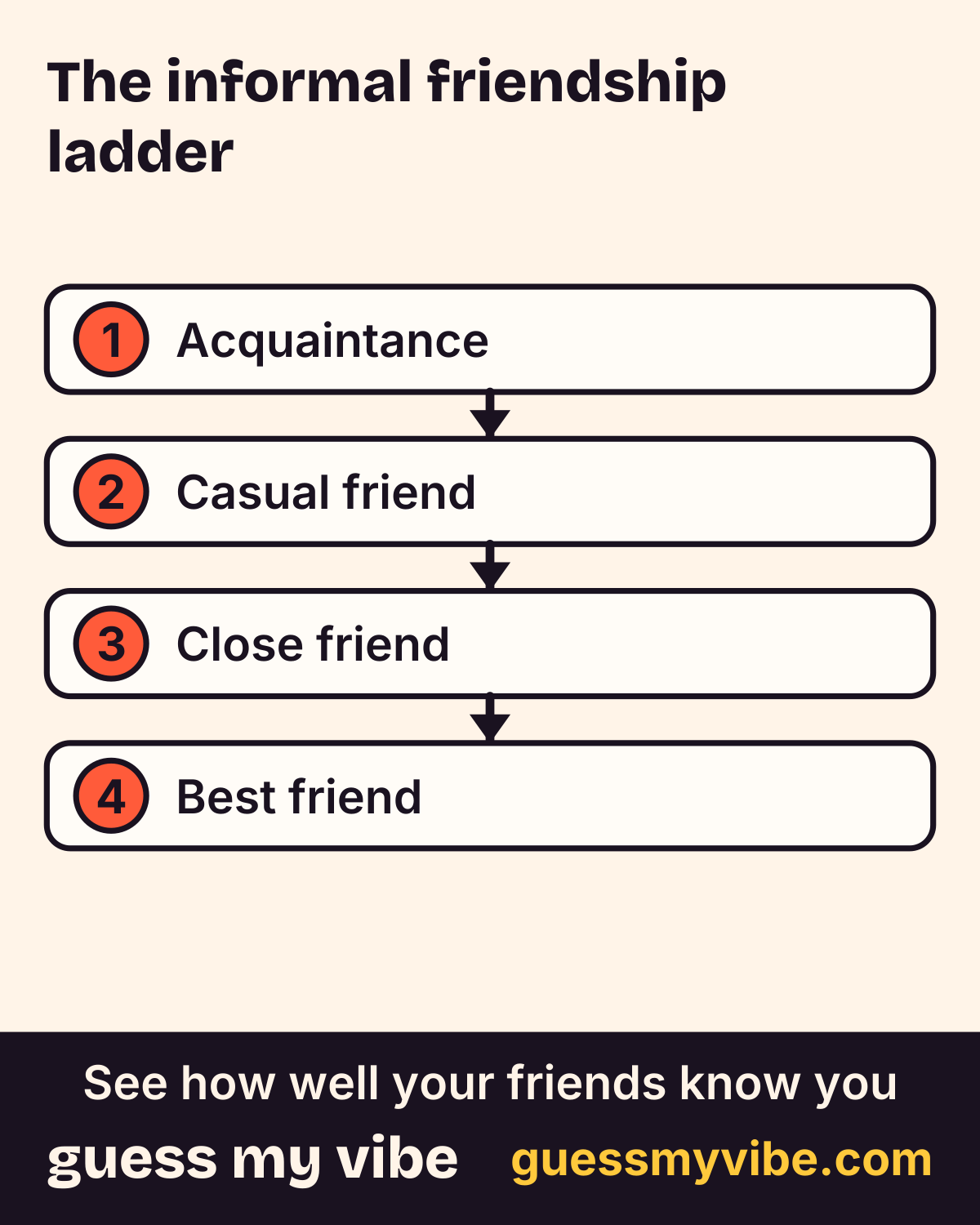
Here is the informal sketch most people carry around. It is a way to talk about friendship, not a result from a study, and real friendships skip steps, stall, or move backward.
- Acquaintance. You know each other's name and a few surface facts. Contact is tied to a setting, like a class, a team, or a workplace.
- Casual friend. You choose to spend time together sometimes, usually in a group or around a shared activity. Conversation is friendly but mostly on safe topics.
- Close friend. You share more private things, you expect each other to show up, and contact does not need a built-in reason.
- Best friend. One or a few people you rely on most. How many people count, and what "best" means, differs a lot from person to person.
A well-known theory in this area, social penetration theory from Irwin Altman and Dalmas Taylor in 1973, describes closeness growing as people gradually share more topics (breadth) and more personal ones (depth). We haven't opened the original book, so treat it here as a framework that matches the studies below, not as a finding we are citing.
Cite this figure
Figure: "The informal friendship ladder." Guess My Vibe (guessmyvibe.com). https://guessmyvibe.com/learn/stages-of-friendship#figure-friendship-ladder
What a study that followed new friendships found
One classic longitudinal study followed new friendships as they developed. At three-week intervals during their first term at university, 84 first-year students filled out questionnaires about two same-sex people they had just met. By the end of the fall term, some of those twosomes had become close friendships and some had not, and the two groups differed in what they did and how they felt about each other [1].
Two details stand out. First, as friendships developed, the intimacy of the interaction accounted for a growing share of how intense the friendship was, over and above the sheer quantity of interaction [1]. That fits the common sense idea that seeing someone a lot gets you started, and what you do together decides where it goes. Second, ratings of what each person got out of the relationship went up as it progressed, while the study found no difference in perceived costs between close and non-close friends [1].
The patterns at the end of the term were also good indicators of whether the two were still friends three months later, and motivational and situational factors were also correlated with friendship outcomes [1]. The limits are real: these were same-sex twosomes of first-year students in one setting, studied decades ago, so it can't tell you how adult friendships, cross-sex friendships, or online friendships unfold.
Time matters, and so does what you talk about
Two more recent studies looked at the time side. In one, 355 people who had recently moved estimated how much time they had spent with a new acquaintance, and more hours together went with closer friendships. In the other, 112 first-year students reported hours spent with two new acquaintances at three points over nine weeks, and hours together was associated with changes in closeness between waves. Two types of everyday talk also went with changes in closeness [2]. We cover the numbers and the limits in our article on how long it takes to make a friend; the point here is that time together goes with closeness, and so does what people talk about.
Similarity shows up in the early stages too, but in a surprising way. A study that followed undergraduates through their first year at university measured personality similarity three ways. How similar people believed they were, and how similar peers rated them, went with more friendship intensity among just-acquainted people. Actual similarity in personality did not [4]. The study also suggests that feeling similar is partly a result of getting close, not only a cause of it [4]. In plain words, early on it seems to matter more that two people feel alike than that they measurably are.
Curious how your friends would answer?
Free. Answer 10 quick questions about you, then send your link. Friends play in their browser, no app needed.
Start freeSelf-disclosure: the step that turns acquaintance into friend
If there is one move that most clearly separates the stages, it is sharing something personal and having the other person respond well. A meta-analysis of the disclosure and liking literature found three separate effects, each significant. People who disclose intimately tend to be liked more than people who disclose less, people disclose more to those they already like, and people like others as a result of having disclosed to them [3]. The authors suggest these fit together as one dynamic system, which is a useful way to picture a friendship: liking invites disclosure, and disclosure builds liking [3]. The disclosure-liking relation was also moderated by study paradigm, type of disclosure, and the gender of the person disclosing [3].
Two diary studies of everyday interactions add the other half. Intimacy in an interaction came from a combination of what a person disclosed and what their partner disclosed, with the sense that the partner was responsive partly explaining the link. In the second study, sharing emotions mattered more for intimacy than sharing facts [5]. That is why a long chat about schedules and classes can leave two people no closer, while a short, honest exchange about something that is going badly can move things along.
Acquaintance vs friend: where the line falls
There is no agreed cutoff, and different studies draw the line differently. The longitudinal study above tracked how intense people rated each friendship and whether two people had developed into a close friendship by the end of the term, without a single cutoff between the two [1]. One useful, concrete difference is how well the other person knows you. In a classic study of about 150 undergraduates, close acquaintances' descriptions of someone's personality agreed with each other and with the person's own description much better than the descriptions of strangers who had only watched one videotaped interaction [6]. Note the words: that study compared close acquaintances to strangers, not friends to casual acquaintances, so it speaks to what experience adds, not to a precise line.
A practical way to place a relationship, using the findings above, is to ask three questions. Do we see each other outside the place we met? Do we share things we wouldn't say to most people? Do both of us put in effort to keep it going? None of this is a tested measure, and you can be a close friend to someone who would answer no to the first question, for example in a long-distance friendship. It is a prompt for thinking, not a score.
How to move a friendship to the next stage
- Add a second setting. If you only see someone at work or class, an invitation to something unrelated gives the friendship room to exist outside the setting that created it.
- Match their depth, then go a little deeper. Reciprocal sharing is the pattern in the research [3], so the simplest step is to answer a personal share with one of your own.
- Respond like you care. Partner responsiveness mattered in the diary studies of intimacy [5], so the way you receive what someone tells you counts as much as what you tell them.
- Give it time, and don't panic about the pace. Hours together were associated with closeness in the time studies [2], and many friendships don't move in a straight line.
- Skip the small-talk loop. If every conversation stays on neutral topics, the friendship has no way to deepen. Question lists can help break it, which is one reason people play get-to-know-you games.
What the research doesn't settle
Several things are open. The studies above mostly follow students, who are surrounded by chances to meet, so they say little about adults building friendships with a job and family in the way. Nobody has shown that every friendship passes through the same stages in the same order, and many don't: a friendship can start close because of a shared crisis, or stay casual for years and still be valued. And most of this work relies on what people report about their own relationships, which is an incomplete view of what actually goes on between them. A fair summary is that the ladder is a metaphor that matches an average trend, not a map of your friendships.
If you want to see where one of your friendships sits, Guess My Vibe gives you a low-pressure way to find out how well each of you actually knows the other. Friends guess your answers on a short set of questions, and the gaps and hits are usually a better conversation starter than another round of small talk.
Key takeaways
- No study has established a fixed set of friendship stages; the common "acquaintance, casual friend, close friend, best friend" ladder is a handy description, not a measured sequence.
- In a study of 84 first-year students followed through a term, how intimate their interactions were explained more and more of friendship closeness over time, beyond how much contact they had [1].
- Hours together went with closer friendships in two studies, and two types of everyday talk went with changes in closeness in the second, so time is part of the picture but probably not all of it [2].
- A meta-analysis found that people who disclose more intimately tend to be liked more, people disclose more to those they already like, and people come to like others because they have disclosed to them [3].
- This isn't therapy, a diagnosis, or a substitute for professional care, and none of these studies can tell you which stage one specific friendship is in.
Questions people ask
What are the stages of friendship?
The usual description runs from acquaintance to casual friend to close friend to best friend, but that ladder is an informal sketch rather than a measured sequence. In one longitudinal study of new friendships, the intimacy of interactions explained a growing share of friendship intensity beyond the sheer amount of contact [1].
What is the difference between an acquaintance and a friend?
There is no agreed cutoff. Common markers are seeing each other outside the setting you met in, sharing more personal things, and both putting in effort. In one longitudinal study, how intimate the interactions were explained more of friendship closeness over time than the quantity of contact alone [1].
How does a friendship move from casual to close?
Research points to time together and mutual self-disclosure. A meta-analysis of disclosure and liking found that disclosing intimately goes with being liked, that people disclose more to people they like, and that people come to like others after disclosing to them [3].
Is social penetration theory proven?
It is a theory, not a single finding. It describes closeness growing as people share more topics and more personal ones. It fits the disclosure research, but we describe it here as a framework, since we haven't opened the original 1973 book.
Do all friendships go through the same stages?
No study shows that. Some friendships start close, some stay casual for years, and some fade. The studies we cite followed mostly students, so they can't tell you how every kind of friendship develops [1].
See how well your friends know you.
Free. Answer 10 quick questions about you, then send your link. Friends play in their browser, no app needed.
Start freeReferences
- [1] Hays, R. B. (1985). A longitudinal study of friendship development. Journal of Personality and Social Psychology, 48(4), 909-924. PubMed: 3989674 (opens in a new tab)
- [2] Hall, J. A. (2019). How many hours does it take to make a friend?. Journal of Social and Personal Relationships, 36(4), 1278–1296. doi.org/10.1177/0265407518761225 (opens in a new tab)
- [3] Collins, N. L., & Miller, L. C. (1994). Self-disclosure and liking: A meta-analytic review. Psychological Bulletin, 116(3), 457-475. PubMed: 7809308 (opens in a new tab)
- [4] Selfhout, M., Denissen, J., Branje, S., & Meeus, W. (2009). In the eye of the beholder: Perceived, actual, and peer-rated similarity in personality, communication, and friendship intensity during the acquaintanceship process. Journal of Personality and Social Psychology, 96(6), 1152–1165. PubMed: 19469593 (opens in a new tab)
- [5] Laurenceau, J. P., Barrett, L. F., & Pietromonaco, P. R. (1998). Intimacy as an interpersonal process: the importance of self-disclosure, partner disclosure, and perceived partner responsiveness in interpersonal exchanges. Journal of Personality and Social Psychology, 74(5), 1238-1251. PubMed: 9599440 (opens in a new tab)
- [6] Funder, D. C., & Colvin, C. R. (1988). Friends and strangers: Acquaintanceship, agreement, and the accuracy of personality judgment. Journal of Personality and Social Psychology, 55(1), 149–158. PubMed: 3418488 (opens in a new tab)
How we find and check these sources: how we write. Spotted an error? Report a correction.
Related
- How Long Does It Take to Make a Friend? What the Study Says
- How to Make Friends: What the Research Says
- Signs Someone Wants to Be Your Friend, and What's Known
- How to Have Deep Conversations, Backed by Research
- What Is a Best Friend? What Makes Someone Your Best Friend
- How to Ask Someone to Hang Out: Less Risky Than It Feels
Want to try it with your own friends? Make a friendship quiz to play with your friends
Cite this article
- Title
- The Stages of Friendship: From Acquaintance to Close Friend
- Publisher
- Guess My Vibe
- Updated
- URL
- https://guessmyvibe.com/
learn/ stages-of-friendship
Copy this citation
Guess My Vibe. (2026, October 4). The Stages of Friendship: From Acquaintance to Close Friend. Guess My Vibe. https://guessmyvibe.com/
To point at one section, add that section's anchor (the # link on its heading) to the URL.