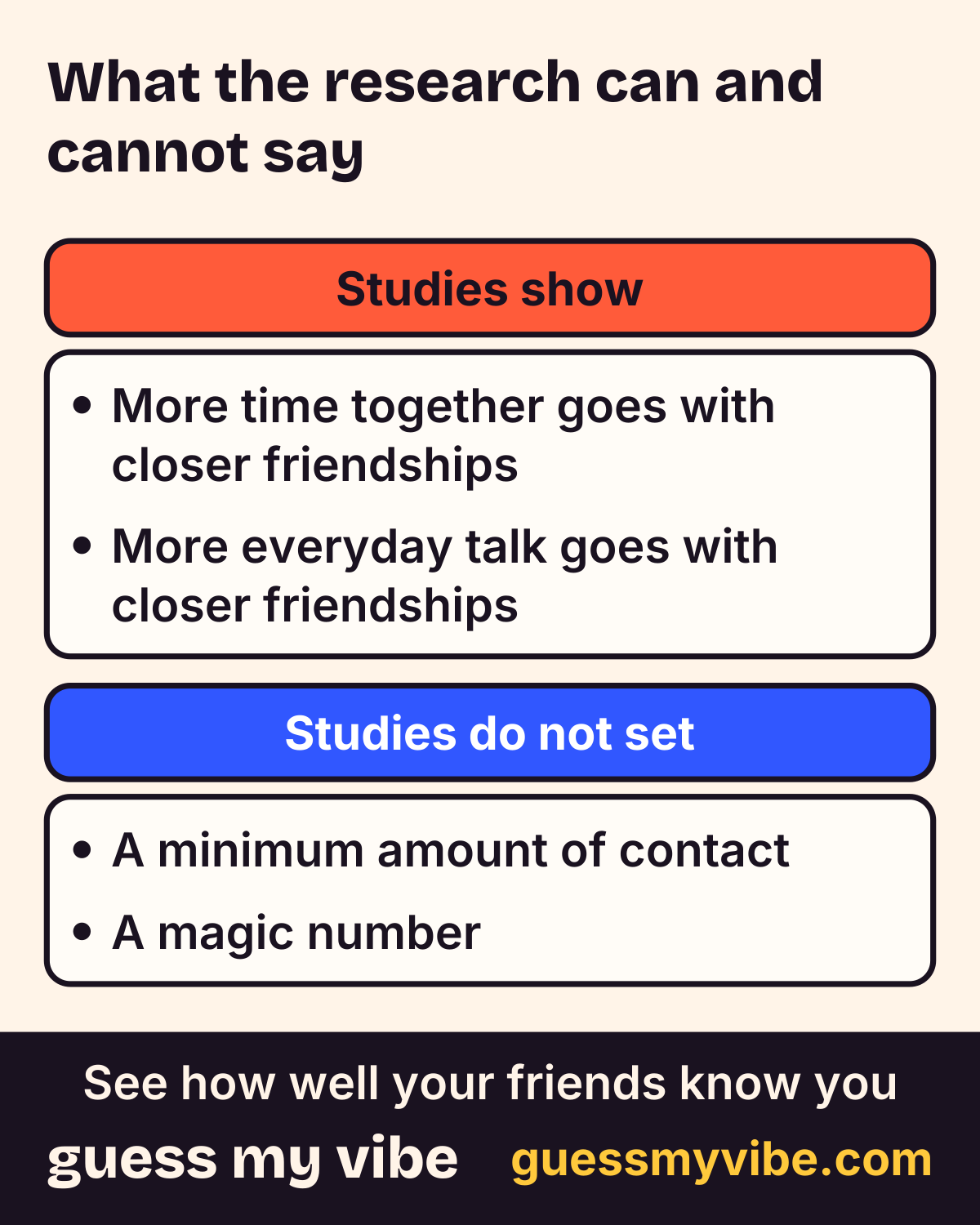
There's no research-backed number for how often you should see friends. What the studies do show is that more time together and more everyday talk go with closer friendships [1], and that over a life transition the decline in friendship quality was reduced by more effort invested [2]. How much contact is enough depends on the friendship, the stage of life, and the person.
How often should you see friends? Honestly, nobody knows the exact number, and anyone who gives you one is guessing. The research does point to a direction: friendships get closer with more time together and more everyday talk, and they tend to fade when nobody invests in them. But the studies are about averages, they don't set a minimum, and they leave plenty of room for the friend you see twice a year and still feel close to.
This article walks through what the science actually measured, what it can't tell you, and a few practical ways to think about your own schedule without turning friendship into a quota. If you're coming back to a friendship after a long gap, start with how to reconnect with an old friend, and for the general case of keeping friendships going, see how to maintain friendships.
Why there's no magic number
A popular claim says it takes a specific number of hours to turn an acquaintance into a friend, and by extension that friends need a set amount of contact to stay close. When the published paper on this question (Hall, 2019) was checked for this article, the published abstract reported a relationship, not a threshold: hours together were associated with closer friendships, but the abstract names no number of hours at which a friendship begins or is safe [1]. Figures repeated online were not found in that abstract, so we don't repeat them.
There's a good reason a clean number is unlikely. Friendships differ in history, in what the two people need from each other, and in life circumstances. A friend who has known you since childhood and a friend from your new job don't run on the same clock. And a study that finds contact goes with closeness can't tell you how much contact is the right amount for you, only that the two tend to move together.
Cite this figure
Figure: "What the research can and cannot say." Guess My Vibe (guessmyvibe.com). https://guessmyvibe.com/learn/how-often-should-you-see-friends#figure-research-can-and-cannot
What time together does for a friendship
The closest thing to a direct answer comes from two studies in a single paper. In Study 1, 355 adults who had recently relocated estimated how much time they spent with a new acquaintance. More hours together went with a closer friendship, and so did time spent in leisure activities. In Study 2, 112 first-year college students reported the hours they spent with two new acquaintances at three points over nine weeks. Hours together was associated with changes in closeness between waves, and two types of everyday talk also went with changes in closeness [1].
Two cautions apply. First, these were new acquaintances, not long-standing friends, so the findings say more about how friendships form than about how often established friends need to meet. Second, the research is observational: closer friends may spend more time together partly because they're closer, so the arrow can run both ways. What you can reasonably take from it is modest: ordinary time and ordinary talk are part of how closeness grows.
Friendships slip without upkeep, but the kind of upkeep varies
Researchers followed entire personal networks over 18 months, across a major life transition. Family relationships and friendships differed strikingly. The decline in friendship quality was reduced by more effort put into the relationship, with a gender difference: for women, relationship decline was prevented most by more contact frequency (talking together), and for men, by doing more activities together [2].
This is the most useful finding for the "how often" question, because it suggests frequency isn't a single dial. For some friendships and some people, frequent talking is what holds things together. For others, a shared activity matters more than the number of messages. It's a group-level difference, so plenty of individual men will prefer talking and plenty of women will prefer doing things. The takeaway is to notice which kind of contact keeps a particular friendship feeling alive, instead of copying a generic schedule.
Curious how your friends would answer?
Free. Answer 10 quick questions about you, then send your link. Friends play in their browser, no app needed.
Start freeWhy your closest friends probably get the most contact
A review by Sutcliffe, Dunbar, Binder and Arrow describes personal social networks as a series of layers, roughly 5, 15, 50 and 150 people. Each layer out has more people but less intimacy and less frequent interaction. The authors argue that the benefits of a relationship level off while the cost of maintaining it, most obviously the time it takes, rises roughly in line with the number of relationships. They also suggest trust is tied to the time invested [3]. This is a theoretical account, not a test of any particular schedule, and the layer sizes are approximations, not rules.
It helps explain something most people feel without being able to say: you can't see everyone you like as often as you'd like. A broader review of friendship describes it as costly in time and in the mental effort behind it, while personal networks nonetheless show regular patterns in their size and structure [4]. Seeing your inner circle most often and a wider circle less often isn't a failure of friendship. It's what the time budget produces. It also means a lower frequency with a friend isn't automatically a sign that the friendship is weaker, although it may be one input.
Small touchpoints count too
Seeing a friend in person isn't the only form of contact. In the college study above, everyday talk went with changes in closeness [1], and a study of students found they felt happier and more like they belonged on days when they interacted with more classmates than usual, and two broader studies of all daily interactions again linked contact with casual acquaintances to social and emotional well-being [5]. That second paper is about well-being, not friendship closeness, so it doesn't show that texting keeps a friendship alive. It does fit the broader picture that small, ordinary social contact is worth something.
Practically, this means contact can be layered. A quick message, a shared meme, a voice note or a short call in between hangouts is a real touchpoint, and for many friendships it's the realistic way to stay in touch when schedules don't line up. Whether those small touchpoints can replace time together for a particular friendship is something these studies don't settle.
Finding a rhythm that works for you
Because the research can't hand you a number, a more useful question is whether the amount of contact you have matches what each friendship needs. A few questions can help.
- Do you both seem content with the current rhythm? If neither of you is bothered, the rhythm is probably fine, whatever a calendar says.
- What kind of contact helps most? Talking, doing things together, or both. The 18-month study suggests this may differ between friendships [2].
- Is something changing? A move, a new job, or a new baby tends to disrupt contact, and the 18-month study followed people through exactly that kind of transition, when friendship quality declined [2].
- Does your social energy come into it? Some people need more recovery time between social plans than others, and that's a normal personality difference, not a failing as a friend. Our piece on social battery goes into it.
- Are you carrying the effort alone? If one person is doing all the reaching out for a long time, the rhythm may not suit both of you.
None of this is a guarantee. A friendship can thin out even with regular contact, and some friendships restart easily after years apart. The studies describe tendencies across many people, and your own friendships are the best evidence about what works for you.
A low-effort touchpoint between hangouts
If your problem is that you can't meet as often as you'd like, one option is a small, repeatable activity that doesn't need scheduling. Guess My Vibe is a free game where a friend guesses how you'd answer questions about yourself, and you see how close they got. It takes a few minutes, can be done from anywhere, and often turns into the kind of everyday talk the research above links to closeness.
Key takeaways
- No study we could find gives a number of hangouts per week or month that keeps a friendship healthy, so be wary of any article that does.
- In recently relocated adults, more hours together and more shared leisure time went with closer new friendships, and in first-year students, hours together and two types of everyday talk went with changes in closeness over nine weeks [1].
- Over an 18-month life transition, friendship quality declined, and more effort reduced the decline: more contact (talking) for women, more shared activities for men [2].
- A theoretical review of personal networks describes inner layers of people with more intimacy and more frequent interaction, and argues that the cost of keeping up a relationship, most obviously the time it takes, rises roughly in line with the number of relationships [3].
- This isn't therapy, a diagnosis, or a substitute for professional care.
Questions people ask
How often should you see your friends?
There's no research-based number. Studies link more time together and more everyday talk to closer friendships [1], but they don't set a minimum, and the right amount depends on the friendship and your life stage.
Is it okay to only see a friend a few times a year?
It can be fine. A theoretical review of personal networks describes inner layers with more frequent interaction and outer layers with less, and argues that the time cost of maintaining relationships rises with their number [3]. What matters is whether you both feel the friendship is still alive.
Do friendships fade if you don't see each other?
They can. Over an 18-month life transition, friendship quality declined, and more effort invested reduced the decline [2]. Effort doesn't have to mean in-person meetups, and the best kind of contact differed between women and men on average.
Does texting count as keeping in touch?
It's a real touchpoint, and everyday talk went with changes in closeness among first-year college students [1]. The studies cited here don't test whether texting can fully replace time together, so it's reasonable to mix both.
How many hours does it take to become close friends?
The abstract of the study on this question reports that more hours together went with closer friendships but gives no specific hour count [1]. Figures you see online weren't in that abstract.
See how well your friends know you.
Free. Answer 10 quick questions about you, then send your link. Friends play in their browser, no app needed.
Start freeReferences
- [1] Hall, J. A. (2019). How many hours does it take to make a friend?. Journal of Social and Personal Relationships, 36(4), 1278–1296. doi.org/10.1177/0265407518761225 (opens in a new tab)
- [2] Roberts, S. B. G., & Dunbar, R. I. M. (2015). Managing Relationship Decay: Network, Gender, and Contextual Effects. Human Nature, 26(4), 426-450. PubMed: 26489745 (opens in a new tab)
- [3] Sutcliffe, A., Dunbar, R., Binder, J., & Arrow, H. (2012). Relationships and the social brain: Integrating psychological and evolutionary perspectives. British Journal of Psychology, 103(2), 149-168. PubMed: 22506741 (opens in a new tab)
- [4] Dunbar, R. I. M. (2018). The Anatomy of Friendship. Trends in Cognitive Sciences, 22(1), 32-51. PubMed: 29273112 (opens in a new tab)
- [5] Sandstrom, G. M., & Dunn, E. W. (2014). Social Interactions and Well-Being: The Surprising Power of Weak Ties. Personality and Social Psychology Bulletin, 40(7), 910–922. PubMed: 24769739 (opens in a new tab)
How we find and check these sources: how we write. Spotted an error? Report a correction.
Related
Want to try it with your own friends? Make a friendship quiz to play with your friends
Cite this article
- Title
- How Often Should You See Friends? What the Research Says
- Publisher
- Guess My Vibe
- Updated
- URL
- https://guessmyvibe.com/
learn/ how-often-should-you-see-friends
Copy this citation
Guess My Vibe. (2026, October 4). How Often Should You See Friends? What the Research Says. Guess My Vibe. https://guessmyvibe.com/
To point at one section, add that section's anchor (the # link on its heading) to the URL.