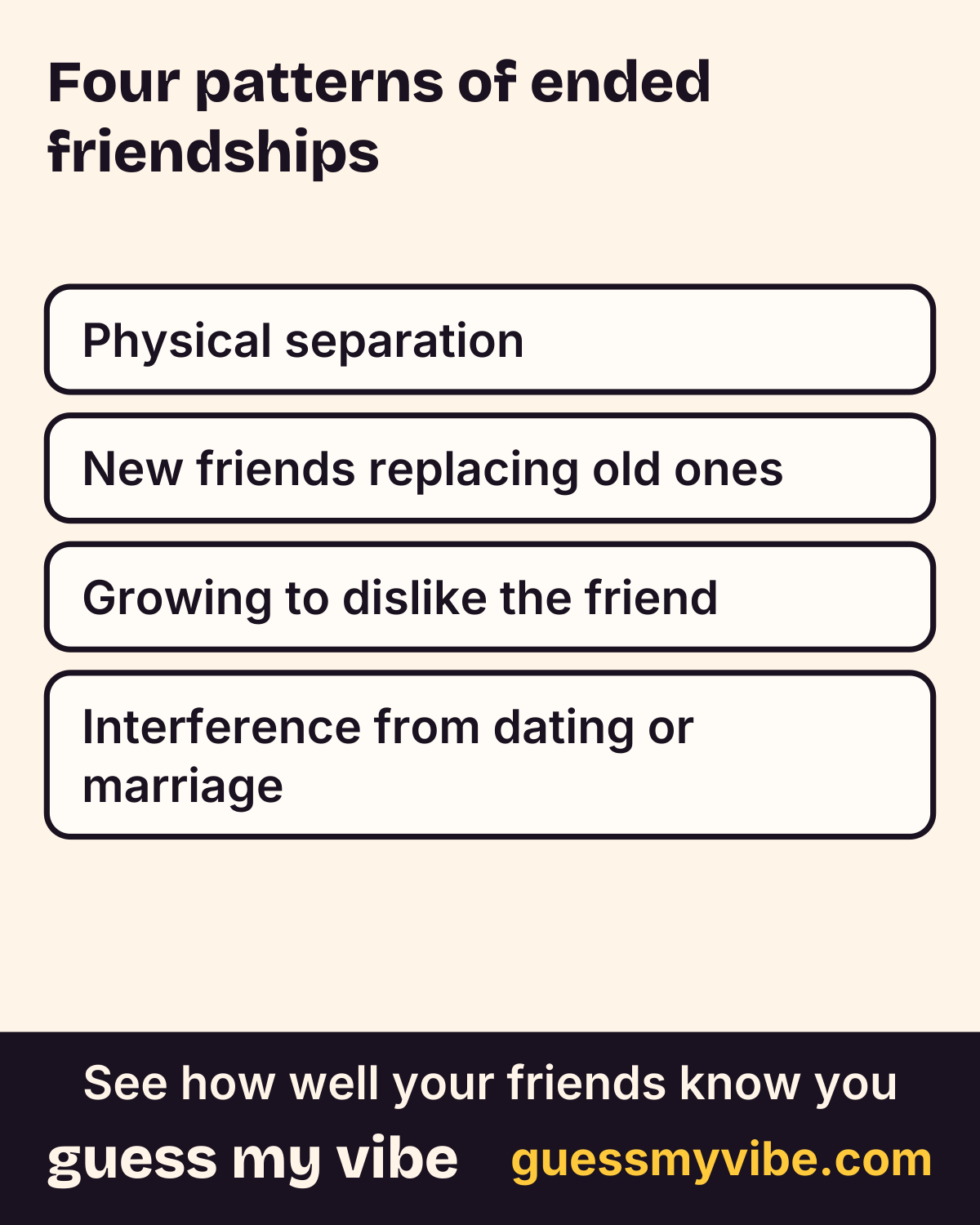
A friendship breakup can happen for several ordinary reasons. In a classic study of young adults' ended close friendships, researchers found four patterns: physical separation, new friends replacing old ones, growing to dislike the friend, and interference from dating or marriage [1]. A recent review adds that friendships end in many ways and for many reasons, with differences in timing, communication and intent [2]. A friendship ending doesn't prove you did something wrong.
A friendship breakup can hurt in a way people rarely admit, partly because there's no script for it. Nobody sends a card. You just notice that the texts stopped, or that a conversation changed something for good. The research on how friendships end is useful here, because it shows that most explanations people reach for first ("I must have messed up") are only one possibility among several. This article covers how friendships actually end, what differs between a best friend and a casual one, and what the evidence says about ending a friendship on purpose. If you're mostly dealing with a slow fade after a move or a new job, our guide to growing apart from friends is the closer match.
Four common ways a friendship breakup happens
One of the best-known studies asked college women and men to describe, in hindsight, close same-sex friendships that had recently ended or deteriorated, along with changes in their friendship networks over the past five years. The researchers identified four patterns of friendship dissolution: physical separation, new friends replacing old, growing to dislike the friend, and interference from dating or marriage [1].
Look at that list again. Only one of the four is about coming to dislike someone. The others are about circumstances (you're no longer in the same place), replacement (your life filled with different people) and priorities (a partner takes up the time). That doesn't mean every ending is painless or blameless. But it does mean a breakup can come from where life took you, not from anything one friend did to the other. The abstract doesn't say how often each pattern occurred, so we can't tell you which is most common.
The same study found that the transition to college produced a higher rate of deteriorated friendships than the high school years, particularly for women. Two gender differences also showed up. Physical separation was more likely to precipitate the end of men's friendships, while dating or marriage was more likely to interfere with women's [1]. Keep the limits in mind: this was a college sample describing past friendships from memory, published in 1984, so it's a useful map and not a current statistic.
Cite this figure
Figure: "Four patterns of ended friendships." Guess My Vibe (guessmyvibe.com). https://guessmyvibe.com/learn/friendship-breakup#figure-four-patterns
Why a best friend and a casual friend end differently
Not every friendship is built to survive the same things. In a study of 90 young adults aged 20 to 28, best friendships were seen as more self-maintaining, more based on affection and less affected by a decrease in contact than close friendships. Close friendships, in turn, depended more on affection and interaction and less on proximity than casual friendships [3]. The authors also found that best and close friendships were more clearly set apart for hypothetical friendships than for actual ones, and that life stage and sex affected how people thought about friendship [3].
In plain terms, a casual friendship tends to need circumstances to hold it up, such as the same dorm, office or class, and when the circumstances end, so can the friendship. A best friendship leans more on the bond itself. That's one reason losing a casual friend to a move feels like a natural end, while losing a best friend to the same move can feel like a loss that shouldn't have happened. Both reactions fit the pattern.
Curious how your friends would answer?
Free. Answer 10 quick questions about you, then send your link. Friends play in their browser, no app needed.
Start freeBig transitions and friendship change
Several studies point to life transitions as a time when friendships change. A study following high school best friendships through the first year of college found they declined on average in satisfaction, commitment, rewards and investments, while costs and alternatives to the relationship increased. Proximity didn't influence the friendships, but level of communication moderated how much they deteriorated, and people who stayed best friends reported more positivity, supportiveness, self-disclosure and interaction than those whose friendship became a close or casual one [4].
At a larger scale, a meta-analysis of 277 studies and 177,635 participants found that friendship networks got smaller throughout adulthood, and that life events like starting a job or becoming a parent showed network changes similar to the age-related pattern [5]. In short, changes in friendships seem to go along with changes in life.
How stable is the inner circle?
It helps to know how rare real turnover is among the closest people. A study of a national cellphone database found that membership of the inner circle of intimate relationships was extremely stable over a three-year period, but around 1 to 4% of those contacts changed each year. The rate of change was higher among 17- to 21-year-olds than among older adults [6]. Because this is phone-contact data, it measures who people call and text, not how they'd describe their friendships, so it's a rough view. Even so, it suggests the people at the center of your life tend to stay put, and that when someone does leave the inner circle, it's a notable event and not background noise.
Ending a friendship on purpose
Some endings aren't drift. Sometimes one person decides. Research on this is thin, and it's mostly about younger people. A recent review of friendship dissolution from childhood through young adulthood notes that little work has examined friendship stability in adulthood. It also points out that friendships end in many ways and for many reasons, differing in timing, communication and intent, which may lead to different social and emotional outcomes, and it discusses circumstances under which dissolving a friendship may be helpful versus harmful [2]. That last point is the honest summary of the field: ending a friendship isn't automatically good or bad, and the research doesn't hand out a rule for when to do it.
So here are some questions to think through, offered as our own reflection and not as research findings. Is this about a situation that has changed, or about how the two of you treat each other? Have you said anything to the other person, or are you reacting to a story in your head? Would a smaller change, like seeing each other less, give you what you need? And if you do end it, a short, kind, direct message is one option, though no approach guarantees how the other person will take it. If the friendship feels one-sided, our article on one-sided friendships looks at that pattern. If it's weighing on you heavily, talking it through with someone you trust may help, and this isn't therapy, a diagnosis, or a substitute for professional care.
If you're the one who was left
Being dropped is its own experience, and the research on it is limited, so we'll stay modest. What the evidence does show is that only one of the four patterns in Rose's study involves growing to dislike the friend, the others being separation, replacement and dating or marriage [1], and that even best friendships declined in satisfaction and commitment across the move to college [4]. That's not a guarantee your case is one of those. But it's a reason to hold off on concluding that you were the problem. You may never get a full explanation, which can be painful, and it isn't a measure of your worth.
If the friendship is worth keeping
Some "breakups" are really two people who stopped checking in. If that's yours, a small, low-stakes reconnection can do more than a big talk. Guess My Vibe is a light way to do it: send your link, let the friend guess how you'd answer, and see what each of you gets right and wrong about the other. It won't fix a real rift, but it can restart a conversation without anyone having to rehearse an apology.
Key takeaways
- Young adults' accounts of ended close friendships fell into four patterns: physical separation, new friends replacing old ones, growing to dislike the friend, and interference from dating or marriage; only one of the four is about disliking the friend [1].
- Best friendships were described as more self-maintaining and less affected by a drop in contact than close friendships, while casual friendships depended more on proximity [3].
- During the first year of college, high school best friendships declined on average in satisfaction, commitment, rewards and investments, and while proximity did not influence the friendships, the level of communication moderated how much they deteriorated [4].
- A review says friendships end in many ways and for many reasons, and discusses when dissolving a friendship may be helpful versus harmful [2].
- This isn't therapy, a diagnosis, or a substitute for professional care.
Questions people ask
Why do friendships end?
Researchers describing young adults' ended close friendships found four patterns: physical separation, new friends replacing old, growing to dislike the friend, and interference from dating or marriage [1]. A later review says friendships end in many ways and for many reasons [2].
Is it normal to lose a best friend when you start college?
Best friendships often change at that point. In a study of high school best friendships through the first year of college, satisfaction, commitment, rewards and investments declined on average, and people who stayed best friends reported more positivity, support, self-disclosure and interaction than those whose friendship changed [4].
Does distance end friendships?
It can, but not always. Physical separation was one of four patterns in ended friendships and was likelier to end men's friendships than women's [1]. Among best friends moving to college, proximity didn't influence the friendship, but the level of communication did [4].
When should you end a friendship?
Research doesn't give a rule. A review of the field discusses circumstances under which dissolving a friendship may be helpful versus harmful [2]. It's a personal call, and talking it through with someone you trust may help.
How often do people leave the inner circle?
In a national cellphone study, the inner circle was extremely stable over three years, with around 1-4% of contacts changing each year and higher change among 17-21 year olds [6].
See how well your friends know you.
Free. Answer 10 quick questions about you, then send your link. Friends play in their browser, no app needed.
Start freeReferences
- [1] Rose, S. M. (1984). How friendships end: Patterns among young adults. Journal of Social and Personal Relationships, 1(3), 267–277. doi.org/10.1177/0265407584013001 (opens in a new tab)
- [2] Santucci, K., Dirks, M. A., & Lydon, J. E. (2025). With or without you: Understanding friendship dissolution from childhood through young adulthood. Journal of Social and Personal Relationships, 42(9), 2675–2699. doi.org/10.1177/02654075251334226 (opens in a new tab)
- [3] Rose, S., & Serafica, F. C. (1986). Keeping and ending casual, close and best friendships. Journal of Social and Personal Relationships, 3(3), 275–288. doi.org/10.1177/0265407586033002 (opens in a new tab)
- [4] Oswald, D. L., & Clark, E. M. (2003). Best friends forever?: High school best friendships and the transition to college. Personal Relationships, 10(2), 187–196. doi.org/10.1111/1475-6811.00045 (opens in a new tab)
- [5] Wrzus, C., Hänel, M., Wagner, J., & Neyer, F. J. (2013). Social network changes and life events across the life span: A meta-analysis. Psychological Bulletin, 139(1), 53–80. PubMed: 22642230 (opens in a new tab)
- [6] Roy, C., Bhattacharya, K., Dunbar, R. I. M., & Kaski, K. (2022). Turnover in close friendships. Scientific Reports, 12. doi.org/10.1038/s41598-022-15070-4 (opens in a new tab)
How we find and check these sources: how we write. Spotted an error? Report a correction.
Related
- Growing Apart From Friends: Why It Happens
- How to Reconnect With an Old Friend Without It Feeling Weird
- One-Sided Friendship: What the Research Actually Finds
- Forgiveness in Friendship: Why Some People Forgive Faster
- How to Maintain Friendships Through Life's Transitions
- Frenemy: What Mixed Feelings About a Friend Do to You
- Friend Ditching You for a Partner: What the Research Says
Want to try it with your own friends? Make a friendship quiz to play with your friends
Cite this article
- Title
- Friendship Breakup: Why Friendships End, Research Says
- Publisher
- Guess My Vibe
- Updated
- URL
- https://guessmyvibe.com/
learn/ friendship-breakup
Copy this citation
Guess My Vibe. (2026, October 4). Friendship Breakup: Why Friendships End, Research Says. Guess My Vibe. https://guessmyvibe.com/
To point at one section, add that section's anchor (the # link on its heading) to the URL.