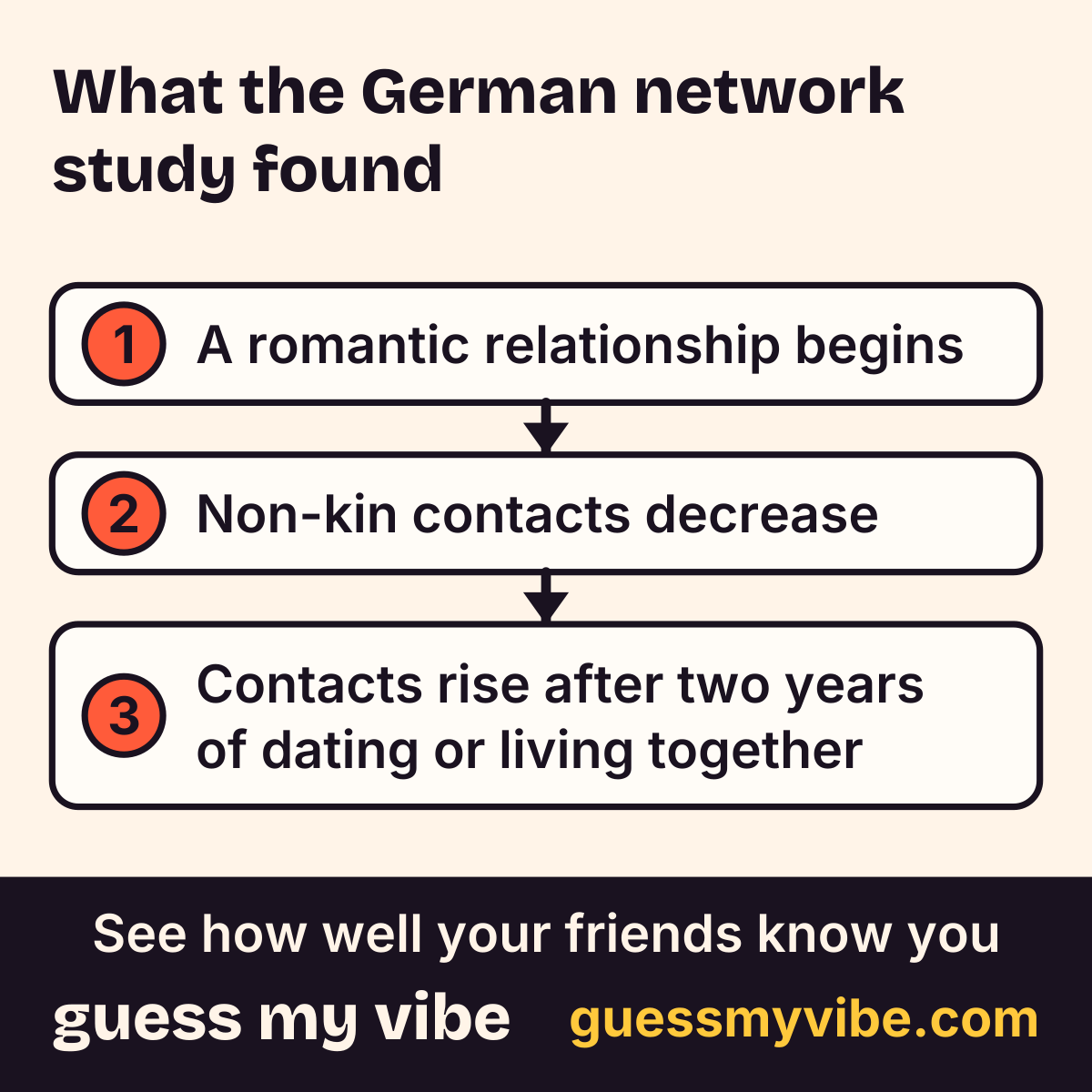
A friend who vanishes into a new relationship is often going through a shift in time and attention that, on average, does not last, rather than making a permanent exit. In a German study of 6,640 people aged 16 to 39, contacts outside the family dropped after a romantic relationship began, but rose again after two years of dating and after two years of living together [1]. You can help it along by keeping the friendship on a small, regular rhythm.
Want to take it for real? Send a friendship quiz as an easy way to reconnect
A friend ditching you for a partner is one of the most common friendship hurts, and also one of the least studied directly. The research can't say what your friend is feeling, and no study here measured the sting of being left behind. What it does show is a general pattern: when people begin a romantic relationship, the rest of their social network shifts on average, and on average it does not stay shifted. That is useful, because the feeling of being dropped often arrives right at the start, when the shift looks steepest.
A quick note on scope. These studies cover romantic relationships in general, and most describe average patterns across thousands of people, which tells you nothing about a particular friend or a particular partner. The advice at the end is our own reading of the findings, not tested instructions.
What happens to friendships when someone starts dating
The social withdrawal hypothesis says that a person's network shrinks when they start dating, living together or marrying. It had mostly been tested with data from a single point in time, which can't show how a network actually changes. One study used two waves of data (2008 and 2011) from 6,640 Germans between 16 and 39 and tracked changes within the same people, using fixed-effects models. After a romantic relationship formed, people showed a decrease in non-kin contacts. But there was an increase in non-kin contacts after two years of dating, and again after two years of cohabitation. The authors conclude that people adapt their social networks to the demands of each phase of a relationship, and that because the decline after dating is not stable, there is no need to be afraid that people with a partner stay isolated [1].
So the pattern that hurts, the early disappearance, was real in the data. But so was the recovery. That is the single most useful fact for the friend on the other side: what looks like a permanent exit may often be a dip.
Cite this figure
Figure: "What the German network study found." Guess My Vibe (guessmyvibe.com). https://guessmyvibe.com/learn/friend-ditching-you-for-a-partner#figure-dip-and-recovery
Why it can feel like ditching, even when it isn't
A separate study followed friendship formation for nine months among 126 people and their cohabiting partners in a university-related graduate housing community, covering 2,250 self-reported friendship relations. Partnership ties strongly shaped how friendships formed: they were a main driver of clustering, meaning that partners tend to have friends in common and to befriend other couples [2].
That study is about forming friendships, not losing them, and it covers one unusual community. But it points at something relevant: once a person has a partner, their social life tends to organize around the two of them, and some friendships get absorbed into couple friendships. If you are the single friend, that can feel like a door closing even if no one meant it to. It is also an opening: the friend who is now half of a couple may be easier to see with their partner than alone.
We can't tell from these studies what any friend is thinking, and that is the honest limit. A friend who is in the middle of a new relationship may be absorbed, may feel guilty about it, or may simply assume the friendship is fine because nothing is wrong. The pattern in the data is consistent with all of those.
Curious how your friends would answer?
Free. Answer 10 quick questions about you, then send your link. Friends play in their browser, no app needed.
Start freeFriendships need upkeep, and upkeep can be small
A study tracked people's entire active personal networks over 18 months across a major life transition. Family relationships and friendships differed strikingly, and friendship quality declined. The decline was mitigated by increased effort invested in the relationship, but the type of effort that worked differed by sex: contact frequency, meaning talking together, did most for women on average, and doing more activities together did most for men [3]. That study wasn't about romance specifically. It is about life transitions in general, but a new relationship is one of them, and the lesson transfers reasonably well: when the default changes, effort matters.
Another set of three studies built a measure of friendship maintenance with four parts: positivity, supportiveness, openness and interaction. Best friends used more of all of them than close or casual friends. Friendships also tended to be equitable and to show agreement between the two friends about how much effort each put in [4]. One reading is that both friends are often tracking the same ledger, though that goes beyond what the abstract states.
What to do when a friend disappears into a relationship
- Say it once, kindly, without an accusation. Something like I miss hanging out, can we put something on the calendar, is easier to hear than you never see me anymore. Our guess is the first is far more likely to get a yes.
- Make it small and regular. A weekly walk, a call on the same evening or a standing coffee takes less effort than a big plan. The network study suggests upkeep effort is what slows decline, and small recurring plans are easier to keep during a busy new relationship.
- Match the way your friendship works. If you two mostly talk, keep the calls going. If you mostly do things, invite them to a thing. The effort that worked in the study differed, so fit it to your friend.
- Include the partner sometimes. Since partners shape how friendships form, getting to know the partner may help the friendship survive. It is not a requirement, but it can make you part of the new picture.
- Give it time. In the German data the dip was followed by a rise after about two years of dating or living together. That is an average across people, not a promise about your friend, but it argues for patience before deciding the friendship is over.
- Notice your own side too. If you feel hurt, that is a real feeling. Our article on feeling left out covers what is happening when a friend's absence stings, and our article on friendship jealousy covers the feeling that can come with it.
- If a friend truly pulls away for good, you are allowed to grieve it. Friendships do end, and our article on friendship breakups covers what the research says about that.
If you are the one in the new relationship
If you recognize yourself on the other side of this, the research suggests the answer is not guilt but small, regular upkeep. A text that says thinking of you, a standing plan or a night that is just for friends costs little and matters more than you might expect. The same study that found a dip also found that contacts recovered with time, so staying connected during the first months is how that recovery gets going [1].
How Guess My Vibe fits in
A guessing game is an easy, no-pressure plan to propose, and it takes ten minutes. Send a friend your link and see how well each of you knows the other, which is a light way to reconnect when a big hangout feels like too much.
Key takeaways
- People's non-family contacts dropped after a romantic relationship started, but increased after two years of dating and after two years of cohabitation; the authors conclude people adapt their networks to each phase [1].
- In a nine-month study of a graduate housing community, partnership ties were a main driver of how friendships formed, as partners shared friends and befriended other couples [2].
- Across 18 months and a major life transition, friendship quality declined, and the decline was softened by more effort, talking together for women and doing more together for men on average [3].
- Friendship maintenance has four recognizable parts, positivity, supportiveness, openness and interaction, and best friends use more of them than casual friends [4].
- This isn't therapy, a diagnosis, or a substitute for professional care.
Questions people ask
Why does my friend ignore me now that she has a boyfriend?
Often it is a shift in attention and time, not a choice about you. In a German study, people's non-family contacts dropped after a romantic relationship began, then rose again after two years of dating and cohabitation [1]. The study can't tell you what any one friend is thinking.
Do friendships fade when someone gets into a relationship?
On average there is an early dip and then a recovery. The German study found a decrease in non-kin contacts after a relationship formed and an increase after two years of dating and after two years of cohabitation [1]. Averages hide a lot of variation between friendships.
How do I tell a friend I miss them without sounding needy?
Keep it short, positive and specific, and attach a plan: I miss you, are you free Thursday for a walk. That is our suggestion rather than a tested script. Friendship upkeep, including positivity and interaction, is what the maintenance research points to [4].
Is it normal to feel jealous of a friend's partner?
It is common, and feeling it doesn't make you a bad friend. It often comes from missing time with someone you value. Our article on jealousy in friendship goes into the research behind that feeling.
When should I give up on a friendship after a friend gets a partner?
Not after one stretch of quiet. The data show a dip followed, on average, by a rise after about two years of dating or living together [1]. If you have tried asking for small, regular plans over a long time and nothing changes, that is a reasonable moment to adjust your expectations.
See how well your friends know you.
Free. Answer 10 quick questions about you, then send your link. Friends play in their browser, no app needed.
Start freeReferences
- [1] Rözer, J. J., Mollenhorst, G., & Völker, B. (2014). Romantic relationship formation, maintenance and changes in personal networks. Advances in Life Course Research. PubMed: 26047843 (opens in a new tab)
- [2] Stadtfeld, C., & Pentland, A. (2015). Partnership ties shape friendship networks: A dynamic social network study. Social Forces. doi.org/10.1093/sf/sov079 (opens in a new tab)
- [3] Roberts, S. B. G., & Dunbar, R. I. M. (2015). Managing Relationship Decay: Network, Gender, and Contextual Effects. Human Nature, 26(4), 426-450. PubMed: 26489745 (opens in a new tab)
- [4] Oswald, D. L., Clark, E. M., & Kelly, C. M. (2004). Friendship maintenance: An analysis of individual and dyad behaviors. Journal of Social and Clinical Psychology, 23(3), 413–441. doi.org/10.1521/jscp.23.3.413.35460 (opens in a new tab)
How we find and check these sources: how we write. Spotted an error? Report a correction.
Related
Cite this article
- Title
- Friend Ditching You for a Partner: What the Research Says
- Publisher
- Guess My Vibe
- Updated
- URL
- https://guessmyvibe.com/
learn/ friend-ditching-you-for-a-partner
Copy this citation
Guess My Vibe. (2026, October 7). Friend Ditching You for a Partner: What the Research Says. Guess My Vibe. https://guessmyvibe.com/
To point at one section, add that section's anchor (the # link on its heading) to the URL.