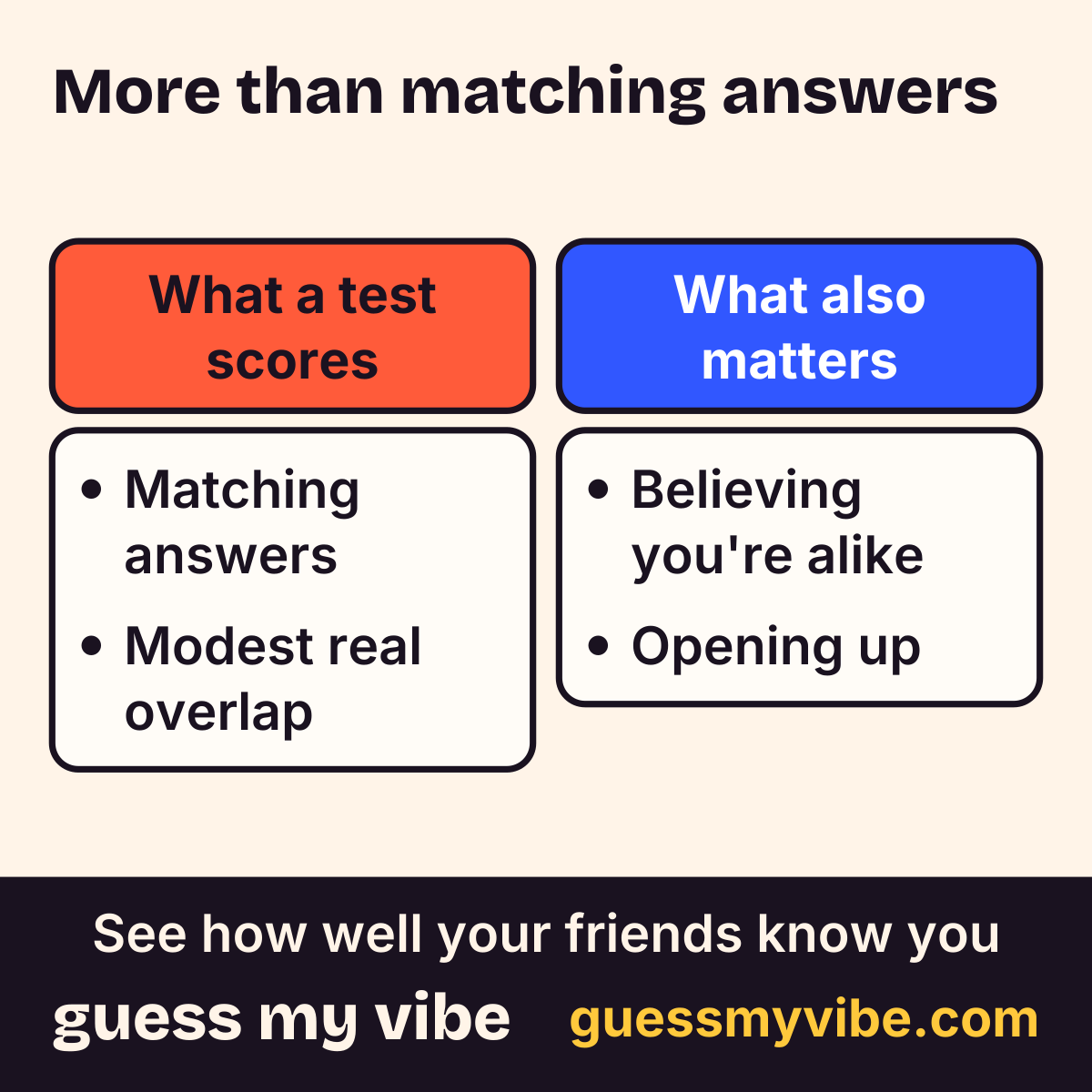
Friendship compatibility isn't mainly about matching personalities. Research finds friends really do share a modest, real personality overlap once it's measured from actual behavior [1], but close friends also reliably overestimate how alike they actually are [2], and other things, like how much you open up to each other, go with closeness just as directly as similarity does [3]. A compatibility test that only checks whether you two picked the same answers is measuring the easy, surface-level version of this.
Friendship compatibility: it's not mainly about matching personalities
Friendship compatibility sounds like it should mean two personalities that line up, and a lot of online "compatibility tests" are built around exactly that idea: answer the same questions, see how many match, call that your score. The research tells a more useful, less tidy story. Friends really do share some real personality overlap, but it's modest, not a match, and a close friendship runs on more than shared traits. How much you actually open up to each other goes with closeness in its own right, and here's the part worth sitting with: close friends reliably assume they're more alike than they actually are.
How similar are close friends, actually?
Self-report surveys have a blind spot for measuring this question: when you rate your own personality, you're often comparing yourself to whoever you happen to have in mind, which can mask real similarity between two people. One study got around this by measuring personality from actual digital behavior instead of a questionnaire, across more than 46,000 friend duos [1]. It found friends are genuinely alike in personality, with correlations roughly between .12 and .31 depending on the trait. That's a real, consistent pattern, worth taking seriously, and also clearly short of "basically the same person." Compatibility, in the data, looks like a real but partial overlap, not a mirror.
The bias that inflates how compatible you feel
If friends are only modestly alike in reality, why does a close friendship so often feel like "we're basically the same"? Part of the answer is a specific, well-studied bias called assumed similarity: the tendency to see other people as more like you than they actually are. A meta-analysis of 24 studies on person perception treated this as its own measurable pattern in how people judge others, distinct from simply judging how alike two other people seem to an outside observer [2]. In a friendship, that means some of what feels like deep compatibility is a real overlap, and some of it is your own mind quietly filling in the rest.
A study following new college friendships for a full year put a sharper point on this [4]. It tracked both actual personality similarity and perceived similarity (believing you're alike), then checked which one went with how close the friendship actually became. Actual similarity had no meaningful link to closeness. Perceived similarity did. In other words, the belief that you're compatible did more work in building the friendship than really being compatible did. That's not a flaw in friendship, it's just evidence that "compatibility" is partly something you build together, not only something you discover by comparing notes.
Curious how your friends would answer?
Free. Answer 10 quick questions about you, then send your link. Friends play in their browser, no app needed.
Start freeWhat close friends actually agree on, trait by trait
There's a related but different question worth separating from "how similar are we": how accurately does your friend actually read the traits you do have, similar to theirs or not. A meta-analysis of 263 samples and more than 44,000 people found self-other agreement isn't even across the board. Friends and family read outgoing, visible traits well, and read traits that live mostly inside someone's head, like how easily they get stressed, far less reliably [5]. That matters for compatibility: feeling genuinely understood by a friend isn't only a matter of sharing traits. It's also about how accurately they can read the traits you actually have, whatever those happen to be. Two friends with fairly different personalities who each read the other accurately can end up feeling more understood than two similar friends who are mostly seeing their own reflection in each other.
It's not only similarity: opening up matters on its own
If a friendship compatibility test only measures matching answers, it's missing something that builds closeness and has nothing to do with how similar you are. A classic meta-analytic review of the disclosure-liking link found three separate, reinforcing effects: people who disclose more intimately tend to be liked more, people disclose more to those they already like, and people come to like someone more as a direct result of having opened up to them [3]. None of that requires two similar personalities. A friendship between two people with fairly different traits can still build real closeness through exactly this loop, trusting each other with more over time, in a way a pure similarity score would never catch.
That loop also compounds in a way a one-time similarity score can't capture. People who already feel close tend to open up more, and then opening up more tends to deepen that closeness further, creating a cycle that keeps building regardless of how alike two friends' personalities were on day one. A friendship built mostly on this kind of back-and-forth trust has its own momentum, separate from whatever a trait-by-trait compatibility score would show.
What a real compatibility check should actually measure
Put together, the honest version of "friendship compatibility" has at least four moving parts: a real, modest personality overlap worth knowing about [1], a gap between how alike you actually are and how alike you assume you are [2], how accurately you each actually read the other's real traits, similar or not [5], and a separate track of closeness built through actually opening up to each other, not just matching [3]. A quiz that only counts matching answers can only ever see the first part, and even that part gets contaminated by assumed similarity if you're both guessing rather than measuring. Guess My Vibe is built to catch the gap directly: you and a friend each answer the same personality questions for yourselves, your friend separately guesses your answers, and you see where your assumptions about each other actually held up and where they didn't.
None of these four parts is a one-time score, either. Actual overlap, assumed similarity, read-accuracy, and disclosure all shift as a friendship goes on, usually for the better the longer two people actually spend real time together. A compatibility check worth trusting is less a verdict on day one and more a periodic check-in: a way of noticing, every so often, where your sense of a friend and the reality of them have drifted apart, and closing that gap on purpose instead of leaving it to assumption.
Cite this figure
Figure: "More than matching answers." Guess My Vibe (guessmyvibe.com). https://guessmyvibe.com/learn/friendship-compatibility#figure-beyond-matching-answers
Key takeaways
- Friends are genuinely a little alike in personality, but the real overlap is modest (roughly .12 to .31 depending on the trait), not a personality match [1].
- Friends consistently assume they're more alike than they really are: this "assumed similarity" is a well-documented, independently measurable pattern researchers have studied in its own right [2].
- Believing you're similar to a new friend tracked with how close that friendship became better than actually being similar did [4].
- Opening up to each other goes with closeness on its own, independent of how similar your personalities are: more intimate disclosure is linked to more liking, in both directions [3].
- This isn't therapy, a diagnosis, or a substitute for professional care.
Questions people ask
Does friendship compatibility mean having the same personality?
Not mainly. Research measuring personality from real behavior finds friends share a real but modest overlap (roughly .12 to .31 depending on the trait), not a match [1]. Other things, like how much you open up to each other, go with closeness on their own, independent of personality similarity [3].
Do friends overestimate how alike they are?
Yes, consistently. Assumed similarity, seeing other people as more like yourself than they really are, is a well-documented, independently measurable pattern in how people judge others [2]. In new friendships, believing you were similar to someone tracked with how close the friendship became better than actually being similar did [4].
What actually builds a close friendship, if not similarity?
Opening up to each other is one well-studied factor that works on its own: more intimate self-disclosure is linked to more liking in both directions, independent of how similar two people's personalities are [3].
Can a compatibility test actually measure how compatible two friends are?
Only partly, and only if it checks real answers against each other rather than asking people to guess how similar they are. A test built purely on matching self-reported answers still only measures the modest, real similarity part of the picture, and misses both assumed similarity and the role of disclosure in building closeness.
Is it bad if my best friend and I have pretty different personalities?
No. The research says actual similarity is only part of what builds friendship closeness, and a comparatively small part at that. Believing you're alike and building closeness through opening up to each other both matter in their own right, which is good news for close friendships between people who aren't personality twins.
See how well your friends know you.
Free. Answer 10 quick questions about you, then send your link. Friends play in their browser, no app needed.
Start freeReferences
- [1] Youyou, W., Schwartz, H. A., Stillwell, D., & Kosinski, M. (2017). Birds of a feather do flock together: Behavior-based personality-assessment method reveals personality similarity among couples and friends. Psychological Science, 28(3), 276–284. PubMed: 28059682 (opens in a new tab)
- [2] Kenny, D. A., & West, T. V. (2010). Similarity and agreement in self- and other perception: A meta-analysis. Personality and Social Psychology Review, 14(2), 196-213. PubMed: 20142435 (opens in a new tab)
- [3] Collins, N. L., & Miller, L. C. (1994). Self-disclosure and liking: A meta-analytic review. Psychological Bulletin, 116(3), 457-475. PubMed: 7809308 (opens in a new tab)
- [4] Selfhout, M., Denissen, J., Branje, S., & Meeus, W. (2009). In the eye of the beholder: Perceived, actual, and peer-rated similarity in personality, communication, and friendship intensity during the acquaintanceship process. Journal of Personality and Social Psychology, 96(6), 1152–1165. PubMed: 19469593 (opens in a new tab)
- [5] Connelly, B. S., & Ones, D. S. (2010). An other perspective on personality: Meta-analytic integration of observers' accuracy and predictive validity. Psychological Bulletin, 136(6), 1092–1122. PubMed: 21038940 (opens in a new tab)
How we find and check these sources: how we write. Spotted an error? Report a correction.
Related
- Do Opposites Attract? What the Research Actually Says
- BFF Test: A Real One to Take With Your Best Friend
- Introvert vs Extrovert: What the Research Actually Shows
- Attraction Psychology: 4 Forces That Draw People Together
- Assumed Similarity: Why You Think Friends Are More Like You
- The False Consensus Effect: Why You Assume Others Agree
- Do You Become Like Your Friends? What Research Says
- Instant Connection: Why You Click With Some People Fast
Cite this article
- Title
- Friendship Compatibility: What Actually Makes It Work
- Publisher
- Guess My Vibe
- Updated
- URL
- https://guessmyvibe.com/
learn/ friendship-compatibility
Copy this citation
Guess My Vibe. (2026, October 3). Friendship Compatibility: What Actually Makes It Work. Guess My Vibe. https://guessmyvibe.com/
To point at one section, add that section's anchor (the # link on its heading) to the URL.