Assumed similarity is the tendency to see other people as more similar to you than they actually are. Research measures it directly, comparing how similar a perceiver judges someone to themselves against how similar they judge two other people to each other [1]. It matters because assuming a friend thinks or feels the way you do is a different question from actually knowing how they think or feel, and the two get confused constantly.
Assumed similarity: what the term actually means
Assumed similarity is a specific idea in personality research, not just a casual observation that friends "act alike." It's the degree to which you project your own personality, opinions, or likely answers onto someone else when you're guessing what they're like, separate from how similar the two of you actually are. A meta-analysis of 24 studies on person perception examined it carefully: it compared assumed similarity (how much a perceiver sees someone else as being like themselves) against assimilation (how much a perceiver sees two other people as being like each other, with the self not involved), and found the two behave much alike across moderators, with group size mattering more when the self is involved [1]. In plain terms, when you guess how a friend feels about something, part of that guess is genuinely about them, and part of it is quietly just you, mapped onto them.
Cite this figure
Figure: "Two parts of a guess." Guess My Vibe (guessmyvibe.com). https://guessmyvibe.com/learn/assumed-similarity#figure-two-parts-of-a-guess
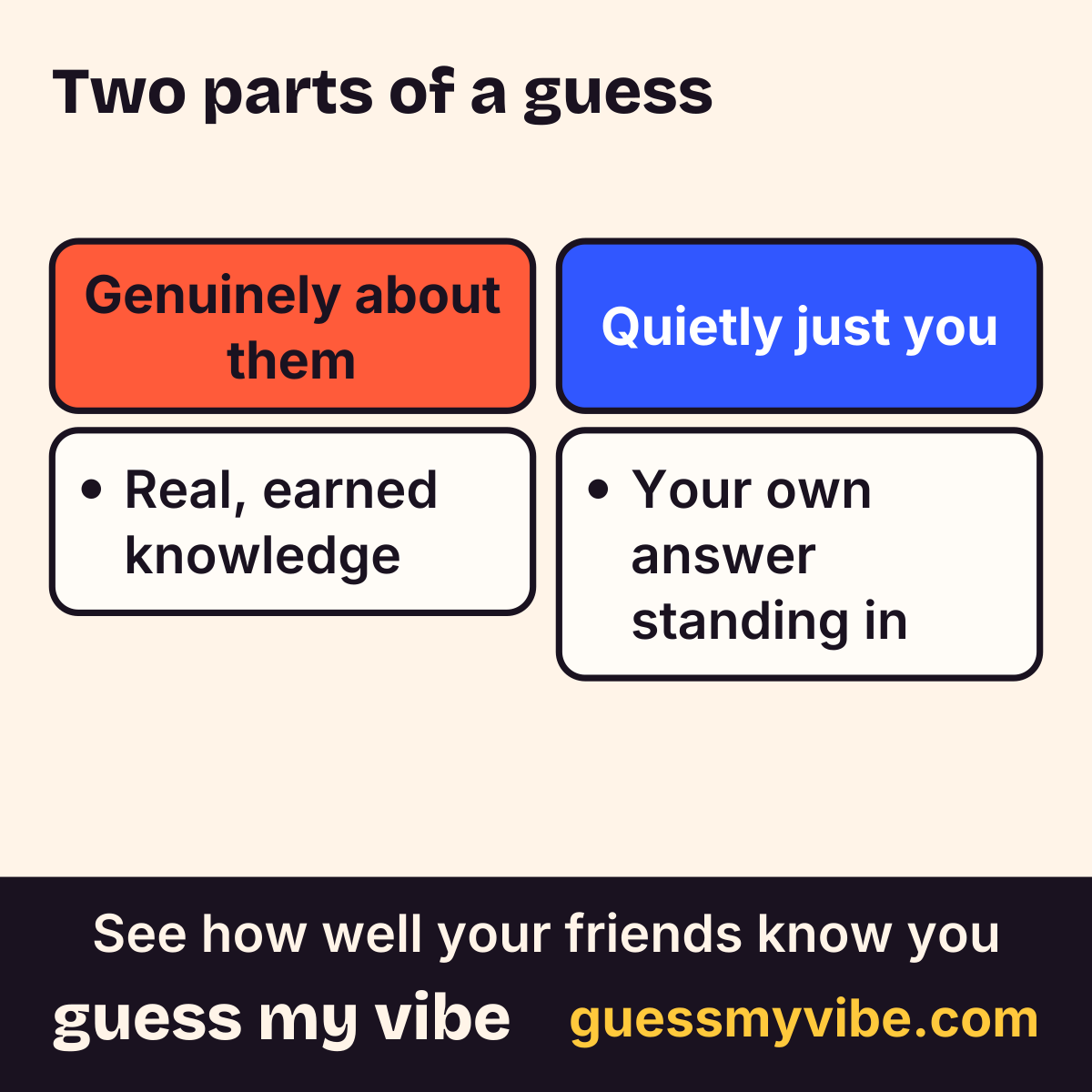
Assuming someone is like you isn't the same as being right about them
This is the part that's easy to miss: assumed similarity and accuracy are two completely different questions. You can assume a friend shares your taste in music and happen to be right. You can also assume it and be completely wrong, because you're not actually drawing on anything you know about them, you're borrowing from yourself. Research on "meta-insight," the question of whether people can genuinely tell how they see themselves apart from how others see them, found that people can make valid distinctions here, across social contexts that included first impressions and friends [2]. That's the reassuring half of the finding: people don't just assume everyone sees them as they see themselves. The gap between "how I see it" and "how you see it" is a real, nameable difference. The less reassuring half is that being capable of telling the difference and actually doing it in the moment, instead of defaulting to the easy, self-shaped guess, are not the same thing either.
Where the bias comes from: anchoring on your own experience
Assumed similarity fits into a broader, well-documented pattern in how people judge others: starting from your own experience and failing to adjust enough for the fact that someone else's experience is different. A set of studies on the "spotlight effect" demonstrated a close cousin of this same bias: people consistently overestimated how much others noticed and remembered their own actions and appearance, like wearing an embarrassing T-shirt into a room of strangers, because they were anchored on how vivid and obvious the moment felt to themselves, and under-adjusted for the fact that nobody else was experiencing it with the same intensity [3]. Assumed similarity may run on similar machinery pointed in a different direction: instead of overestimating how much others notice you, you overestimate how much others are, underneath it all, like you. Your own answer to a question is the loudest, easiest piece of information sitting right in front of you when someone asks what your friend would say, so it gets used as the starting point even when it shouldn't be.
Curious how your friends would answer?
Free. Answer 10 quick questions about you, then send your link. Friends play in their browser, no app needed.
Start freeWhat assumed similarity looks like in an actual friendship
It shows up in small, specific moments more than big dramatic ones. You text a friend "obviously we're both dreading this family thing," and it turns out she doesn't mind it at all, she was just being agreeable when you first complained about yours months ago. You assume a close friend shares your exact take on a messy situation at work, because you've never actually asked and your own opinion feels obvious enough to stand in for hers. You pick the restaurant you'd want, confident she'll love it too, because liking the same things has felt true of the two of you for years. None of these are dramatic failures of friendship. They're just the quiet, constant cost of a shortcut: using yourself as a stand-in for someone else because it's faster than actually checking, and usually close enough that nobody notices when it's wrong.
The feeling of similarity matters, even when it's partly assumed
Here's the twist that makes assumed similarity worth taking seriously instead of just correcting for: the feeling itself does real work in a friendship, whether or not it's fully earned. A study following brand-new college friendships for a year measured actual personality similarity, perceived similarity, and how close the friendships became over time [4]. Actual similarity in personality had little real connection to closeness. Perceived similarity, believing you were alike, did go with it. That's not an argument for staying comfortably wrong about a friend. It's a reminder that the belief "we're similar" is doing something relationally real even when part of where it comes from is you, not them, which is exactly why it's worth being able to tell the two apart.
Can you actually correct for it?
The meta-insight research above has a practical implication worth drawing out: since people can make valid distinctions between how they see themselves and how others see them, assuming everyone sees things your way isn't some permanent fog you're stuck inside [2]. It's closer to a default setting that kicks in specifically when you're going fast, guessing under uncertainty, or simply haven't asked. The same research looked at both first impressions and friends. A twenty-year friendship doesn't stop you from occasionally defaulting to your own answer; it just gives you more real data to draw on instead, if you actually use it rather than reaching for the fast guess out of habit.
Where assumed similarity shows up when you're guessing for a friend
Assumed similarity shows up most clearly in exactly the situation where you have to produce an answer for someone else on the spot: guessing what a friend would say to a question you haven't actually discussed with them. The fast, available answer sitting right there is your own. Given the research above, some of what feels like "I just know her" in that moment is real, earned knowledge, and some of it is your own answer quietly standing in for hers. The only way to find out how much of each is to actually check: ask the question, compare the two answers, and see where they land. Guess My Vibe turns exactly that moment into the game itself, a friend guesses your real answer to a personality question instead of describing you in the abstract, which is the cleanest test there is for how much of "knowing you" was really about you, and how much was them.
Key takeaways
- Assumed similarity, projecting your own traits and views onto someone else, is a real, measurable pattern that researchers study alongside assimilation, the parallel tendency to see two other people as similar to each other [1].
- Assuming someone is like you is not the same as accurately knowing them. Research on "meta-insight" shows people can tell how they see themselves apart from how others see them, so the gap between assuming everyone sees things your way and actually knowing is a real, nameable thing, not just noise [2].
- One likely source of assumed similarity is a broader habit of anchoring judgments on your own experience and not adjusting enough for someone else's different point of view [3].
- Feeling similar to a new friend goes with closeness even better than actually being similar does, which means the feeling itself, assumed similarity included, is doing real relational work, right or wrong [4].
- This isn't therapy, a diagnosis, or a substitute for professional care; it's a plain-English summary of what personality research says about assumed similarity.
Questions people ask
What is assumed similarity in psychology?
Assumed similarity is the tendency to see another person as more like yourself than they actually are, measured as a real pattern in studies of person perception [1].
Is assumed similarity the same as being wrong about someone?
Not automatically. Assumed similarity can happen to land on an accurate guess or a wrong one. Research on meta-insight found people can make valid distinctions between how they see themselves and how others see them, which is part of why assuming sameness isn't the whole story about what others actually think [2].
Why do people assume their friends are more like them than they are?
One likely reason is a broader habit of anchoring on your own point of view and under-adjusting for someone else's different one, the same mechanism behind biases like the spotlight effect, where people overestimate how much others notice their own actions [3].
Does feeling similar to a friend matter even if it's not accurate?
Yes. A study following new college friendships over a year found that actually being similar in personality had little link to how close the friendship became, while simply feeling similar did go with closeness, meaning the feeling itself carries real weight in a friendship [4].
How is assumed similarity different from actual similarity?
Actual similarity is how alike two people's real traits or views are. Assumed similarity is how alike one person guesses the other is, based partly on projecting themselves. A meta-analysis of 24 studies measured assumed similarity directly and compared it with assimilation (seeing two other people as similar), rather than treating it as the same thing as real similarity [1].
See how well your friends know you.
Free. Answer 10 quick questions about you, then send your link. Friends play in their browser, no app needed.
Start freeReferences
- [1] Kenny, D. A., & West, T. V. (2010). Similarity and agreement in self- and other perception: A meta-analysis. Personality and Social Psychology Review, 14(2), 196-213. PubMed: 20142435 (opens in a new tab)
- [2] Carlson, E. N., Vazire, S., & Furr, R. M. (2011). Meta-insight: Do people really know how others see them?. Journal of Personality and Social Psychology, 101(4), 831-846. PubMed: 21688920 (opens in a new tab)
- [3] Gilovich, T., Medvec, V. H., & Savitsky, K. (2000). The spotlight effect in social judgment: An egocentric bias in estimates of the salience of one's own actions and appearance. Journal of Personality and Social Psychology, 78(2), 211-222. PubMed: 10707330 (opens in a new tab)
- [4] Selfhout, M., Denissen, J., Branje, S., & Meeus, W. (2009). In the eye of the beholder: Perceived, actual, and peer-rated similarity in personality, communication, and friendship intensity during the acquaintanceship process. Journal of Personality and Social Psychology, 96(6), 1152–1165. PubMed: 19469593 (opens in a new tab)
How we find and check these sources: how we write. Spotted an error? Report a correction.
Related
Cite this article
- Title
- Assumed Similarity: Why You Think Friends Are More Like You
- Publisher
- Guess My Vibe
- Updated
- URL
- https://guessmyvibe.com/
learn/ assumed-similarity
Copy this citation
Guess My Vibe. (2026, October 3). Assumed Similarity: Why You Think Friends Are More Like You. Guess My Vibe. https://guessmyvibe.com/
To point at one section, add that section's anchor (the # link on its heading) to the URL.