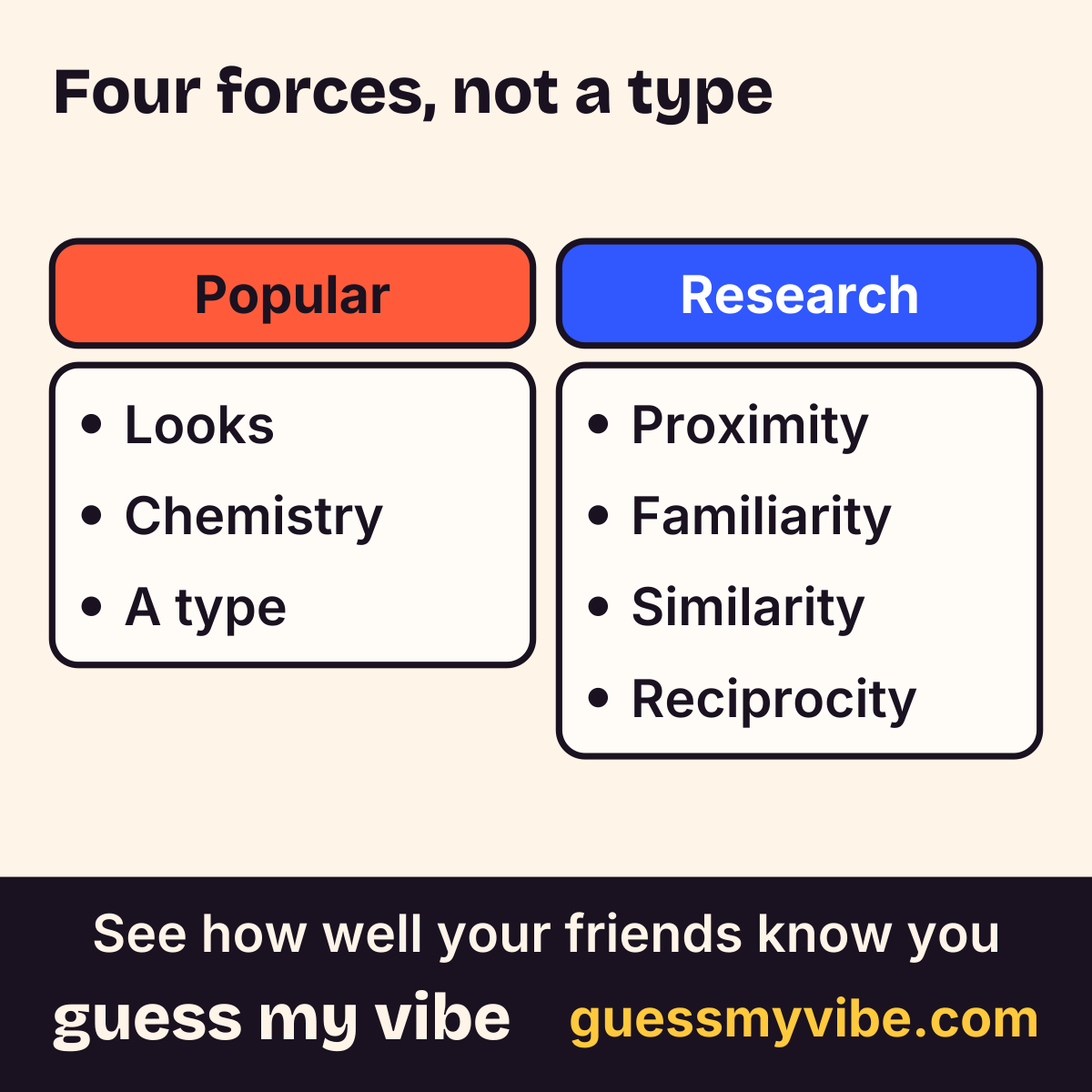
Attraction psychology keeps finding the same short list of forces behind who we like, whether it's a new friend or a new crush: proximity (you keep running into them), familiarity (you've gotten used to them), similarity (you're actually alike, or just feel like you are), and reciprocity (they seem to like you back). None of the four is "chemistry" or a fixed type, and the research on them has been building for decades [1] [2] [3] [4].
Attraction psychology: four forces, not a type
Attraction psychology is the decades-old research field asking a simple question: out of everyone you could have liked, why these specific people? The popular answer is some mix of looks, chemistry, and a personal "type." The research answer is less romantic and more useful: a short, repeatable list of forces, proximity, familiarity, similarity, and reciprocity, shows up again and again, across strangers, new friends, and new couples alike. None of the four is about who someone is on paper. All four are about the situation two people are actually in together.
Cite this figure
Figure: "Four forces, not a type." Guess My Vibe (guessmyvibe.com). https://guessmyvibe.com/learn/attraction-psychology#figure-popular-vs-research
Proximity: just being around someone, repeatedly
The plainest force is also the easiest to miss, because it has nothing to do with the other person's personality at all: you like things, and people, more just by being exposed to them more. A meta-analysis pulling together 20 years of research on this "mere exposure effect" found it holds up consistently: repeated exposure to a stimulus reliably increases how much people like it, with the exact size of the effect shifting depending on how complex the stimulus is, how long each exposure lasts, and how much time passes before someone rates it [1]. Applied to people, that's plausibly part of why the person who sits near you in class, shows up at the same gym time, or works the same shifts starts to feel likable before you've had a real conversation. Proximity doesn't need a personality match to work. It just needs repetition.
Familiarity: usually a boost, but not always
Proximity gets you repeated exposure; familiarity is what builds on top of it as you actually get to know someone. For a long time, researchers who studied familiarity and attraction disagreed about something basic: does getting more familiar with someone make you like them more, or does it wear the shine off? A later review, written by researchers from both sides of that disagreement as a deliberate attempt to resolve it, proposed that the real answer depends on which stage a relationship is in. Early on (awareness, then surface-level contact), more familiarity tends to help. Later, once two people have had enough real contact to see each other's actual flaws and habits (what the review calls the "mutuality" stage), familiarity's effect gets more mixed, and can undermine attraction instead of building it [2]. That lines up with ordinary experience: an easy early connection doesn't guarantee it survives getting to know someone for real, and that's not a flaw in either person, it's just what the research on familiarity actually finds.
Curious how your friends would answer?
Free. Answer 10 quick questions about you, then send your link. Friends play in their browser, no app needed.
Start freeSimilarity: feeling alike matters more than actually being alike
"Birds of a feather flock together" has a lot of research behind it, and the twist is which kind of similarity is doing the work. A large meta-analysis of 460 effect sizes across 313 studies found both actual similarity (real overlap in traits, attitudes, background) and perceived similarity (just feeling alike) go with more attraction. The interesting part is what happens once people actually interact: actual similarity's effect shrinks, and in existing relationships it stops mattering in any statistically meaningful way, while perceived similarity stays a reliable predictor of attraction regardless [3]. Once you actually know someone, in other words, it's not how alike you really are that keeps the attraction going. It's how alike you feel.
One reason perceived similarity can run ahead of the real thing may be a specific, well-documented bias: people have a built-in habit of seeing others as more like themselves than they actually are. A meta-analysis of 24 studies on person perception examined this "assumed similarity" as a measurable pattern in its own right [5]. Some of what feels like "we just click because we're so alike" is a real match. Some of it is your own mind quietly filling in the rest.
Reciprocity: liking someone back isn't automatic
There's a reason "they like you back" feels like such a relief: it isn't guaranteed. Two studies looked specifically at what makes people reciprocate attraction once they learn someone likes them. The finding was that an admirer's expressed interest works mainly by implying something about their intentions: when someone's interest reads as coming from a genuinely well-meaning place, people reciprocate liking them back, both in how they feel and in how they act. But reciprocated behavioral interest (actually wanting to spend time together, not just feeling warmly toward someone) broke down when the admirer's stated plans didn't match what their expressed interest seemed to promise [4]. Reciprocity, in other words, isn't a simple mirror ("they like me, so I like them"). It's a judgment about why someone likes you, and whether that reason holds up.
Why this is a friendship story too, not only a romance one
A lot of attraction research was originally designed around strangers, dating, or new couples, but all four forces above show up just as reliably in how friendships start. The friend you ran into constantly before you ever talked (proximity), the one who felt easy to be around from the start and stayed that way as you got closer (familiarity, holding up past the early stage), the one who felt like "finally, someone who gets it" (perceived similarity, doing real work whether or not you're actually alike), and the one who liked you back in a way that felt genuine rather than performed (reciprocity): that's the same short list, just applied to a friendship instead of a date. None of it is really about a type. It's about whether these specific, well-studied conditions happen to line up between two particular people.
That's also exactly where a friend's honest guesses are worth more than a vibe check. If perceived similarity carries more weight than the real thing once you actually know someone, the honest version of "we're so alike" is partly a fact and partly a story you're both telling yourselves. Guess My Vibe is built around checking that gap directly: you and a friend each answer the same personality questions for yourselves, then guess each other's answers, and see where your sense of being alike actually holds up against real answers instead of assumption.
Key takeaways
- Repeated exposure to something, on its own, makes people like it more, and people are no exception to the logic. A meta-analysis of 20 years of exposure research confirmed this 'mere exposure effect' is real and reliable [1].
- Familiarity can also backfire. A later review from researchers on both sides proposed that whether familiarity helps or hurts attraction depends on the relationship's stage: it mostly helps early on but can undermine attraction once two people know each other well enough to see real flaws [2].
- Feeling similar to someone keeps going with attraction once people have really interacted, while actual similarity's link fades [3]. A related habit is that people tend to assume others are more like them than they really are [5].
- Liking someone back isn't automatic. Reciprocated attraction depends on believing the other person's interest comes from real, well-meaning intentions, not just on hearing they're interested [4].
- This isn't therapy, a diagnosis, or a substitute for professional care.
Questions people ask
What are the main factors in attraction psychology?
Research keeps finding the same four: proximity (repeated contact), familiarity (how well you've come to know someone, which helps early on but can get more mixed later), similarity (actual and felt, with felt similarity mattering more once you know each other), and reciprocity (believing someone's interest in you is genuine) [1] [2] [3] [4].
Does being around someone more really make you like them more?
Yes, on average. A meta-analysis of two decades of exposure research found repeated exposure to something, reliably increases liking, though the size of the effect depends on factors like how complex the exposure is and how long it lasts [1].
Is actual similarity or perceived similarity more important for attraction?
Perceived similarity, once people have actually interacted. A large meta-analysis found actual similarity's link to attraction shrinks with real interaction and isn't significant in existing relationships, while perceived similarity, feeling alike, stays a reliable predictor of attraction regardless [3].
Why do I sometimes feel like I just click with someone who's nothing like me?
Partly because perceived similarity, not actual similarity, is what goes with attraction once you know someone [3], and partly because people have a documented tendency to project some of their own traits onto others, called assumed similarity, regardless of how alike the two of you really are [5].
Does familiarity always make attraction stronger?
No. A review built specifically to settle this disagreement proposed that familiarity's effect on attraction depends on the relationship's stage: it tends to help early on, but can undermine attraction once two people know each other well enough to see real flaws, not just a polished first impression [2].
See how well your friends know you.
Free. Answer 10 quick questions about you, then send your link. Friends play in their browser, no app needed.
Start freeReferences
- [1] Bornstein, R. F. (1989). Exposure and affect: Overview and meta-analysis of research, 1968–1987. Psychological Bulletin, 106(2), 265–289. doi.org/10.1037/0033-2909.106.2.265 (opens in a new tab)
- [2] Finkel, E. J., Norton, M. I., Reis, H. T., Ariely, D., Caprariello, P. A., Eastwick, P. W., Frost, J. H., & Maniaci, M. R. (2015). When does familiarity promote versus undermine interpersonal attraction? A proposed integrative model from erstwhile adversaries. Perspectives on Psychological Science, 10(1), 3-19. PubMed: 25910379 (opens in a new tab)
- [3] Montoya, R. M., Horton, R. S., & Kirchner, J. (2008). Is actual similarity necessary for attraction? A meta-analysis of actual and perceived similarity on attraction. Journal of Social and Personal Relationships, 25(6), 889-922. doi.org/10.1177/0265407508096700 (opens in a new tab)
- [4] Montoya, R. M., & Insko, C. A. (2008). Toward a more complete understanding of the reciprocity of liking effect. European Journal of Social Psychology, 38(3), 477-498. doi.org/10.1002/ejsp.431 (opens in a new tab)
- [5] Kenny, D. A., & West, T. V. (2010). Similarity and agreement in self- and other perception: A meta-analysis. Personality and Social Psychology Review, 14(2), 196-213. PubMed: 20142435 (opens in a new tab)
How we find and check these sources: how we write. Spotted an error? Report a correction.
Related
- Do Opposites Attract? What the Research Actually Says
- Friendship Compatibility: What Actually Makes It Work
- BFF Test: A Real One to Take With Your Best Friend
- Instant Connection: Why You Click With Some People Fast
- Ideal Partner: Why Your List Doesn't Match Who You Like
- Can Men and Women Be Friends? What the Research Says
- Attractive Personality Traits: What Research Says Matters
- Do Couples Look Alike? A Classic Finding Didn't Replicate
Cite this article
- Title
- Attraction Psychology: 4 Forces That Draw People Together
- Publisher
- Guess My Vibe
- Updated
- URL
- https://guessmyvibe.com/
learn/ attraction-psychology
Copy this citation
Guess My Vibe. (2026, October 3). Attraction Psychology: 4 Forces That Draw People Together. Guess My Vibe. https://guessmyvibe.com/
To point at one section, add that section's anchor (the # link on its heading) to the URL.