Your ideal partner list is a weaker guide to who you'll actually like than most people assume. In a speed-dating study, preferences people stated beforehand failed to forecast who they were drawn to at the event [1], and a later meta-analysis found that attractiveness and earning prospects tracked romantic evaluations to a similar degree for men and for women, even though the sexes state different ideals [2].
Most people can describe an ideal partner without much effort: funny, ambitious, kind, good-looking, into the same things. The interesting scientific question is whether that description tells you anything about who you'll actually be drawn to once you meet people. The research suggests it tells you less than you'd expect. The ideal partner you describe in the abstract and the person you feel attracted to in real life overlap, but not as neatly as the list implies.
This article is about the science of stated preferences, not about dating. It doesn't tell you what to look for or how to find anyone, and nothing here is relationship advice. It covers what researchers have measured, where the findings are strong, and where they're limited. For what goes with how well an existing relationship goes, see our guides on relationship compatibility and personality and relationships, and for the friendship version of attraction, see attraction psychology.
What people say they want in an ideal partner
The most studied differences in stated ideals involve two qualities: physical attractiveness and earning prospects. In studies where people state their ideal partner preferences, or react to made-up profiles and photographs, men tend to value physical attractiveness more than women do, and women tend to value earning prospects more than men do [1]. A large review confirms the pattern for hypothetical targets: men and women reliably differ in how much these qualities affect their romantic evaluations of imagined people [2].
That is the part of the story most people have heard. It's well replicated for what people say and for how they react to profiles on a screen. The next question is the one that matters for real life: do these stated preferences actually steer who someone becomes interested in?
The speed-dating test: do ideals forecast real attraction?
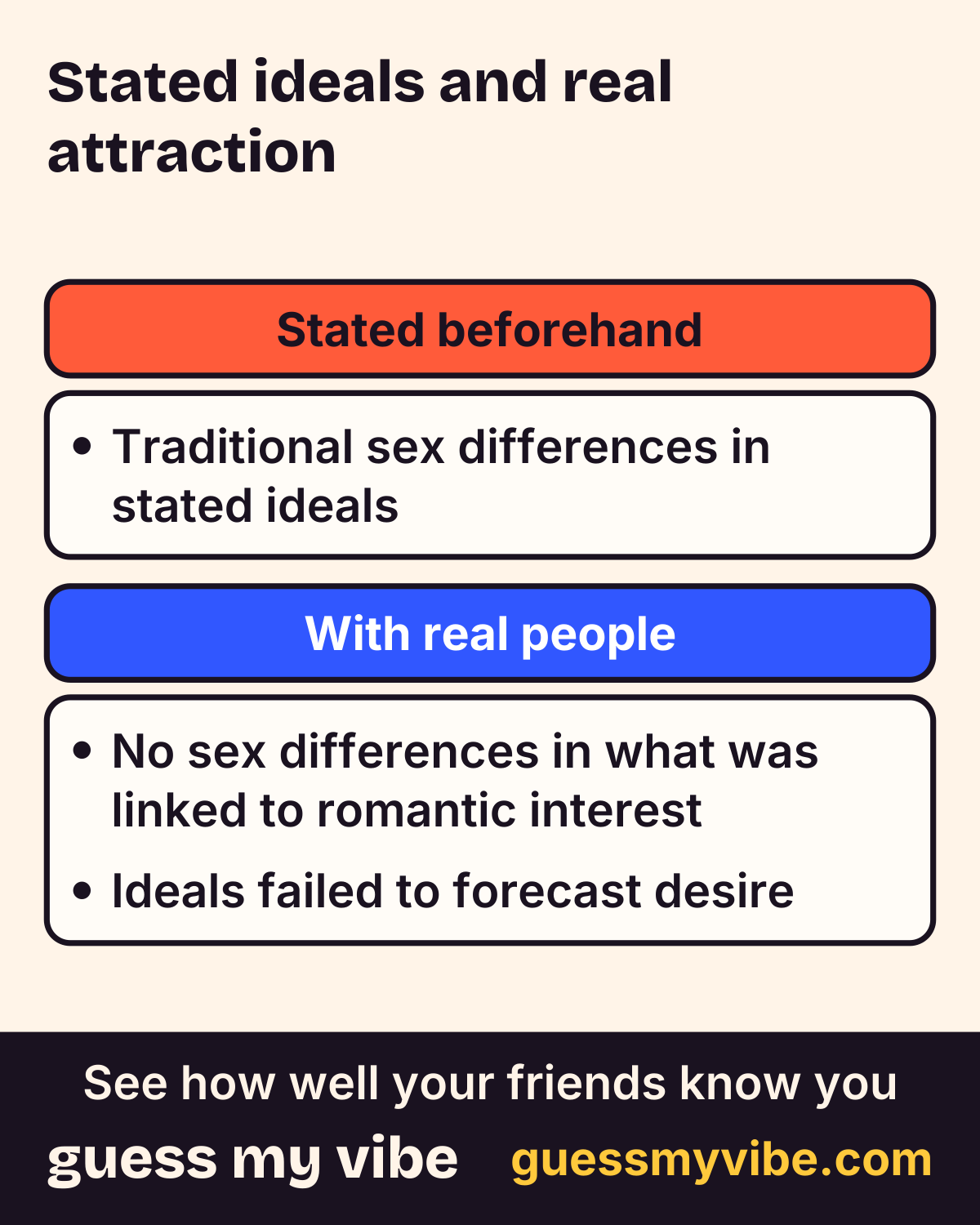
Eastwick and Finkel tested exactly this in a speed-dating study with longitudinal follow-up. Participants first stated how much attractiveness and earning prospects mattered in an ideal partner, and as in earlier research, they showed the traditional sex differences. Then they met real potential partners, both at the event and outside it. The researchers measured how romantic interest in those actual people related to the attractiveness and earning prospects of those people [1].
The result was different from the stated ideals. There were no sex differences in how attractiveness and earning prospects were linked to romantic interest in real-life potential partners. And the preferences people reported before the event failed to forecast what actually inspired their desire there [1]. The authors connect this to a classic idea in psychology: people may lack introspective awareness of what influences their judgments and behavior, even about something as consequential as romantic-partner preferences. In plain words, people are not always good at forecasting what will attract them.
A single speed-dating study is a limited setting, and the abstract gives no numbers, so it's best read as a warning sign, not a final answer. That's why the next piece of evidence matters.
Cite this figure
Figure: "Stated ideals and real attraction." Guess My Vibe (guessmyvibe.com). https://guessmyvibe.com/learn/ideal-partner#figure-stated-vs-real
What the large meta-analysis found
Eastwick, Luchies, Finkel and Hunt reviewed the research on how well ideal partner preferences forecast relationship outcomes, and ran a new meta-analysis across the attraction and relationships literatures (k = 97). Physical attractiveness tracked romantic evaluations with a moderate-to-strong effect (r about .40) for both sexes. Earning prospects tracked them with a small effect (r about .10), also for both sexes. The sex differences in those correlations were small (a difference of .03) and nonsignificant [2].
In plain terms, how attractive someone is rated to be has a real relationship with how romantically positive people feel about them, while earning prospects have a much weaker one, and in both cases men and women look alike. That runs against the popular story that the sexes differ sharply in what actually moves them. The sexes do differ in what they say and in how they react to hypothetical profiles. In the meta-analysis, which spanned the attraction and relationships literatures, they differ little in how those qualities relate to romantic evaluations. This doesn't mean preferences are meaningless: the review also identifies alternative ways of measuring ideals that forecast better in certain situations, and discusses how live interactions differ from hypothetical ones [2].
Curious how your friends would answer?
Free. Answer 10 quick questions about you, then send your link. Friends play in their browser, no app needed.
Start freeCan traits and preferences forecast who you'll click with?
Two later speed-dating studies pushed the question further with machine learning. Joel, Eastwick and Finkel had unattached participants complete more than 100 self-report measures of traits and preferences that earlier research linked to choosing a partner, and each participant then went on 4-minute dates with every opposite-sex participant at the event. The models accounted for 4% to 18% of the differences in how much people tend to desire others in general, and 7% to 27% of the differences in how much they tend to be desired. But they were unable to forecast desire for specific partners, above those general tendencies, from any combination of the traits and preferences reported beforehand [3].
That is a useful way to see the limit. Some people tend to be desired more by others, and some tend to desire others more, and those general tendencies are partly predictable. What isn't predictable from a questionnaire is the chemistry between two particular people: whether this person will like that person more than they like others. The authors conclude that the compatibility elements of human mating are hard to forecast before two people meet [3]. These were speed dates among romantically unattached people, so the findings describe initial attraction, not how long relationships last.
What changes once people are in a relationship
Once a couple exists, the research looks different again. A project that combined 43 longitudinal datasets from 29 laboratories used machine learning to find the strongest predictors of relationship quality. The top relationship-specific predictors were perceived-partner commitment, appreciation, sexual satisfaction, perceived-partner satisfaction and conflict, while the top individual-difference predictors included life satisfaction, negative affect, depression and attachment avoidance and anxiety [4]. This study measured relationship quality in existing couples, not first attraction, and it didn't test ideal-partner checklists, so it can't speak to them directly. It does show that what forecasts a relationship's quality is largely about how the people experience the relationship itself.
Why would a list and real attraction come apart?
The research above documents the gap but doesn't prove why it exists, so these are possible explanations, not findings. One is introspection: the 2008 authors point to evidence that people often can't report accurately on what influences their judgments [1]. A second is that a list describes traits in the abstract, while attraction to a real person responds to the whole person in context: how they talk, how they treat you, how the conversation feels. A third is that hypothetical judgments and live interactions differ, which the 2014 review discusses directly [2].
There's also a personality angle on the introspection point. Self-knowledge has limits in general: our piece on how others see you explains why your view of yourself and other people's view of you don't always match, which is one reason a friend's read on your reactions can add something a list can't.
What this does and doesn't mean
- It doesn't mean preferences are fake. People really do state different ideals, and the meta-analysis found attractiveness tracks evaluations moderately well [2].
- It doesn't mean anyone should ignore their values. The studies measured initial romantic interest and short-term evaluations. They say nothing about whether a person's deeper priorities matter over a lifetime.
- It doesn't mean attraction is random. Some of it is predictable: people differ in how much they like others and are liked by others [3].
- It does suggest holding a list lightly. If a questionnaire completed before meeting anyone can't forecast your reaction to a specific person [1], your reaction to the real person may be better information than the list.
These are group-level findings, many of them from speed-dating settings, so no study can tell you what will work for you. They describe tendencies across many people and leave plenty of room for individuals who know themselves well.
Do your friends know what you're really like?
If your own list is an imperfect map of your tastes, friends can be a useful second opinion, because they watch how you actually react to people. Guess My Vibe is a free game where a friend guesses how you'd answer questions about yourself, and you can see where their guesses and your own self-image line up or don't. It's a light way to notice the gap between what you say about yourself and what the people around you see.
Key takeaways
- People do state different ideals: men and women reliably differ in how much physical attractiveness and earning prospects affect their evaluations of hypothetical partners [2].
- For real people they met, no sex differences showed up in how attractiveness and earning prospects related to romantic interest, and ideals reported before a speed-dating event failed to forecast who inspired desire there [1].
- In a meta-analysis (k = 97), physical attractiveness tracked romantic evaluations at about r = .40 and earning prospects at about r = .10, for both sexes, with sex differences of .03 [2].
- Across two speed-dating studies, more than 100 traits and preferences accounted for some of how much people desired others in general, but none accounted for desire for a specific person beyond that [3].
- This isn't therapy, a diagnosis, or a substitute for professional care.
Questions people ask
Do ideal partner preferences forecast who you'll actually like?
Not well, in the speed-dating research. Preferences reported before a speed-dating event failed to forecast what inspired romantic desire at the event [1], and a later study found that no combination of more than 100 traits and preferences reported beforehand forecast desire for specific partners beyond people's general tendencies to desire and be desired [3].
Do men and women really want different things in a partner?
They state different ideals and react differently to hypothetical profiles, but a meta-analysis found physical attractiveness and earning prospects tracked romantic evaluations about equally for both sexes (a difference of .03) [2].
How much does physical attractiveness matter for attraction?
In a meta-analysis (k = 97), physical attractiveness tracked romantic evaluations at about r = .40, a moderate-to-strong link, and earning prospects at about r = .10, a small one [2].
Can a personality quiz tell me who I'll click with?
Not very well, according to the speed-dating research. Self-reported traits and preferences accounted for some of people's general tendencies to like and be liked, but not who they would like in particular [3].
Does this mean my standards don't matter?
No. The studies looked at initial attraction and short-term evaluations, and the research doesn't say your values are irrelevant. It suggests a list written in advance is an imperfect guide to your reactions to real people [1].
See how well your friends know you.
Free. Answer 10 quick questions about you, then send your link. Friends play in their browser, no app needed.
Start freeReferences
- [1] Eastwick, P. W., & Finkel, E. J. (2008). Sex differences in mate preferences revisited: Do people know what they initially desire in a romantic partner?. Journal of Personality and Social Psychology, 94(2), 245-264. PubMed: 18211175 (opens in a new tab)
- [2] Eastwick, P. W., Luchies, L. B., Finkel, E. J., & Hunt, L. L. (2014). The predictive validity of ideal partner preferences: A review and meta-analysis. Psychological Bulletin, 140(3), 623-665. PubMed: 23586697 (opens in a new tab)
- [3] Joel, S., Eastwick, P. W., & Finkel, E. J. (2017). Is romantic desire predictable? Machine learning applied to initial romantic attraction. Psychological Science, 28(10), 1478-1489. PubMed: 28853645 (opens in a new tab)
- [4] Joel, S., Eastwick, P. W., Allison, C. J., Arriaga, X. B., Baker, Z. G., et al. (2020). Machine learning uncovers the most robust self-report predictors of relationship quality across 43 longitudinal couples studies. Proceedings of the National Academy of Sciences, 117(32), 19061-19071. PubMed: 32719123 (opens in a new tab)
How we find and check these sources: how we write. Spotted an error? Report a correction.
Related
- Attraction Psychology: 4 Forces That Draw People Together
- Do Opposites Attract? What the Research Actually Says
- Relationship Compatibility: What Research Can Tell You
- Personality and Relationships: What the Research Shows
- Self-Perception vs. How Others See You
- Attractive Personality Traits: What Research Says Matters
Cite this article
- Title
- Ideal Partner: Why Your List Doesn't Match Who You Like
- Publisher
- Guess My Vibe
- Updated
- URL
- https://guessmyvibe.com/
learn/ ideal-partner
Copy this citation
Guess My Vibe. (2026, October 4). Ideal Partner: Why Your List Doesn't Match Who You Like. Guess My Vibe. https://guessmyvibe.com/
To point at one section, add that section's anchor (the # link on its heading) to the URL.