Kindness and intelligence are two traits people treat as must-haves in a partner. In studies where people built an ideal long-term partner on a budget, kindness and intelligence were treated as necessities by both men and women, before other qualities were considered [1]. Warmth and trustworthiness also show up as one of the main groups of qualities people want in a partner [2].
The most attractive personality traits, according to research
If you want a one-line answer to "which personality traits are attractive," one set of studies points to kindness and intelligence. In three studies of what people look for in a long-term partner, kindness and intelligence were treated as necessities by both men and women [1]. Warmth and trustworthiness also form one of the main clusters of qualities people say they want [2]. That gives a first answer to the question "is kindness attractive?", at least for stated preferences. The studies are about stated preferences and long-term partners, though, so this article also covers what they can and can't tell you.
Kindness and intelligence as necessities
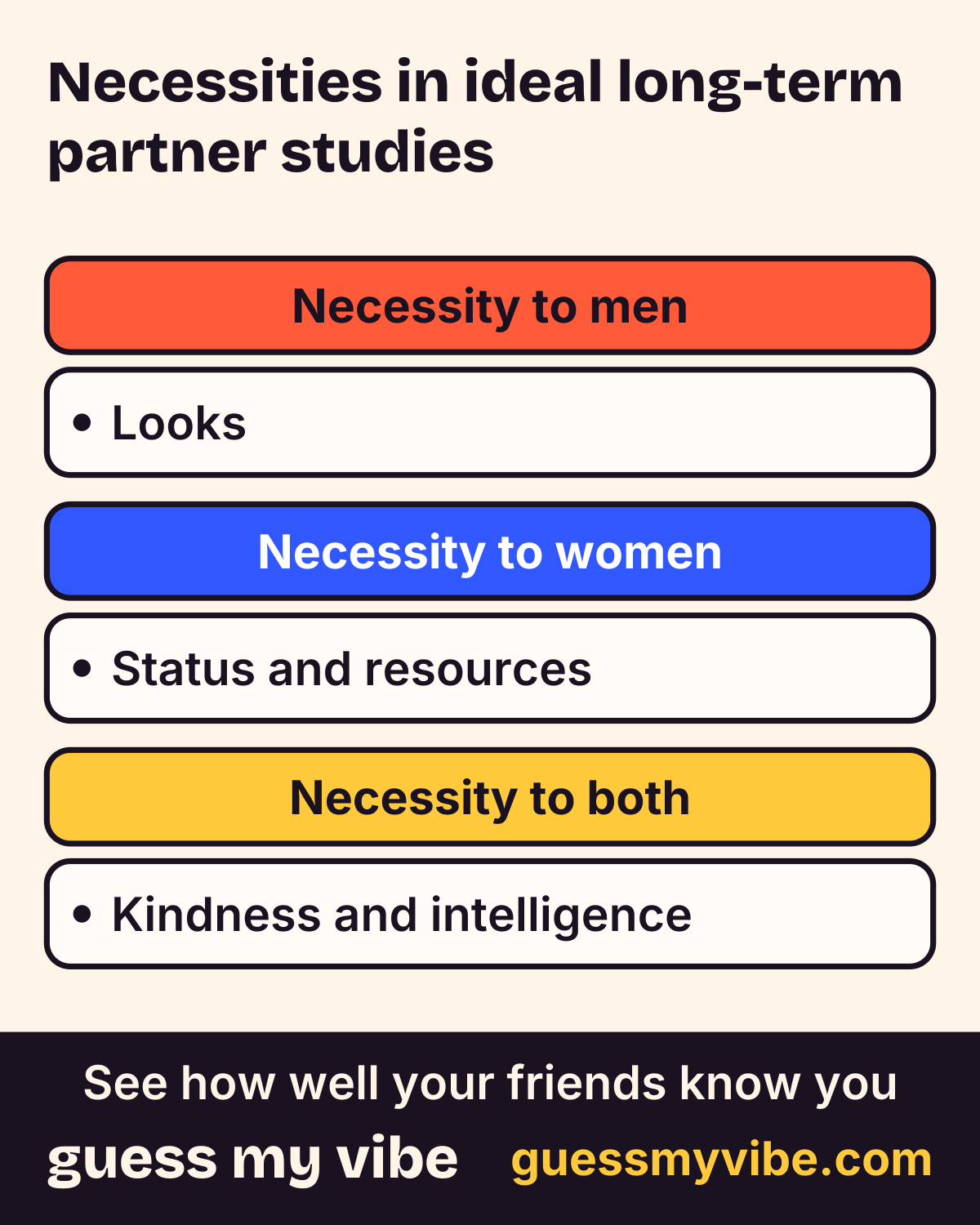
The researchers behind the first study noticed a puzzle. Qualities like status and looks are emphasized a lot in the research, yet they are not typically rated highly when people are simply asked what matters. They suggested the answer is a difference between necessities and luxuries. In two studies, participants designed an ideal long-term mate by "buying" characteristics under three different budgets. In a third study, people screened potential partners, and the researchers recorded what they asked about first. The findings supported the idea that people first ensure sufficient levels of necessities before considering other characteristics. Looks were a necessity to men, status and resources were necessities to women, and kindness and intelligence were necessities to both [1].
Notice what "necessity" means here. It does not mean kindness is the most exciting trait. It means that when budgets are tight, people don't skimp on it. In plain terms, our reading is that kindness works more like a must-have than a bonus. These were research tasks about long-term partners, so the findings don't automatically describe friendships or first meetings.
Cite this figure
Figure: "Necessities in ideal long-term partner studies." Guess My Vibe (guessmyvibe.com). https://guessmyvibe.com/learn/attractive-personality-traits#figure-necessities
Is kindness attractive? How the qualities group together
Another line of work asked what the ideal partner looks like to ordinary people. Across several studies, the qualities of an ideal partner fell into three groups: warmth-trustworthiness, vitality-attractiveness, and status-resources. A separate set of two groups described the ideal relationship: intimacy-loyalty and passion [2]. Warmth and trustworthiness is the group closest to what most people mean by kindness.
The same paper adds a point about happiness. The more consistent a person's ideals were with their assessments of their current partner and relationship, the more positively they evaluated the relationship [2]. A pattern like that can't show that matching ideals causes happier relationships. But it is a reason to take stated ideals seriously as a reading of what people hope for.
What the Big Five say about preferred traits
A third paper, with two parallel studies, used the Big Five, the same model Guess My Vibe is built on, to look at personality preferences. It tested a sample of dating couples (118 people) and a sample of married couples (216 people), using self-reports, partner reports and independent interviewer reports. Women expressed a greater preference than men for a wide array of socially desirable personality traits. People differed from each other in which traits they wanted. They tended to prefer partners similar to themselves, and they actually obtained partners who embodied what they desired [3].
The study also looked at what happened afterward. A partner's personality was linked to marital dissatisfaction, most notably when the partner was lower than desired on agreeableness, emotional stability, and intellect-openness [3]. Agreeableness is the Big Five trait closest to kindness, so this lines up with the other findings. Again, it is a pattern in couples, not a guarantee about any one relationship, and it is not a cause-and-effect result.
One more nuance from this study is worth keeping. "What people want" is not one list. Individuals differed in which traits they wanted, and people leaned toward partners who were similar to themselves [3]. So the most attractive personality trait is partly the one that fits you.
Curious how your friends would answer?
Free. Answer 10 quick questions about you, then send your link. Friends play in their browser, no app needed.
Start freeWhat counts as "kind" in everyday life
The studies above use the word kindness as a label, and the abstracts don't spell out what behaviors people had in mind. So here is our own working definition, offered as reasoning rather than a finding. Kindness shows up in small, repeated choices: remembering something someone said, offering help without being asked, being patient when someone is struggling, and being honest in a way that doesn't hurt more than it needs to. It is less about big gestures and more about consistency.
That matters because kindness is a trait other people judge by watching you over time. A single warm moment can be a good mood. A pattern is what people call a trait. It also means that people closest to you are usually in the best position to say whether you are kind, because they have seen the pattern and not just one scene.
The research also hints that the idea of an ideal partner is wider than any one trait. In the ideal-partner study, the structure of ideal qualities overlapped considerably with the structure of ideal relationship qualities, such as intimacy-loyalty and passion [2]. In other words, people don't only want a certain kind of person. They want a certain kind of relationship, and the traits they list are partly a shorthand for that.
What a list of attractive traits can't tell you
It is easy to turn all this into a checklist. Be kind, be smart, be trustworthy. But a checklist has limits. In two speed-dating studies, researchers collected more than 100 self-report measures of traits and preferences from romantically unattached people. Machine-learning models using those measures could account for 4% to 18% of how much people tend to desire others in general, and 7% to 27% of how much they tend to be desired by others. But the models could not account for desire for specific partners, beyond those general tendencies [4].
In plain words, who you click with is hard to figure out from traits and preferences alone, even with a huge set of measures. We think that is a fair warning for this article too. The traits people rank as must-haves matter, but they are not a formula. Our own reading is that kindness works more like an entry ticket than a magic ingredient: it makes it much more likely someone gets a closer look, and the rest happens in the specific conversation between two people. For more on how stated lists and real attraction diverge, see our article on the ideal partner.
Do other people actually see you as kind?
Here is the practical question the research raises. If kindness is a necessity, then it matters less whether you are kind in your own head and more whether the people around you can see it. Those can differ. You may feel generous and still come across as distracted, or you may be warm in ways you rarely notice. The studies above can't tell you which is true for you, because they measured preferences and traits in groups.
A friend can help here. Ask someone who knows you well for a specific example of a time you came across as kind, and a time you didn't. Guess My Vibe does a lighter version of this: friends guess your real answers to personality questions, including ones about agreeableness, and the gaps between their guesses and your answers show where your kindness is seen and where it is not.
Key takeaways
- In three studies of long-term partner choices, kindness and intelligence were necessities for both men and women, meaning people made sure they were present before weighing other things [1].
- People's ideal-partner qualities group into three clusters: warmth-trustworthiness, vitality-attractiveness and status-resources [2].
- In studies of dating and married couples, people differed in which personality traits they wanted, tended to prefer partners similar to themselves, and obtained partners who embodied what they desired [3].
- Knowing what people say they want only goes so far: traits and preferences reported before speed dates could not account for desire for specific partners [4].
- This isn't therapy, a diagnosis, or a substitute for professional care.
Questions people ask
What are the most attractive personality traits?
In research on long-term partner choices, kindness and intelligence were necessities for both men and women [1], and warmth-trustworthiness is one of the main groups of ideal-partner qualities [2].
Is kindness attractive?
Research suggests it is important. People in three studies made sure kindness was present before weighing other qualities [1]. These are stated preferences about long-term partners, though.
Do men and women want different personality traits?
One study of dating and married couples found women expressed a greater preference than men for a wide array of socially desirable traits [3], while kindness and intelligence were necessities to both in another [1].
Do people prefer partners with similar personalities?
In the couples study, people preferred partners similar to themselves and actually obtained partners who embodied what they desired [3].
Can a list of traits tell me who I'll click with?
Not very well. Traits and preferences reported before speed dates could not account for desire for specific partners [4].
See how well your friends know you.
Free. Answer 10 quick questions about you, then send your link. Friends play in their browser, no app needed.
Start freeReferences
- [1] Li, N. P., Bailey, J. M., Kenrick, D. T., & Linsenmeier, J. A. W. (2002). The necessities and luxuries of mate preferences: testing the tradeoffs. Journal of Personality and Social Psychology, 82(6), 947-955. PubMed: 12051582 (opens in a new tab)
- [2] Fletcher, G. J. O., Simpson, J. A., Thomas, G., & Giles, L. (1999). Ideals in intimate relationships. Journal of Personality and Social Psychology, 76(1), 72-89. PubMed: 9972554 (opens in a new tab)
- [3] Botwin, M. D., Buss, D. M., & Shackelford, T. K. (1997). Personality and mate preferences: five factors in mate selection and marital satisfaction. Journal of Personality, 65(1), 107-136. PubMed: 9143146 (opens in a new tab)
- [4] Joel, S., Eastwick, P. W., & Finkel, E. J. (2017). Is romantic desire predictable? Machine learning applied to initial romantic attraction. Psychological Science, 28(10), 1478-1489. PubMed: 28853645 (opens in a new tab)
How we find and check these sources: how we write. Spotted an error? Report a correction.
Related
- Ideal Partner: Why Your List Doesn't Match Who You Like
- Attraction Psychology: 4 Forces That Draw People Together
- Do Opposites Attract? What the Research Actually Says
- Agreeableness: The Trait Closeness Barely Helps Friends Read
- Relationship Compatibility: What Research Can Tell You
- Signs of a True Friend, According to Research
Cite this article
- Title
- Attractive Personality Traits: What Research Says Matters
- Publisher
- Guess My Vibe
- Updated
- URL
- https://guessmyvibe.com/
learn/ attractive-personality-traits
Copy this citation
Guess My Vibe. (2026, October 4). Attractive Personality Traits: What Research Says Matters. Guess My Vibe. https://guessmyvibe.com/
To point at one section, add that section's anchor (the # link on its heading) to the URL.