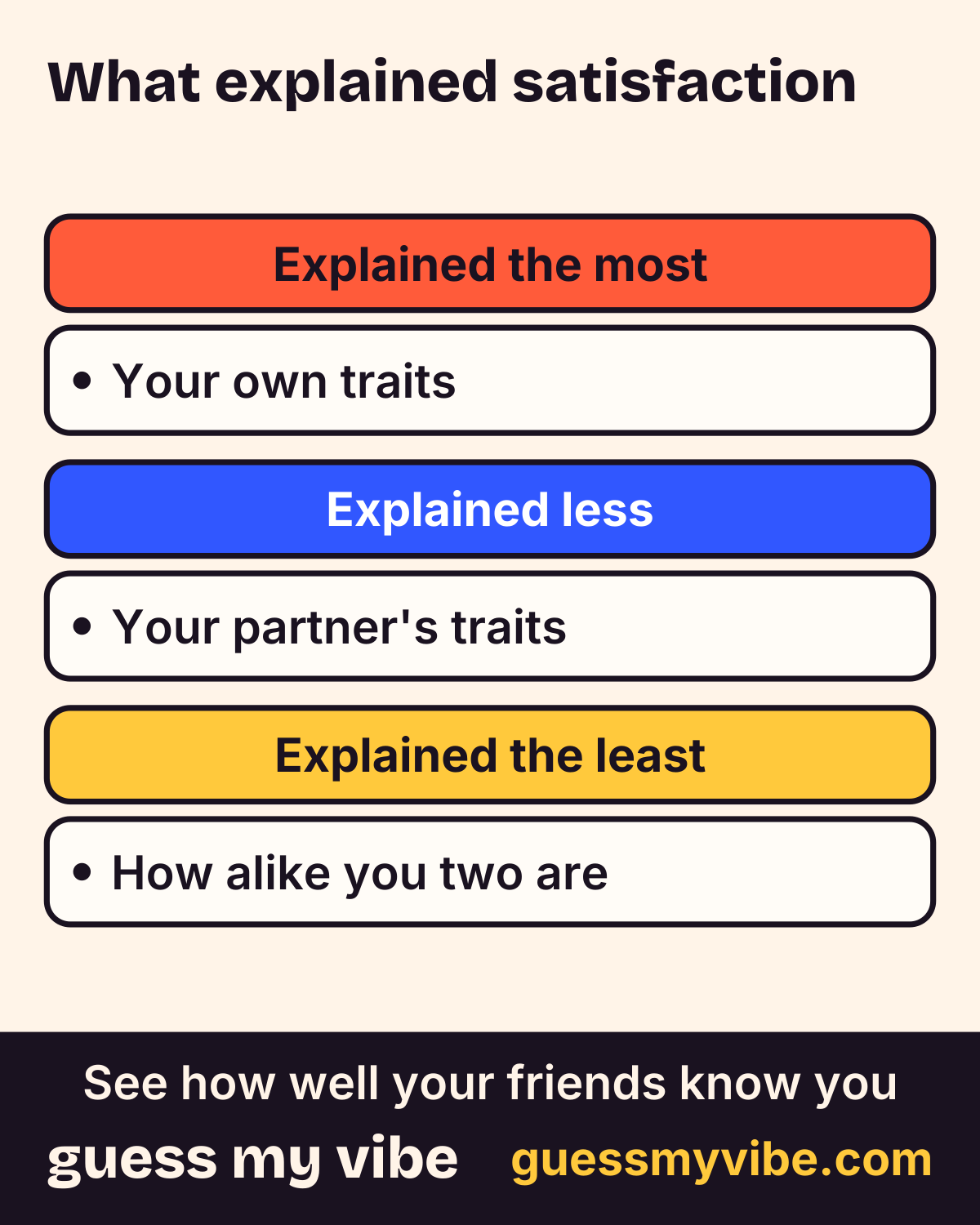
Personality and relationships research finds a modest but consistent pattern: people lower in stress-reactivity (Neuroticism) and higher in warmth (Agreeableness), Conscientiousness and Extraversion tend to report happier relationships [1]. Your own personality matters more for your own satisfaction than your partner's personality does, and how similar you two are matters least of all [2].
Personality and relationships: what decades of research actually shows
Personality and relationships have been studied together for decades, and the honest summary is modest rather than dramatic: certain traits go with happier couples on average, but no trait guarantees happiness and no trait dooms a relationship. The clearest, most consistently replicated finding is about stress-reactivity, what personality researchers call Neuroticism: people lower in it tend to report, and to be reported by a partner as having, more satisfying relationships. Warmth (Agreeableness), Conscientiousness and Extraversion show the same pattern, a bit less strongly. None of this is about finding the one right personality for love. It's about which everyday tendencies make the day-to-day friction of sharing a life with someone a little easier to manage.
Which personality traits go with relationship satisfaction
A meta-analysis pooling 19 separate samples and 3,848 people looked specifically at the Five-Factor Model (the Big Five) and a partner's relationship satisfaction. Four of the five traits showed a real, significant link: lower Neuroticism, and higher Agreeableness, Conscientiousness and Extraversion each went with a happier partner. Openness to experience showed no reliable link either way. The pattern held up the same way for men and women, and for married and unmarried couples alike [1]. None of the four significant traits had a huge effect on its own; this is a real, replicated pattern across thousands of people, not a rule that guarantees how any one couple will feel.
Why these particular traits? Lower stress-reactivity means fewer spirals into worry or hurt feelings over small, ambiguous moments, the kind that make up most of actual daily life together. Higher warmth means a readier instinct to give a partner the benefit of the doubt. Higher Conscientiousness means more follow-through on the small, boring promises (showing up on time, doing a fair share of the chores) that quietly build or erode trust. None of these is exotic. They're ordinary habits that happen to make cohabiting with another person smoother, day after day.
Your own traits matter more than your partner's, and matching matters least
A separate, much larger line of research asked a different question: whose personality matters more for a given person's happiness, their own or their partner's? Using nationally representative samples of married couples from Australia (5,278 people), the United Kingdom (6,554 people) and Germany (11,418 people), researchers compared three distinct sources of influence. A person's own personality (an "actor effect") explained about 6% of the difference in their own relationship satisfaction. Their partner's personality (a "partner effect", strongest for Agreeableness, Conscientiousness and Emotional Stability) explained only 1-3%. And how similar the two partners' personalities were to each other explained under 0.5%, once each person's own traits were already accounted for. All three numbers held up across all three countries [2].
That's a genuinely useful, if deflating, finding for anyone hunting for a "compatible personality type." Your own temperament does more work in your own happiness than your partner's temperament does, and whether the two of you are alike barely moves the needle at all once that's accounted for. A companion piece on this site, relationship compatibility, goes deeper into exactly what matching profiles can and can't tell you.
Cite this figure
Figure: "What explained satisfaction." Guess My Vibe (guessmyvibe.com). https://guessmyvibe.com/learn/personality-and-relationships#figure-what-matters-more
Curious how your friends would answer?
Free. Answer 10 quick questions about you, then send your link. Friends play in their browser, no app needed.
Start freeWhy researchers track relationships for years, not one survey
A classic review pulled together 115 longitudinal studies, together following more than 45,000 marriages over time, to make a methodological point that still matters: relationship quality isn't a fixed trait of a couple, it's a trajectory that moves as life circumstances change, new conflicts surface, and old patterns either get reinforced or interrupted [4]. A personality trait measured once at the start of a relationship is a starting condition, not a verdict. The same review notes that even marriages that look alike on paper can diverge sharply over years, shaped by how couples handle the inevitable new sources of friction that show up as life gets more complicated.
Why these effects look small, and why that's actually normal
None of the numbers above are large in the way a popular headline might imply. A 6% share of the difference in satisfaction, or a path coefficient around .3, is a real, repeatable finding across thousands of people, not a huge one. That's typical for personality research generally, and it's worth sitting with rather than explaining away: a relationship is shaped by hundreds of day-to-day moments, finances, health, work stress, how a single hard week gets handled, and personality is only ever one ingredient sitting alongside all of that. Expecting a trait or a couple's survey to single-handedly tell you whether a relationship will work sets up a test the research was never built to pass. Its honest job is narrower and more useful: naming a few ordinary habits that nudge the odds, not handing out a verdict.
Seeing a partner generously goes with being happier, regardless of the match
If matching traits isn't the main story, what is? One well-known study of 82 married and 98 dating couples found that people who saw their partner more positively than the partner saw themselves (controlling for the partner's own self-reported traits) reported meaningfully higher satisfaction, in both the married and dating samples. Being seen that generously by one's own partner also independently went with higher satisfaction [3]. This idea, sometimes called positive illusions, gets its own deeper look in a companion article on this site, but the short version matters here too: a generous, idealized view of a partner's character tracked with happiness far more directly than how closely the partner's real, self-reported traits lined up with some objective standard of compatibility.
What this actually means, in plain terms
Put together, this research says something fairly ordinary: a few broad habits of temperament (staying relatively calm under stress, giving people the benefit of the doubt, following through on commitments) go with happier couples on average, your own habits matter more for your own happiness than your partner's do, matching each other on paper matters the least of everything studied here, and how generously you see your partner matters more than most people assume. None of this is a test anyone can fail, and none of it is a diagnosis of any relationship, happy or struggling. It's a set of modest, honestly-reported patterns across thousands of real couples, not a formula.
See a version of this with the person you're with
Guess My Vibe is built on the same everyday-behavior approach this research uses: real personality questions, answered honestly, then guessed by someone who knows you. Played with a partner, it's a two-minute way to see where your sense of each other actually lines up and where it doesn't, the same kind of comparison this research runs on a much larger scale.
Key takeaways
- A meta-analysis of 19 samples and 3,848 people found low Neuroticism and high Agreeableness, Conscientiousness and Extraversion each went with higher relationship satisfaction for a partner; Openness showed no reliable link [1].
- Your own personality explains more of your own relationship satisfaction (about 6% of the difference between people) than your partner's personality does (1-3%), across huge nationally representative samples in three countries [2].
- How similar two partners' personalities are to each other explains under 0.5% of the difference in satisfaction once each person's own traits are accounted for, in every country studied [2].
- Seeing a partner more generously than the partner sees themselves goes with being happier in the relationship, in both dating and married couples [3].
- This isn't therapy, a diagnosis, or a substitute for professional care.
Questions people ask
Which personality traits are linked to a happier relationship?
Lower Neuroticism (stress-reactivity), and higher Agreeableness, Conscientiousness and Extraversion, each went with higher relationship satisfaction for a partner across a meta-analysis of 19 samples and 3,848 people. Openness showed no reliable link in either direction [1].
Does my personality or my partner's personality matter more for my own happiness?
Your own personality matters more. Across nationally representative samples from three countries, a person's own traits explained about 6% of the difference in their own satisfaction, versus 1-3% for their partner's traits [2].
Do couples need similar personalities to be happy together?
No. How similar two partners' personalities are to each other explained under 0.5% of the difference in satisfaction once each person's own traits were accounted for, in every country studied [2]. The companion article relationship compatibility goes deeper into what matching actually does and doesn't tell you.
Can personality research tell you if a relationship will last?
Not reliably on its own. A review of 115 longitudinal studies covering more than 45,000 marriages found relationship quality changes over time with life circumstances; a trait measured once is a starting point, not a verdict [4].
Is it good or bad to idealize your partner a little?
Research on positive illusions found that people who saw their partner more positively than the partner saw themselves tended to report higher relationship satisfaction, in both dating and married couples [3]. The positive illusions article covers this in more depth.
See how well your friends know you.
Free. Answer 10 quick questions about you, then send your link. Friends play in their browser, no app needed.
Start freeReferences
- [1] Malouff, J. M., Thorsteinsson, E. B., Schutte, N. S., Bhullar, N., & Rooke, S. E. (2010). The Five-Factor Model of personality and relationship satisfaction of intimate partners: A meta-analysis. Journal of Research in Personality, 44(1), 124-127. doi.org/10.1016/j.jrp.2009.09.004 (opens in a new tab)
- [2] Dyrenforth, P. S., Kashy, D. A., Donnellan, M. B., & Lucas, R. E. (2010). Predicting relationship and life satisfaction from personality in nationally representative samples from three countries: The relative importance of actor, partner, and similarity effects. Journal of Personality and Social Psychology, 99(4), 690-702. PubMed: 20718544 (opens in a new tab)
- [3] Murray, S. L., Holmes, J. G., & Griffin, D. W. (1996). The benefits of positive illusions: Idealization and the construction of satisfaction in close relationships. Journal of Personality and Social Psychology, 70(1), 79-98. doi.org/10.1037/0022-3514.70.1.79 (opens in a new tab)
- [4] Karney, B. R., & Bradbury, T. N. (1995). The longitudinal course of marital quality and stability: A review of theory, method, and research. Psychological Bulletin, 118(1), 3-34. PubMed: 7644604 (opens in a new tab)
How we find and check these sources: how we write. Spotted an error? Report a correction.
Related
- Relationship Compatibility: What Research Can Tell You
- Positive Illusions: Why Idealizing Your Partner Helps
- Do Opposites Attract? What the Research Actually Says
- Friendship Compatibility: What Actually Makes It Work
- What Makes an Open-Minded Person? Openness in Friendships
- Big Five Personality Traits: A Plain-Words Guide
- Openness to Experience: Meaning, Facets and Creativity
- Is MBTI Accurate? MBTI vs the Big Five, Fairly
- Love Languages: What the Research Actually Shows
More in Dating and partner personality (science, not advice)
- How Well Do You Know Your Partner? 100+ Questions
- Love Languages: What the Research Actually Shows
- Ideal Partner: Why Your List Doesn't Match Who You Like
- First Date Questions: 25 to Ask (and Why Follow-Ups Win)
- Newlywed Game Questions (and How Well You Know Them)
- Couple Compatibility Test: What It Can and Can't Tell You
- Relationship Compatibility: What Research Can Tell You
- Positive Illusions: Why Idealizing Your Partner Helps
- Questions to Ask Your Partner That Build Real Closeness
- What Makes Relationships Last? The Biggest Study Yet
- Dating an Introvert: What Research Actually Says
Cite this article
- Title
- Personality and Relationships: What the Research Shows
- Publisher
- Guess My Vibe
- Updated
- URL
- https://guessmyvibe.com/
learn/ personality-and-relationships
Copy this citation
Guess My Vibe. (2026, October 3). Personality and Relationships: What the Research Shows. Guess My Vibe. https://guessmyvibe.com/
To point at one section, add that section's anchor (the # link on its heading) to the URL.