An open-minded person is, in research terms, someone high in openness to experience: curious, drawn to new ideas and experiences, and comfortable with the unfamiliar (the app calls it Curiosity). A well-known review argued the trait reaches into social life, from political ideology and social attitudes to marital choice and interpersonal relations [1]. Curious people also tend to be playful, tolerant of uncertainty and non-defensive [2].
What is an open-minded person, in research terms?
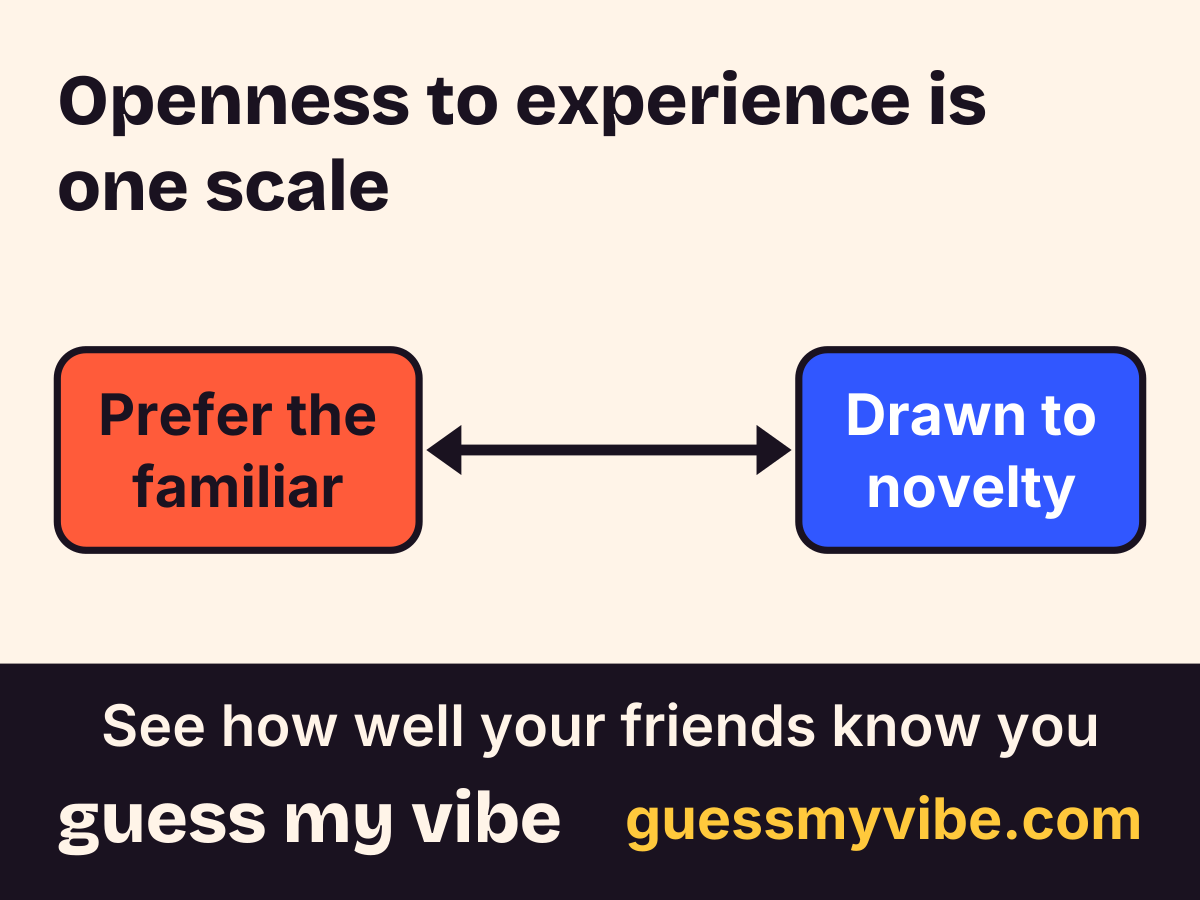
In everyday speech, an open-minded person is someone willing to consider views and experiences different from their own. Personality psychology has a close match: openness to experience, one of the five broad Big Five traits. People high in openness tend to be curious, imaginative and drawn to novelty, while people low in it tend to prefer the familiar, the practical and the tried-and-true. The app calls this trait Curiosity, and the plain name is a good one, because curiosity is the part of it you can see in daily life.
A caution before going further. "Open-minded" in conversation is a moral compliment, and "closed-minded" is a criticism. The research trait is more neutral and more specific. Openness describes how a person approaches and processes experience, and it doesn't measure how kind, fair or smart they are. A high-openness person can be dismissive of people they find boring. A low-openness person can be generous and fair-minded. With that in mind, here is what studies say the trait goes with.
Cite this figure
Figure: "Openness to experience is one scale." Guess My Vibe (guessmyvibe.com). https://guessmyvibe.com/learn/open-minded-person#figure-openness-scale
Why openness matters in social life
Openness is usually described as an inner trait, about thoughts and imagination. McCrae's 1996 review in Psychological Bulletin made the case that it's a social trait too. He argued that different ways of approaching and processing experience lead to different value systems with a profound effect on social interactions, and he reviewed the effects of Openness versus Closedness on cultural innovation, political ideology, social attitudes, marital choice and interpersonal relations [1]. That's a review, not a single experiment, and the abstract doesn't give effect sizes, so think of it as a map of where the trait shows up rather than a measurement of how big each effect is.
The practical takeaway is that openness may shape who you spend time with and what you do together, not just what you think about alone. Two friends who differ a lot on openness may disagree about what makes a good weekend, a good book or a good conversation, even if they're equally warm and equally reliable. That's one reason differences on this trait can feel like "we don't click" when nothing is actually wrong.
How curious people actually behave with others
The most direct evidence on what open, curious people are like around others comes from a study that asked several kinds of people. Kashdan and colleagues used self-reports, reports from friends and parents, and coded behavior from direct observation of unstructured social interactions among unacquainted people. They found an impressive degree of convergence among self, friend and parent reports of curiosity, and a curious personality was linked to a range of adaptive behaviors: tolerance of anxiety and uncertainty, positive emotional expressiveness, initiating humor and playfulness, unconventional thinking, and a nondefensive, noncritical attitude [2].
In plain words, curious people tend to be fun to talk to. They try things, joke around, and don't get prickly when you disagree with them. That convergence is also worth noticing for a second reason: friends and parents agreed with the person's own rating of curiosity, so it looks like a trait that other people can see fairly well. Curiosity is not the same thing as the full Big Five trait of openness, but the study's authors treat open and curious people as one group, and the findings fit what the trait is supposed to look like in daily life.
Curious how your friends would answer?
Free. Answer 10 quick questions about you, then send your link. Friends play in their browser, no app needed.
Start freeOpenness, attitudes and other groups
One well-studied social link of openness is with attitudes toward other groups. A meta-analysis of 71 studies with 22,068 participants found that right-wing authoritarianism (an attitude style that values conformity, tradition and obedience to authority) was linked to low openness to experience, and that the effect of openness on prejudice ran largely through it [3]. The same analysis said the effects of openness were robust and consistent across samples, though it found subtle moderators, including which personality inventory was used and the type of prejudice measured [3].
Read that carefully. It is a statement about averages across many people, and the link is correlational. It does not say that a particular low-openness person is prejudiced, or that a high-openness person is free of it. It also doesn't say openness is a virtue. It says that how people process novelty goes along with how they feel about people and ideas outside their own circle, which is the kind of social consequence McCrae argued openness had.
Who becomes friends with an open-minded person?
People often end up friends with others who are similar to them, and openness is one of the traits where that shows. In a study that tracked 205 late adolescents through their first year at university, individuals tended to select friends with similar levels of agreeableness, extraversion and openness [4]. These were newly acquainted students building friend networks from scratch, so this describes how friendships form when people have just met, not what makes friendships last. Still, it fits everyday experience: people who love trying new things tend to find each other.
Similarity in friend choice does not mean difference is a problem, which is the question our friends with different personalities article answers more fully. Plenty of friendships match a curious, novelty-seeking friend with a more traditional one, and they work because each brings something the other lacks. The tradeoff is just that planning takes more negotiation.
Openness in relationships: smaller than you'd guess
It might seem that an open-minded partner would make a happier relationship, but the evidence is less clear. A meta-analysis of 19 samples and 3,848 people found that low neuroticism, high agreeableness, high conscientiousness and high extraversion each correlated significantly with a partner's relationship satisfaction, while openness did not [5]. The pattern held across sex and across married versus unmarried couples. The abstract doesn't give per-trait effect sizes, so the most we can say is that openness did not stand out the way the other four traits did.
That is an average, not a forecast for any couple, and it is about openness as a Big Five score, not about whether two partners are willing to hear each other out. But it is a useful correction to the idea that "being open-minded" is a master key to relationship happiness. Warmth, reliability and calm seem to do more of that work, as our personality and relationships article explains.
Can you be more open-minded?
This is the most common question behind the search, and the research here doesn't answer it. None of the studies cited above tested a way to raise openness, so any specific "how to be more open-minded" recipe would go beyond the evidence. What the studies do support is a modest, practical idea: curiosity shows up in behavior, such as tolerating uncertainty, being playful and not getting defensive [2], so those are the behaviors to notice in yourself and in friends who seem to have the trait. Whether practicing them changes the underlying trait is a separate question this article can't answer.
A more interesting test is how others see you. Guess My Vibe asks friends to guess your answers on Curiosity and the other traits, then shows you where they were right and where they weren't. If your friends think you're more open to new things than you think you are, or less, that gap is worth a conversation, and it's a lot more informative than asking yourself whether you're open-minded.
Key takeaways
- Openness to experience is the Big Five trait behind "open-minded": curiosity, imagination and a taste for novelty, and one review argued it shapes social attitudes, marital choice and relationships [1].
- In friends', parents' and observers' ratings, a curious personality went with tolerance of anxiety and uncertainty, humor and playfulness, unconventional thinking and a nondefensive, noncritical attitude [2].
- Across 71 studies and 22,068 people, low openness was linked to right-wing authoritarianism, an attitude style that favors conformity and tradition and goes with prejudice [3].
- New university students tended to pick friends similar to them in openness, but a meta-analysis found openness did not reliably track a partner's relationship satisfaction [4] [5].
- This isn't therapy, a diagnosis, or a substitute for professional care; it's a plain-English summary of personality research on one trait.
Questions people ask
What is an open-minded person in psychology?
Psychologists describe it as high openness to experience, one of the Big Five traits: curiosity, imagination and a taste for novelty. The everyday word "open-minded" also carries a moral meaning (fair, willing to listen) that the trait itself does not measure [1].
Are curious people better in social situations?
Curious people tended to show tolerance of anxiety and uncertainty, positive emotional expressiveness, humor and playfulness, and a nondefensive, noncritical attitude in one multi-informant study [2]. That's a description of how they behave, not a ranking of who is better.
Does openness affect who you become friends with?
Among 205 new university students, people tended to select friends with similar levels of openness, along with agreeableness and extraversion [4]. It describes early friendship choices, not what keeps friendships going.
Does being open-minded make relationships happier?
Not clearly. A meta-analysis of 19 samples found that four Big Five traits correlated with a partner's relationship satisfaction, but openness did not [5]. Willingness to hear a partner out is a skill, not just a trait score.
Is low openness bad?
No. It describes a preference for the familiar and practical. Low openness was linked to right-wing authoritarianism in a meta-analysis of 71 studies, which is an average link and not a statement about any person [3].
See how well your friends know you.
Free. Answer 10 quick questions about you, then send your link. Friends play in their browser, no app needed.
Start freeReferences
- [1] McCrae, R. R. (1996). Social consequences of experiential openness. Psychological Bulletin, 120(3), 323-337. PubMed: 8900080 (opens in a new tab)
- [2] Kashdan, T. B., Sherman, R. A., Yarbro, J., & Funder, D. C. (2013). How are curious people viewed and how do they behave in social situations? From the perspectives of self, friends, parents, and unacquainted observers. Journal of Personality, 81(2), 142-154. PubMed: 22583101 (opens in a new tab)
- [3] Sibley, C. G., & Duckitt, J. (2008). Personality and prejudice: a meta-analysis and theoretical review. Personality and Social Psychology Review, 12(3), 248-279. PubMed: 18641385 (opens in a new tab)
- [4] Selfhout, M., Burk, W., Branje, S., Denissen, J., van Aken, M., & Meeus, W. (2010). Emerging late adolescent friendship networks and Big Five personality traits: A social network approach. Journal of Personality, 78(2), 509–538. PubMed: 20433629 (opens in a new tab)
- [5] Malouff, J. M., Thorsteinsson, E. B., Schutte, N. S., Bhullar, N., & Rooke, S. E. (2010). The Five-Factor Model of personality and relationship satisfaction of intimate partners: A meta-analysis. Journal of Research in Personality, 44(1), 124-127. doi.org/10.1016/j.jrp.2009.09.004 (opens in a new tab)
How we find and check these sources: how we write. Spotted an error? Report a correction.
Related
- Friends With Different Personalities: When Opposites Work
- Personality and Relationships: What the Research Shows
- Friendship Compatibility: What Actually Makes It Work
- Do You Become Like Your Friends? What Research Says
- How to Make Friends: What the Research Says
- Agreeableness: The Trait Closeness Barely Helps Friends Read
- Openness to Experience: Meaning, Facets and Creativity
Cite this article
- Title
- What Makes an Open-Minded Person? Openness in Friendships
- Publisher
- Guess My Vibe
- Updated
- URL
- https://guessmyvibe.com/
learn/ open-minded-person
Copy this citation
Guess My Vibe. (2026, October 4). What Makes an Open-Minded Person? Openness in Friendships. Guess My Vibe. https://guessmyvibe.com/
To point at one section, add that section's anchor (the # link on its heading) to the URL.