The best first date questions are easy to answer, a little specific, and set up a follow-up. That last part is what the research backs: in three studies of live conversations, including speed dating, people who asked more questions, especially follow-up questions, were better liked by their partner [1]. Below are 25 questions to start with, then the evidence on what to do with the answers.
First date questions: 25 to try
Good first date questions do three jobs at once. They are easy to answer, so nobody feels interrogated. They are specific enough to produce a real story instead of a one-word reply. And they leave something to ask about next. Skip anything that sounds like a job interview ("where do you see yourself in five years?") and anything that needs a long backstory to answer. Pick a few from each group below, in any order, and let the conversation wander.
Warm-up questions
- What was the best part of your week so far?
- What's the thing you'd happily talk about for an hour if I let you?
- What did you eat all the time as a kid that you still love?
- Is there a local spot you keep recommending to people?
- What's a tiny habit of yours that you'd defend to the death?
- What was the last thing you watched that you couldn't stop thinking about?
- What's your go-to order at a place you've been a hundred times?
- What are you weirdly good at that doesn't show up on a resume?
- What's a song that instantly puts you back in a specific year?
Getting-to-know-you questions
- What's something you taught yourself just because you were curious?
- Which part of your life right now feels most like "you"?
- What did you want to be at ten, and how close did you get?
- What's a trip, big or small, that changed how you think about something?
- How do you like to spend a day when nothing is scheduled?
- Who in your life would be the funniest person to bring along tonight?
- What's a small kindness someone did for you that you still remember?
- What's the most useful thing you learned the hard way?
- What kind of work do you find yourself losing track of time in?
A little deeper (once it's flowing)
- What are you looking forward to over the next few months?
- What's a belief of yours that's changed in the last few years?
- What does a really good Sunday feel like to you?
- What do the people closest to you say you're like when you're stressed?
- What's something you're working on getting better at?
- What do you think people tend to get wrong about you at first?
- What would you do with an extra free day every week?
That's 25, and the best question of the night is the one you make up in the moment: the follow-up. Which brings us to the part that matters more than any list.
Why follow-up questions beat a perfect opening question
A team of researchers studied question-asking directly. Across three studies of live, two-person conversations, they found a consistent link between asking questions and being liked: people who asked more questions, particularly follow-up questions, were better liked by the person they were talking to. When people were told to ask more questions, their partners rated them as more responsive, a word researchers use for listening, understanding, validating, and caring. Responsiveness explained why the questions led to liking [1].
The research analyzed live get-to-know-you conversations online and also looked at face-to-face speed dating. To analyze the speed-dating conversations at scale, the team trained a program to spot follow-up questions in the transcripts. Speed daters who asked more follow-up questions during their dates were more likely to get their partner to agree to a second date, which the authors treat as a behavioral sign of liking [1]. Notice what that does and doesn't say. It's about follow-ups specifically, not a count of how many questions were asked. It comes from a particular setting, speed-dating conversations. And the second-date measure is the partner's agreement, not whether a relationship formed. It's a useful clue about first impressions, not a guarantee about anything after that.
There was one more finding worth knowing before you walk in. The same research found that people do not anticipate that asking questions will make them more liked [1]. Most of us worry about being interesting. The evidence here suggests that being interested, and showing it by asking about what the other person just said, may do more for how you come across than any story you could prepare.
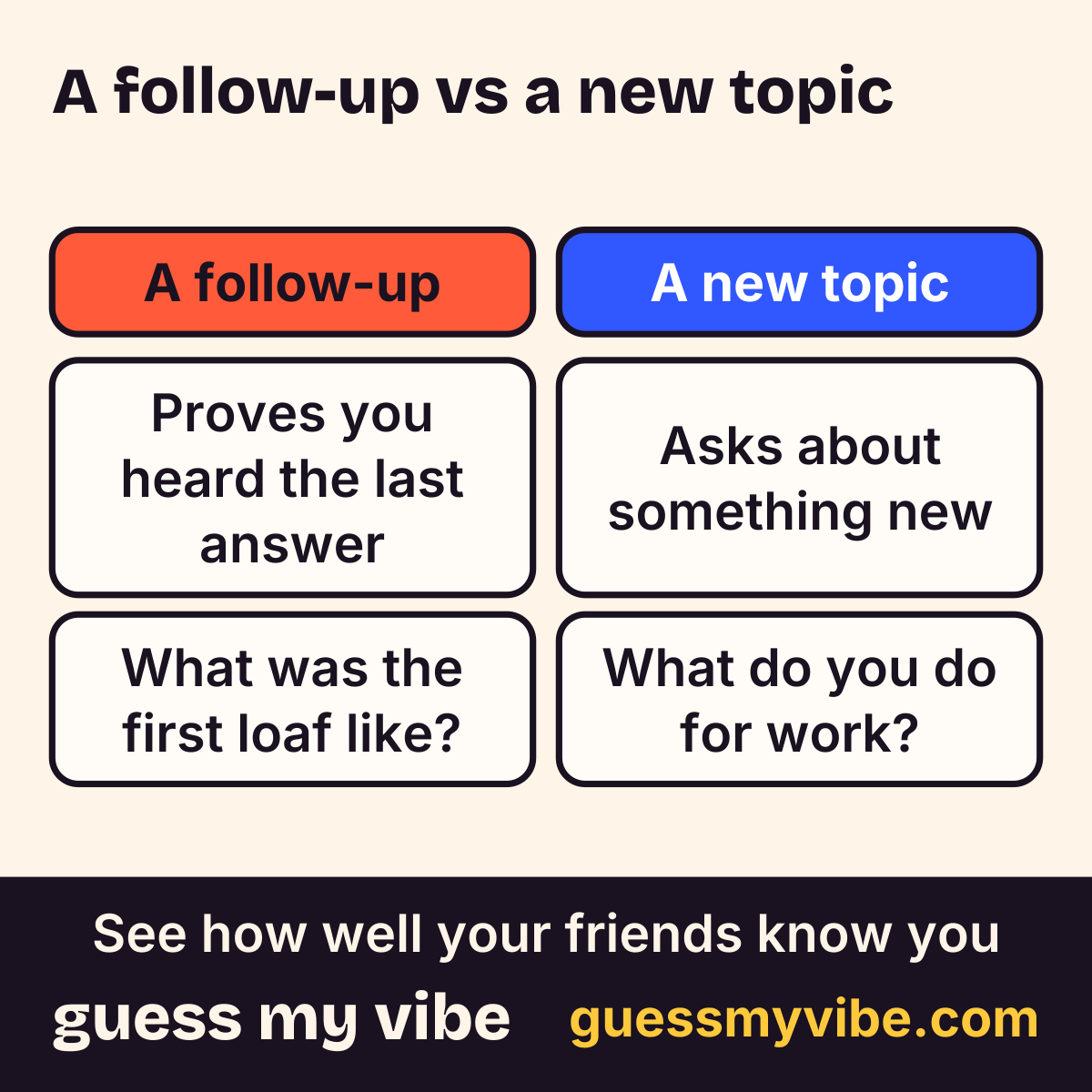
In practice, a follow-up is just a question that proves you heard the last answer. If they say they taught themselves to bake bread, "what was the first loaf like?" is a follow-up and "what do you do for work?" is a new topic. Both are fine, but only one tells the other person you were listening. That is the same quality the researchers measured as responsiveness.
Cite this figure
Figure: "A follow-up vs a new topic." Guess My Vibe (guessmyvibe.com). https://guessmyvibe.com/learn/first-date-questions#figure-follow-up-vs-new-topic
Curious how your friends would answer?
Free. Answer 10 quick questions about you, then send your link. Friends play in their browser, no app needed.
Start freeThey probably like you more than you think
First dates come with a running commentary in your own head: that joke fell flat, that pause was too long, that story went on too long. A set of studies on conversations between new people suggests that commentary is unreliable. After conversations, people systematically underestimated how much their partners liked them and enjoyed their company. The authors call this the liking gap. They saw it with strangers getting acquainted in a lab, with first-year college students meeting others in their dorm, and with members of the public at a personal development workshop, and it persisted across conversations of different lengths [2].
None of these were dates, so it would be a stretch to say the same size of gap applies when romance is on the table. But if it holds on a first date, it's a reason to relax into the questions instead of grading yourself after each answer. Our liking gap article covers the full research.
Taking turns: both people answer
A question list can turn into a one-way interview if one person asks everything and the other just answers. Research on disclosure suggests that's the weaker setup. An experiment with twosomes of people who didn't know each other compared taking turns disclosing with one-sided disclosure in a first interaction, and its title reports that reciprocal disclosure promotes liking [4]. These were unacquainted twosomes doing a structured activity in a study, not people on dates, so read it as a hint about how first conversations go, not a rule for romance.
The easy version: answer your own question after they do. "What's the thing you'd talk about for an hour?" is much better when you've got your own answer ready, and offering it back is what turns the exchange into a conversation instead of a quiz.
What no question list can tell you
It's tempting to treat questions as a screening tool: find out their traits and preferences, and decide whether it's a match. The evidence on that is humbling. In two speed-dating studies, participants completed more than 100 self-report measures of traits and preferences before the event, then had a 4-minute date with every opposite-sex attendee. Machine-learning models could account for some of how much a person desired others in general (4% to 18% of that variation) and how much a person was desired by others in general (7% to 27%). But the models could not forecast anyone's desire for a specific partner, beyond those general tendencies, from any combination of traits and preferences reported beforehand [3]. The authors conclude that the compatibility part of attraction is hard to forecast before two people meet.
Translated: what someone says they want in a partner on a form tells you little about whether you two will click. What happens between you, in the conversation, is where the information lives. That's an argument for treating the first date as a chance to find out how it feels to talk to this particular person, not a data-gathering session with a pass-or-fail outcome. It also means a list of dealbreaker questions is less revealing than it feels, and curiosity is more useful than a checklist.
Guess My Vibe works on a similar idea from a different angle. Instead of asking what someone says about themselves, it asks friends to guess how you'd answer, which is a low-pressure way to see how you come across to people who know you. If you want a fun warm-up before a date, or just to compare notes with a friend about each other's quirks, that's what it's for. It is not a compatibility test, and it won't tell you whether a date will go well.
Key takeaways
- In three studies of live conversations, which included online get-to-know-you chats and face-to-face speed dating, people who asked more questions, particularly follow-up questions, were better liked by their conversation partners [1].
- In the speed-dating data, people who asked more follow-up questions were more likely to get their partner's agreement to a second date; the same research found people don't expect asking questions to make them more liked [1].
- After conversations with new people, people systematically underestimated how much their partner liked them, so a quiet stretch or a clumsy moment probably reads worse in your head than in theirs [2].
- A pre-date checklist of traits and preferences did not forecast which specific person someone would desire in two speed-dating studies, so a lot may only show up in the live conversation [3].
- This isn't therapy, a diagnosis, or a substitute for professional care.
Questions people ask
What are good questions to ask on a first date?
Ones that are easy to answer, a bit specific, and leave room for a follow-up: a favorite spot, something you taught yourself, what you're looking forward to. The list above has 25 to start with, and the best one is whatever follow-up the answer sparks.
Does asking more questions make people like you more?
In three studies of live conversations, people who asked more questions, especially follow-up questions, were better liked by their partners [1]. Those studies covered online chats and speed dating, so they say less about, for example, long relationships.
How many questions should I ask on a first date?
The research doesn't give a number. What it points to is follow-up questions, ones that build on what the other person just said, being the kind that went with being liked [1]. Taking turns answering is also reported to promote liking in first interactions [4].
Do people like me less if the conversation feels awkward?
Less than you'd think. After conversations with new people, people systematically underestimated how much their partner liked them [2]. Those studies were not on dates, but they suggest your own read of how it went may be harsher than theirs.
Can a list of questions tell me if we're compatible?
Not very well. In two speed-dating studies, traits and preferences reported before the dates could not forecast who desired whom beyond general tendencies [3]. The conversation itself is where you find out how it feels to talk to each other.
See how well your friends know you.
Free. Answer 10 quick questions about you, then send your link. Friends play in their browser, no app needed.
Start freeReferences
- [1] Huang, K., Yeomans, M., Brooks, A. W., Minson, J., & Gino, F. (2017). It doesn't hurt to ask: Question-asking increases liking. Journal of Personality and Social Psychology, 113(3), 430–452. PubMed: 28447835 (opens in a new tab)
- [2] Boothby, E. J., Cooney, G., Sandstrom, G. M., & Clark, M. S. (2018). The Liking Gap in Conversations: Do People Like Us More Than We Think?. Psychological Science, 29(11), 1742–1756. PubMed: 30183512 (opens in a new tab)
- [3] Joel, S., Eastwick, P. W., & Finkel, E. J. (2017). Is romantic desire predictable? Machine learning applied to initial romantic attraction. Psychological Science, 28(10), 1478-1489. PubMed: 28853645 (opens in a new tab)
- [4] Sprecher, S., Treger, S., Wondra, J. D., Hilaire, N., & Wallpe, K. (2013). Taking turns: Reciprocal self-disclosure promotes liking in initial interactions. Journal of Experimental Social Psychology, 49(5), 860-866. doi.org/10.1016/j.jesp.2013.03.017 (opens in a new tab)
How we find and check these sources: how we write. Spotted an error? Report a correction.
Related
Cite this article
- Title
- First Date Questions: 25 to Ask (and Why Follow-Ups Win)
- Publisher
- Guess My Vibe
- Updated
- URL
- https://guessmyvibe.com/
learn/ first-date-questions
Copy this citation
Guess My Vibe. (2026, October 4). First Date Questions: 25 to Ask (and Why Follow-Ups Win). Guess My Vibe. https://guessmyvibe.com/
To point at one section, add that section's anchor (the # link on its heading) to the URL.