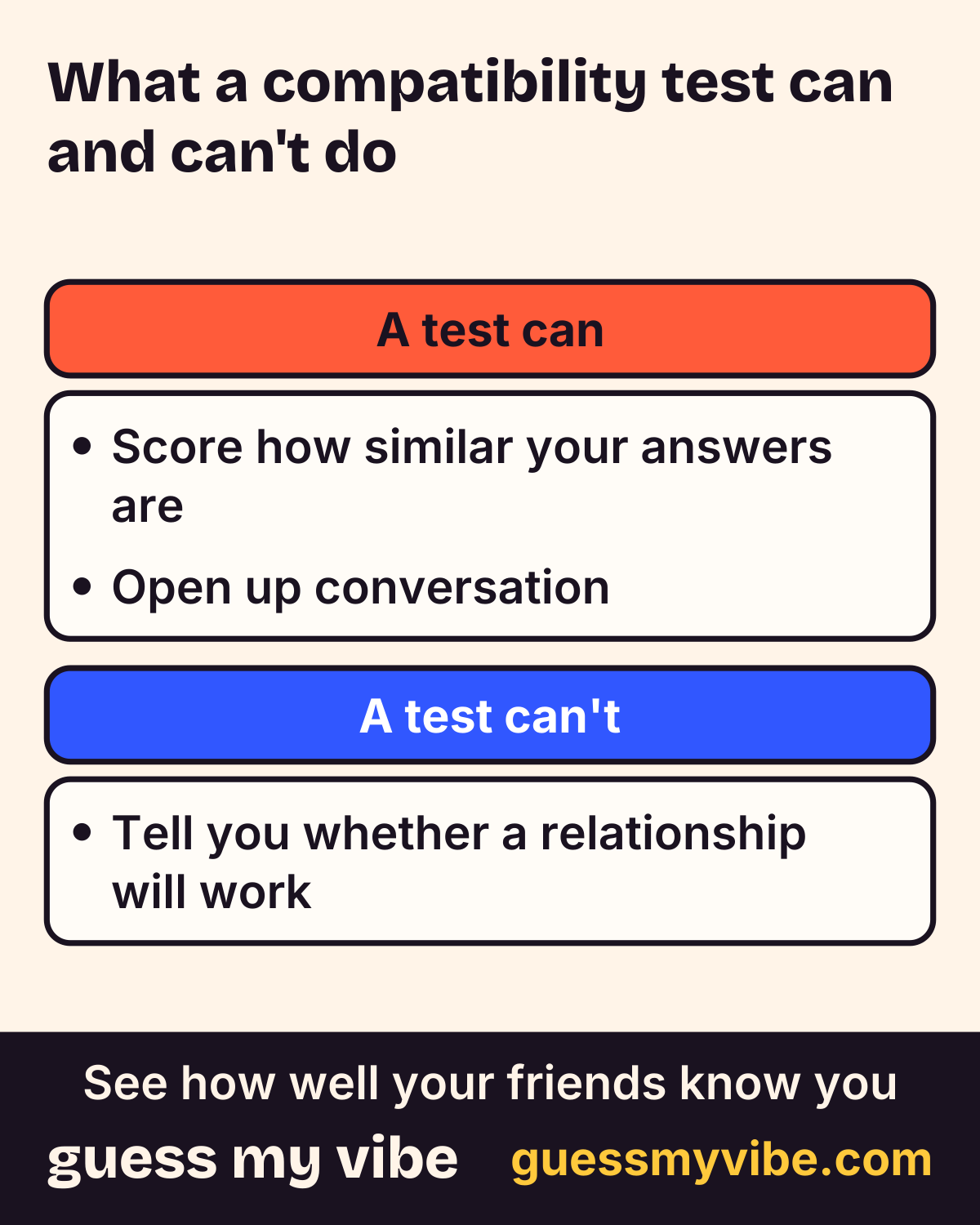
A couple compatibility test can start a good conversation, but it can't tell you whether a relationship will work. A major review of online-dating science found no compelling evidence that matching sites' mathematical algorithms produce better romantic outcomes than other ways of matching people [1], and in a large sample of couples, personality similarity was not robustly linked to how satisfied partners were [2].
A couple compatibility test measures answers, not outcomes
A couple compatibility test usually works like this: you and your partner each answer a set of questions about personality, values or habits, and the test scores how closely the answers line up. It feels scientific, because it produces a number. But the number only says how similar two sets of answers are. Whether similarity of that kind goes with a happier relationship is a separate question, and it's the one the research is cautious about. The short version is that a test can be fun and can open up conversation, but its score shouldn't be treated as a forecast.
This article is about the tests themselves: what they claim, what the evidence can say about those claims, and what's actually worth doing with one. For the broader research on what goes with happier couples, see our relationship compatibility article.
Cite this figure
Figure: "What a compatibility test can and can't do." Guess My Vibe (guessmyvibe.com). https://guessmyvibe.com/learn/couple-compatibility-test#figure-what-a-test-can-and-cant-do
Do matching algorithms work?
The most direct evaluation of compatibility matching came in a long review of online-dating science by five relationship researchers. They looked at what dating sites offer (access to partners, communication, and matching) and held the matching claims to a scientific standard. Their summary was blunt: no compelling evidence supports the sites' claims that mathematical algorithms work, in the sense of fostering romantic outcomes that are superior to those fostered by other means of matching partners [1].
The review also looked at the most common principle behind matching, similarity. It called the picture mixed. Most people do end up with partners who resemble them in demographics and attitudes. But once two people are together, it remains unclear whether the degree of similarity within the couple goes with more successful relationships over time. The authors concluded that similarity may be a beginning but is far from the whole story [1]. One honest limit: this was a 2012 review focused on dating sites and on the traits that had been studied in published research, so it doesn't speak directly to a free quiz on the internet. Still, it's the sort of benchmark a compatibility score would need to meet, and the review found it hadn't been met.
Can traits and preferences forecast who you'll click with?
A tougher test is to measure everything beforehand and see who actually ends up attracted to whom. In two speed-dating studies, unattached people completed more than 100 self-report measures of traits and preferences that earlier research had flagged as relevant to choosing a partner. Then each person had a 4-minute date with every opposite-sex participant at the event. Machine-learning models could account for between 4% and 18% of how much people desired others in general and between 7% and 27% of how much people were desired by others in general. But they could not forecast anyone's desire for a specific partner, beyond those general tendencies, using any combination of the traits and preferences reported before the dates [3].
In plain words, the form you fill out in advance can say something about whether a person tends to be popular or tends to be picky, but not much about whether two particular people will click. The authors' conclusion is that the compatibility elements of human mating are challenging to forecast before two people meet [3]. That was initial attraction, over 4 minutes, so it's not a statement about long-term couples. But it's a direct hit on the idea that a pre-date questionnaire can foresee chemistry.
Curious how your friends would answer?
Free. Answer 10 quick questions about you, then send your link. Friends play in their browser, no app needed.
Start freeDoes matching personalities matter for couples who are already together?
Many tests for couples are built on the idea that similar personalities fit better. A 2023 study looked at that with a sample of 1,294 female-male romantic couples. It tested whether each person's own traits, their partner's traits, and the similarity between them were associated with life satisfaction and relationship satisfaction, using both the broad Big Five traits and their narrower facets. The study's conclusion was that similarity in traits and facets was not robustly associated with either life or relationship satisfaction for the partners. The authors note that earlier research had already found personality similarity played a negligible role [2].
Note the limits. This was a sample of female-male couples, and it was a snapshot of how satisfied people reported being, not a forecast of who stays together. But combined with the speed-dating work above, a consistent picture emerges: similarity on a personality form, whether you're just meeting or already together, is a weak guide.
What does track relationship quality, according to the biggest study
The strongest single piece of evidence comes from a project that pooled 43 longitudinal datasets from 29 labs and used machine learning to see which self-report measures best track relationship quality. The top relationship-specific predictors included how committed people believed their partner was, how appreciated they felt, how satisfied they thought their partner was, and how much conflict there was. The top individual-difference predictors were life satisfaction, negative affect, depression, and attachment avoidance and anxiety. Relationship-specific measures accounted for up to 45% of the variance in relationship quality at baseline, and up to 18% at the end of each study. Individual differences accounted for 21% and 12% [4].
Two more findings from that paper matter for anyone holding a compatibility score. First, individual differences and partner reports added no predictive power beyond a person's own relationship-specific reports. Second, change in relationship quality over the course of a study was largely unpredictable from any combination of self-report variables [4]. That second one is the sobering part. If a team of researchers with dozens of datasets couldn't forecast whether a relationship would get better or worse from the surveys, a short quiz is unlikely to.
How to read a compatibility score sensibly
Here is a way to think about a result like "87% compatible," using only what the studies above establish. First, the number describes your answers, not your future. The strongest data we have found that change in relationship quality over time was largely unpredictable from self-reports [4], and a score is a self-report summary. Second, a high score and a low score are both thin evidence: similarity in traits was not robustly tied to satisfaction in a large couples sample [2], so a low score is not a warning and a high one is not a promise. Third, the questions inside the test matter more than the label on the result. A test built on commitment, appreciation and how you handle conflict is at least asking about the kinds of things that went with relationship quality [4], while one built purely on matching hobbies and personality labels is asking about similarity, which was not robustly tied to satisfaction in the couples sample above.
A fair way to treat any result is to ask what it would take to change your mind. If a 95% match would not make you want to ignore a worry, and a 40% match would not make you give up on someone you care about, the number isn't doing much work. That's our own rule of thumb, not a study finding, but it's consistent with how little the research says a score can carry.
So what is a compatibility test good for?
None of this means you shouldn't take one. It means treating the score as a conversation starter instead of a verdict. A few ways that's reasonable (this part is our suggestion, not a finding from the studies above):
- Look at the questions you disagreed on, not the total. A single surprising answer is more useful than a percentage.
- Use it to learn what your partner would say, and why. The explanation is the interesting part.
- Retake it in a few months. Answers change, and a score from one afternoon isn't a fixed fact about you.
- Be skeptical of any result that sounds certain, whether it says you're a perfect match or a poor one.
Guess My Vibe isn't a compatibility test and doesn't try to be one. It's a game in which friends guess how you'd answer personality questions, so you can see how well people see you. Played with a partner or a friend, it's a way to find out where your picture of each other matches and where it doesn't, which is a fun conversation and no more than that.
Key takeaways
- A review of online-dating science concluded that no compelling evidence supports matching sites' claims that their algorithms foster better romantic outcomes than other ways of matching partners [1].
- In two speed-dating studies, more than 100 traits and preferences reported before the dates could not forecast who would desire whom beyond general tendencies, though they forecast some of how much people desired others and were desired in general [3].
- In 1,294 female-male couples, similarity in personality traits and facets was not robustly associated with either partner's life satisfaction or relationship satisfaction [2].
- Across 43 longitudinal couples datasets, relationship-specific factors such as perceived commitment and appreciation accounted for up to 45% of the variance in relationship quality at baseline, while change in quality over time was largely unpredictable from self-reports [4].
- This isn't therapy, a diagnosis, or a substitute for professional care.
Questions people ask
Are couple compatibility tests accurate?
They can accurately score how similar two sets of answers are, but similarity is a weak guide to how a relationship goes. A review of online-dating science found no compelling evidence that matching algorithms produce better romantic outcomes than other ways of matching partners [1].
Do similar personalities make a better couple?
In a study of 1,294 female-male couples, similarity in personality traits and facets was not robustly associated with life or relationship satisfaction [2].
Can a test forecast if a relationship will last?
Not reliably. Across 43 longitudinal datasets, change in relationship quality over time was largely unpredictable from self-report measures [4].
Can a questionnaire forecast who I'll be attracted to?
Only in general terms. In speed-dating studies, pre-date traits and preferences accounted for some of how much people desired others and were desired in general, but could not forecast desire for a specific partner [3].
Is it still worth taking a couple compatibility test for fun?
Yes, as a conversation starter. Treat disagreements between your answers as topics to talk about, not as a score you have to defend.
See how well your friends know you.
Free. Answer 10 quick questions about you, then send your link. Friends play in their browser, no app needed.
Start freeReferences
- [1] Finkel, E. J., Eastwick, P. W., Karney, B. R., Reis, H. T., & Sprecher, S. (2012). Online dating: A critical analysis from the perspective of psychological science. Psychological Science in the Public Interest, 13(1), 3-66. PubMed: 26173279 (opens in a new tab)
- [2] Weidmann, R., Purol, M. F., Alabdullah, A., Ryan, S. M., Wright, E. G., Oh, J., & Chopik, W. J. (2023). Trait and facet personality similarity and relationship and life satisfaction in romantic couples. Journal of Research in Personality, 104, 104378. PubMed: 37396145 (opens in a new tab)
- [3] Joel, S., Eastwick, P. W., & Finkel, E. J. (2017). Is romantic desire predictable? Machine learning applied to initial romantic attraction. Psychological Science, 28(10), 1478-1489. PubMed: 28853645 (opens in a new tab)
- [4] Joel, S., Eastwick, P. W., Allison, C. J., Arriaga, X. B., Baker, Z. G., et al. (2020). Machine learning uncovers the most robust self-report predictors of relationship quality across 43 longitudinal couples studies. Proceedings of the National Academy of Sciences, 117(32), 19061-19071. PubMed: 32719123 (opens in a new tab)
How we find and check these sources: how we write. Spotted an error? Report a correction.
Related
Cite this article
- Title
- Couple Compatibility Test: What It Can and Can't Tell You
- Publisher
- Guess My Vibe
- Updated
- URL
- https://guessmyvibe.com/
learn/ couple-compatibility-test
Copy this citation
Guess My Vibe. (2026, October 4). Couple Compatibility Test: What It Can and Can't Tell You. Guess My Vibe. https://guessmyvibe.com/
To point at one section, add that section's anchor (the # link on its heading) to the URL.