Partly. Studies find MBTI scores are fairly consistent [1], and its four scales do touch real personality traits [2]. What research does not support is the idea of 16 separate types: the scales behave like sliding scales, not either-or boxes [2]. The Big Five is built as sliding scales from the start, and its five-factor structure has been found in most of 50 cultures [3].
Want to take it for real? Test how well one friend knows your Big Five traits
Is MBTI accurate? The short, fair answer
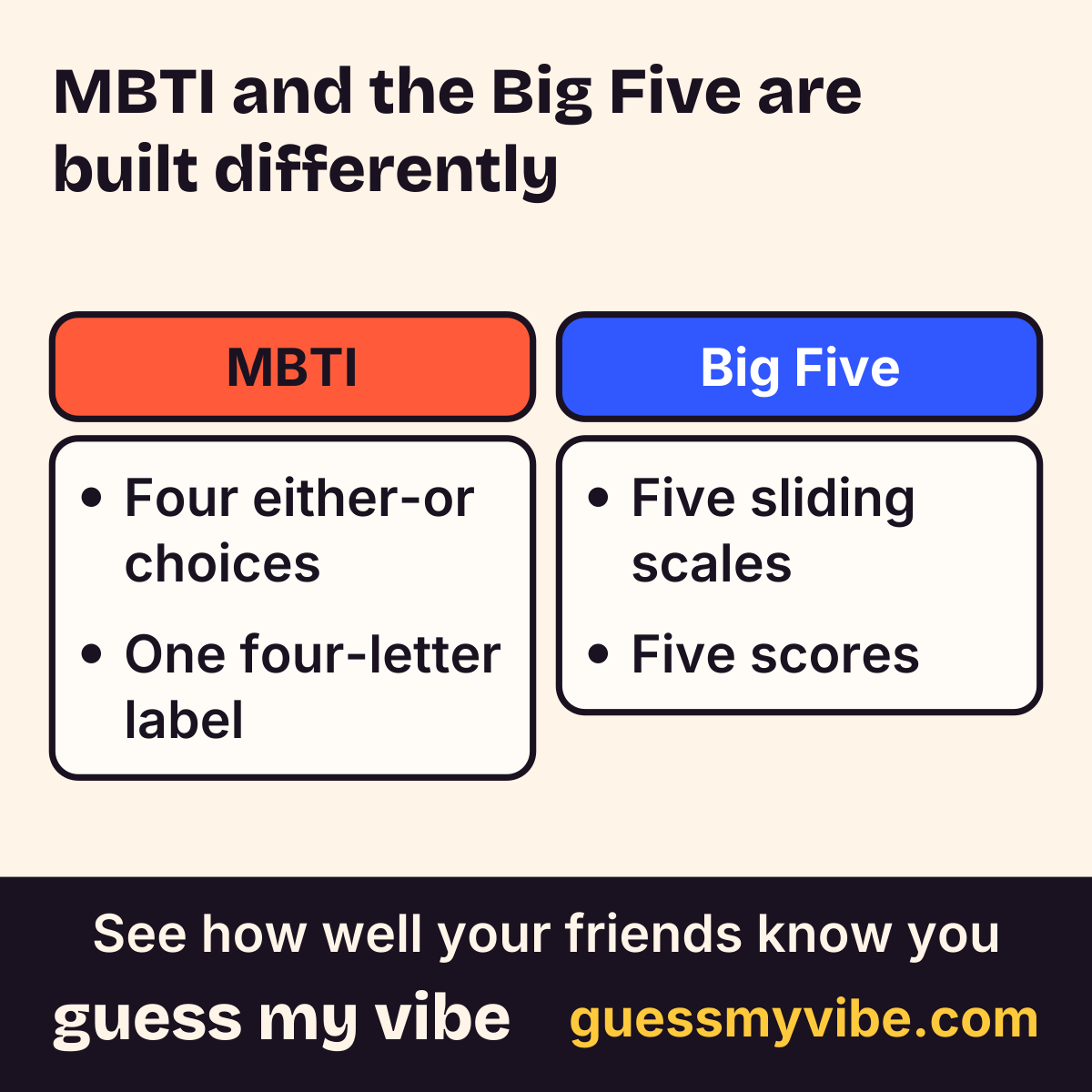
It depends on what you mean by accurate. If you mean "does the test give about the same scores when you retake it", the research is more favorable. If you mean "are there 16 distinct types of people", the research says no. The MBTI sorts people on four either-or choices and gives a four-letter label. Studies of how its scores behave suggest it is measuring four sliding scales instead. The Big Five measures sliding scales on purpose, so it avoids that mismatch.
None of this makes MBTI worthless. It is simple, memorable and fun, and having a label gives people a language for talking about themselves. That appeal is real. The question is only how much weight the four letters can carry once you start using them to explain, sort or choose people.
Big Five vs MBTI: how they are built
The MBTI is based on Jung's theory of psychological types and puts each person on one side of four dichotomies. A critical review of that theory describes the idea of a "true type" delineated across four dichotomies [5]. The Big Five came from a different tradition. It grew out of everyday trait words and factor analysis, which finds the dimensions that statistically go together. The result is five continuous scales: openness, conscientiousness, extraversion, agreeableness and neuroticism. Our article on the Big Five personality traits explains each one.
Cite this figure
Figure: "MBTI and the Big Five are built differently." Guess My Vibe (guessmyvibe.com). https://guessmyvibe.com/learn/is-mbti-accurate#figure-types-vs-scales
What the evidence says about MBTI
Start with the fair part. A reliability generalization analysis, which pools how consistently a test measures across many studies, found that in general the MBTI and its scales yielded scores with strong internal consistency and test-retest reliability estimates, although there was variation across administrations [1]. Reliability is about consistency. A scale can be consistent and still not mean what it claims.
That is where the questions begin. In a classic study of 468 adults aged 19 to 93, with both self-reports and peer ratings on a Big Five inventory, researchers found no support for the view that the MBTI measures truly dichotomous preferences or qualitatively distinct types. They concluded it instead measures four relatively independent dimensions, and they questioned how the Judging-Perceiving index should be interpreted. They also found the four MBTI indices did measure aspects of four of the five major dimensions of normal personality [2]. In other words, MBTI is not measuring nothing. It overlaps with the Big Five, minus one dimension and plus a type framework that the data did not support.
A second line of evidence is about the shape of scores. If people were really of two types on each scale, scores should pile up in two groups. Some earlier reports said they did. A study of about 12,000 people in leadership development programs found those reports were artifacts of a scoring program's default settings. With a better setting, score distributions became strongly center-weighted [4]. That means most people score near the middle, so the letter you get may depend on a small difference.
A later review judged the theory itself. It concluded that the theory behind the MBTI's four dichotomies lacks agreement with known facts and data, lacks testability and possesses internal contradictions [5]. And a psychometric review concluded the MBTI, while offering much intuitive appeal, may not yet be able to support the claims its promoters make [6]. Both are critiques by researchers, not new experiments, but they point the same way as the data above.
Curious how your friends would answer?
Free. Answer 10 quick questions about you, then send your link. Friends play in their browser, no app needed.
Start freeA fairer way to read your four letters
Treating MBTI as four scales makes it more useful, not less. Because the four indices did measure aspects of four of the five major dimensions of normal personality [2], each letter probably carries some real information about where you sit on a trait people have studied for decades. What the letter overstates is the gap between you and someone with the opposite letter. If you both scored near the middle, which the center-weighted score distributions suggest is common [4], you may be far more alike than your letters imply.
The caveat is the Judging-Perceiving letter, whose interpretation the same study called into question [2]. So if one of your four letters feels like a poor fit, that is not you being confused. It is consistent with a known weak spot in how the test is read.
What the Big Five has going for it
The first advantage is that its structure shows up in many places. When college students in 50 cultures rated 11,985 people they knew well, the five-factor structure was clearly replicated in most of the cultures and recognizable in all of them [3]. The second is that scores relate to things that matter. A review of long-term studies that controlled for background factors found that the effects of personality traits on death, divorce and occupational attainment were indistinguishable in size from those of socioeconomic status and cognitive ability [7].
Now the limits, because the Big Five has them. It is mostly measured by asking people about themselves, and self-reports can be biased, which our article on personality test accuracy discusses. It describes broad tendencies, so it will not capture everything that makes a person interesting. And a high or low score on a scale is a summary, not a destiny. Much Big Five research also uses ratings from people who know someone well, not just self-ratings, which is the idea behind our game [3].
MBTI and the Big Five, side by side
The practical differences are simple. MBTI gives you a four-letter label that is easy to remember and share. The Big Five gives you five scores, each on a continuum, which is less catchy but closer to how scores behave. MBTI scores tend to be consistent when you retake the test, while the label can feel different because most people sit near the middle of each scale. The Big Five also has a record of links to life outcomes in long-term studies [7]. Neither is a clinical tool, and neither can tell you what you should do with your life.
How to use each one sensibly
- Use MBTI as a conversation starter, not a verdict. Enjoy the label, but do not use it to rule people in or out for jobs or relationships. A review of its limits advises caution about its claims [6].
- Read your four letters as four scales. If you scored near the middle on one, you could easily get the other letter next time, which fits the center-weighted scores [4].
- If you want a more research-grounded description, look for a Big Five measure that reports five scores, not a label.
- Add another person's view. Others' ratings of personality carry real information beyond your own, according to a meta-analysis of 263 samples [8].
Compare your view with a friend's
Guess My Vibe uses real Big Five questions, not types. A friend guesses your answers on the five traits, and you see where they were close and where they missed. It is a fun comparison of your view and theirs, not a test, and not a replacement for a validated questionnaire.
Key takeaways
- MBTI gives you four letters from four either-or choices. The Big Five gives you five sliding scales. That difference, not popularity, is the center of the accuracy debate.
- MBTI scores are not random. A reliability review found that the MBTI and its scales generally yielded scores with strong internal consistency and test-retest estimates, with some variation [1].
- The type idea is the weak part. In 468 adults there was no support for truly dichotomous preferences or distinct types, only four relatively independent dimensions [2]. In about 12,000 people, scores bunched in the middle instead of splitting into two groups [4].
- A critical review finds the theory behind the four types lacks agreement with known data, lacks testability and has internal contradictions [5].
- The Big Five is not perfect either. It is usually measured by self-report, which has its own limits, covered in our article on whether personality tests are accurate.
- This isn't therapy, a diagnosis, or a substitute for professional care.
Questions people ask
Is MBTI accurate?
Its scores are fairly consistent across studies [1], and its four scales overlap with four of the five Big Five dimensions [2]. The idea of 16 distinct types is not supported by the evidence reviewed here [2] [4].
Is MBTI real?
The scales measure real aspects of personality, but the type framework is questionable. Researchers found four relatively independent dimensions, not dichotomous types, in 468 adults [2].
What is the difference between the Big Five and MBTI?
The MBTI sorts people into one of two sides on four dichotomies, giving a four-letter label. The Big Five measures five continuous traits: openness, conscientiousness, extraversion, agreeableness and neuroticism.
See how well your friends know you.
Free. Answer 10 quick questions about you, then send your link. Friends play in their browser, no app needed.
Start freeReferences
- [1] Capraro, R. M., & Capraro, M. M. (2002). Myers-Briggs Type Indicator score reliability across studies: A meta-analytic reliability generalization study. Educational and Psychological Measurement, 62(4). doi.org/10.1177/001316402128775030 (opens in a new tab)
- [2] McCrae, R. R., & Costa, P. T., Jr. (1989). Reinterpreting the Myers-Briggs Type Indicator from the perspective of the five-factor model of personality. Journal of Personality, 57(1), 17–40. PubMed: 2709300 (opens in a new tab)
- [3] McCrae, R. R., & Terracciano, A. (2005). Universal features of personality traits from the observer's perspective: Data from 50 cultures. Journal of Personality and Social Psychology, 88(3), 547–561. PubMed: 15740445 (opens in a new tab)
- [4] Bess, T. L., & Harvey, R. J. (2002). Bimodal score distributions and the Myers-Briggs Type Indicator: Fact or artifact?. Journal of Personality Assessment, 78(1), 176–186. PubMed: 11936208 (opens in a new tab)
- [5] Stein, R., & Swan, A. B. (2019). Evaluating the validity of Myers-Briggs Type Indicator theory: A teaching tool and window into intuitive psychology. Social and Personality Psychology Compass, 13(2), e12434. doi.org/10.1111/spc3.12434 (opens in a new tab)
- [6] Pittenger, D. J. (2005). Cautionary comments regarding the Myers-Briggs Type Indicator. Consulting Psychology Journal: Practice and Research, 57(3), 210–221. doi.org/10.1037/1065-9293.57.3.210 (opens in a new tab)
- [7] Roberts, B. W., Kuncel, N. R., Shiner, R., Caspi, A., & Goldberg, L. R. (2007). The power of personality: The comparative validity of personality traits, socioeconomic status, and cognitive ability for predicting important life outcomes. Perspectives on Psychological Science, 2(4), 313–345. PubMed: 26151971 (opens in a new tab)
- [8] Connelly, B. S., & Ones, D. S. (2010). An other perspective on personality: Meta-analytic integration of observers' accuracy and predictive validity. Psychological Bulletin, 136(6), 1092–1122. PubMed: 21038940 (opens in a new tab)
How we find and check these sources: how we write. Spotted an error? Report a correction.
Related
- Big Five Personality Traits: A Plain-Words Guide
- Are Personality Tests Accurate? What the Evidence Shows
- Introvert vs Extrovert: What the Research Actually Shows
- Personality and Relationships: What the Research Shows
- Self-Awareness: What the Research Says It Actually Takes
- 16Personalities vs the Big Five: How They Differ
Cite this article
- Title
- Is MBTI Accurate? MBTI vs the Big Five, Fairly
- Publisher
- Guess My Vibe
- Updated
- URL
- https://guessmyvibe.com/
learn/ is-mbti-accurate
Copy this citation
Guess My Vibe. (2026, October 7). Is MBTI Accurate? MBTI vs the Big Five, Fairly. Guess My Vibe. https://guessmyvibe.com/
To point at one section, add that section's anchor (the # link on its heading) to the URL.