Some are, with limits. Well-built Big Five questionnaires line up with how people actually behave: across 15 studies, trait scores went with average daily behavior at correlations between .42 and .56, a moderate link [1]. But they rely on how you describe yourself, people can fake them when told to [2], and they are weak tools for high-stakes decisions like hiring [3].
Want to take it for real? Add a friend's view: test how well one friend knows you
Are personality tests accurate? It depends what you ask
Some personality tests are reasonably accurate in a modest, specific sense, and many are not. The honest answer starts by splitting "accurate" into three questions. Is the test consistent, giving similar scores if you take it again? Does it measure what it claims, so a high score on a trait goes with the behavior you would expect? And does it connect to things in real life? A quiz can do well on the first and badly on the second. A questionnaire built from the Big Five, which is a research model of five trait scales, has the most research behind it on all three. Even that record has limits, and this page lays them out.
Our separate article on MBTI covers that one test in detail. This page is about how to judge any personality test, including the free ones on the internet.
What a good test gets right
The strongest evidence that trait questionnaires measure something real comes from studies that compare them with what people actually do. A meta-analysis of 15 experience-sampling studies gathered over 20,000 reports in which people described their behavior as it happened, several times a day for several days. Scores on typical self-report trait questionnaires went with average levels of trait-relevant behavior at correlations between .42 and .56 [1]. In plain words, someone who says they are outgoing really is, on average, more outgoing across their days. A correlation in that range is real and meaningful, and it is also far from perfect. It leaves a lot of room for any one day to look different.
Scores also link to larger things. A review organized around the Big Five found that personality measures have relations to happiness, physical and psychological health, the quality of relationships with friends, family and partners, and to occupational choice, satisfaction and performance [4]. A review of long-term studies concluded that the effects of personality traits on mortality, divorce and occupational attainment were indistinguishable in size from those of socioeconomic status and cognitive ability [7]. These are statements about groups. They do not say what will happen to you.
Scores are also fairly stable, which is part of what makes a test usable. In a meta-analysis of studies published after 2005, with more than 178,000 people in the stability analysis, stability of rank order rose through early life and then leveled off in young adulthood, with little evidence of further increases after about age 25. Narrow facet-level measures were less stable than broad domain measures [8]. So a broad Big Five score taken in your twenties should look roughly similar next year, and a very detailed sub-score will bounce around more. Our article on whether personality can change covers what that stability does and does not mean.
Where personality tests fall short
The first limit is that most tests ask you to describe yourself, and you can bend your answers. A meta-analysis of 51 studies in which people were told to fake their answers on a personality inventory found that all five Big Five factors were equally fakable, that faking distorted social desirability scales the most, and that instructions to fake good produced smaller effects than instructions to fake bad [2]. That tells us people can change their answers when asked to. It does not tell us how often people fake on their own, and for a casual online quiz there is little reason to.
The second limit is high stakes. When tests are used to pick job applicants, the incentive to look good is strong. Five former journal editors who reviewed the research concluded that faking on self-report tests cannot be avoided, but that the bigger issue is the very low validity of such tests for job performance, and they suggested published self-report tests should be reconsidered for selection and alternatives explored [3]. That is a view about hiring. It is a reason to be wary of any employer or school that treats a personality score as a deciding factor.
The third limit is that a questionnaire is one view of you. You answer from how you see yourself, which is usually informative and sometimes off. We cover that next.
Curious how your friends would answer?
Free. Answer 10 quick questions about you, then send your link. Friends play in their browser, no app needed.
Start freeWhat other people add
A meta-analysis of 263 samples found that frequency of interaction improved the accuracy of other people's ratings, but real closeness was needed for substantial gains, especially for traits that are hard to see from outside. It also found that others' ratings forecast real outcomes such as job performance and achievement beyond what self-ratings alone captured [5].
Who knows what also differs by trait. In a study of 165 people rated by themselves, four friends and strangers, then checked against behavioral tests, the self was the best judge of neuroticism-related traits, friends were the best judges of intellect-related traits, and everyone was about equally good on extraversion-related traits [6]. In a separate study, real-life behavior was recorded unobtrusively over four days. A close other's rating of daily behavior matched the recorded behavior about as well as the person's own rating did, and the two views often added independent information [9]. The point is not that friends are always right. It is that no single viewpoint knows you best, and a questionnaire gives you only one.
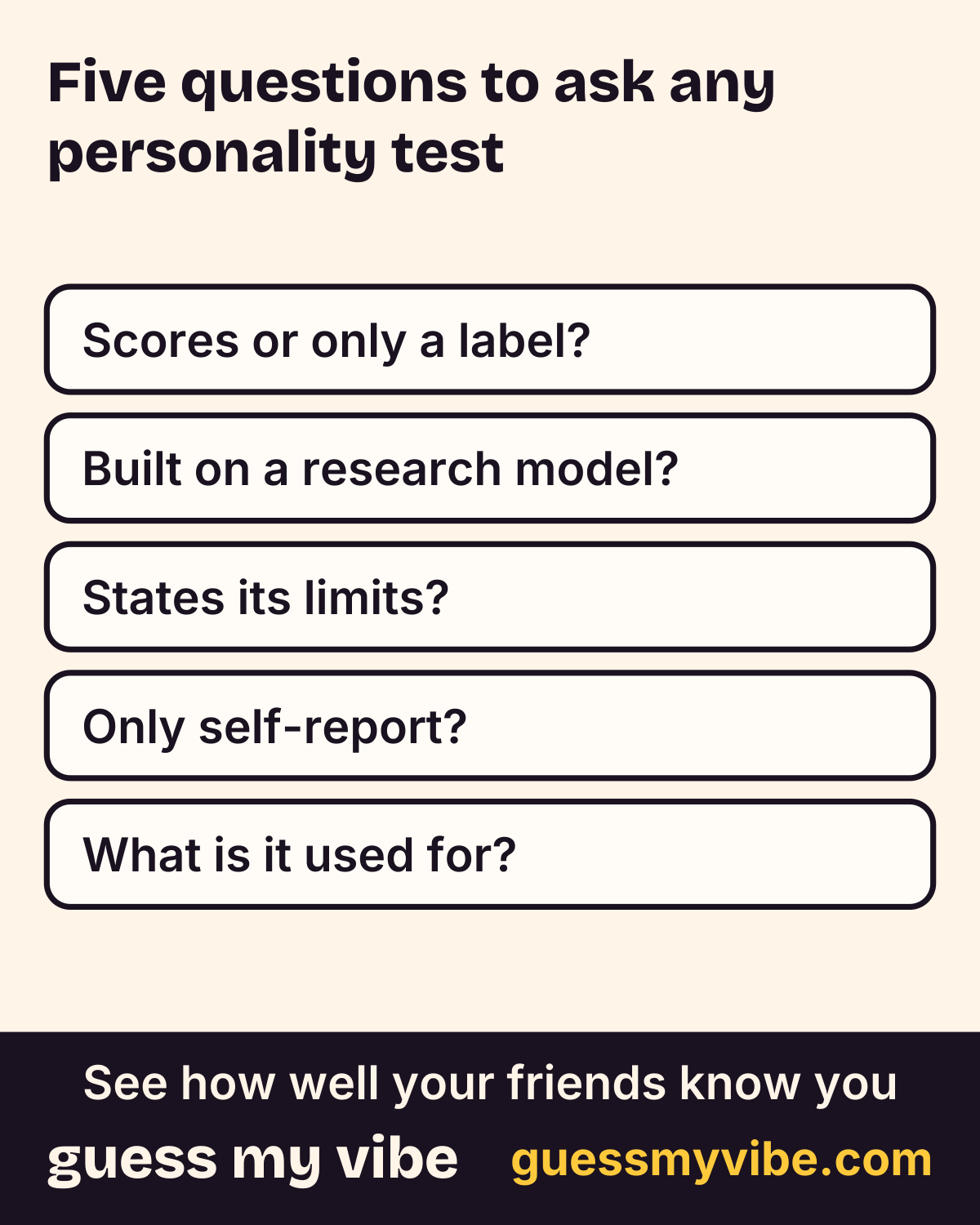
How to judge a personality test
You do not need a psychology degree to spot a weak test. These checks follow from the evidence above and from common sense, and none of them is a guarantee.
- Does it give scores on scales or only a label? Scores on continuous scales fit the research better than boxes, a point covered in our MBTI article.
- Is it built on a research model, such as the Big Five, and does it say so? A quiz that invents its own types without saying where they came from deserves less trust.
- Does it state its limits? A trustworthy test says it describes tendencies and is not a diagnosis or a forecast. Broad trait scores are more stable than narrow sub-scores [8].
- Is it only self-report? Adding a friend's view fills in what you cannot see about yourself [5].
- What is it being used for? A fun look at yourself is fine. Using one to hire or sort people is where the research is most skeptical [3].
Cite this figure
Figure: "Five questions to ask any personality test." Guess My Vibe (guessmyvibe.com). https://guessmyvibe.com/learn/are-personality-tests-accurate#figure-five-checks
What this means for you
Treat a good personality test as a decent sketch, not an X-ray. It can help you notice patterns and give you words for them. It cannot say who you should date or what job to take, and it will miss things that your friends can see. The most useful use is as a conversation: where does your answer differ from how a friend sees you, and what does that gap tell you?
Put your self-view next to a friend's
Guess My Vibe is built around that gap. It uses real Big Five questions: you answer about yourself, a friend guesses your answers, and you see where they were close and where they missed. It is a fun comparison of two views, not a scientific instrument, and not a measure of your personality.
Key takeaways
- "Accurate" has three meanings: consistent, measuring what it claims, and linked to real life. A test can do one and fail another.
- Trait scores from typical questionnaires went with people's average behavior in daily life at correlations between .42 and .56 across 15 experience-sampling studies, a moderate link [1].
- Personality measures have relations to health, relationships and work outcomes [4], but the links are about groups of people, not one person's future.
- Self-report has limits. Across 51 studies, all Big Five factors were equally fakable when people were told to fake [2], and former journal editors found self-report tests had very low validity for job performance in hiring [3].
- Other people see things you do not. A meta-analysis found others' ratings carry information beyond self-ratings [5], and in a study of 165 people the self was the best judge of some traits and friends of others [6].
- This isn't therapy, a diagnosis, or a substitute for professional care.
Questions people ask
Are personality tests accurate?
Good ones are moderately accurate in a specific sense: trait scores went with average daily behavior at correlations between .42 and .56 across 15 studies [1]. They are not perfect, they depend on self-description, and they should not be used as the main basis for hiring [3].
What is the most accurate personality test?
No single test is the most accurate for everything. Tests built on the Big Five, that report scores on continuous scales and state their limits, have the strongest research behind them. Adding a friend's ratings improves on self-report alone [5].
Can you fake a personality test?
Yes, when asked to. In 51 studies, people instructed to fake could change their scores on all five Big Five factors [2]. How often people fake without being told is a separate question.
Do personality test scores change over time?
Broad trait scores are fairly stable in adulthood, with little evidence of increasing stability after about age 25, while narrow sub-scores are less stable [8].
Should employers use personality tests?
Researchers have raised serious doubts. Five former journal editors concluded that the validity of self-report personality tests for job performance is very low and that their use in selection should be reconsidered [3].
Do my friends know my personality better than a test does?
In some ways. Friends were the best judges of intellect-related traits while the self was the best judge of neuroticism-related ones in a study of 165 people [6]. Each view adds something.
See how well your friends know you.
Free. Answer 10 quick questions about you, then send your link. Friends play in their browser, no app needed.
Start freeReferences
- [1] Fleeson, W., & Gallagher, P. (2009). The implications of Big Five standing for the distribution of trait manifestation in behavior: Fifteen experience-sampling studies and a meta-analysis. Journal of Personality and Social Psychology, 97(6), 1097–1114. PubMed: 19968421 (opens in a new tab)
- [2] Viswesvaran, C., & Ones, D. S. (1999). Meta-analyses of fakability estimates: Implications for personality measurement. Educational and Psychological Measurement, 59(2), 197–210. doi.org/10.1177/00131649921969802 (opens in a new tab)
- [3] Morgeson, F. P., Campion, M. A., Dipboye, R. L., Hollenbeck, J. R., Murphy, K., & Schmitt, N. (2007). Reconsidering the use of personality tests in personnel selection contexts. Personnel Psychology, 60(3), 683–729. doi.org/10.1111/j.1744-6570.2007.00089.x (opens in a new tab)
- [4] Ozer, D. J., & Benet-Martínez, V. (2006). Personality and the prediction of consequential outcomes. Annual Review of Psychology, 57, 401–421. PubMed: 16318601 (opens in a new tab)
- [5] Connelly, B. S., & Ones, D. S. (2010). An other perspective on personality: Meta-analytic integration of observers' accuracy and predictive validity. Psychological Bulletin, 136(6), 1092–1122. PubMed: 21038940 (opens in a new tab)
- [6] Vazire, S. (2010). Who knows what about a person? The self-other knowledge asymmetry (SOKA) model. Journal of Personality and Social Psychology, 98(2), 281–300. PubMed: 20085401 (opens in a new tab)
- [7] Roberts, B. W., Kuncel, N. R., Shiner, R., Caspi, A., & Goldberg, L. R. (2007). The power of personality: The comparative validity of personality traits, socioeconomic status, and cognitive ability for predicting important life outcomes. Perspectives on Psychological Science, 2(4), 313–345. PubMed: 26151971 (opens in a new tab)
- [8] Bleidorn, W., Schwaba, T., Zheng, A., Hopwood, C. J., Sosa, S. S., Roberts, B. W., & Briley, D. A. (2022). Personality stability and change: A meta-analysis of longitudinal studies. Psychological Bulletin, 148(7–8), 588–619. PubMed: 35834197 (opens in a new tab)
- [9] Vazire, S., & Mehl, M. R. (2008). Knowing me, knowing you: The accuracy and unique predictive validity of self-ratings and other-ratings of daily behavior. Journal of Personality and Social Psychology, 95(5), 1202–1216. PubMed: 18954202 (opens in a new tab)
How we find and check these sources: how we write. Spotted an error? Report a correction.
Related
- Is MBTI Accurate? MBTI vs the Big Five, Fairly
- Big Five Personality Traits: A Plain-Words Guide
- Self-Perception vs. How Others See You
- Self-Awareness: What the Research Says It Actually Takes
- Personality Blind Spots: What You Can't See About Yourself
- Are You a Good Judge of Character? What Research Finds
- 16Personalities vs the Big Five: How They Differ
Cite this article
- Title
- Are Personality Tests Accurate? What the Evidence Shows
- Publisher
- Guess My Vibe
- Updated
- URL
- https://guessmyvibe.com/
learn/ are-personality-tests-accurate
Copy this citation
Guess My Vibe. (2026, October 7). Are Personality Tests Accurate? What the Evidence Shows. Guess My Vibe. https://guessmyvibe.com/
To point at one section, add that section's anchor (the # link on its heading) to the URL.