Yes, being a good judge of character is a real, measurable individual difference, not just a flattering thing people say about themselves. Research finds people who are more socially skilled, more agreeable and better adjusted tend to read others' personalities more accurately [1]. But a good judge is not a perfect one, and being a good judge of one person doesn't guarantee being a good judge of everyone.
Almost everyone thinks they're a decent judge of character, and research on judging character finds that some people really are better at it than others, just not by the dramatic margin the phrase implies. The honest version of "good judge of character" is a real, modest, measurable edge, not a superpower that lets someone read anyone accurately in five minutes flat.
What actually makes someone a good judge
A study designed specifically to find what separates good judges from everyone else put previously unacquainted groups of three strangers through unstructured get-to-know-you conversations, then measured how accurately each person judged the other two. Three characteristics of the judge were linked to better accuracy: social skill, Agreeableness, and psychological adjustment [1]. None of these are exotic traits. They're closer to "someone who's comfortable in conversation, genuinely interested in other people, and not too anxious or defensive to actually pay attention," which lines up with common sense about who seems to "get" people quickly in real life.
A good judge changes the room, not just their own reading of it
The same study found something less obvious: the accuracy of observers watching a group of three went up when the group contained more good judges. The author's reading is that this points to something beyond a pure solo skill: a good judge's own personality and behavior may draw more natural, revealing behavior out of the people they're talking to, which gives everyone watching (not just the good judge) better material to work with [1]. Being a good judge of character, in other words, isn't purely a receiving skill. Part of it is making other people easier to read in the first place.
Two different things "good judge" can mean
"Good judge of character" quietly blends two separate questions that researchers actually study apart from each other: is this person generally accurate across everyone they judge (perceptive accuracy), and is some other specific person just generally easy for anyone to read accurately (expressive accuracy)? A statistical framework for separating these, the Social Accuracy Model, found reliable individual differences in several aspects of interpersonal perception, including both [2]. That means some of what looks like "my friend is a great judge of character" might actually be "the person they're judging happens to be an easy read," and some of what looks like "I'm hard to read" might really be "the people around me aren't especially good judges." The same conversation has two people in it, and the accuracy of the read depends on both.
Curious how your friends would answer?
Free. Answer 10 quick questions about you, then send your link. Friends play in their browser, no app needed.
Start freeWhy accuracy isn't automatic, even for a good judge
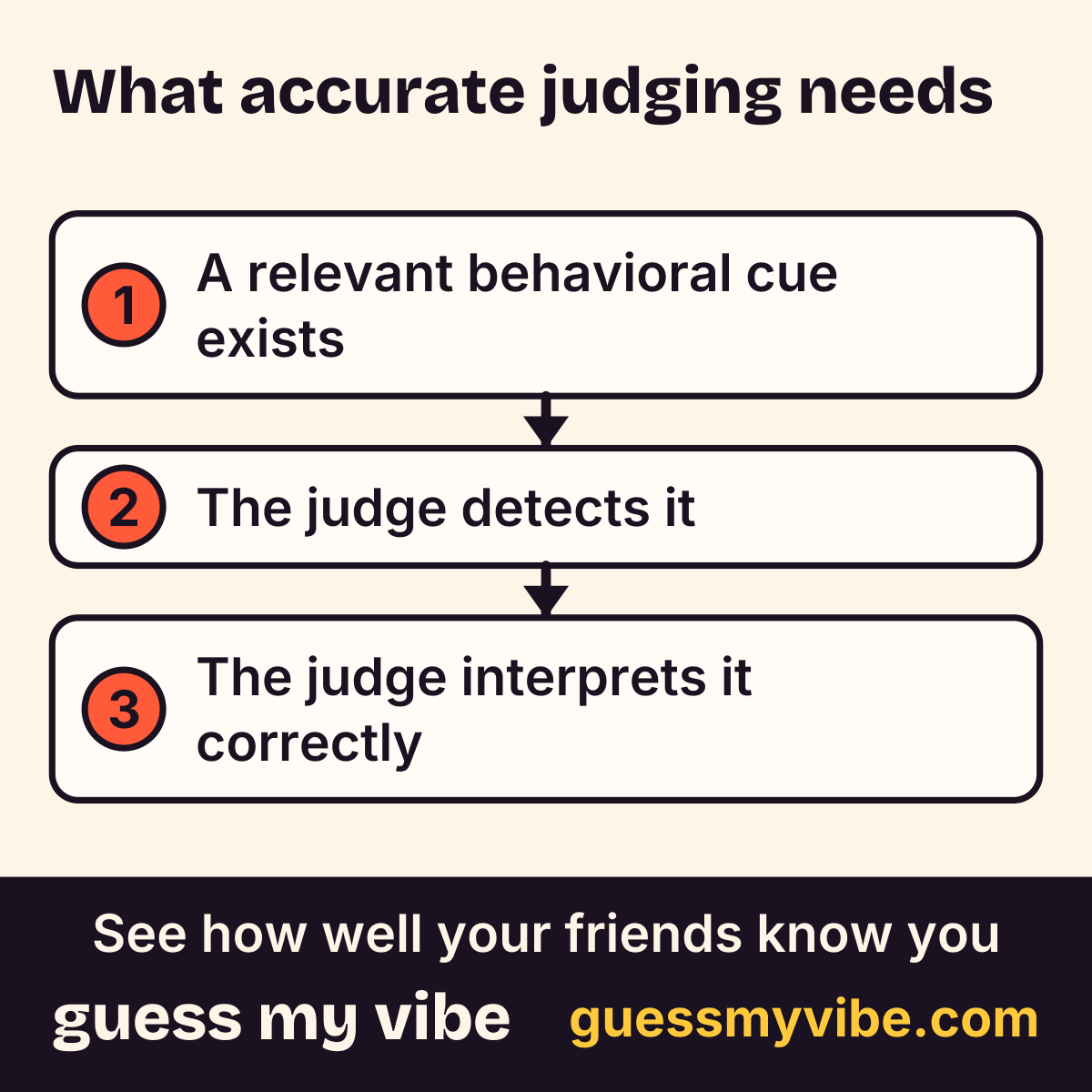
A foundational framework for how personality judgment works at all, the Realistic Accuracy Model, lays out why even a talented judge can still misread someone: an accurate judgment requires a relevant behavioral cue to actually exist, the judge to detect that cue among everything else happening, and the judge to then interpret it correctly [3]. A skip at any one of those three steps breaks the chain. A genuinely good judge can still misread someone who's simply not showing much relevant behavior that day, is in an unfamiliar setting, or is being read on a trait that's inherently hard to observe from the outside, like private worry or self-doubt. This is also why closeness and repeated exposure matter so much across personality research generally; a meta-analysis of 44,178 people found closeness to the rater mattered most specifically for traits that are hard to observe, exactly the traits where even a good judge's skill alone isn't enough without real access to the right cues [4].
Cite this figure
Figure: "What accurate judging needs." Guess My Vibe (guessmyvibe.com). https://guessmyvibe.com/learn/good-judge-of-character#figure-three-links-in-the-chain
Is being a good judge a fixed talent?
Nothing in this research suggests judging accuracy is either purely innate or purely learnable; the honest answer is that it hasn't been tested that way here. What the research does show is that judging accuracy correlates with traits (social skill, Agreeableness, adjustment) that themselves aren't fixed from birth and do shift somewhat over a lifetime. It's reasonable to read this as "some people currently have an edge, for identifiable reasons," without extending it into "and that edge is permanent or impossible to build toward." That's a more honest claim than either a hopeless "some people just have it" or an overconfident "anyone can become a master judge of character with practice," neither of which the studies above actually tested.
What this means for a "call it" style game
A game that scores how well you read a friend's answers, or how well they read yours, is tapping into exactly the real, modest skill this research describes, not inventing a new one. It's worth being clear-eyed about what a single score from one game session can and can't tell you: it reflects your accuracy with one specific person, on one specific day, on a specific set of questions, not a certified, stable measurement of your general character-judging ability the way the multi-session lab studies above were designed to isolate. A high score is a genuinely fun, honest signal that you read that friend well on those traits. It isn't a diagnosis of how good a judge of character you are in general, any more than one good conversation proves someone is universally socially skilled. Treat it the way the research above treats its own findings: real, specific, worth noticing, and still only one small, honest piece of a much bigger picture. If it helps, notice the situations where your reads have turned out right and the ones where they haven't, and treat that as useful information about where your own judgment is strongest.
See where you actually land
If you're curious whether you're a good judge of a specific friend's character rather than character in the abstract, Guess My Vibe gives you something to actually check it against: you guess your friend's answers to real Big Five personality questions, they guess yours, and you both see how close the calls landed. It's a smaller, friendlier version of exactly what the lab studies above measured, minus the unstructured strangers and the three-person conversation.
Key takeaways
- A "good judge of character" is a real, studied trait: judges higher in social skill, Agreeableness and adjustment were more accurate at reading new acquaintances' personalities in a controlled study [1].
- Judging accuracy splits into two separate things: how good a specific judge is in general (perceptive accuracy), and how easy a specific person is to read, regardless of who's judging them (expressive accuracy) [2].
- Accuracy isn't automatic even for a good judge. It requires a relevant behavioral cue to actually be available, the judge noticing it, and the judge interpreting it correctly [3].
- A good judge's own behavior may change the outcome: in one study, observers' accuracy was higher for conversations with more good judges in them, which the author took to imply that good judges draw more revealing behavior out of the people around them [1].
- This isn't therapy, a diagnosis, or a substitute for professional care; it's a plain-English summary of what personality research says about judging character.
Questions people ask
Is being a good judge of character a real thing, scientifically?
Yes. A study of unacquainted triads found judges higher in social skill, Agreeableness, and psychological adjustment were measurably more accurate at reading new acquaintances' personalities [1].
What personality traits make someone a good judge of character?
Social skill, Agreeableness, and psychological adjustment were the three characteristics linked to higher accuracy in a controlled study of first-time interactions [1].
Is it the judge or the person being judged that matters more?
Both, separately. Research distinguishes perceptive accuracy (how good a specific judge is in general) from expressive accuracy (how easy a specific person is to read, regardless of who's judging), and finds reliable individual differences in each [2].
Why can a good judge still misread someone?
Because accuracy requires a relevant behavioral cue to be available, the judge to notice it, and the judge to interpret it correctly. Any missing link breaks the chain, regardless of the judge's general skill [3].
Can you get better at judging character with practice?
The research above hasn't directly tested whether practice improves judging accuracy. It shows the skill correlates with traits like social skill and adjustment, which aren't fixed, but it doesn't prove training alone closes the gap.
Does a high score in a friend-guessing game mean I'm a good judge of character?
It means you read that specific friend well on that specific set of questions, which is a real and fun signal, but it isn't a certified, general measurement of judging ability the way a multi-session lab study would be.
See how well your friends know you.
Free. Answer 10 quick questions about you, then send your link. Friends play in their browser, no app needed.
Start freeReferences
- [1] Letzring, T. D. (2008). The good judge of personality: Characteristics, behaviors, and observer accuracy. Journal of Research in Personality, 42(4), 914–932. PubMed: 19649134 (opens in a new tab)
- [2] Biesanz, J. C. (2010). The social accuracy model of interpersonal perception: Assessing individual differences in perceptive and expressive accuracy. Multivariate Behavioral Research, 45(5), 853–885. PubMed: 26795267 (opens in a new tab)
- [3] Funder, D. C. (1995). On the accuracy of personality judgment: A realistic approach. Psychological Review, 102(4), 652–670. doi.org/10.1037/0033-295X.102.4.652 (opens in a new tab)
- [4] Connelly, B. S., & Ones, D. S. (2010). An other perspective on personality: Meta-analytic integration of observers' accuracy and predictive validity. Psychological Bulletin, 136(6), 1092–1122. PubMed: 21038940 (opens in a new tab)
How we find and check these sources: how we write. Spotted an error? Report a correction.
Related
- First Impressions: How Fast and How Accurate They Are
- Thin Slicing: What a Few Seconds Reveal About You
- The Liking Gap: Why People Like You More Than You Think
- How to Make a Good First Impression, According to Research
- Agreeableness: The Trait Closeness Barely Helps Friends Read
- How to Tell if Someone Is Trustworthy (Faces Won't Help)
- Are Personality Tests Accurate? What the Evidence Shows
Cite this article
- Title
- Are You a Good Judge of Character? What Research Finds
- Publisher
- Guess My Vibe
- Updated
- URL
- https://guessmyvibe.com/
learn/ good-judge-of-character
Copy this citation
Guess My Vibe. (2026, October 3). Are You a Good Judge of Character? What Research Finds. Guess My Vibe. https://guessmyvibe.com/
To point at one section, add that section's anchor (the # link on its heading) to the URL.