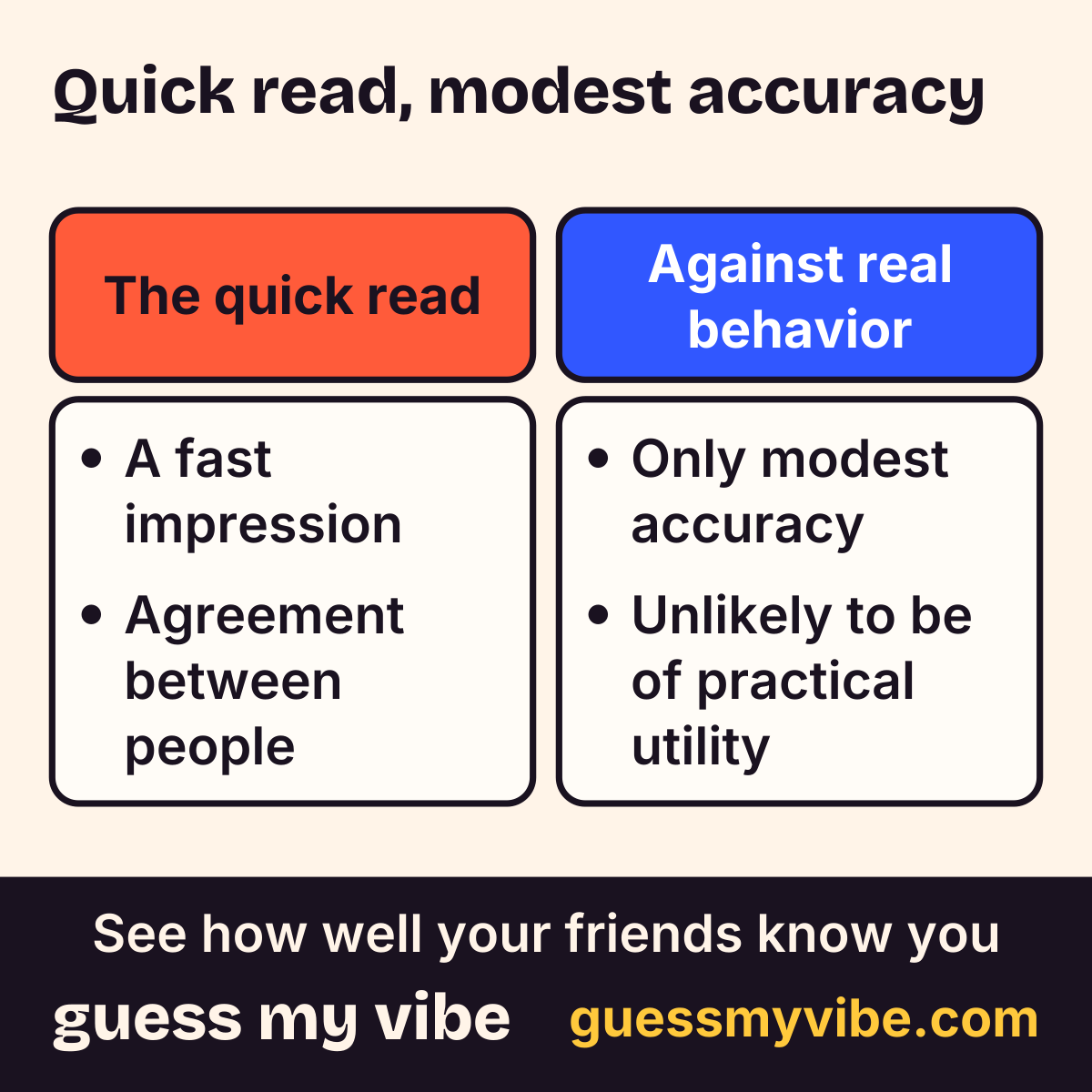
You can't reliably tell if someone is trustworthy from their face. Research finds people agree with each other about who looks trustworthy, but agreement isn't accuracy: a 2022 meta-analysis found perceived and actual trustworthiness were only modestly related, and the authors said that accuracy is unlikely to be of practical use [1]. Faces give a fast, confident first impression, not evidence.
How to tell if someone is trustworthy: not from their face
If you're trying to work out how to tell if someone is trustworthy on a first meeting, a profile photo or a glance across a room, here is the research answer: the face is a poor guide. People do form strong, fast opinions about whether a stranger looks trustworthy, and those opinions are surprisingly consistent from person to person. But consistent is not the same as correct. A 2022 meta-analysis of the evidence found that how trustworthy a face looks and how trustworthy the person actually is are only modestly related, and the authors concluded that this accuracy is unlikely to be of practical utility [1].
That's a useful thing to know, because the feeling of reading someone's trustworthiness is vivid and confident. This article explains where that feeling comes from, what happens when researchers test it against real behavior, and what the evidence can and can't say about better ways to judge. For the other side, how trust is built between people who already know each other, see our how to build trust article.
Why some faces feel trustworthy
Researchers asked people to judge emotionally neutral faces on many traits and found that the judgments boil down to two dimensions: valence, roughly whether someone seems friendly or threatening, and dominance, roughly whether they seem strong or weak. Valence can be approximated by judgments of trustworthiness [4]. Faces that look more trustworthy tend to have features resembling expressions that signal approach, while less trustworthy ones resemble expressions that signal avoidance.
The authors' explanation is the important part. They suggest that face evaluation is an overgeneralization of adaptive mechanisms for inferring harmful intentions, and that this can account for rapid, yet not necessarily accurate, judgments [4]. In plain words: we read emotion-like cues in a resting face, and then treat them as information about character. A person whose neutral face happens to resemble a slight smile can look kind, and a person whose neutral face resembles a frown can look hostile, even when neither reflects how they act.
How fast the impression forms
The impression also arrives almost instantly. In five experiments, judgments made after a 100-millisecond exposure to a face (about a tenth of a second) correlated highly with judgments made with no time limit, and for trustworthiness among other traits, extra time didn't significantly increase that correlation. Longer exposure did make judgments more confident and more differentiated between people [2]. The study measured how fast impressions form and how well they agree, not whether they're right, so it says nothing about accuracy.
This helps explain why the feeling is so convincing. The judgment shows up fast, and further looking did not significantly improve how well it matched the quick one while confidence rose for some judgments, so it feels like you saw something real. A review of this research notes that there is consensus in attributing social and personality traits from faces, and that surprisingly little time and effort are needed to reach it [3]. Consensus, though, is a statement about how much people agree with each other. It doesn't show that the thing they agree on is true.
What happens when face judgments are tested against real behavior
The decisive test is to compare how trustworthy faces look with how people actually behave. Rule and colleagues ran five studies. In one, the type of photo judged made a significant difference to whether a person looked trustworthy, so the same person can look more or less trustworthy depending on the picture. In others, faces of corporate criminals were judged no differently from faces of non-criminal executives, and faces of military criminals no differently from faces of military heroes [5].
The most direct study tempted undergraduates to cheat on a test. Judgments of intelligence from their faces were related to their test scores, and judgments of extraversion correlated with self-reported extraversion. But there was no relationship between judged trustworthiness from the students' faces and whether they actually cheated [5]. A brain-imaging part of the study found that amygdala responses tracked perceived trustworthiness, but not actual cheating. The authors concluded that judgments of trustworthiness may not be accurate and instead reflect subjective impressions that people agree on [5].
Notice what this study does not say. It doesn't say faces carry no information about anything, since some trait judgments tracked reality in the same experiment. It says trustworthiness specifically did not track cheating in that test. One experiment with undergraduates is also not a final word, which is why the next section matters.
Curious how your friends would answer?
Free. Answer 10 quick questions about you, then send your link. Friends play in their browser, no app needed.
Start freeWhat the big meta-analysis found
Foo and colleagues pooled the evidence in two meta-analyses. The first asked whether faces that look more trustworthy belong to people who really are more trustworthy; the second asked whether people, as perceivers, do better than chance at spotting trustworthiness. Both found significant but modest accuracy: r = .14 at the level of faces and r = .27 at the level of perceivers [1]. A correlation of .14 means a very weak relationship, and .27 means a weak-to-moderate one. Neither is the kind of accuracy you'd want to rely on for a decision with real stakes.
The meta-analysis also found the effect depended on the domain. Perceivers did better at judging aggressiveness and sexual unfaithfulness than agreeableness, criminality, financial reciprocity and honesty [1]. In other words, accuracy was weaker for judgments close to what people use trustworthiness for, such as honesty and financial reciprocity. The authors concluded that this modest accuracy is unlikely to be of practical utility. They also flagged a preponderance of Western studies, which means we know least about how this works across cultures [1]. And Todorov and colleagues' review reached a similar view, arguing that the diagnostic validity of social attributions from faces has been greatly overstated in the literature [3].
The honest statement, then, is not that face-based trust judgments are always wrong, since a modest correlation is still above zero. It is that they are too weak and too noisy to be a useful signal in any individual case, while feeling far more certain than they should.
Cite this figure
Figure: "Quick read, modest accuracy." Guess My Vibe (guessmyvibe.com). https://guessmyvibe.com/learn/how-to-tell-if-someone-is-trustworthy#figure-face-impression-not-evidence
What to use instead of a gut feeling about a face
The studies above test faces, and they do not test alternatives, so be careful about claims that any single trick works better. What they do establish is a negative: the quick read on a face is not evidence. That points toward the kind of information a face can't give you, which is how someone acts across time and situations. Whether they do what they say, whether they're the same person when it costs them something, how they treat people who can do nothing for them. Our how to build trust article covers how trust develops through those repeated experiences, and our first impressions and thin slicing articles cover when quick reads are more reliable, such as for traits like extraversion.
A few modest habits follow from the research without overreaching. Notice the fast feeling and treat it as a hypothesis. Be a little more suspicious of your confidence than of the impression itself, since longer looking did not significantly raise the correlation with the quick judgment but did boost confidence for some judgments [2]. And remember the photo effect: the same person can look more or less trustworthy in different pictures [5], so a single profile photo is a weak basis for judging anyone. If a decision has real consequences, such as money, safety or a major commitment, a face is not the evidence to rest it on.
A better test: how well do you know the people you already trust?
There's a flip side to all this. We spend a lot of energy judging strangers from a glance, and much less checking how accurately we read the people we know well. Guess My Vibe turns that into something you can try: friends guess how you'd answer questions about your Warmth, Social battery and other traits, and you see where their read of you matched and where it missed. It's a small, low-stakes reminder that confident impressions and accurate ones are different things, even for people who have known you for years.
Key takeaways
- People form a trustworthiness impression from a face in about a tenth of a second, and those impressions agree with each other, but a review of the research argues their diagnostic validity has been greatly overstated [2] [3].
- Face impressions run on a valence dimension that tracks looking friendly versus threatening, which is why they feel meaningful even when they aren't accurate [4].
- In a tempted-cheating experiment, how trustworthy a student's face looked was unrelated to whether they cheated [5].
- A meta-analysis found only modest accuracy (r = .14 across faces, r = .27 across perceivers), and its authors said this is unlikely to be of practical utility [1].
- This isn't therapy, a diagnosis, or a substitute for professional care; it's a plain-English summary of social-perception research.
Questions people ask
Can you tell if someone is trustworthy by looking at them?
Not reliably. A meta-analysis found only modest accuracy (r = .14 across faces, r = .27 across perceivers) and said it is unlikely to be of practical utility [1]. A tempted-cheating experiment also found no link between how trustworthy a face looked and who cheated [5].
Why do some people just look trustworthy?
Judgments of trustworthiness track features of a neutral face that resemble approach-signaling expressions, such as looking friendly rather than angry, an overgeneralization of mechanisms for spotting harmful intent [4]. People agree about it, but agreement isn't accuracy [3].
How quickly do we judge trustworthiness?
Very quickly. Judgments made after a 100-millisecond look at a face correlated highly with judgments made with no time limit, and more time did not significantly raise that correlation, though confidence rose for some judgments [2].
Do trustworthy-looking people behave more honestly?
Only slightly at best. In one study, faces of corporate criminals were judged no differently from those of non-criminal executives [5], and the meta-analysis found accuracy for honesty and financial reciprocity to be weaker than for aggressiveness and sexual unfaithfulness [1].
What's a better way to judge whether to trust someone?
These studies test faces, not alternatives, so they can't rank other methods. What they support is not relying on a first look. Trust usually builds from how someone behaves over time; see our how to build trust article.
See how well your friends know you.
Free. Answer 10 quick questions about you, then send your link. Friends play in their browser, no app needed.
Start freeReferences
- [1] Foo, Y. Z., Sutherland, C. A. M., Burton, N. S., Nakagawa, S., & Rhodes, G. (2022). Accuracy in facial trustworthiness impressions: kernel of truth or modern physiognomy? A meta-analysis. Personality and Social Psychology Bulletin, 48(11), 1580-1596. PubMed: 34609231 (opens in a new tab)
- [2] Willis, J., & Todorov, A. (2006). First impressions: Making up your mind after a 100-ms exposure to a face. Psychological Science, 17(7), 592–598. PubMed: 16866745 (opens in a new tab)
- [3] Todorov, A., Olivola, C. Y., Dotsch, R., & Mende-Siedlecki, P. (2015). Social attributions from faces: determinants, consequences, accuracy, and functional significance. Annual Review of Psychology, 66, 519-545. PubMed: 25196277 (opens in a new tab)
- [4] Oosterhof, N. N., & Todorov, A. (2008). The functional basis of face evaluation. Proceedings of the National Academy of Sciences, 105(32), 11087-11092. PubMed: 18685089 (opens in a new tab)
- [5] Rule, N. O., Krendl, A. C., Ivcevic, Z., & Ambady, N. (2013). Accuracy and consensus in judgments of trustworthiness from faces: behavioral and neural correlates. Journal of Personality and Social Psychology, 104(3), 409-426. PubMed: 23276271 (opens in a new tab)
How we find and check these sources: how we write. Spotted an error? Report a correction.
Related
- How to Build Trust in a Friendship, According to Research
- First Impressions: How Fast and How Accurate They Are
- Snap Judgments: How Accurate Are They, Really?
- Thin Slicing: What a Few Seconds Reveal About You
- Are You a Good Judge of Character? What Research Finds
- How to Read People: The Cues That Actually Work
Cite this article
- Title
- How to Tell if Someone Is Trustworthy (Faces Won't Help)
- Publisher
- Guess My Vibe
- Updated
- URL
- https://guessmyvibe.com/
learn/ how-to-tell-if-someone-is-trustworthy
Copy this citation
Guess My Vibe. (2026, October 4). How to Tell if Someone Is Trustworthy (Faces Won't Help). Guess My Vibe. https://guessmyvibe.com/
To point at one section, add that section's anchor (the # link on its heading) to the URL.