A snap judgment from a total stranger, someone who's never met you, interacted with you, or even heard you speak, is better than a guess for some traits and close to useless for others. Research on "zero acquaintance" (judging someone from a single photo, silent clip, or voice recording, with zero actual interaction) finds strangers' ratings were most valid for how outgoing and how conscientious someone is, and weaker for traits like how warm or how emotionally steady someone is. Snap judgments are also reliably distorted by looks: attractive people get rated as warmer and more open than their own self-reports actually support.
What "zero acquaintance" actually means
Snap judgment research covers a few different setups, and it's worth being precise about which one this article is about. "Zero acquaintance" is the strictest version: a stranger who has never met the person, never spoken to them, and isn't even watching them interact with anyone, forms a judgment from one single, isolated piece of information. In the classic study that established this paradigm, 100 adults were videotaped walking into a room, sitting down, and reading a short weather forecast aloud, about 90 seconds of footage. Strangers who'd never seen any of them then rated their personalities from just one slice of that footage: a sound film, a silent film, a single still photo, or only the audio [1]. No conversation. No back-and-forth. No chance to ask a question or watch how someone actually treats another person.
That's a genuinely harder test than it might sound. It's also a narrower, more controlled question than "how accurate is a first impression" in general, which usually involves watching someone talk or interact for a few minutes. Zero acquaintance strips even that away, right down to what a single photo or a few seconds of silent footage can carry.
What strangers actually get right
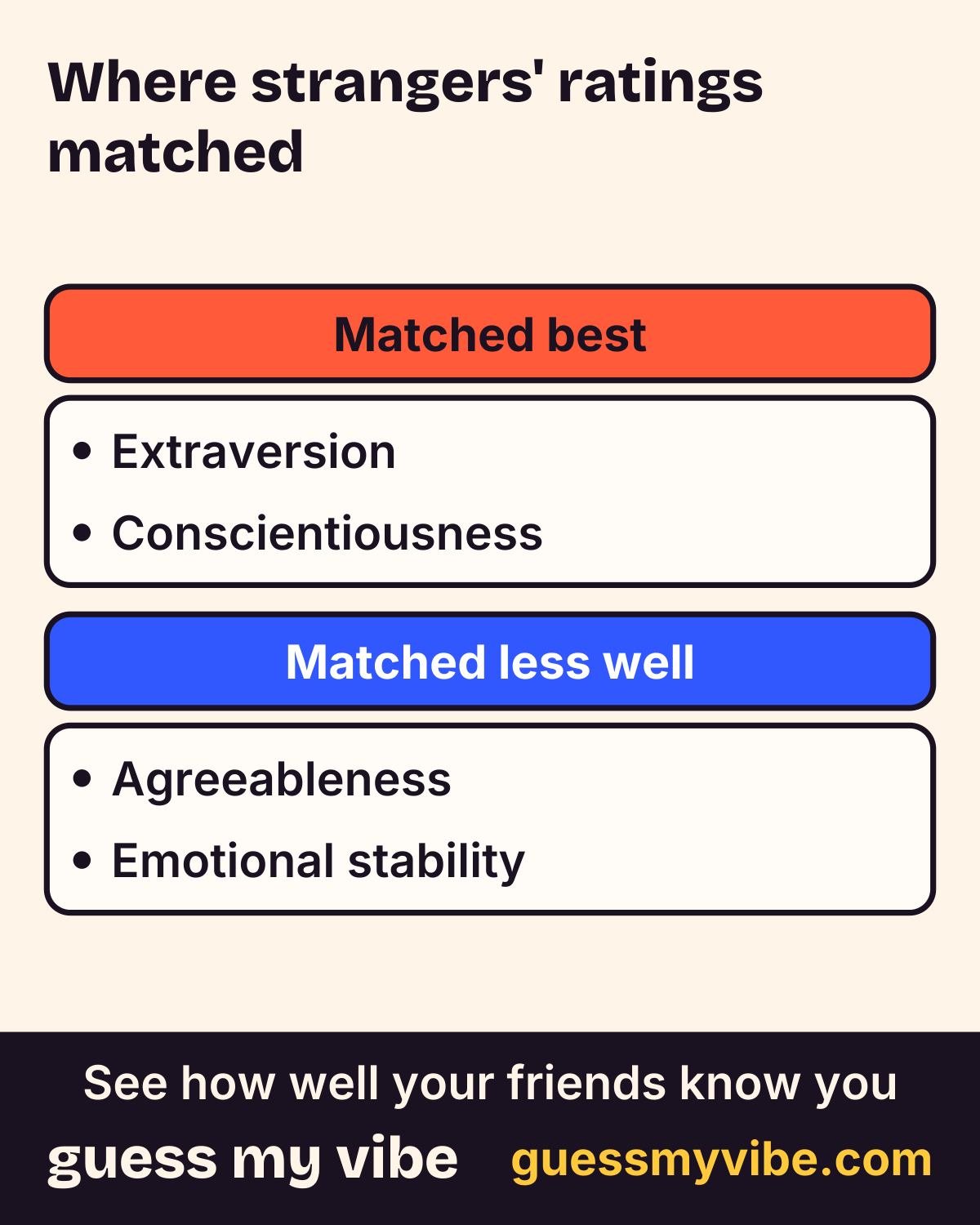
The honest answer is: more than chance, for some things. Strangers' ratings from that single slice of information lined up with the targets' own self-reported personality, and they were most valid for Extraversion and Conscientiousness. The strangers' built-in assumptions about how traits go with looks and manner were also more accurate for those two traits than for Agreeableness, emotional stability (how anxious, moody, or easily stressed someone is), or openness [1]. The study also found that how much information strangers got mattered: it changed how valid their ratings were, though not how consistent they were with each other. A strong match means two people who are genuinely different on a trait will usually, not always, rank in the expected order; a weak one is a faint signal with a lot of noise mixed in.
That pattern, outgoing behavior reads clearly, inner emotional states don't, shows up again and again across personality-judgment research, and it has an explanation that isn't just "some people are easier to read." The Realistic Accuracy Model lays out the actual chain: an outside judgment of someone's trait can only be accurate if that trait produces a visible behavioral cue, the cue actually gets noticed by the person judging, and the judge then interprets the cue correctly [2]. Extraversion is practically built for this chain: it shows up in posture, movement, facial expression, even in 90 seconds of silent footage, and those cues aren't easy to miss or misread. Anxiety and stress proneness mostly don't work that way. They can simmer entirely below the surface, visible maybe to someone who's watched a person for months, essentially invisible to a stranger watching 90 seconds of video.
Cite this figure
Figure: "Where strangers' ratings matched." Guess My Vibe (guessmyvibe.com). https://guessmyvibe.com/learn/snap-judgments#figure-where-strangers-do-better
Curious how your friends would answer?
Free. Answer 10 quick questions about you, then send your link. Friends play in their browser, no app needed.
Start freeThe bias: looks shape the snap judgment too
Accuracy is only half the picture. The same zero-acquaintance study also measured something separate from accuracy: whether strangers' ratings were pulled in a particular direction by a physical attribute that has nothing to do with the trait itself. Physical attractiveness turned out to be exactly that kind of distortion. Strangers rated attractive targets as noticeably more agreeable and more open than those targets' own self-reports actually backed up. The correlation between a target's rated attractiveness and a stranger's agreeableness rating of them was .31; the correlation between that same target's attractiveness and their own self-reported agreeableness was only .08 [1]. In plain terms: attractive people weren't meaningfully more agreeable by their own account, but strangers rated them as if they were. That's a halo effect, not an accurate read, and it's baked into the same snap-judgment process that gets Extraversion mostly right.
This is the part a lot of "first impressions are surprisingly accurate" takes leave out. A snap judgment isn't one clean signal; it's a mix of real, usable information about some traits and a genuine bias riding along with it for others, and from the inside, the two feel identical. Nothing about how confident a stranger seems in their read tells you which part you're getting.
A stranger's snap judgment vs. someone who actually knows you
None of this means acquaintance doesn't matter, it very much does, just unevenly across traits, the same way zero acquaintance itself does. A meta-analysis pooling 263 samples and more than 44,000 people found the exact traits that are hardest for a total stranger (things tied to inner emotional states) are also the traits where closeness to the rater matters most: the better someone actually knows you, the more that specific gap closes [4]. A separate study that checked people's self-views, friends' views, strangers' views, and behavioral test results side by side added a wrinkle: the person being judged is still the best judge of their own anxiety and worry, friends were the best judges of traits tied to intellect, and everyone, self included, was about equally good at judging how outgoing someone is [3]. A stranger's zero-acquaintance snap judgment is a real but limited starting point. Time and actual interaction don't just add more of the same information; they open up access to traits a single photo or silent clip structurally can't carry at all.
See how your own read compares
Guess My Vibe scores how close a friend's guess lands to your real answers across the same kinds of traits this research measures, outgoing behavior, warmth, stress, and more. It's not a zero-acquaintance stranger's snap read; it's someone who already knows you guessing on purpose, which is exactly the condition the research above says should close the gap on the traits a stranger gets wrong.
Key takeaways
- "Zero acquaintance" is a specific research setup: strangers judging someone from a single photo, silent video, sound video, or audio clip, with no conversation and no interaction at all [1].
- Under those conditions, strangers' ratings matched the person's own self-reported personality best for Extraversion and Conscientiousness, and less well for traits like Agreeableness and emotional stability, how anxious or stressed someone really is [1].
- Snap judgments carry a real, measurable bias: strangers rated attractive people as more agreeable and more open than those same people's own self-reports supported, a halo effect separate from any trait strangers were actually reading correctly [1].
- The pattern isn't random. A trait only comes through in a snap judgment if it reliably shows up as a visible cue, gets noticed, and gets read correctly, and the first two steps are much easier for outgoing, expressive behavior than for an inner state like worry [2].
- A friend who's actually spent time with you adds something a stranger's snap judgment can't, especially for traits tied to intellect, where friends were the best judges; you remain the best judge of your own anxiety, and on how outgoing you are, everyone reads about equally well [3].
- This isn't therapy, a diagnosis, or a substitute for professional care.
Questions people ask
Are snap judgments from strangers actually accurate?
Partly. In zero-acquaintance research, strangers' ratings from a single photo or short clip matched people's own self-reported personality best for Extraversion and Conscientiousness and less well for traits like emotional stability [1]. Accuracy depends heavily on which trait you mean.
What's the difference between a snap judgment and a first impression?
They overlap, but "zero acquaintance" (the research behind snap judgments) is stricter: a stranger rates someone from one isolated piece of information, like a single photo or a silent clip, with no interaction at all. A typical first impression usually involves at least a few minutes of watching someone talk or interact.
Why are some personality traits easier to guess than others?
A trait only comes through in a stranger's judgment if it shows up as a visible cue, the cue gets noticed, and it gets read correctly. Outgoing behavior checks all three boxes easily; an inner state like anxiety mostly doesn't [2].
Does being attractive make people seem to have a better personality?
Yes, and the research separates this from actual accuracy. Strangers rated attractive people as more agreeable and more open than those people's own self-reports supported, a bias (a halo effect), not a correct read [1].
Do close friends make better snap judgments than strangers?
Friends aren't making "snap" judgments in the zero-acquaintance sense, but closeness does close the accuracy gap, especially for traits strangers read poorly, like anxiety and stress [4]. On how outgoing someone is, strangers, friends, and the person themselves land in roughly the same place [3].
Can a snap judgment ever replace actually getting to know someone?
No. It's a real but narrow signal, strong for a couple of traits, weak or biased for others. This isn't therapy, a diagnosis, or a substitute for professional care, and it isn't a substitute for actually spending time with someone either.
See how well your friends know you.
Free. Answer 10 quick questions about you, then send your link. Friends play in their browser, no app needed.
Start freeReferences
- [1] Borkenau, P., & Liebler, A. (1992). Trait inferences: Sources of validity at zero acquaintance. Journal of Personality and Social Psychology, 62(4), 645–657. doi.org/10.1037/0022-3514.62.4.645 (opens in a new tab)
- [2] Funder, D. C. (1995). On the accuracy of personality judgment: A realistic approach. Psychological Review, 102(4), 652–670. doi.org/10.1037/0033-295X.102.4.652 (opens in a new tab)
- [3] Vazire, S. (2010). Who knows what about a person? The self-other knowledge asymmetry (SOKA) model. Journal of Personality and Social Psychology, 98(2), 281–300. PubMed: 20085401 (opens in a new tab)
- [4] Connelly, B. S., & Ones, D. S. (2010). An other perspective on personality: Meta-analytic integration of observers' accuracy and predictive validity. Psychological Bulletin, 136(6), 1092–1122. PubMed: 21038940 (opens in a new tab)
How we find and check these sources: how we write. Spotted an error? Report a correction.
Related
Cite this article
- Title
- Snap Judgments: How Accurate Are They, Really?
- Publisher
- Guess My Vibe
- Updated
- URL
- https://guessmyvibe.com/
learn/ snap-judgments
Copy this citation
Guess My Vibe. (2026, October 3). Snap Judgments: How Accurate Are They, Really?. Guess My Vibe. https://guessmyvibe.com/
To point at one section, add that section's anchor (the # link on its heading) to the URL.