A personality blind spot is a trait other people can see in you that you can't easily see in yourself. Research finds these blind spots aren't spread evenly across every trait. They cluster specifically on the most flattering and the most unflattering traits, exactly where you have the most reason to see yourself kindly [1]. A friend's honest guess is one of the few ways to actually find yours.
What a personality blind spot actually is
A personality blind spot is a real, specific gap: a trait where other people's view of you is more accurate than your own. It's not the same as just being a little wrong about yourself here and there. Everyone's self-view is imperfect in small, random ways. A true blind spot is something more patterned than that, a trait where your own rating is systematically off in a particular direction, usually a flattering one, and where the people around you can see the gap clearly even though you can't. Personality research has spent decades asking a very practical question about this: when self-view and other-view disagree, which one is actually tracking reality, and does the disagreement happen on every trait equally, or does it cluster somewhere specific?
Why personality blind spots cluster on your best and worst traits
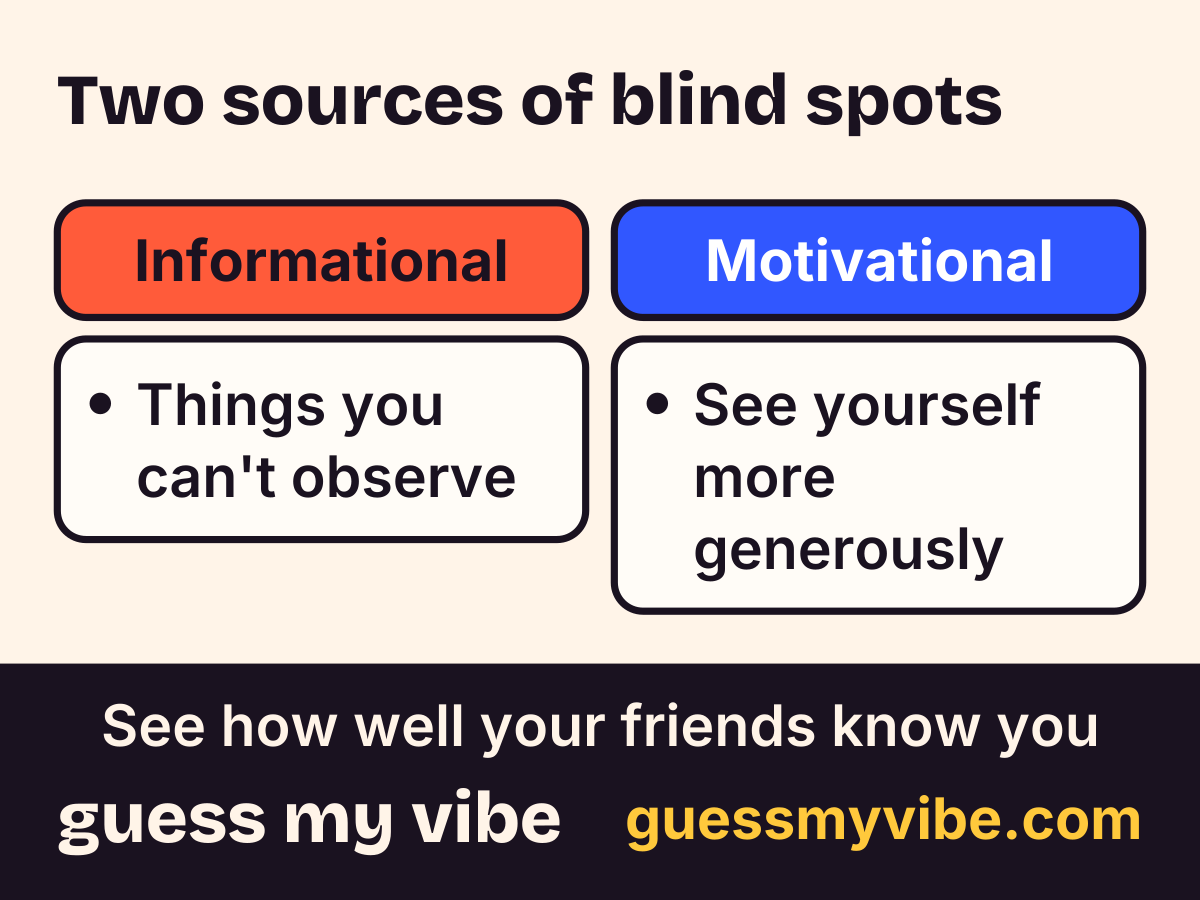
The answer, according to a review of this research, is that blind spots aren't random at all. Self-perceptions are largely accurate across the board, but they have genuine blind spots from two distinct sources [1]. The first is informational: there are things about yourself you structurally can't observe, like what your face does when you're not paying attention, or how your tone lands in a tense conversation. The second is motivational: people have real, usually unconscious reasons to see themselves a little more generously than a neutral observer would, and that pull is strongest exactly on the traits that matter most to a person's self-image. Put those two sources together and a pattern falls out: the biggest blind spots show up on the most evaluative traits, the ones that are clearly good (generous, smart, a good friend) or clearly bad (controlling, dishonest, cold) to have. Nobody has much motivation to distort their self-view on a trait nobody cares about either way. Everybody has some motivation to distort it on the traits that feel like they define whether you're a good person.
Cite this figure
Figure: "Two sources of blind spots." Guess My Vibe (guessmyvibe.com). https://guessmyvibe.com/learn/personality-blind-spots#figure-two-sources
What a study on being seen as "difficult" actually found
One of the more striking tests of this came from a study of people in basic military training, a setting where small groups spend months living and working closely together, which gives peers an unusually large amount of real behavioral information to judge each other on [2]. Researchers collected both self-ratings and peer-ratings of a range of difficult-to-admit personality traits, then asked a sharper question than a normal personality survey ever does: not just "how would you rate yourself," but "how do you think your peers would rate you." The answer was genuinely informative. When people guessed how a peer would describe them, that guess carried real, measurable knowledge of how they were actually seen, information that didn't show up anywhere in their ordinary self-ratings. In other words, people weren't simply unaware. A piece of accurate self-knowledge was sitting there the whole time, just never surfacing unless someone asked for it directly.
There's a second finding from the same study worth sitting with. Among people who guessed their peers would see them as, say, narcissistic, the ones who agreed with that guess when asked ended up being rated less negatively by their actual peers than the ones who denied it. Admitting you suspect you come across a certain way, even an unflattering way, seemed to soften how negatively you were actually seen. That's the opposite of what a lot of people assume, that owning a flaw makes it more visible. Here, owning it looks like it made the flaw a little less defining.
Curious how your friends would answer?
Free. Answer 10 quick questions about you, then send your link. Friends play in their browser, no app needed.
Start freeCan you close your own blind spot? What "meta-insight" means
A separate line of research asked a related but different question: when people try to guess how others see them, are they actually drawing on real information, or just assuming others see them the way they see themselves? Three studies across first-impression and established-friendship settings found something reassuring: people can genuinely tell their own self-view apart from how others actually see them, a capacity researchers call meta-insight [3]. That's an important nuance. A blind spot isn't a wall that makes you incapable of separating your view from theirs in general. It's a specific, localized gap on specific traits, sitting next to real, working self-knowledge everywhere else. The skill to spot the gap exists. It just doesn't get used by default, the same way the military-training study found the knowledge was there but hidden until someone asked for it directly.
Which personality traits have the biggest blind spots
A meta-analysis covering 263 samples and more than 44,000 people gives a useful hint about which traits are hardest to pin down [4]. Closeness to the person being rated improved accuracy a lot for low-visibility traits like Emotional Stability, but only minimally for highly evaluative traits like Agreeableness, the trait covering warmth, trust and cooperation. The authors read the Agreeableness result as raters being idiosyncratic about how likable someone is, not as targets hiding unlikable behavior [4]. A separate idea fits the blind-spot pattern: agreeableness is one of the most socially desirable traits there is, which gives almost everyone some motivation to rate themselves a bit more cooperative and warm than they actually come across. Extraversion, by contrast, is mostly just visible, and that visibility is part of why it's easier to read: loud or quiet, outgoing or reserved, with much less moral weight attached to either end, so there's less incentive to see it through a flattering lens.
How to actually find your blind spots
The research above points to a specific, practical method, not a vague "be more open to feedback." First, ask directly, about a specific trait, rather than hoping feedback arrives on its own. The military-training study's key finding was that hidden self-knowledge only surfaced once researchers asked a pointed question; it never showed up in ordinary self-ratings. A friend sitting across from you isn't going to volunteer "I think you come across as controlling sometimes" unprompted, the same way those trainees didn't volunteer it about themselves. You have to ask the specific, slightly uncomfortable question. Second, focus on the traits with the most at stake, the clearly good or clearly bad ones, since that's exactly where the research says the gap is biggest. A blind-spot check about which snack you prefer is a waste of the method. One about whether you actually listen in conversations, or whether you're as reliable as you think you are, is where it earns its keep. Third, expect a friend's answer to be informative even when it disagrees with your self-view, and resist the pull to argue it down to match what you already believed. That disagreement is the signal, not noise to be explained away.
That's the exact mechanic Guess My Vibe is built around: you answer a real personality question about yourself, a friend answers the same question guessing at you, and the app shows you both answers side by side instead of letting either one quietly win by default. On the traits where your guesses and a friend's guesses line up, you've probably got that one right. On the traits where they don't, you've just found a real, specific blind spot, with a name attached to it, instead of a vague feeling that you might be missing something.
Key takeaways
- Personality blind spots cluster on the most evaluative traits, the ones that are clearly good or clearly bad to have, not on neutral or low-stakes traits [1].
- Blind spots come from two separate sources: information you genuinely can't observe about yourself, and a mild, usually unconscious motivation to see yourself a little more generously than an outside observer would [1].
- A study of military trainees who'd trained together for months found people do have real, hidden knowledge of how peers see them, but it only shows up when someone asks directly. It isn't reflected in their everyday self-ratings at all [2].
- People can genuinely tell their own self-view apart from how others see them when asked to; a blind spot isn't a total inability to separate the two, it's a specific gap on specific traits [3].
- Agreeableness (warmth, trust, cooperation) is a highly evaluative trait where, in a large meta-analysis, getting closer to someone improved the accuracy of their ratings only minimally, which fits the pattern that desirable traits are harder to see clearly [4].
- This isn't therapy, a diagnosis, or a substitute for professional care.
Questions people ask
What is a personality blind spot?
A personality blind spot is a trait where someone else's view of you is more accurate than your own self-view. Research finds these aren't random; they cluster on the most flattering and most unflattering traits, where people have the most motivation to see themselves generously [1].
Why do I have blind spots about my own personality?
Two reasons. Some information about how you come across genuinely isn't available to you, since you can't observe your own behavior the way an outside person can. The other is motivational: people have a mild, usually unconscious pull to see themselves a little more kindly, especially on traits tied closely to their self-image [1].
Can other people really know me better than I know myself?
On specific traits, yes. A large meta-analysis found that getting closer to someone improved the accuracy of ratings only minimally for agreeableness, one of the most socially desirable traits, and that other-ratings line up with real outcomes even beyond what a person says about themselves [4].
Do people actually know they have blind spots?
Partly, and only when asked directly. A study of military trainees found people's own guesses about how peers saw them carried real, accurate information that never showed up in their everyday self-ratings. The knowledge exists; it just doesn't surface unprompted [2].
How can I find out what my personality blind spots actually are?
Ask a friend a specific, pointed question about a trait with real stakes, rather than a general "be honest with me." Research shows the useful information only comes out when someone asks directly [2], and the biggest gaps sit on the traits that are clearly good or clearly bad to have, not neutral ones [1].
See how well your friends know you.
Free. Answer 10 quick questions about you, then send your link. Friends play in their browser, no app needed.
Start freeReferences
- [1] Vazire, S., & Carlson, E. N. (2011). Others sometimes know us better than we know ourselves. Current Directions in Psychological Science, 20(2), 104–108. doi.org/10.1177/0963721411402478 (opens in a new tab)
- [2] Oltmanns, T. F., Gleason, M. E. J., Klonsky, E. D., & Turkheimer, E. (2005). Meta-perception for pathological personality traits: Do we know when others think that we are difficult?. Consciousness and Cognition, 14(4), 739–751. PubMed: 16256371 (opens in a new tab)
- [3] Carlson, E. N., Vazire, S., & Furr, R. M. (2011). Meta-insight: Do people really know how others see them?. Journal of Personality and Social Psychology, 101(4), 831-846. PubMed: 21688920 (opens in a new tab)
- [4] Connelly, B. S., & Ones, D. S. (2010). An other perspective on personality: Meta-analytic integration of observers' accuracy and predictive validity. Psychological Bulletin, 136(6), 1092–1122. PubMed: 21038940 (opens in a new tab)
How we find and check these sources: how we write. Spotted an error? Report a correction.
Related
- Self-Perception vs. How Others See You
- Self-Awareness: What the Research Says It Actually Takes
- The Johari Window, and What's Actually Real About It
- What Do People Think of Me? What Research Can Tell You
- Self-Knowledge: Why You Know Some Traits Better Than Others
- Are Personality Tests Accurate? What the Evidence Shows
Want to try it with your own friends? Take the best friend test and see how your friends see you
Cite this article
- Title
- Personality Blind Spots: What You Can't See About Yourself
- Publisher
- Guess My Vibe
- Updated
- URL
- https://guessmyvibe.com/
learn/ personality-blind-spots
Copy this citation
Guess My Vibe. (2026, October 3). Personality Blind Spots: What You Can't See About Yourself. Guess My Vibe. https://guessmyvibe.com/
To point at one section, add that section's anchor (the # link on its heading) to the URL.