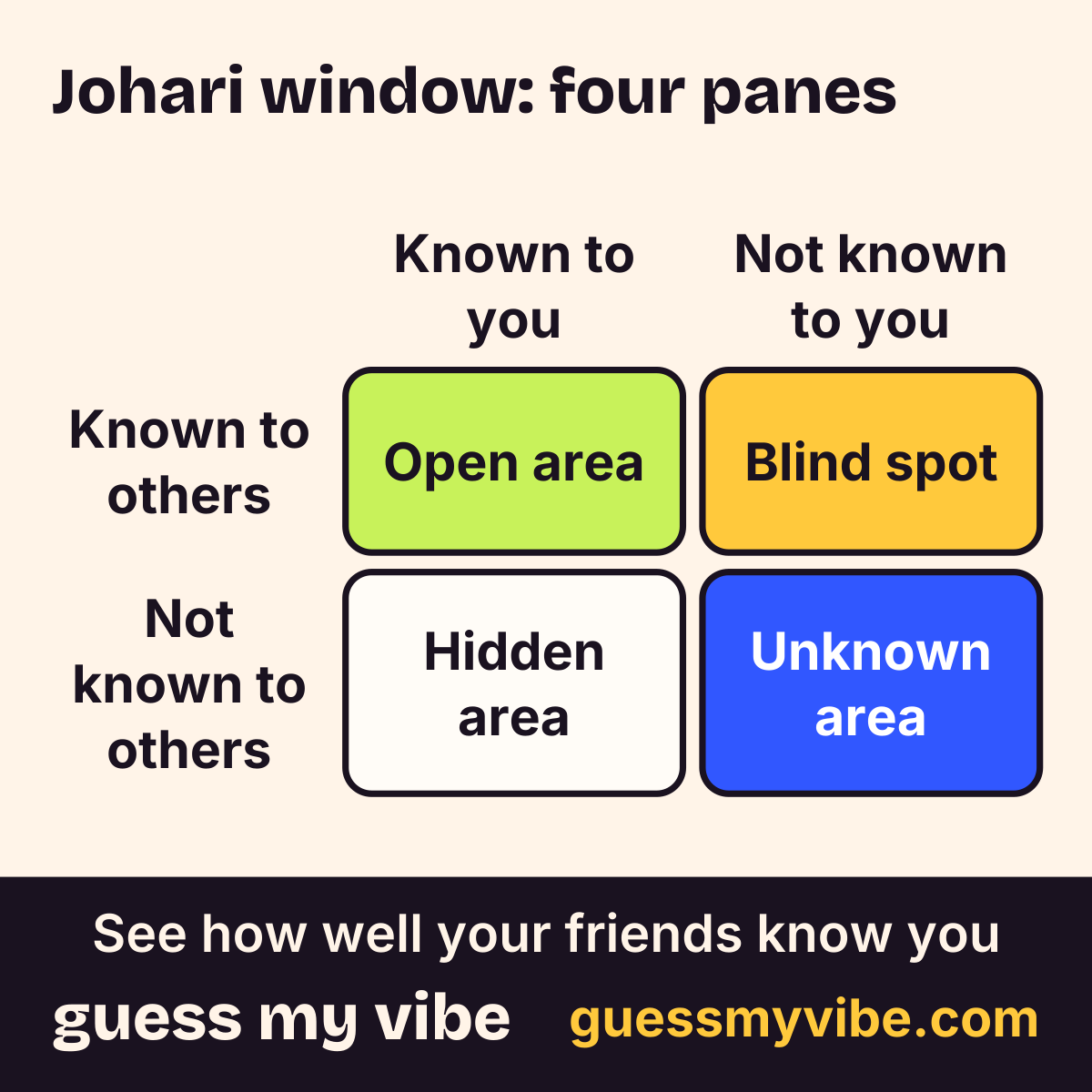
The Johari window is a 1955 teaching framework that sorts what's known about a person into four panes: an open area (known to you and others), a blind spot (others see it, you don't), a hidden area (you know it, others don't), and an unknown area (neither does). It was built for group workshops, not as a tested scientific model, but each quadrant lines up surprisingly well with real self-other-knowledge research done decades later. Below is the model explained in full, how to actually run it with a friend, and what the research says about each quadrant.
What the Johari window actually is
The Johari window is a simple four-pane diagram for thinking about what's known about a person, and who knows it. Two psychologists, Joseph Luft and Harrington Ingham, built it in 1955 for a workshop on group dynamics (the name "Johari" is just their two first names mashed together). It isn't a personality test, a diagnosis, or a research finding. It's a teaching tool: a way to structure a conversation about self-perception and feedback that group facilitators have used in classrooms and workshops for seventy years. The reason it's worth understanding in real depth, beyond the one-paragraph mention most articles give it, is that each of its four panes maps surprisingly well onto specific, separately conducted research on how well people actually know themselves and each other.
The four panes of the Johari window
Picture a two-by-two grid. One side is "known to self" versus "not known to self." The other is "known to others" versus "not known to others." That gives four panes:
- Open area: things both you and the people around you already know (you're the friend who's always ten minutes late, and you know it too).
- Blind spot: things others can see that you can't (you come across as more sarcastic in meetings than you think you do).
- Hidden area: things you know but haven't shown (you're more anxious about money than anyone around you realizes).
- Unknown area: things neither you nor anyone else has noticed yet, at least so far.
The original exercise Luft and Ingham built around this used a published list of about 56 personality-describing adjectives. A person picked five or six words from the list that they felt described them. Then, separately, a few people who knew them did the same thing, picking words to describe that same person. Comparing the two lists sorted the words into the four panes: adjectives both lists picked went into the open area, ones only the peers picked went into the blind spot, ones only the person themselves picked went into the hidden area, and the unpicked remainder, by definition, nobody had flagged yet.
Cite this figure
Figure: "Johari window: four panes." Guess My Vibe (guessmyvibe.com). https://guessmyvibe.com/learn/johari-window#figure-johari-four-panes
How to actually run a Johari window with a friend
You don't need the original 56-word list to do a useful modern version of this. Pick ten to fifteen plain, non-judgmental trait words (organized, anxious, blunt, warm, stubborn, curious, private, loud, patient, competitive). Separately, you and a friend each circle the five or six that feel true of you. Compare lists without arguing about who's "right" first; just notice which words landed in each of the four panes. The blind-spot words, the ones your friend circled that you didn't, are the actual point of the exercise. They're also the ones that are hardest to hear, so the original workshop format matters here too: this works best with someone who already has some trust built up, not a stranger.
The open area: where self and friends already agree
The open area isn't an empty teaching concept; it has a real, measured size. A meta-analysis covering 263 samples and more than 44,000 people found that how much a person's self-rating and an outside rater's rating agree depends on the trait and on how close the rater is: closeness boosted accuracy most for traits that are hard to see from the outside, like emotional stability, and only minimally for highly evaluative traits like Agreeableness [1]. The open area, in other words, isn't one fixed size; it shifts with the trait and with how well the other person knows you. Agreement between self and others is real but imperfect, meaning even the "open," agreed-upon part of a personality still has real disagreement baked into it.
Curious how your friends would answer?
Free. Answer 10 quick questions about you, then send your link. Friends play in their browser, no app needed.
Start freeThe blind spot: what others see that you don't
This is the quadrant with the most interesting research behind it. A review of self-other knowledge research found that self-perceptions are largely accurate but have genuine blind spots, caused partly by missing information (you can't watch yourself from across the room) and partly by motivated distortion (you have real reasons to see yourself a little kindly, or a little harshly). The traits where others have the biggest edge over self-perception tend to be the most evaluative ones, the most clearly good or bad traits, exactly where a person has the strongest motivation to see themselves generously [2]. The same large meta-analysis above found that other-ratings aren't just a weaker echo of self-ratings either: they lined up with real outcomes, like job performance and achievement, independently of what the person said about themselves [1]. The blind spot isn't a minor footnote. Sometimes it's where the more accurate information actually lives.
The hidden area: what you know that others don't
The flip side has its own real research, named the self-other knowledge asymmetry (SOKA) model. A study of 165 people, rated by close friends and by strangers and checked against real behavior in a lab setting, found that for low-observability traits, things that mostly happen inside someone's head, like how easily their mood is thrown off by stress, the person themselves was consistently the best judge [3]. That's the hidden area in research form: not secrets you're deliberately keeping, necessarily, but private experience nobody else has direct access to, so nobody else can rate it as accurately as you can.
The unknown area: the hardest one to test
This is the quadrant the original 1955 model can't really prove exists, by its own logic: if nobody's noticed something yet, there's no way to directly measure it. The closest real research gets is a related, testable question: do you even know how others see you, as opposed to how you see yourself? A classic review of eight studies on this, called meta-perception, found that people are fairly good at guessing their general reputation but much worse at guessing how one specific person sees them. The reason given is the useful part: people mostly build their sense of "how others see me" out of their own self-image, not out of real feedback they've actually received [4]. That's not quite the same as the unknown quadrant, but it points at the same practical problem: the gaps in self-knowledge are often invisible from the inside precisely because there's no signal yet telling you they're there.
What a 1955 model couldn't have tested
Worth saying plainly: Luft and Ingham built this as a teaching tool for group workshops, not a hypothesis to be tested in a lab, and nothing about the four-pane structure itself (as opposed to the real research it maps onto) has been directly verified by an experiment. Treat the window as what it's always been: a genuinely useful way to organize a conversation about self-perception, where each quadrant happens to describe something researchers later studied separately and rigorously, not a finding with its own data behind the diagram itself.
Guess My Vibe as a live Johari window
The exercise above, you and a friend each picking words separately, then comparing, is basically what Guess My Vibe automates every day: you answer a real question about yourself, a friend guesses your answer, and the app scores how close their blind-spot guess landed to your actual, hidden-from-them answer. It's the same open-area, blind-spot comparison the 1955 model was built around, just scored instead of sorted by hand onto a sheet of paper.
Key takeaways
- The Johari window, created in 1955 by psychologists Joseph Luft and Harrington Ingham, is a teaching framework, not an experiment. Nobody ran a study and found four quadrants; it's a structure for organizing a conversation about self-perception.
- The blind spot quadrant lines up with real findings: other people's ratings of someone carry information beyond that person's own self-rating: they line up with outcomes like job performance beyond what self-ratings capture [1], and others can see some traits better than the self can, especially very desirable or undesirable ones [2].
- The hidden area lines up with research too: people really are the better judge of their own private, low-visibility traits, like how easily they get stressed [3].
- The "unknown" quadrant is the hardest to test directly, but a related finding comes close: people are better at knowing how others generally see them than how one specific person sees them, mostly because they guess from their own self-image rather than real feedback [4].
- This isn't therapy, a diagnosis, or a substitute for professional care.
Questions people ask
What are the four quadrants of the Johari window?
The open area (known to you and others), the blind spot (others see it, you don't), the hidden area (you know it, others don't), and the unknown area (neither does yet). Luft and Ingham built the model in 1955 for group workshops.
Is the Johari window based on scientific research?
The four-pane model itself is a teaching framework, not a tested finding; nobody ran an experiment and found four quadrants. But each quadrant lines up well with separate, real research done later on self-other knowledge, which this article walks through quadrant by quadrant.
How do you actually use the Johari window with a friend?
Pick ten to fifteen plain trait words. You and a friend each separately circle the ones that feel true of you. Compare lists: words you both picked are the open area, words only your friend picked are your blind spot. It works best with someone you already trust, since blind-spot words can be hard to hear.
Who created the Johari window and why is it called that?
Psychologists Joseph Luft and Harrington Ingham created it in 1955. "Johari" is a combination of their first names, Joe and Harry.
Is there an official Johari window test?
The original version used a published list of about 56 personality adjectives that a person and their peers each chose from separately. Modern versions just need any shared list of plain trait words and someone willing to answer honestly alongside you; there's no single standardized test.
See how well your friends know you.
Free. Answer 10 quick questions about you, then send your link. Friends play in their browser, no app needed.
Start freeReferences
- [1] Connelly, B. S., & Ones, D. S. (2010). An other perspective on personality: Meta-analytic integration of observers' accuracy and predictive validity. Psychological Bulletin, 136(6), 1092–1122. PubMed: 21038940 (opens in a new tab)
- [2] Vazire, S., & Carlson, E. N. (2011). Others sometimes know us better than we know ourselves. Current Directions in Psychological Science, 20(2), 104–108. doi.org/10.1177/0963721411402478 (opens in a new tab)
- [3] Vazire, S. (2010). Who knows what about a person? The self-other knowledge asymmetry (SOKA) model. Journal of Personality and Social Psychology, 98(2), 281–300. PubMed: 20085401 (opens in a new tab)
- [4] Kenny, D. A., & DePaulo, B. M. (1993). Do people know how others view them? An empirical and theoretical account. Psychological Bulletin, 114(1), 145–161. PubMed: 8346325 (opens in a new tab)
How we find and check these sources: how we write. Spotted an error? Report a correction.
Related
- Self-Perception vs. How Others See You
- What Do People Think of Me? What Research Can Tell You
- Self-Awareness: What the Research Says It Actually Takes
- How Well Do You Know Me Questions to Ask Friends
- Self-Monitoring: Are You the Same Person Everywhere?
- Personality Blind Spots: What You Can't See About Yourself
- Self-Knowledge: Why You Know Some Traits Better Than Others
Want to try it with your own friends? Take the best friend test and see how your friends see you
Cite this article
- Title
- The Johari Window, and What's Actually Real About It
- Publisher
- Guess My Vibe
- Updated
- URL
- https://guessmyvibe.com/
learn/ johari-window
Copy this citation
Guess My Vibe. (2026, October 3). The Johari Window, and What's Actually Real About It. Guess My Vibe. https://guessmyvibe.com/
To point at one section, add that section's anchor (the # link on its heading) to the URL.