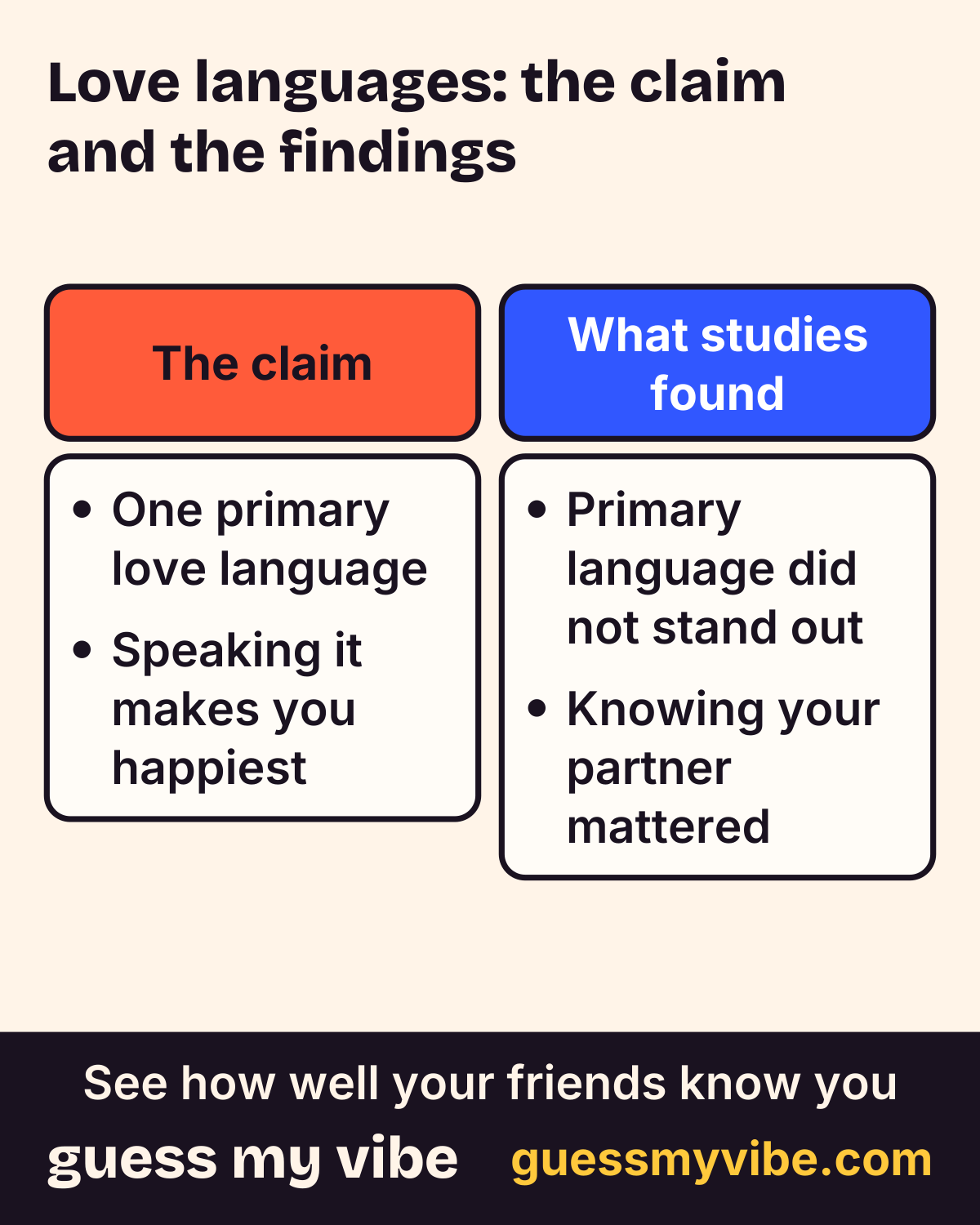
The idea behind love languages, that you have one main way of feeling loved and that your relationship goes best when a partner speaks it, has not held up well when tested. In a sample of 696 people, satisfaction with a partner's behavior in your top love language explained relationship satisfaction no better than the other love languages [1]. What did seem to matter was knowing what your partner actually likes.
Love languages are one of the most popular ideas in relationship advice, so it is fair to ask how well they hold up. The short version is that the specific claim, that everyone has a primary love language and that a partner who speaks it makes you happiest, did not do well in the tests we could open. A looser version of the idea, that people differ in how they like affection shown and that noticing those differences helps, has more support. This article separates the two.
A note on scope before we start. Every study here recruited people in romantic relationships, mostly couples who live together. We found no study in what we read that tests love languages between friends, so what follows is about couples, and anything about friends is our own extension and labeled as such.
What the love languages idea actually claims
The framework comes from a self-help book. It proposes five ways people give and receive affection: words of affirmation, quality time, gifts, acts of service and physical touch. The research that tests it spells out two claims. First, people vary in the ways they prefer to receive and express affection. Second, partners who show their feelings in the way the other prefers have better relationships [5]. A stronger version says the key to a happy marriage is speaking your partner's primary love language, and that version has been very influential in pop culture and has even been used in therapy, even though it had not been empirically validated [1].
The first claim is hardly controversial. Of course people differ in what feels loving. It is the second, and especially the strong form of it with one fixed primary language, that needs testing. That is what recent studies did.
Does your primary love language matter?
The most direct test recruited 696 people online, average age about 44, most of them married and living with their partner. The question was whether satisfaction with a partner's behavior in your own top love language explains how satisfied you are with the relationship better than satisfaction with behavior in your lower-ranked languages. It did not. The primary language was no better at explaining relationship satisfaction or feeling loved than the others. Two of the five, words of affirmation and quality time, explained both outcomes better than a person's own primary language did, and the authors note this replicates earlier work [1].
A second, preregistered study of 499 people in long-term relationships found the same, plus a surprise: fewer than half of participants had an identifiable primary love language to begin with. Relationship quality was more strongly tied to being satisfied across a wide range of loving behaviors than to any one favorite. Verbal affirmations, encouragement for your own pursuits, support during difficult times and accountability stood out as especially strong signals [2].
Put plainly, in these samples it did not look like each person has one key that unlocks their relationship. It looked more like a broad mix of warmth, praise, support and time together goes a long way for most people. These were questionnaires filled out at one time point, so they describe what goes together, not what causes what.
Are there really five?
Another team asked a different question. Instead of assuming five categories, they started from a large set of statements about loving behavior and let the data sort them. In three studies of US adults in long-term relationships (N = 696, 500 and 499), solutions with 7 to 10 love languages fit better than the five-factor solution, and they also did a better job of explaining relationship quality. The authors concluded Chapman's model may be too narrow [3].
This is a useful reminder that five tidy categories are a choice, not a discovery. Real affection is messier. Encouraging someone's own goals, for example, arguably doesn't fit neatly under any of the five, yet it showed up as one of the stronger signals in the study above.
Curious how your friends would answer?
Free. Answer 10 quick questions about you, then send your link. Friends play in their browser, no app needed.
Start freeWhat does have support: knowing your partner
Not every study was a bust for the idea. One study of 100 heterosexual couples found that people who expressed affection in the way their partner preferred to receive it reported more satisfaction with the relationship, and more sexual satisfaction, than those who met their partner's preferences less. It also looked at empathy as an explanation and found some support for that among men but not women [5]. That is more favorable than the studies above, and it is a reminder that the evidence is mixed, with different measures and samples pointing in somewhat different directions.
A study of 84 couples looked at the same theme from the side of accuracy. People tended to have a biased understanding of their partner's preferences for different kinds of affection, and those biases shaped the affection they showed. Understanding your partner's preferences accurately was associated with more relationship satisfaction [4]. This is the part of the love languages idea that seems to survive: not a fixed label, but paying attention to what this particular person experiences as caring.
Zoom out to a much larger body of couples data, and the picture is not in conflict with this. A project that pooled 43 longitudinal data sets from 29 labs found that the top relationship-specific factors linked to relationship quality included how appreciated a person felt and how committed they believed their partner was. Those relationship-specific measures explained up to 45% of the variation at the start of the studies, and traits like life satisfaction or negative mood explained 21% [6]. Feeling appreciated being near the top is at least in the spirit of love languages, but the study did not test love languages themselves.
Cite this figure
Figure: "Love languages: the claim and the findings." Guess My Vibe (guessmyvibe.com). https://guessmyvibe.com/learn/love-languages#figure-claim-vs-findings
Love languages and personality
People often ask whether love languages are a personality type, or whether they line up with the Big Five traits. None of the studies we opened tests that, so we can't tell you that being, say, more outgoing means you will favor quality time. Be wary of any quiz that tells you your personality determines your love language. The honest answer is that this is untested in what we read.
What we can say is that the Big Five and the love language framework are different kinds of thing. A trait like Warmth in our game describes a fairly stable pattern in how a person comes across across many situations. A love language, as the book defines it, is a claim about what a person needs to feel loved. The first has a large body of measurement research behind it; the second, as the recent studies show, is still being tested and so far is not holding up in its strong form.
What about friends?
Friends have preferences too: one friend lights up at a voice note, another would rather be driven to the airport. Our own reading is that the loose version of the idea probably carries over, since noticing how a specific friend likes to be treated is common sense. But no study we opened tests it, so treat it as a reasonable habit, not an evidence-backed rule.
A small, practical way to apply it is to ask. Asking a friend what made their week easier is a low-pressure question, and their answer beats any quiz. And if you want to see how well you read your friends in general, that is what a guessing game is for: you answer for yourself, they guess, and the gaps are the interesting part.
How to use love languages without leaning on them
- Treat the five categories as conversation starters, not a diagnosis of anyone. They are a vocabulary, not a measurement.
- Ask instead of assuming. The couples research points to accuracy about a partner's preferences, and the easiest way to get accurate is to ask.
- Aim for variety. In the larger studies, a broad range of caring behaviors tracked relationship quality better than one favorite did.
- Keep noticing what your person responds to over time. Preferences may shift, and the studies are snapshots that cannot tell you how stable they are.
- Don't use a label to excuse a missing behavior. Saying that is just not my love language is an easy way to dodge, and the findings we read give it no support.
None of this makes love languages harmful. If a framework gets a couple or two friends talking about how they like to be cared for, that is a good outcome whatever the model's scientific standing. The mistake is treating the quiz result as a fixed fact about you.
How Guess My Vibe fits in
Guess My Vibe is built on the Big Five, which describes how people tend to come across, and on a simple idea from the same research family: your friends see some things about you better than you do. It does not measure love languages and doesn't claim anything about them. If you want a low-stakes way to see how well your friends know you, send your link and compare their guesses to your answers.
Key takeaways
- In 696 people, being satisfied with a partner's behavior in your primary love language explained relationship satisfaction and feeling loved no better than the lower-ranked love languages, so the central claim wasn't supported [1].
- In a preregistered study of 499 people in long-term relationships, fewer than half had an identifiable primary love language at all [2].
- Statistical analysis of a new set of questions found that 7 to 10 love languages fit the data better than five did, so five categories may be too few [3].
- In 84 couples, understanding what your partner likes was linked to more satisfaction, which fits a looser reading of the idea: pay attention to the person in front of you [4].
- This isn't therapy, a diagnosis, or a substitute for professional care.
Questions people ask
Are love languages real?
People do differ in how they like affection shown, but the strong claim, that you have one primary love language and that a partner speaking it makes you happiest, was not supported in a sample of 696 people [1]. A preregistered study found fewer than half of people even had an identifiable primary love language [2].
Is there scientific evidence for the five love languages?
Not for the strong version. Recent studies of couples found a primary love language was no better at explaining relationship satisfaction than the others [1], and a statistical analysis found 7 to 10 love languages fit better than five [3]. One study of 100 couples did find that matching a partner's preferred way of being shown affection went with more satisfaction [5], so the evidence is mixed.
Do love languages explain relationship satisfaction?
Weakly or not at all in the strict sense. Satisfaction with a partner's behavior in your top love language did not explain relationship satisfaction better than satisfaction in lower-ranked languages [1]. Accurately understanding your partner's preferences was linked to more satisfaction in 84 couples [4], which is a related but different idea.
Is a love language the same as a personality type?
No. A love language, as defined by its author, is about how you prefer to receive affection, while personality traits such as the Big Five describe broader patterns in how people think, feel and act. We did not find a study in the papers we opened that links the two, so avoid quizzes that claim your personality sets your love language.
Do love languages work for friends?
We don't know. The studies we read all sampled romantic couples, so nobody has shown it either way for friendships. Noticing how a particular friend likes to be treated is still sensible, but it is a habit, not a tested method.
See how well your friends know you.
Free. Answer 10 quick questions about you, then send your link. Friends play in their browser, no app needed.
Start freeReferences
- [1] Flicker, S. M., & Sancier-Barbosa, F. (2025). Testing the predictions of Chapman's five love languages theory: Does speaking a partner's primary love language predict relationship quality?. Journal of Marital and Family Therapy, 51(1), e12747. PubMed: 39420529 (opens in a new tab)
- [2] Flicker, S. M., Sancier-Barbosa, F., & Impett, E. A. (2025). Revisiting the Five Love Languages Framework: Toward a More Flexible Model of Love Expression. Journal of Marital and Family Therapy, 51(4), e70078. PubMed: 40977357 (opens in a new tab)
- [3] Flicker, S. M., Sancier-Barbosa, F., Clemons-Castanos, C., Field, S., Jackson-Zambon, S., Phelan, M., & Impett, E. A. (2025). How Many Love Languages Are There? Examining Chapman's Five Love Languages Using a Bottom-Up Approach. Journal of Marital and Family Therapy, 51(4), e70072. PubMed: 40916580 (opens in a new tab)
- [4] Coy, A. E., & Rodriguez, L. M. (2023). Affection preference, enactment, and relationship satisfaction: A dyadic analysis of love languages. Journal of Marital and Family Therapy, 49(4), 741-761. PubMed: 37431256 (opens in a new tab)
- [5] Mostova, O., Stolarski, M., & Matthews, G. (2022). I love the way you love me: Responding to partner's love language preferences boosts satisfaction in romantic heterosexual couples. PLoS ONE, 17(6), e0269429. PubMed: 35731784 (opens in a new tab)
- [6] Joel, S., Eastwick, P. W., Allison, C. J., Arriaga, X. B., Baker, Z. G., et al. (2020). Machine learning uncovers the most robust self-report predictors of relationship quality across 43 longitudinal couples studies. Proceedings of the National Academy of Sciences, 117(32), 19061-19071. PubMed: 32719123 (opens in a new tab)
How we find and check these sources: how we write. Spotted an error? Report a correction.
Related
Cite this article
- Title
- Love Languages: What the Research Actually Shows
- Publisher
- Guess My Vibe
- Updated
- URL
- https://guessmyvibe.com/
learn/ love-languages
Copy this citation
Guess My Vibe. (2026, October 7). Love Languages: What the Research Actually Shows. Guess My Vibe. https://guessmyvibe.com/
To point at one section, add that section's anchor (the # link on its heading) to the URL.