Couples do tend to look somewhat alike, but they probably don't grow to look alike over time. A 2020 study of 517 couples found spouses' faces were similar at the start of marriage and did not become more similar 20 to 69 years later [1]. A famous 1987 study had reported the opposite.
Do couples look alike? The short answer
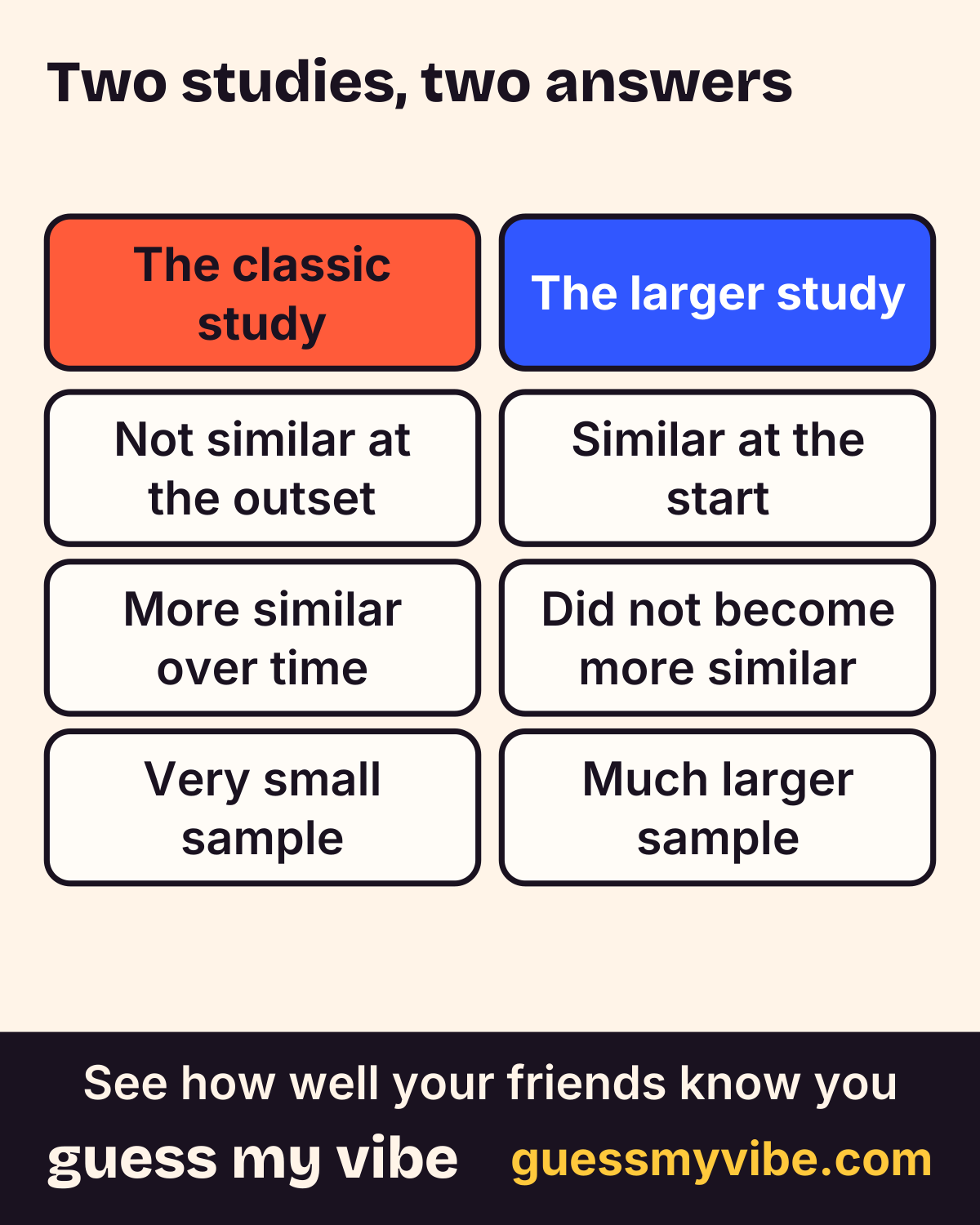
Do couples look alike? A little, yes. But the popular idea that partners slowly grow to look like each other over the years has little support. In a 2020 study of 517 couples, faces were similar at the start of the marriage and did not become more similar over the next 20 to 69 years [1]. This is a nice example of how science sometimes works. A classic finding gets repeated in textbooks for decades, then a much bigger study tests it and it doesn't hold. The 2020 authors say the idea has been widely disseminated through textbooks and books [1]. Here is what each side found, and how to weigh them.
The 1987 finding that couples grow alike
The idea comes from a 1987 paper by Zajonc and colleagues. We couldn't find an abstract for that paper anywhere we could open, so we are relying on how the 2020 authors describe it in their own open article, not on the original. According to them, the 1987 study reported that spouses' faces were not similar at the outset of marriage but became more similar with time, and that the amount of convergence went along with couples' ratings of marriage quality [1].
The proposed reason was easy to believe. Partners share the same home, eat similar food, do the same activities and copy each other's expressions. If you smile at each other a lot, the thinking goes, you might develop similar smile lines [1]. The 2020 authors note that the 1987 study was, in their words, elegantly designed but based on a very small sample of 12 married heterosexual couples, and that its findings have never been replicated [1]. A small sample isn't a reason to dismiss a study, but it is a reason to want a second look.
The 2020 test with 517 couples
That second look arrived in 2020. Researchers collected facial images of 517 couples, one taken near the start of the marriage and one taken 20 to 69 years later. They used two independent ways of measuring facial similarity: human judges and a facial-recognition algorithm. Both methods showed that spouses' faces tended to be similar at the beginning of the marriage, but they did not converge over time [1].
A few details help you picture it. In the human-judging task, each face was shown with six faces of the opposite sex: the person's spouse and five random others, matched on age and glasses. Judges ranked them from most to least like the target. If there was no link between marriage and resemblance, the spouse would land at an average rank of 3.5. At the time of marriage the average rank was 2.75 for human judges and 2.89 for the algorithm, so spouses did look more alike than chance. Later in the marriage, the human judges actually ranked spouses as slightly less similar, a small difference that the algorithm did not reproduce [1].
Why the two studies disagree, and how to weigh them
Two studies, two answers. Here is how to think about it. The 2020 study is far larger, used a preregistered design with two measurement methods, and tested the same ranking task as the original. Those are real strengths. It also has limits that the authors list. The photos came from public online sources, such as newspaper anniversary announcements, so things like grooming, expression and photo quality could not be controlled. The sample was white heterosexual couples, because the authors could not find enough couples of other kinds for a meaningful analysis. The average marriage in the sample lasted 49 years [1].
So the fairest reading is not "the 1987 study was wrong about everything." It is that the convergence idea has weak support, the larger test did not find it, and we don't know whether it would show up in other kinds of couples or with different photos. That is how most science reads when you look closely: a claim gets tested again, and the answer is a little more careful than the headline.
Cite this figure
Figure: "Two studies, two answers." Guess My Vibe (guessmyvibe.com). https://guessmyvibe.com/learn/do-couples-look-alike#figure-two-studies
Curious how your friends would answer?
Free. Answer 10 quick questions about you, then send your link. Friends play in their browser, no app needed.
Start freeCouples start similar in other ways, too
The facial result fits a larger pattern. The 2020 authors point out that for personality, intelligence, attitudes, values and well-being, couples tend to show initial similarity but not convergence [1]. Two newlywed studies are consistent with that. One found strong similarity in age, religiousness and political orientation, moderate similarity in education and verbal intelligence, modest similarity in values, and little similarity in self- and spouse-rated personality, and it concluded the similarity reflected initial assortment, meaning similarity at the time of marriage, rather than convergence over time [2]. A second newlywed study (N = 291) found substantial similarity on attitudes but little on personality, and said the similarity was not due to social homogamy or convergence [3].
These were newlyweds, so they can't tell us what happens over decades the way the 517-couple study can. A review of the research on couple similarity organizes the possible reasons into four mechanisms: initial active choice, the way the mating market operates, social homogamy (being surrounded by similar people), and convergence [4]. In that framing, the 2020 faces result points away from the last of these, though it doesn't say which of the first three explains the similarity.
Which facial traits couples actually match on
If couples start out looking somewhat alike, what are they matching on? One study of young couples from the United Kingdom and the United States found that couples matched on facial symmetry, but not on how masculine or feminine their faces looked and not on independently rated attractiveness. Within-couple similarity on these traits did not forecast how long relationships lasted or how good they were [5]. This is one sample, and it looks at a narrow set of facial measurements, so don't read it as a list of what couples "look for." What it shows is that similarity can be specific, not a general resemblance.
Why does the idea feel so true? One reason is simple: it is a good story. Another is that there are plausible-sounding mechanisms for it, and a plausible mechanism makes a claim easier to believe. There is also a subtler one. The 2020 authors list attrition as one proposed route to couples seeming more alike, meaning less similar couples break up and leave the more similar ones behind [1]. That would make long-married couples look more alike on average, without any individual couple changing. Our own addition, not a tested finding, is that once we expect a match, we are quicker to notice the points of resemblance and slower to notice the differences.
What this means for you and your people
If you hear that long-married couples look alike, you can now say what is known. They may look somewhat alike from early on, but there is no strong evidence that sharing a life makes their faces converge. A tidy story about two people becoming one is appealing, which is a good reason to check it. We do the same with personality. People often assume friends and partners are more alike than they really are, and the way to find out is to compare actual answers, not guesses.
That is the idea behind Guess My Vibe. A friend guesses how you would really answer a personality question, and you see where the guess matches and where it misses. It is a simple way to test an assumption about someone close to you, instead of trusting a story that sounds right.
Key takeaways
- Spouses' faces tended to look similar at the beginning of marriage, as judged by people and by a facial-recognition algorithm [1].
- In 517 couples photographed at the start of marriage and 20 to 69 years later, faces did not converge over time [1].
- The classic 1987 finding of convergence was, according to the 2020 authors, based on 12 couples and never replicated [1].
- Two newlywed studies found that couples' similarity was not simply a result of growing alike after marriage [2] [3].
- This isn't therapy, a diagnosis, or a substitute for professional care.
Questions people ask
Do couples really look alike?
On average, yes, somewhat. In a study of 517 couples, spouses' faces were similar at the beginning of marriage, as judged by people and by a facial-recognition algorithm [1].
Do couples start to look alike over time?
The larger, newer evidence says no. Faces did not become more similar 20 to 69 years after the start of marriage [1]. A 1987 study had found the opposite, but it used 12 couples and was not replicated, according to the 2020 authors.
Why do old couples seem to look alike?
Our own reasoning, not a tested finding: they may have been somewhat alike to begin with, and once you expect a match, you notice the resemblances.
Are couples similar in personality?
Less than in age, religion or politics. One newlywed study found little similarity in self- and spouse-rated personality [2], and another found little on personality-related domains [3].
Does the research say convergence never happens?
No. The 2020 study covered white heterosexual couples with public photos, so it can't rule out convergence in other groups or circumstances [1].
See how well your friends know you.
Free. Answer 10 quick questions about you, then send your link. Friends play in their browser, no app needed.
Start freeReferences
- [1] Tea-Makorn, P. P., & Kosinski, M. (2020). Spouses' faces are similar but do not become more similar with time. Scientific Reports, 10, 17001. PubMed: 33046769 (opens in a new tab)
- [2] Watson, D., Klohnen, E. C., Casillas, A., Simms, E. N., Haig, J., & Berry, D. S. (2004). Match makers and deal breakers: analyses of assortative mating in newlywed couples. Journal of Personality, 72(5), 1029-1068. PubMed: 15335336 (opens in a new tab)
- [3] Luo, S., & Klohnen, E. C. (2005). Assortative mating and marital quality in newlyweds: a couple-centered approach. Journal of Personality and Social Psychology, 88(2), 304-326. PubMed: 15841861 (opens in a new tab)
- [4] Luo, S. (2017). Assortative mating and couple similarity: Patterns, mechanisms, and consequences. Social and Personality Psychology Compass, 11(8), e12337. doi.org/10.1111/spc3.12337 (opens in a new tab)
- [5] Burriss, R. P., Roberts, S. C., Welling, L. L. M., Puts, D. A., & Little, A. C. (2011). Heterosexual romantic couples mate assortatively for facial symmetry, but not masculinity. Personality and Social Psychology Bulletin, 37(5), 601-613. PubMed: 21343440 (opens in a new tab)
How we find and check these sources: how we write. Spotted an error? Report a correction.
Related
- Do Opposites Attract? What the Research Actually Says
- Attraction Psychology: 4 Forces That Draw People Together
- Do You Become Like Your Friends? What Research Says
- Assumed Similarity: Why You Think Friends Are More Like You
- Relationship Compatibility: What Research Can Tell You
- Couple Compatibility Test: What It Can and Can't Tell You
Cite this article
- Title
- Do Couples Look Alike? A Classic Finding Didn't Replicate
- Publisher
- Guess My Vibe
- Updated
- URL
- https://guessmyvibe.com/
learn/ do-couples-look-alike
Copy this citation
Guess My Vibe. (2026, October 4). Do Couples Look Alike? A Classic Finding Didn't Replicate. Guess My Vibe. https://guessmyvibe.com/
To point at one section, add that section's anchor (the # link on its heading) to the URL.