The false consensus effect is the tendency to overestimate how many other people share your own opinions, choices, and habits. If you'd agree to something, you assume most people would too; if you'd refuse, you assume most people would refuse too. It's one of the most replicated findings in social psychology, it's roughly the same size whether the topic is trivial or serious, and research has found it survives even when people are taught about it directly.
What the false consensus effect actually is
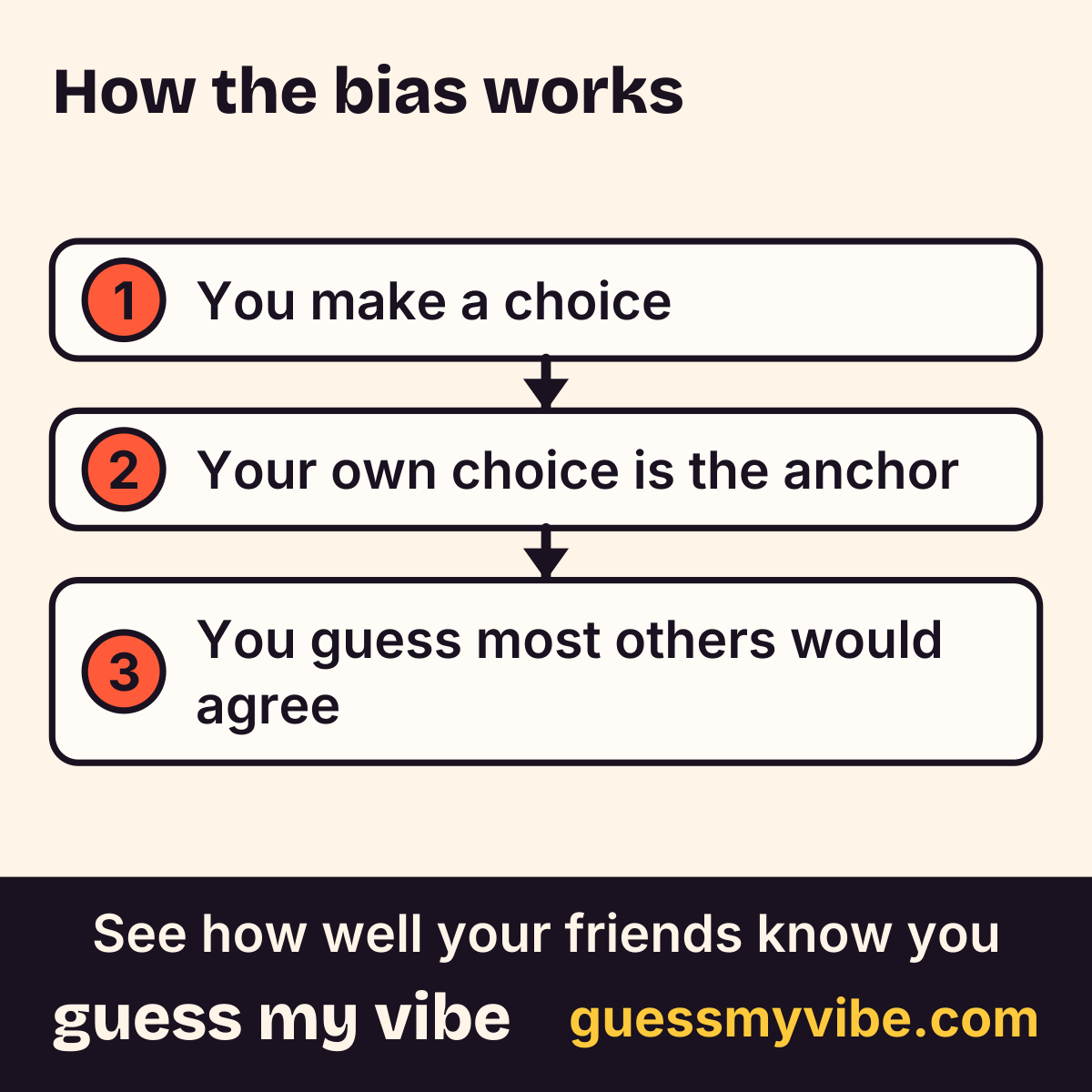
The false consensus effect got its name from a set of studies that asked people to make a choice and then estimate how many other people would make the same one. In one version, students were asked whether they'd be willing to walk around campus wearing a sign reading "Eat at Joe's", and were asked to guess what percentage of other students would also agree. The students who agreed estimated that most other students would agree too. The students who refused estimated that most others would refuse too. Each group used its own choice as the anchor for guessing everyone else's [1]. The same pattern showed up on other questions in the same research, not just the campus sign: whatever someone happened to pick, they assumed that pick was more common in the wider population than it actually was.
This is distinct from simply being overconfident, and it's distinct from thinking your opinion is correct. It's specifically a bias in estimating what other people think or do, built entirely out of what you yourself think or do. The researchers behind the original studies framed it as an egocentric bias in social perception: a general tendency, not something limited to any one topic, opinion, or kind of person [1].
Cite this figure
Figure: "How the bias works." Guess My Vibe (guessmyvibe.com). https://guessmyvibe.com/learn/false-consensus-effect#figure-own-choice-as-anchor
How solid is the evidence, really
A single study finding an effect is interesting. A meta-analysis finding the same effect across many independent studies is a different kind of evidence, and this is one of the better-replicated findings in social psychology. A meta-analysis pooling 115 separate hypothesis tests confirmed the false consensus effect holds up as a real, moderately sized bias, not an artifact of one lab's particular questions or setup, though the exact size varies somewhat depending on how researchers measured consensus [2]. That's a notably large and consistent body of evidence behind what sounds, on the surface, like a small quirk of guessing games.
Why you can't just "know better" and fix it
The most interesting part of this research isn't that the bias exists, it's how hard it is to remove once someone knows about it. A set of three experiments tested exactly that question directly, under the blunt title "the truly false consensus effect." People who had been explicitly taught about the bias beforehand still showed it. People who were given real feedback about the actual rate of agreement on a topic still showed it. People who were shown unanimous responses from 20 real other people, information that should have overridden any guess based on their own opinion, still showed the bias even with that outside evidence in front of them [3]. None of the usual fixes (education, feedback, hard data from real people) made the bias go away. That's a strong claim, and it's backed by three separate experiments, not a single try.
The honest reason this is so persistent: your own answer is always available to you instantly and effortlessly, while real information about what everyone else thinks usually isn't, or takes real effort to go find. Faced with a gap between an easy, always-on data point (your own view) and a harder, less available one (everyone else's actual views), people tend to default to the easy one, even when they've been taught about the bias.
Curious how your friends would answer?
Free. Answer 10 quick questions about you, then send your link. Friends play in their browser, no app needed.
Start freeWhy this is the most common miss in a friend-guessing game
Here's an honest caveat before the connection: the original studies tested how people estimate a broad group's behavior (most students, most people), not how someone guesses one specific friend's answer in a game. That's a related but genuinely different question, and no citation here claims it was tested the exact way a two-player guessing game works. What the research does establish is the mechanism: your own answer is cheap, instant, and always on hand, while actually simulating what a specific other person, even someone you know well, would say takes real effort. When guessing what a friend would pick, reaching for "whatever I'd pick" is the same low-effort shortcut the false consensus studies caught people using for strangers, just aimed at someone closer to you instead of a crowd.
That's also why this is worth separating from a related idea: assumed similarity, specifically believing one particular person is like you, rather than assuming a whole group agrees with you. Research on similarity and attraction has looked at exactly this, and found something a little different: how similar you feel to someone keeps tracking with how much you like them even once you've actually gotten to know each other, while how similar you actually are matters less the longer you know them [4]. False consensus is about the crowd; assumed similarity is about one specific person. They likely share some of the same root cause (your own view being the easiest reference point you have), but they're measured, and they show up, differently.
What actually helps, given it can't be talked away
Since education and feedback didn't remove the bias in controlled experiments, the realistic takeaway isn't "just be more self-aware." It's lower-stakes than that: expect to be wrong in this specific, well-documented direction when guessing someone else's answer, especially a friend's. If your first instinct is your own answer, that instinct is doing exactly what the research says it will do, acting as an anchor, not as real information about the other person. Knowing that doesn't erase the bias, the research is fairly clear that it won't, but it does mean a miss is evidence of a well-documented, universal pattern, not evidence that you don't know your friend.
Watch the bias happen in real time
Guess My Vibe scores how close a friend's guess lands to your real answer, round after round. The single most common pattern behind a missed guess is exactly this effect: reaching for your own answer instead of really picturing the other person's. Playing a few rounds is a quick, low-stakes way to actually watch it happen, in both directions.
Key takeaways
- The false consensus effect, named in a set of studies where people's own choices lined up with how common they assumed that choice was among others, is an egocentric bias in estimating other people, not a reasoning mistake limited to one topic [1].
- A meta-analysis of 115 separate tests confirmed the bias is real and reliably moderate in size, not a fluke of any single study's design [2].
- The bias resists being talked out of: people who were taught about it, given real feedback on actual consensus, or shown unanimous answers from 20 real other people still showed the bias despite that outside information [3].
- False consensus (assuming people in general think like you) is a different bias from assumed similarity (believing one specific person, like a friend, is like you) — the research on that second one finds perceived similarity, not actual similarity, is what keeps tracking with how much you like someone [4].
- This isn't therapy, a diagnosis, or a substitute for professional care.
Questions people ask
What is the false consensus effect in simple terms?
It's the tendency to think more people agree with you than actually do. If you'd make a certain choice, you tend to assume that choice is more common among other people than it really is [1].
Is the false consensus effect well established, or just one study?
It's one of the better-replicated findings in social psychology. A meta-analysis of 115 separate tests confirmed it's a real, consistently moderate bias, not a one-off result [2].
Can you train yourself out of the false consensus effect?
Experiments specifically tested this and found it resists the usual fixes: being taught about the bias, getting real feedback, and even seeing unanimous answers from 20 real people all failed to remove it [3].
Is false consensus the same as projection bias?
They're closely related ideas, both describe assuming others are more like you than they actually are, though "false consensus" specifically refers to overestimating how common your own views are in a broader group [1].
Is this the same as assuming a specific friend is similar to me?
Not quite. False consensus is about a crowd ("most people agree with me"). Assumed similarity about one specific person is a related but separately studied idea, and research on it finds feeling similar to someone keeps tracking with how much you like them even when you're not actually that alike [4].
Why do I keep guessing my friend would answer exactly like I would?
Your own answer is instant and effortless to reach for, while actually picturing someone else's specific answer takes real mental work. In experiments, people kept leaning on their own answer even after being taught about the bias [3].
See how well your friends know you.
Free. Answer 10 quick questions about you, then send your link. Friends play in their browser, no app needed.
Start freeReferences
- [1] Ross, L., Greene, D., & House, P. (1977). The "false consensus effect": An egocentric bias in social perception and attribution processes. Journal of Experimental Social Psychology, 13(3), 279–301. doi.org/10.1016/0022-1031(77)90049-x (opens in a new tab)
- [2] Mullen, B., Atkins, J. L., Champion, D. S., Edwards, C., Hardy, D., Story, J. E., & Vanderklok, M. (1985). The false consensus effect: A meta-analysis of 115 hypothesis tests. Journal of Experimental Social Psychology, 21(3), 262–283. doi.org/10.1016/0022-1031(85)90020-4 (opens in a new tab)
- [3] Krueger, J., & Clement, R. W. (1994). The truly false consensus effect: An ineradicable and egocentric bias in social perception. Journal of Personality and Social Psychology, 67(4), 596–610. PubMed: 7965607 (opens in a new tab)
- [4] Montoya, R. M., Horton, R. S., & Kirchner, J. (2008). Is actual similarity necessary for attraction? A meta-analysis of actual and perceived similarity on attraction. Journal of Social and Personal Relationships, 25(6), 889-922. doi.org/10.1177/0265407508096700 (opens in a new tab)
How we find and check these sources: how we write. Spotted an error? Report a correction.
Related
Cite this article
- Title
- The False Consensus Effect: Why You Assume Others Agree
- Publisher
- Guess My Vibe
- Updated
- URL
- https://guessmyvibe.com/
learn/ false-consensus-effect
Copy this citation
Guess My Vibe. (2026, October 3). The False Consensus Effect: Why You Assume Others Agree. Guess My Vibe. https://guessmyvibe.com/
To point at one section, add that section's anchor (the # link on its heading) to the URL.