Betrayal by a friend hurts because it is a broken trust you chose to extend, in a relationship that matters to you. Research finds people demand more compensation to rely on another person than to take a risk caused by chance [1], and a review argues that social rejection hurts because reactions to it are mediated by aspects of the physical pain system [2]. Whether people can forgive afterward depends on things like how committed they are and how they interpret what happened [3].
Betrayal by a friend can hurt more than almost any other friendship problem, and many people are surprised by how much. If you are in the middle of it, you may be asking why it hurts this much, or whether you are overreacting. Research on trust and social pain suggests the intensity makes sense: a friend's betrayal breaks a bet you chose to make, and it threatens a connection you value. This article walks through what studies actually find about that pain and about what shapes whether people can forgive. It can't tell you what your friend meant, or what you should do next. That depends on details only you know.
Why betrayal by a friend is different from bad luck
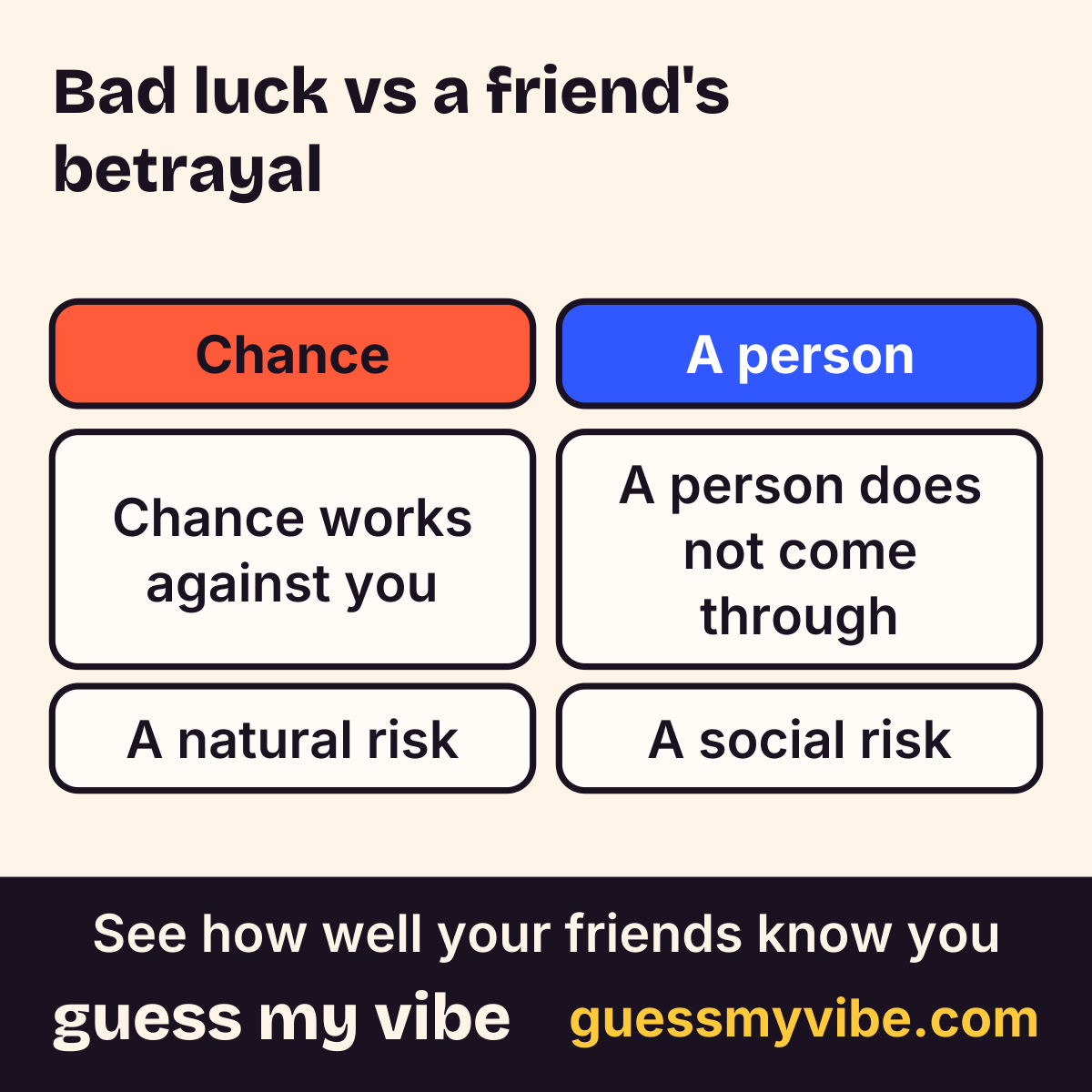
Picture two ways to lose out. In one, chance works against you. In the other, another person chooses not to come through. Economists have studied this contrast, and they call the finding betrayal aversion: people demand a higher risk premium, meaning more compensation, to take social risks than natural risks [1]. The paper we cite here is a methods study that compares two ways of measuring the effect, so we lean on its definition rather than its numbers. The idea itself is simple. In everyday terms, relying on a person feels like a different kind of risk than relying on luck.
That helps explain why a friend's betrayal can feel so different from other setbacks. Trusting a friend with a secret, a plan, or your feelings is a social risk, and you took it on purpose, usually because the friend had earned it. When it goes wrong, you lose the thing you shared, and you may also start doubting your own judgment. That second part is our reading of the research, not a finding of it, but many people describe it.
Cite this figure
Figure: "Bad luck vs a friend's betrayal." Guess My Vibe (guessmyvibe.com). https://guessmyvibe.com/learn/betrayal-by-a-friend#figure-chance-vs-a-person
Why rejection and betrayal can feel physical
People often say betrayal hurts in their chest or stomach, and researchers have taken that seriously. A review argued that social exclusion is painful because reactions to rejection are mediated by aspects of the physical pain system [2]. The authors offer this as a hypothesis. They suggest the overlap may have developed over evolutionary time to help social animals respond to threats to belonging. They pull together evidence that social and physical pain converge in thought, emotion and behavior, but note that the evidence for shared physiology comes primarily from animal research. It is a theory with supporting evidence, not a settled fact about every person.
A brain-imaging study adds a piece. Participants were scanned while playing a virtual ball-tossing game in which they were eventually left out. The anterior cingulate cortex was more active during exclusion than inclusion, paralleling results from physical pain studies, and its activity went along with how distressed people said they felt [4]. Keep the limits in view: that was a ball-tossing game, not a friend breaking a promise, so it shows that being shut out can register in pain-related brain activity, not that betrayal does. If being left out of a game can register this way, it is less surprising that a friend's betrayal stings.
Curious how your friends would answer?
Free. Answer 10 quick questions about you, then send your link. Friends play in their browser, no app needed.
Start freeWhat shapes whether people forgive
Forgiveness is a separate question from pain, and there is useful research on it. One set of studies on betrayal in close relationships proposed that people's self-oriented reactions to betrayal, like holding a grudge or wanting payback, work against forgiveness, while forgiveness rests on what the authors call prorelationship motivation, one source of which is strong commitment [3]. Across a priming experiment, a survey and an interaction-record study, the authors found evidence of associations, or causal effects, of commitment with forgiveness. The link seemed to rest on intent to persist in the relationship, and it was explained by how people interpreted the betrayal. Evidence that emotional reactions explained it was inconsistent.
In plain words, how you read the incident matters as much as how you feel about it. Was it careless or deliberate? A one-off or a pattern? Those readings are partly facts and partly judgment calls. The study doesn't say that a more committed person should forgive, or that forgiving is always right. It describes what tends to go along with forgiving.
A much larger body of work looks at forgiveness more broadly. A meta-analysis of 175 studies and 26,006 participants looked at what goes along with forgiving a single offender. Among the variables with particularly notable effects were the offender's intent (a sizable negative correlation), empathy (positive), apology (positive) and anger (negative), and situational factors accounted for more of the differences than victims' personalities did [5]. These are correlates, so the evidence can't show that an apology causes forgiveness, only that the two tend to travel together. It also covers many kinds of offenses and relationships, so it describes the pattern, not your friendship.
What this research can't tell you
It's worth being plain about the limits. None of these studies can tell you whether your friend is a good or bad person, and we won't try to. Labels like that skip over the context that matters: what exactly happened, how it was handled, and what the friendship was before it. Research also can't say whether a friendship should continue. People differ here. Some work to rebuild a friendship, and others decide the trust can't be rebuilt. Both can be reasonable, and the studies above don't rank them.
One more caution: these findings come mostly from lab tasks, scenarios and surveys, many with student samples. Real betrayals are messier than a ball-tossing game or a questionnaire item, and they sit inside years of shared history.
If you're in the middle of it
A few gentle points follow from the research, offered as ideas rather than instructions. First, the intensity of what you feel is not a sign that something is wrong with you. Feeling a lot after a friend's betrayal is what the pain research would lead you to expect. Second, pain and forgiveness are two different questions, and you don't have to answer the second one while you are still in the first. Third, the findings on intent suggest it can help to separate what the friend did from what they meant, when you are ready, and when that is safe and fair to do. It's fine if you aren't ready yet.
If it has been weighing on you for a long time, or it is affecting your sleep, school or work, it is worth talking with someone you trust, such as a friend, a family member, or a counselor. This isn't therapy, a diagnosis, or a substitute for professional care, and nothing here should be read as advice about your specific situation.
A small note on trust and being known
Playing Guess My Vibe won't repair a betrayal, and we wouldn't suggest it as a fix. What it can do, with a friend you already trust, is give you a low-stakes way to notice the opposite experience: a friend guessing how you would honestly answer, and getting some right and some wrong, with nothing at risk. Sometimes after a betrayal, being reminded that other people in your life do know you is quietly useful.
Key takeaways
- Experiments find people demand a higher risk premium to take social risks than natural risks, which researchers call betrayal aversion [1].
- A review hypothesizes that rejection feels painful because reactions to it are mediated by aspects of the physical pain system [2]. That is a theory about exclusion in general, not a finding about betrayal.
- In a brain-imaging study, being excluded in a virtual ball-tossing game activated the anterior cingulate cortex, as in physical pain studies, and its activity tracked how distressed people felt [4].
- In research on close relationships, forgiveness after betrayal went with stronger commitment and with how people interpreted the incident, not only with how they felt [3].
- A meta-analysis of 175 studies found that intent, empathy, apology and anger were among the variables with notable effects on forgiveness, and these are correlates, not proven causes [5].
- This isn't therapy, a diagnosis, or a substitute for professional care.
Questions people ask
Why does betrayal by a friend hurt so much?
Research suggests two reasons. People demand more compensation to rely on another person than to take a risk caused by chance [1], and a review argues that reactions to social rejection are mediated by aspects of the physical pain system [2].
Does betrayal really hurt like physical pain?
There is evidence for overlap, but it is not settled for every case. In one brain-imaging study, being excluded in a ball-tossing game activated the anterior cingulate cortex, paralleling physical pain studies [4], though that was a game, not a betrayal by a friend.
What makes it easier or harder to forgive a friend who betrayed you?
In a meta-analysis of 175 studies, intent, empathy, apology and anger were among the variables with notable effects on forgiveness, and these are correlates, not proven causes [5]. Commitment to the relationship also went with more forgiveness in close-relationship studies [3].
Should I forgive a friend who betrayed me?
Research can't answer that for you. It describes what tends to go along with forgiveness, not what you should do, and the right choice depends on what happened and what the friendship means to you.
How do I know if I'm overreacting?
Feeling intense hurt after a friend's betrayal is consistent with the research on social pain [2]. If it feels like too much to carry for a long stretch, talking to someone you trust, or a professional, is a reasonable step.
See how well your friends know you.
Free. Answer 10 quick questions about you, then send your link. Friends play in their browser, no app needed.
Start freeReferences
- [1] Quercia, S. (2016). Eliciting and measuring betrayal aversion using the BDM mechanism. Journal of the Economic Science Association, 2(1), 48-59. PubMed: 27366658 (opens in a new tab)
- [2] MacDonald, G., & Leary, M. R. (2005). Why does social exclusion hurt? The relationship between social and physical pain. Psychological Bulletin, 131(2), 202-223. PubMed: 15740417 (opens in a new tab)
- [3] Finkel, E. J., Rusbult, C. E., Kumashiro, M., & Hannon, P. A. (2002). Dealing with betrayal in close relationships: Does commitment promote forgiveness?. Journal of Personality and Social Psychology, 82(6), 956-974. PubMed: 12051583 (opens in a new tab)
- [4] Eisenberger, N. I., Lieberman, M. D., & Williams, K. D. (2003). Does rejection hurt? An fMRI study of social exclusion. Science, 302(5643), 290–292. PubMed: 14551436 (opens in a new tab)
- [5] Fehr, R., Gelfand, M. J., & Nag, M. (2010). The road to forgiveness: A meta-analytic synthesis of its situational and dispositional correlates. Psychological Bulletin, 136(5), 894-914. PubMed: 20804242 (opens in a new tab)
How we find and check these sources: how we write. Spotted an error? Report a correction.
Related
- Forgiveness in Friendship: Why Some People Forgive Faster
- How to Build Trust in a Friendship, According to Research
- Holding Grudges: The Personality Behind It
- Feeling Left Out by Friends: What's Actually Happening
- Honesty in Friendship: Why It Hurts Less Than You Think
- Frenemy: What Mixed Feelings About a Friend Do to You
Cite this article
- Title
- Betrayal by a Friend: Why It Hurts, According to Research
- Publisher
- Guess My Vibe
- Updated
- URL
- https://guessmyvibe.com/
learn/ betrayal-by-a-friend
Copy this citation
Guess My Vibe. (2026, October 4). Betrayal by a Friend: Why It Hurts, According to Research. Guess My Vibe. https://guessmyvibe.com/
To point at one section, add that section's anchor (the # link on its heading) to the URL.