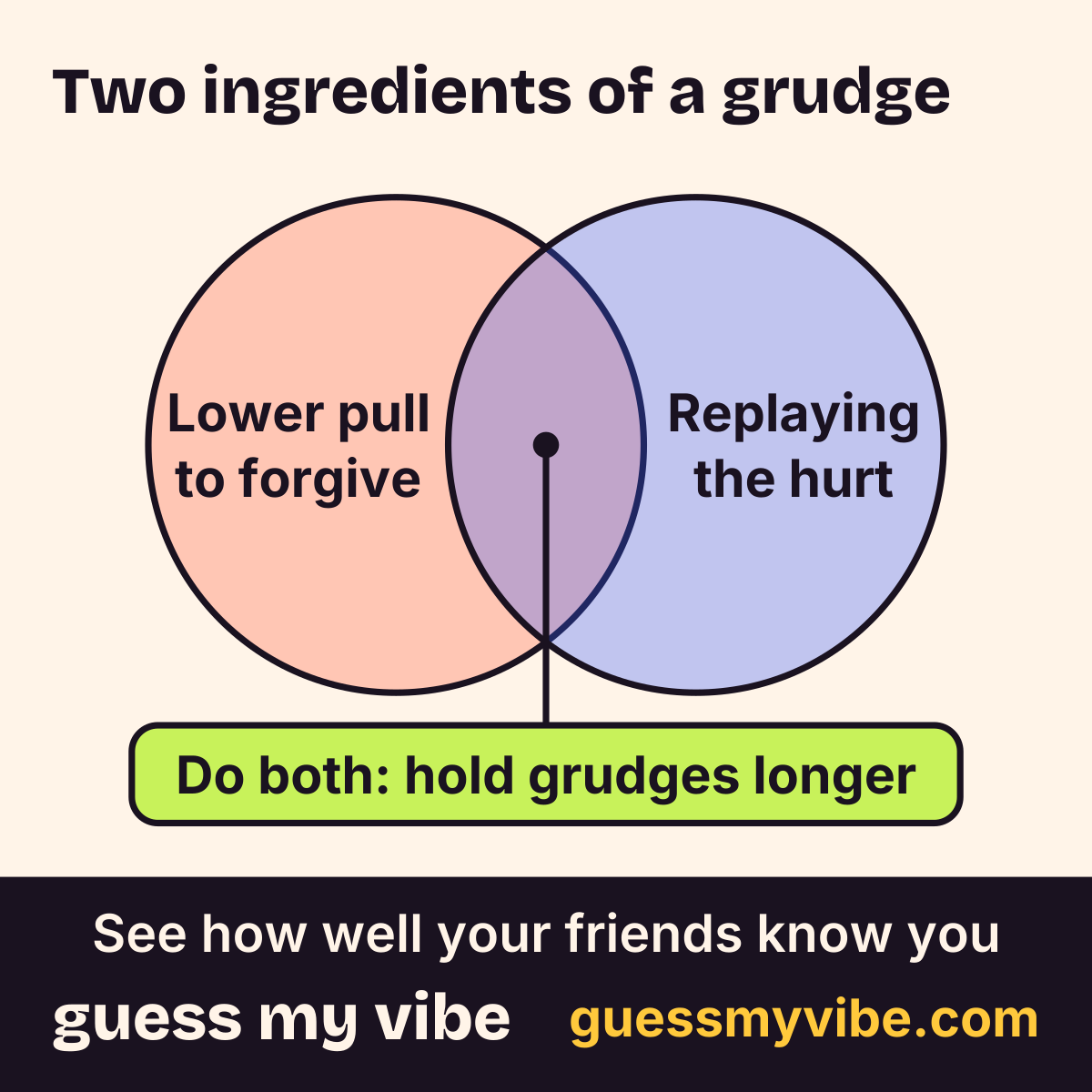
Holding grudges is strongly linked to two things: lower Agreeableness (less natural inclination toward forgiving and letting things go) and higher rumination (replaying the offense instead of moving past it) [1]. Agreeableness consistently goes with lower revenge motivation, more so than the other Big Five traits tested in that work [2], and longitudinal research shows rumination doesn't just accompany a grudge: when a person's replaying of a hurt rises, their forgiveness tends to fall, and over time rising rumination more consistently came first [3].
Holding grudges, staying angry at someone well past the point where most people would have let it go, isn't a character flaw with no explanation behind it. It's a measurable personality pattern with two main ingredients backed by actual research: a lower natural pull toward forgiving in the first place, and a tendency to keep replaying the original hurt instead of setting it down. People who do both of these more than average hold grudges longer, and the research on exactly why is more specific than "some people just can't let things go."
Vengefulness and the Big Five
A study built specifically to connect vengefulness, a general tendency to want payback after being wronged, to the Big Five personality traits found a clear pattern. In a first study (Study 1, N=91) that followed people after an offense, more vengeful people reported less forgiving and more rumination about it, and higher vengefulness at the start went with smaller gains in forgiving over eight weeks. In a second study using a validated personality measure (Study 2, N=192), vengefulness correlated r=-.49 with Agreeableness and r=.36 with Neuroticism, moderate-to-strong relationships by personality-research standards, and the Big Five traits together accounted for roughly 30% of the differences between people in how vengeful they tend to be [1]. Agreeableness and Neuroticism were the traits that lined up with it: the less naturally warm and accommodating someone is, the more a specific hurt tends to be met with a vengeful streak rather than forgiveness.
Cite this figure
Figure: "Two ingredients of a grudge." Guess My Vibe (guessmyvibe.com). https://guessmyvibe.com/learn/holding-grudges#figure-two-ingredients
Why Agreeableness specifically, not just "a bad mood"
A follow-up study dug into the actual motivations behind forgiving or not forgiving after being hurt, using both self-reports and ratings from people who personally know the participant. Across two samples (one with 137 people, one with 95 people plus 145 of their peers rating them), Agreeableness consistently tracked lower revenge motivation, with a self-reported effect size around -.36 to -.50 and a peer-rated effect around -.44, meaning this isn't just how vengeful people describe themselves, it's visible to the people around them too [2]. The same study found a tendency toward both avoidance (distancing from the person) and genuine benevolence (actually wishing them well) were tied to Neuroticism as well as Agreeableness, but revenge specifically tracked Agreeableness the most cleanly. One caution from this research: a single incident is a weak estimate of someone's actual disposition. How someone handles one specific hurt says less than how they handle hurts in general.
Rumination doesn't just sit alongside a grudge, it feeds it
It's tempting to think of rumination (replaying the offense, rehearsing what you should have said, running the scenario on a loop) as just what holding a grudge feels like from the inside. Three longitudinal studies tested whether it's actually doing causal work, tracking the same people's rumination and forgiveness over time instead of comparing different people at a single moment. The pattern held across all three: when a given person's rumination about a specific hurt went up, that same person's forgiveness of the hurt went down, and this link was explained mostly by anger (not fear) toward whoever caused the hurt. In the third study, a cross-lagged design that can weigh which direction the arrow more likely points, increased rumination more consistently came before a later drop in forgiveness than the reverse [3]. In plain terms: the replaying may not be just a side effect of staying angry. It may be one of the things keeping you angry, though these studies are correlational and cannot prove that.
Curious how your friends would answer?
Free. Answer 10 quick questions about you, then send your link. Friends play in their browser, no app needed.
Start freeThe same pattern shows up in how people handle small, everyday conflict
This isn't limited to major betrayals. Research (in a sample that included adolescents) on how people react to ordinary interpersonal conflict, the small daily friction of group chats, plans falling through, a comment that landed wrong, found Agreeableness was the Big Five trait most closely tied to conflict style in both hypothetical scenarios and two weeks of real diary-tracked conflicts [4]. A related study found people lower in Agreeableness rated confrontational, power-based responses to conflict more favorably than higher-Agreeableness people did, even though almost everyone, regardless of trait level, rated negotiation and simply letting things go as the objectively better strategy. The gap isn't in knowing the better move. It's in how appealing the worse one still feels in the moment, which is a reasonable description of what keeps a grudge alive long after the original argument ended.
Forgiveness, in this research, isn't the same as reconciliation
A common sticking point in this research is worth naming directly: forgiveness, as these studies measure it, is an internal shift, letting go of the desire for revenge and the hostility behind it, not an external decision to act like nothing happened or to stay close to someone who keeps causing harm. Someone can genuinely forgive a friend for one specific thing, in the sense this research means it, and still decide to see that friend less, or to not extend the same trust again. Reasonable caution after being hurt repeatedly is a different thing from an unresolved, repeatedly-replayed grudge over a single incident; the vengefulness and rumination research above is about the second pattern, not the first. Confusing the two is part of why "just let it go" can land as bad advice: it conflates giving up on revenge with giving up your own judgment about who's safe to be close to.
What this means if a friend seems to hold onto things
None of this is a reason to label a friend who holds grudges as a worse person, Agreeableness is a trait, not a moral score, and plenty of high-Agreeableness people have one specific relationship where forgiveness genuinely doesn't come easily. But the research does suggest a useful distinction: a friend who holds a grudge for a long time is often ruminating on it in a way that's actively keeping the hurt alive, not just remembering it accurately. If you know that about someone, the honest move is naming that pattern directly rather than guessing at it from the outside, closer to how Guess My Vibe is built around a friend guessing your honest answers rather than assuming they already know them, since a wrong guess about why someone's still upset tends to just add a second grudge on top of the first.
Key takeaways
- Vengefulness correlates moderately with lower Agreeableness (r=-.49) and higher Neuroticism (r=.36), and the Big Five together explain about 30% of why some people are more vengeful than others [1].
- Agreeableness consistently went with lower revenge motivation after being hurt, more cleanly than Neuroticism did, which was tied to avoidance and benevolence as well [2].
- Rumination isn't only a symptom of holding a grudge: across three longitudinal studies, increases in a person's rumination about a hurt went with drops in their forgiveness, an association explained mostly by anger rather than fear [3].
- People lower in Agreeableness also react to everyday conflict with more distress and more favorable views of confrontational tactics, a pattern consistent with staying angry longer after a slight [4].
- This isn't therapy, a diagnosis, or a substitute for professional care.
Questions people ask
Why do some people hold grudges more than others?
Research ties grudge-holding mainly to lower Agreeableness and to higher rumination (replaying the hurt instead of letting it fade); together, personality traits explain roughly 30% of the difference in how vengeful people tend to be [1].
Is holding a grudge a sign of a specific personality trait?
The clearest link is to lower Agreeableness, which went with more revenge motivation and less forgiveness in both self-reports and peer ratings of people who personally know the person [2].
Does thinking about something a lot make you hold onto it longer?
Possibly, according to longitudinal research: increases in rumination about a specific hurt went with drops in forgiveness of that same hurt, an association explained mostly by anger toward the person who caused it [3].
Is holding a grudge the same as just remembering what happened?
Not according to the research. Remembering an event is neutral; rumination is actively replaying and rehearsing it, and rising replaying goes with lower forgiveness, with the timing evidence leaning toward rumination coming first [3].
Do less agreeable people handle everyday arguments differently?
Yes. Studies of both hypothetical and real daily conflicts found Agreeableness was the trait most tied to conflict style, and people lower in it rated confrontational responses more favorably even though most people still rated negotiation as the better strategy [4].
See how well your friends know you.
Free. Answer 10 quick questions about you, then send your link. Friends play in their browser, no app needed.
Start freeReferences
- [1] McCullough, M. E., Bellah, C. G., Kilpatrick, S. D., & Johnson, J. L. (2001). Vengefulness: Relationships with forgiveness, rumination, well-being, and the Big Five. Personality and Social Psychology Bulletin, 27(5), 601–610. doi.org/10.1177/0146167201275008 (opens in a new tab)
- [2] McCullough, M. E., & Hoyt, W. T. (2002). Transgression-related motivational dispositions: Personality substrates of forgiveness and their links to the Big Five. Personality and Social Psychology Bulletin, 28(11), 1556–1573. doi.org/10.1177/014616702237583 (opens in a new tab)
- [3] McCullough, M. E., Bono, G., & Root, L. M. (2007). Rumination, emotion, and forgiveness: Three longitudinal studies. Journal of Personality and Social Psychology, 92(3), 490–505. PubMed: 17352605 (opens in a new tab)
- [4] Jensen-Campbell, L. A., & Graziano, W. G. (2001). Agreeableness as a moderator of interpersonal conflict. Journal of Personality, 69(2), 323–361. PubMed: 11339802 (opens in a new tab)
How we find and check these sources: how we write. Spotted an error? Report a correction.
Related
- Conflict Styles: How Personality Shapes How You Fight
- Honesty in Friendship: Why It Hurts Less Than You Think
- Agreeableness: The Trait Closeness Barely Helps Friends Read
- Competitive Friend: The Psychology Behind the Sting
- Why Do I Get Jealous? The Personality Side of Jealousy
- Forgiveness in Friendship: Why Some People Forgive Faster
- Betrayal by a Friend: Why It Hurts, According to Research
- How to Apologize to a Friend: What Research Says Works
Cite this article
- Title
- Holding Grudges: The Personality Behind It
- Publisher
- Guess My Vibe
- Updated
- URL
- https://guessmyvibe.com/
learn/ holding-grudges
Copy this citation
Guess My Vibe. (2026, October 3). Holding Grudges: The Personality Behind It. Guess My Vibe. https://guessmyvibe.com/
To point at one section, add that section's anchor (the # link on its heading) to the URL.