To apologize to a friend well, give a fuller apology, not a one-line sorry: in scenario experiments, apologies with more components were judged more effective than apologies with fewer [1]. Expressing emotion can help too, since a meta-analysis found emotional apologies generally facilitate more forgiveness [2]. An apology improves the odds of forgiveness but doesn't guarantee it, and forgiveness is up to your friend.
If you are wondering how to apologize to a friend, the research has a clear, practical answer: say more than "sorry." Apologies that include more of the pieces researchers have identified tend to be judged more effective, and apologies that show real feeling generally help. This article covers what studies actually found about how to apologize, what they can't tell you, and a short checklist in plain words. The checklist is our own practical suggestion, not a research finding. The most important thing to know up front is that an apology is something you offer, not something that wins forgiveness on its own. That part belongs to your friend.
How to apologize: what makes an apology work
Researchers have tried to break an apology into parts and test which parts matter. In two studies, people read a scenario in which trust was violated and then judged apologies built from six defined components, shown singly and in combination. Apologies with more components were rated more effective than apologies with fewer, and some components were judged more important than others [1]. The same studies found that apologies after competence-based violations (roughly, a lapse in ability) were rated more effective than apologies after integrity-based violations (roughly, a lapse in honesty).
Two cautions apply. These were ratings of written scenarios, not real friends in real arguments. And the study's summary doesn't spell out which parts mattered most, so we won't guess. What it supports is the general idea that a thin apology is a weaker apology. It also hints at something worth knowing: if the problem was about honesty rather than a mistake, an apology may have more work to do.
The wider evidence points the same direction. A meta-analysis of 175 studies and 26,006 participants looked at what goes along with forgiving a single offender. Apology showed up among the variables with notable effects, with a correlation around r = .42, alongside empathy and the offender's intent [3]. A correlation of that size is real but moderate, and these are correlates. They don't show that apologizing causes forgiveness, only that the two tend to go together.
Why apologies work: they change how your friend sees you
One reason apologies help may be what they signal. In one set of studies, 163 undergraduates who had recently been harmed were followed for 21 days. Conciliatory gestures from the person who harmed them were followed by more forgiveness, and that link was mediated by the victims' perceptions of the transgressor's Agreeableness [4]. A second study, an experiment with 145 undergraduates, found something similar after a breach of trust by an anonymous partner in a game: when the partner apologized and offered financial compensation, participants reported more forgiveness and more feelings of friendship than in a control condition or one where the partner aggravated the situation.
The authors read this as conciliatory gestures making the transgressor seem more sympathetic, considerate and fair. In everyday terms, a good apology tells your friend something about you, not only about the incident: that you care how they were affected and can be fair. A note on the evidence: these were student samples, and the experiment used an anonymous game partner, not a close friend, so the closeness of a real friendship may change how things play out.
Curious how your friends would answer?
Free. Answer 10 quick questions about you, then send your link. Friends play in their browser, no app needed.
Start freeShowing you mean it, and the limits of that
Does it help to show feeling when you apologize? A meta-analysis of 22 studies compared emotional apologies with ones that expressed no emotion or a neutral state, and found that expressing emotions can generally facilitate higher levels of forgiveness [2]. The authors also point out that researchers have studied a narrow range of emotions and have rarely compared how victims, offenders and bystanders respond. So the safe takeaway is modest: a flat, scripted apology is probably weaker than one where your friend can tell you actually feel it.
But performance alone isn't enough. A set of six studies, with a combined 3,818 participants, tested whether physical displays of remorse such as kneeling or crying made public apologies land better. They did raise perceived remorse and a handful of positive reactions, but they had no significant effect on forgiveness in any of the studies, and a combined analysis found an effect that was significant but negligible in size [5]. Those studies were about public apologies, not friends, so the lesson is not that tears are pointless. It is that even a vivid display of remorse can't make forgiveness happen on demand.
A plain-language checklist (our suggestions, not findings)
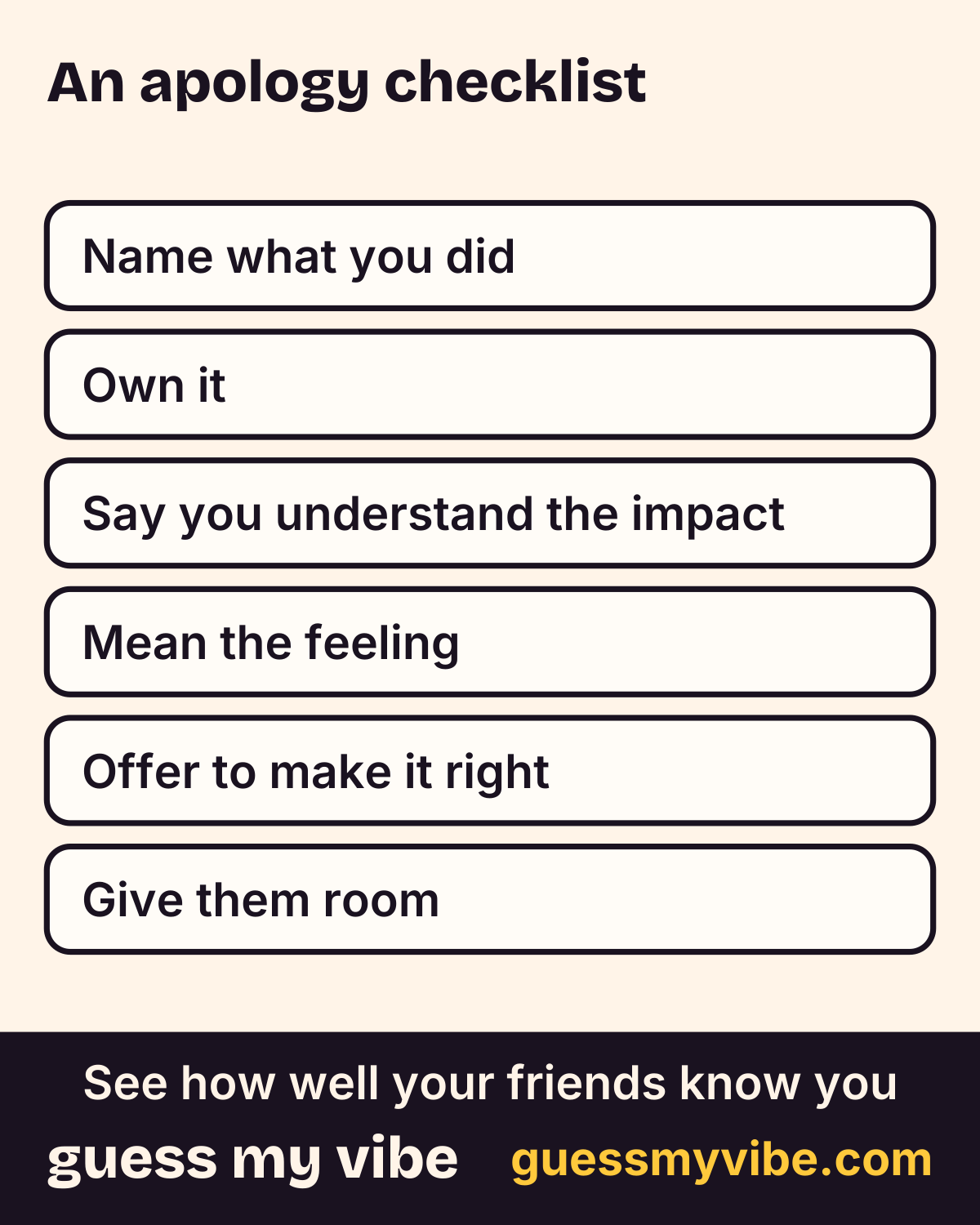
Studies can't write the actual message for you, so here is a practical version in our own words, based on the general idea that fuller apologies work better. Treat it as a starting point and adjust it to your friend and your friendship.
- Name what you did. Be specific, in plain words, about the thing that hurt, instead of "I'm sorry if you were upset."
- Own it. Say it was your choice or your mistake, without a "but" that moves the blame.
- Say you understand the impact. Describe how it may have felt on their side, and let them correct you.
- Mean the feeling. Say you're sorry in your own voice. A scripted line is easy to spot.
- Offer to make it right. If there is something concrete you can do, offer it, and only promise what you will actually do.
- Give them room. Don't demand an answer or a quick "it's fine." Forgiveness takes the time it takes.
Timing and channel are judgment calls. A call or an in-person talk may carry feeling better than a text, but a short message that opens the door can be a fine first step, especially if your friend needs space. There's no research here that settles it, so follow what you know about your friend.
Cite this figure
Figure: "An apology checklist." Guess My Vibe (guessmyvibe.com). https://guessmyvibe.com/learn/how-to-apologize-to-a-friend#figure-apology-checklist
What an apology can't do
An apology can't promise a result. The research above shows that apologies help on average, but it also shows that forgiveness depends on many things, including the friend's own feelings and what the offense was. If your friend isn't ready to forgive, that doesn't mean your apology failed. It may mean they need more time, or that the hurt was larger than words can fix. In our view, pushing for forgiveness works against what an apology is for.
It also helps to remember what an apology is for. It isn't a way to end the awkwardness fastest. It's a way to take responsibility and signal that you care about the person you hurt. When that is the goal, you're more likely to say it well, and more able to accept whatever answer comes back.
A small way to know your friend better first
An apology lands better when it fits the person receiving it. Some friends want directness, some want time, some want you to show up in person. Guess My Vibe is a free game where friends guess how you would answer real questions, and it works the other way too: guessing how your friend would answer is a light way to notice what they value and how they like to be treated. It won't write your apology, but it can help you pay attention to the person you're writing it for.
Key takeaways
- In two studies built on a trust-violation scenario, apologies with more components were rated more effective than apologies with fewer, and some components mattered more than others [1].
- Apology was among the variables with notable effects on forgiveness: in a meta-analysis of 175 studies it correlated at r = .42, which shows association, not cause [3].
- In two studies, conciliatory gestures like apologizing went with more forgiveness, and the authors suggest this works in part by making the person who did the harm seem more agreeable, meaning more considerate and fair [4].
- Expressing emotion in an apology can generally help forgiveness, according to a meta-analysis of 22 studies, but researchers have tested only a narrow range of emotions [2].
- Physical displays of remorse had a negligible effect on forgiveness in a large set of studies on public apologies, so a good apology can't force the other person to forgive [5].
- This isn't therapy, a diagnosis, or a substitute for professional care.
Questions people ask
How do you apologize to a friend?
Give a fuller apology rather than a one-line sorry. In scenario experiments, apologies with more components were judged more effective than apologies with fewer [1]. Name what happened, own it, show you understand the impact, and offer to make it right.
Does apologizing really lead to forgiveness?
It helps but doesn't guarantee it. Apology correlated with forgiveness at r = .42 in a meta-analysis of 175 studies, which shows association, not cause [3], and a large set of studies found physical displays of remorse had a negligible effect on forgiveness in public-apology settings [5].
Should I show emotion when I apologize?
Probably. A meta-analysis of 22 studies found expressing emotions can generally facilitate higher levels of forgiveness, though only a narrow range of emotions has been tested [2].
Why does an apology make a person seem more likable?
In two studies, conciliatory gestures went with more forgiveness and feelings of friendship, and the authors suggest this works in part by making the person who caused harm seem more agreeable, meaning more considerate and fair [4].
What if my friend doesn't forgive me after I apologize?
That can happen and it doesn't mean the apology was wrong. Forgiveness depends on many factors beyond your control, so giving your friend time and space is usually kinder than pushing for an answer.
See how well your friends know you.
Free. Answer 10 quick questions about you, then send your link. Friends play in their browser, no app needed.
Start freeReferences
- [1] Lewicki, R. J., Polin, B., & Lount, R. B. (2016). An exploration of the structure of effective apologies. Negotiation and Conflict Management Research, 9(2), 177-196. doi.org/10.1111/ncmr.12073 (opens in a new tab)
- [2] Russell, P. S., Hepper, E. G., Fasoli, F., Hopkins-Doyle, A., & Boone, F. (2025). Examining the dynamic impact of emotional apologies on forgiveness. Emotion, 25(5), 1337-1348. PubMed: 39964537 (opens in a new tab)
- [3] Fehr, R., Gelfand, M. J., & Nag, M. (2010). The road to forgiveness: A meta-analytic synthesis of its situational and dispositional correlates. Psychological Bulletin, 136(5), 894-914. PubMed: 20804242 (opens in a new tab)
- [4] Tabak, B. A., McCullough, M. E., Luna, L. R., Bono, G., & Berry, J. W. (2012). Conciliatory gestures facilitate forgiveness and feelings of friendship by making transgressors appear more agreeable. Journal of Personality, 80(2), 503-536. PubMed: 21299562 (opens in a new tab)
- [5] Hornsey, M. J., Wohl, M. J. A., Harris, E. A., Okimoto, T. G., Thai, M., & Wenzel, M. (2020). Embodied remorse: Physical displays of remorse increase positive responses to public apologies, but have negligible effects on forgiveness. Journal of Personality and Social Psychology, 119(2), 367-389. PubMed: 31512916 (opens in a new tab)
How we find and check these sources: how we write. Spotted an error? Report a correction.
Related
- Forgiveness in Friendship: Why Some People Forgive Faster
- Holding Grudges: The Personality Behind It
- Betrayal by a Friend: Why It Hurts, According to Research
- How to Build Trust in a Friendship, According to Research
- Conflict Styles: How Personality Shapes How You Fight
- Agreeableness: The Trait Closeness Barely Helps Friends Read
Cite this article
- Title
- How to Apologize to a Friend: What Research Says Works
- Publisher
- Guess My Vibe
- Updated
- URL
- https://guessmyvibe.com/
learn/ how-to-apologize-to-a-friend
Copy this citation
Guess My Vibe. (2026, October 4). How to Apologize to a Friend: What Research Says Works. Guess My Vibe. https://guessmyvibe.com/
To point at one section, add that section's anchor (the # link on its heading) to the URL.