The silent treatment is a deliberate refusal to speak to or acknowledge someone during a conflict, and it overlaps with two well-studied research areas: ostracism (being ignored or excluded) and the demand/withdraw pattern (one person presses an issue, the other shuts down). Research on both finds the reaction it triggers, real distress, a hit to basic needs like belonging and self-esteem, is consistent and measurable, not an overreaction. That doesn't make every instance of it a sign of a bad relationship; what matters is whether it's a single moment of cooling off or a repeating, controlling pattern.
What the silent treatment actually is, in research terms
The silent treatment is a deliberate refusal to speak to, acknowledge, or respond to someone, used during or after a conflict. It sits at the intersection of two separate research literatures. The first is ostracism research, the study of what happens to people when they're ignored or excluded, deliberately or not [1]. The second is the demand/withdraw literature, which studies a specific conflict pattern: one person keeps raising an issue, the other responds by shutting down, going quiet, or physically leaving, over and over on the same issue [4]. The silent treatment is the sharpest, most deliberate version of the withdrawing half of that pattern: not a pause to cool off, but a chosen refusal to engage at all.
Why being shut out hits so hard, even briefly
A review of the ostracism research describes being ignored or excluded as a threat the mind detects almost reflexively, one that triggers real sadness and anger and puts pressure on fundamental needs such as belonging, self-esteem, a sense of control over the situation, and being recognized by the other person [1]. That's not a description specific to romantic partners or close friends. In one large online study, 1,486 people from 62 countries played a simple online ball-tossing game with two other "players" who were actually just computer programs, nothing real, no relationship, nothing at stake. The more a player got frozen out of the tossing, the worse they reported feeling and the less in control and less like they belonged they said they felt [2]. If a meaningless game with literal strangers can produce that reaction, a real person deliberately refusing to speak to you clearly can too.
This isn't a fragile, one-off finding
That original ball-tossing experiment has since been repeated, with variations, well over a hundred times by different research teams. A meta-analysis pooling 120 of these studies and nearly 12,000 participants found the average effect of exclusion is large, not a small statistical blip that only shows up under special conditions, and that it holds up consistently regardless of age, gender, or country [3]. Whatever is happening when someone gets the silent treatment, the broader reaction it taps into is about as well-replicated as findings in this part of psychology get.
Why "it actually hurts" isn't just a figure of speech
One more piece of the ostracism research looked at what's happening in the brain while someone is being shut out, using the same ball-tossing game inside an MRI scanner. Being excluded activated the anterior cingulate cortex, a brain region that's also active during physical pain, and the amount of activity there tracked with how much distress people said they were feeling in the moment [5]. That's a real, measured overlap between a region involved in physical pain and the brain's response to being shut out, not proof the two experiences are identical in every way. But it's a meaningful piece of evidence for something a lot of people already sense about the silent treatment specifically: calling it painful isn't just a dramatic way of describing an inconvenience. There's a real, physical echo of it in how the brain responds.
Curious how your friends would answer?
Free. Answer 10 quick questions about you, then send your link. Friends play in their browser, no app needed.
Start freeThe conflict-specific cost: what demand/withdraw research adds
Ostracism research explains why being shut out feels bad in general. The demand/withdraw research explains what happens when it becomes someone's go-to conflict tactic. A meta-analysis of 74 studies and over 14,000 people, looking specifically at the pattern where one person presses an issue and the other withdraws, found a moderate, meaningful overall link to worse outcomes (r=.36), strongest for relational and communicative outcomes, and mostly studied in couples rather than friends [4]. The same analysis found the pattern's cost was larger in relationships already under strain (r=.41) than in ones that weren't (r=.35), which points to something important: the pattern isn't neutral background noise. Whether it's a symptom of existing friction or a cause of new friction, it tends to travel with it.
A single cool-down versus a repeating, controlling pattern
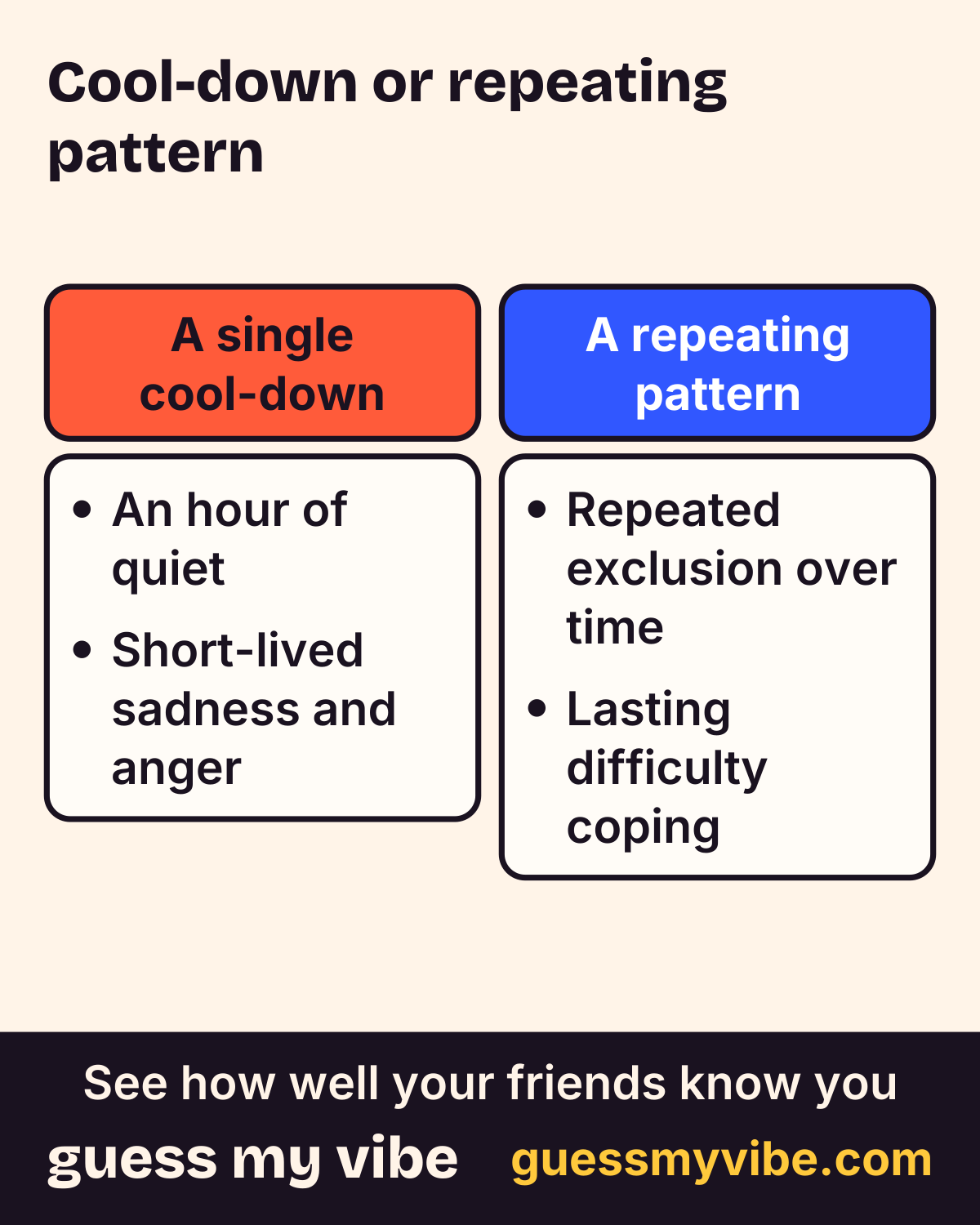
None of this research says every moment of silence after an argument is a crisis. The review on ostracism specifically distinguishes a single, short episode, which tends to produce real but short-lived sadness and anger, from chronic, repeated exclusion over time, which is the pattern linked to more serious, lasting difficulty coping [1]. One person needing an hour of quiet to calm down before talking isn't the same thing as a standing pattern where disagreement is consistently met with days of being frozen out, used specifically to make the other person give in or guess what they did wrong. The first is a normal, if imperfect, way people regulate a hard moment. The second is the pattern the demand/withdraw research flags as costly, and it's worth naming as a pattern, specifically, rather than judging the person using it.
Cite this figure
Figure: "Cool-down or repeating pattern." Guess My Vibe (guessmyvibe.com). https://guessmyvibe.com/learn/silent-treatment#figure-cool-down-or-pattern
When it's worth bringing in outside perspective
None of the research above hands out a verdict on anyone's character for using or receiving the silent treatment; it's a common, human response to conflict, not evidence of who someone fundamentally is. That said, if silence has become the default response to nearly every disagreement, if it regularly stretches on for days, or if it's being used specifically to control what the other person does next, that's a pattern worth talking through with someone you trust, a friend, a family member, or a counselor, rather than something to just absorb quietly every time. Naming the pattern out loud, even once, tends to matter more than figuring out exactly whose fault it is.
A different way to feel heard by a friend
Guess My Vibe is built around the opposite of being shut out: a friend actually paying attention, guessing your real answers, and you seeing exactly how close they landed. It's a small, deliberate way to feel noticed by someone specific, which is precisely the need research says exclusion threatens.
Key takeaways
- Being deliberately ignored or excluded, the core of what the silent treatment does, signals a threat and, even in brief episodes, threatens fundamental needs such as belonging, self-esteem, control, and recognition [1].
- This reaction isn't limited to relationships that matter deeply. People excluded by computer-controlled strangers in a pointless online game, with nothing real at stake, still reported feeling worse, less in control, and less like they belonged [2].
- It's a remarkably well-replicated finding: a meta-analysis of 120 separate studies and nearly 12,000 people found a large, consistent effect of exclusion across age, gender, and country [3].
- The conflict-specific version, one person withdrawing in response to the other pressing an issue, is reliably linked to worse relationship and communication outcomes across a meta-analysis of 74 studies and over 14,000 people, and that cost was larger in already-distressed relationships [4].
- This isn't therapy, a diagnosis, or a substitute for professional care, and nothing here is meant to label anyone who's used or experienced the silent treatment.
Questions people ask
Why does the silent treatment feel like it physically hurts?
Brain-imaging research found social exclusion activates a region also active during physical pain, and that activity matched how much distress people reported feeling in the moment [5]. It's early evidence of a real overlap, not proof the two experiences are identical.
Is the silent treatment a form of abuse?
Not automatically, and it's not something this article diagnoses anyone with. Research on being ignored or excluded finds that even brief episodes cause real distress [1]. A repeating pattern used specifically to control what someone does next is different from an occasional need for quiet to cool down, and that kind of ongoing pattern is worth discussing with someone you trust.
Why does the silent treatment hurt so much, even over something small?
Being ignored or excluded makes people feel bad, less in control, and less like they belong. This shows up even in deliberately meaningless situations with total strangers and nothing real at stake, which is why it hits hard regardless of how "small" the trigger was [2].
Is giving someone the silent treatment the same as needing space?
Not quite. Research distinguishes a short, one-time episode of pulling back, which tends to cause brief sadness or anger, from a repeating pattern where the same person withdraws every time a specific issue comes up, which is the version linked to real relationship cost [1] [4].
Does the silent treatment actually damage a relationship?
Research on the broader demand/withdraw pattern (pressing an issue met with withdrawal) found a moderate, meaningful link to worse relational and communicative outcomes, and the cost was larger in relationships already under strain [4].
How reliable is this research, or is it just a few small studies?
It's unusually well-replicated for this area of psychology. A meta-analysis of 120 separate exclusion studies and nearly 12,000 people found a large, consistent effect across different ages, genders, and countries [3].
See how well your friends know you.
Free. Answer 10 quick questions about you, then send your link. Friends play in their browser, no app needed.
Start freeReferences
- [1] Williams, K. D. (2007). Ostracism. Annual Review of Psychology, 58, 425–452. PubMed: 16968209 (opens in a new tab)
- [2] Williams, K. D., Cheung, C. K., & Choi, W. (2000). Cyberostracism: Effects of being ignored over the Internet. Journal of Personality and Social Psychology, 79(5), 748–762. PubMed: 11079239 (opens in a new tab)
- [3] Hartgerink, C. H. J., van Beest, I., Wicherts, J. M., & Williams, K. D. (2015). The ordinal effects of ostracism: A meta-analysis of 120 Cyberball studies. PLOS ONE, 10(5), e0127002. PubMed: 26023925 (opens in a new tab)
- [4] Schrodt, P., Witt, P. L., & Shimkowski, J. R. (2014). A Meta-Analytical Review of the Demand/Withdraw Pattern of Interaction and its Associations with Individual, Relational, and Communicative Outcomes. Communication Monographs, 81(1), 28-58. doi.org/10.1080/03637751.2013.813632 (opens in a new tab)
- [5] Eisenberger, N. I., Lieberman, M. D., & Williams, K. D. (2003). Does rejection hurt? An fMRI study of social exclusion. Science, 302(5643), 290–292. PubMed: 14551436 (opens in a new tab)
How we find and check these sources: how we write. Spotted an error? Report a correction.
Related
Cite this article
- Title
- The Silent Treatment: What Research Says It Actually Does
- Publisher
- Guess My Vibe
- Updated
- URL
- https://guessmyvibe.com/
learn/ silent-treatment
Copy this citation
Guess My Vibe. (2026, October 3). The Silent Treatment: What Research Says It Actually Does. Guess My Vibe. https://guessmyvibe.com/
To point at one section, add that section's anchor (the # link on its heading) to the URL.