Avoiding conflict usually means one of two different things: stepping back from a disagreement in the moment, which people in one study rated as a better tactic than escalating, or a repeating pattern where one person keeps raising an issue and the other reliably shuts down or changes the subject every time. That second pattern, called demand/withdraw in the research, is the one reliably linked to worse outcomes, and it isn't a fixed role either person is stuck in.
Two different things get called "avoiding conflict"
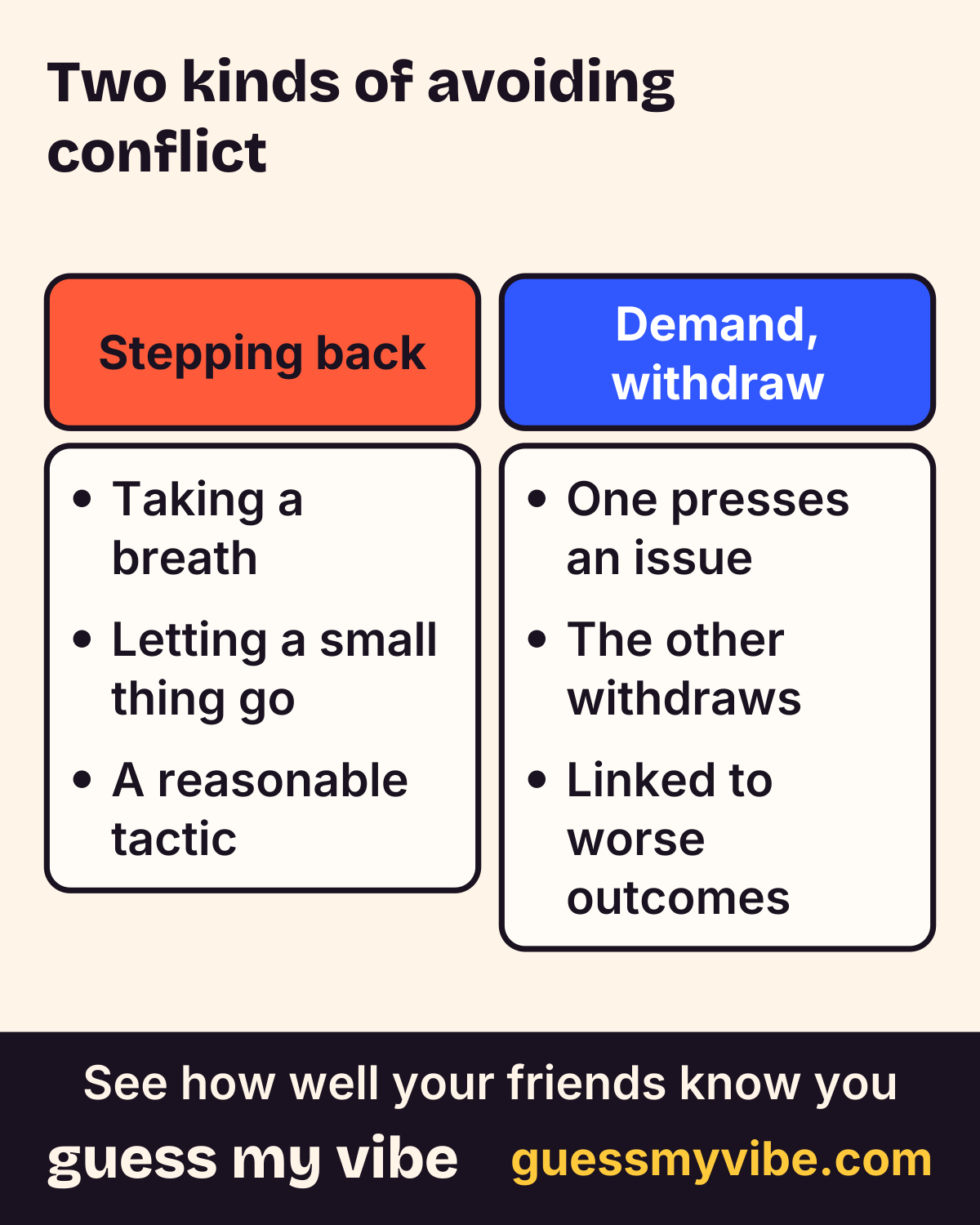
"Avoiding conflict" covers two genuinely different behaviors that research treats very differently. The first is stepping back from a specific disagreement in the moment: taking a breath, deciding a particular fight isn't worth having right now, letting something small go. The second is a repeating pattern where the same issue keeps coming up and the same person reliably goes quiet, changes the subject, or leaves the room every single time it does. Researchers call that second pattern demand/withdraw, and it's the one with a real, well-documented cost. The first kind of avoidance, a single decision to not engage with one disagreement, is treated by the research below as a reasonable tactic, not a problem to fix.
Cite this figure
Figure: "Two kinds of avoiding conflict." Guess My Vibe (guessmyvibe.com). https://guessmyvibe.com/learn/avoiding-conflict#figure-two-kinds-of-avoiding
What the demand/withdraw research actually found
The most direct research on costly conflict avoidance comes from a meta-analysis pooling 74 separate studies and more than 14,000 participants, built around a specific repeating pattern: one person presses an issue (criticizing, pushing, bringing something up again) while the other withdraws (going quiet, changing the subject, physically leaving) [1]. Looking at demanding and withdrawing together as a pattern, the analysis found a moderate, meaningful overall association with worse outcomes (r=.36). That link was strongest for relational and communicative outcomes (both around r=.42), and weaker for broader demographic and well-being measures (around r=.24–.25). The pattern itself, not any one person's character, is what the data is built around.
It isn't a fixed role for either person
One of the more useful findings buried in that same meta-analysis is who ends up doing the withdrawing. The overall effect size was nearly identical whether the wife was the one demanding and the husband withdrew (r=.38) or the husband was demanding and the wife withdrew (r=.39) [1]. If withdrawal were mainly a fixed trait, something one specific kind of person just does regardless of the situation, you'd expect a clearer asymmetry between roles. Instead, the data is at least consistent with roles that aren't tied to one gender. Most of this research is on couples, so how well it carries over to friends is an open question. The meta-analysis also found the pattern's cost was meaningfully larger among couples already in distress (r=.41) than those who weren't (r=.35), which points toward a feedback loop: avoidance likely both reflects existing strain and adds to it, rather than one single cause with one single effect.
What personality research actually says about who avoids conflict
It's tempting to assume there's a specific trait, an "avoidant personality," behind all of this, but the personality research doesn't draw quite that straight a line. The clearest trait finding in conflict research is about Agreeableness, and it's narrower than "avoids conflict." A study combining hypothetical conflict scenarios with two weeks of real diary entries found Agreeableness was the Big Five trait most closely tied to how people respond to conflict overall [3]. But a companion study measuring the actual tactics people rate and use found something more specific: almost everyone, agreeable or not, rated negotiation and quiet disengagement as better options than power assertion (threats, pulling rank, overpowering the other person); less agreeable people just rated power assertion less badly than more agreeable people did [2]. That's a preference against escalation, not a documented preference for shutting down and avoiding the issue altogether. The research doesn't actually support treating conflict avoidance as one fixed personality type waiting to be diagnosed. Part of why Agreeableness pulls people away from escalation specifically, rather than toward avoidance generally, traces back to empathy: a separate research program found Agreeableness is linked to empathic, prosocial feeling, which is in turn linked to actually helping people across a range of situations [4]. Empathy keeps the other person's perspective in view during a disagreement, which argues against raw power assertion; it doesn't, on its own, explain why someone would disappear from the conversation entirely.
Curious how your friends would answer?
Free. Answer 10 quick questions about you, then send your link. Friends play in their browser, no app needed.
Start freeWhen stepping back from one disagreement is fine
This is the detail that gets lost when "avoiding conflict" gets treated as a single bad habit: in the same study that measured real conflict tactics, quiet disengagement, stepping back from a specific disagreement rather than pushing it further, was rated by nearly everyone as a solidly good option, clearly ahead of power assertion [2]. One decision to let a small thing go, or to pause a heated conversation until both people have cooled down, isn't the pattern the demand/withdraw research is describing. The costly version is the repeating cycle: the same issue, raised again, met with the same shutdown, every time, with nothing actually changing in between.
Telling a bad habit from a healthy pause
Most of the demand/withdraw research comes from couples, so it's fair to ask how far it carries over to friends. The meta-analysis itself reports on married and romantic couples, and the pattern it describes (one person pressing, the other retreating) is easy to recognize in friendships too, but nobody should treat these numbers as measured friendship effects. What transfers best is the shape of the pattern, not the exact size of the cost. A useful, honest question to ask is whether the same specific issue keeps resurfacing with the same shutdown every time, or whether this is one particular disagreement that genuinely isn't worth having right now. The first looks like the costly demand/withdraw pattern the research above measured. The second looks like the disengagement tactic that study participants, across the board, rated as a reasonable move. Neither one makes a person a fixed type; the research treats both as things almost anyone does in different situations, not as evidence of who someone fundamentally is.
Guessing how a friend actually handles this
Most people assume they already know whether a close friend is the type to shut down during a disagreement or push through it, often based on one memorable moment rather than an actual pattern. Guess My Vibe scores Agreeableness (the app calls it Warmth) from real personality-science questions, the same trait this research keeps coming back to, and lets a friend guess your actual answers instead of going on a guess built from one remembered fight.
Key takeaways
- A meta-analysis of 74 studies and over 14,000 people found the demand/withdraw pattern, one person pressing an issue while the other avoids or shuts down, has a moderate, real link to worse relational and communication outcomes [1].
- Either partner can end up in the withdrawing role: the same meta-analysis found almost identical effect sizes whether the wife or the husband was the one demanding, which suggests the withdrawing role isn't tied to one fixed 'conflict-avoidant personality' [1].
- The pattern's cost was larger in already-distressed couples (r=.41) than in non-distressed ones (r=.35), so avoidance and relationship strain likely feed each other rather than one simply causing the other [1].
- Stepping back from a disagreement in the moment isn't automatically the wrong move: in one study, almost everyone, regardless of personality, rated quietly disengaging as a better tactic than raw power assertion [2].
- This isn't therapy, a diagnosis, or a substitute for professional care.
Questions people ask
Is avoiding conflict always a bad thing?
No. Stepping back from one specific disagreement was rated by almost everyone in one study as a reasonable tactic, better than escalating [2]. The costly version, called demand/withdraw in research, is a repeating pattern where the same issue keeps coming up and the same person reliably shuts down every time, not a single decision to let something go [1].
What is the demand/withdraw pattern?
It's a repeating conflict dynamic where one person keeps pressing an issue and the other reliably avoids, goes quiet, or changes the subject in response. A meta-analysis of 74 studies and over 14,000 people found it has a moderate, meaningful link to worse relationship and communication outcomes [1].
Are some people just naturally more conflict-avoidant?
The research doesn't clearly support a single fixed "conflict-avoidant" personality type. The demand/withdraw meta-analysis found nearly identical effect sizes whichever partner was demanding, suggesting the roles aren't tied to one gender, though most of this research is on couples, not friends [1].
Does being agreeable mean someone avoids conflict more?
Not exactly. Agreeableness is linked to how people respond to conflict overall, but the specific finding is a preference for negotiation over power assertion (threats, pulling rank), not a documented preference for avoidance or shutting down [3] [2].
How do you tell a friend they hurt you if you tend to avoid conflict?
There's no single research-backed script for this, but the research above suggests a repeating demand/withdraw cycle, not a single honest conversation, is what's linked to real cost, so raising a specific issue once and calmly is a sensible way to avoid slipping into that cycle (the meta-analysis didn't test that remedy) [1].
See how well your friends know you.
Free. Answer 10 quick questions about you, then send your link. Friends play in their browser, no app needed.
Start freeReferences
- [1] Schrodt, P., Witt, P. L., & Shimkowski, J. R. (2014). A Meta-Analytical Review of the Demand/Withdraw Pattern of Interaction and its Associations with Individual, Relational, and Communicative Outcomes. Communication Monographs, 81(1), 28-58. doi.org/10.1080/03637751.2013.813632 (opens in a new tab)
- [2] Graziano, W. G., Jensen-Campbell, L. A., & Hair, E. C. (1996). Perceiving interpersonal conflict and reacting to it: The case for agreeableness. Journal of Personality and Social Psychology, 70(4), 820–835. PubMed: 8636901 (opens in a new tab)
- [3] Jensen-Campbell, L. A., & Graziano, W. G. (2001). Agreeableness as a moderator of interpersonal conflict. Journal of Personality, 69(2), 323–361. PubMed: 11339802 (opens in a new tab)
- [4] Graziano, W. G., Habashi, M. M., Sheese, B. E., & Tobin, R. M. (2007). Agreeableness, empathy, and helping: A person × situation perspective. Journal of Personality and Social Psychology, 93(4), 583–599. PubMed: 17892333 (opens in a new tab)
How we find and check these sources: how we write. Spotted an error? Report a correction.
Related
Cite this article
- Title
- Avoiding Conflict: When It Helps and When It Backfires
- Publisher
- Guess My Vibe
- Updated
- URL
- https://guessmyvibe.com/
learn/ avoiding-conflict
Copy this citation
Guess My Vibe. (2026, October 3). Avoiding Conflict: When It Helps and When It Backfires. Guess My Vibe. https://guessmyvibe.com/
To point at one section, add that section's anchor (the # link on its heading) to the URL.