Attachment styles describe how people tend to think and feel in close relationships, usually along two dimensions: anxiety (worrying about whether the other person will stay) and avoidance (keeping emotional distance). In studies of best friends in emerging adulthood, more anxiety with a best friend went with lower friendship quality, and anxious people disclosed and sought support less [1]. These are correlations from questionnaires, and they describe averages, not fixed types.
Attachment styles in friendship are a way of describing how people tend to feel and act with the friends they are closest to: how much they worry about being left, and how comfortable they are with closeness. The research on this is real but smaller than the research on romantic partners, and the effects are modest. This article covers what the friendship studies found, how much attachment explains, and what it can't tell you. It is not a quiz and it will not tell you what your style is.
A quick note on why you may be here. Attachment quizzes are heavily searched online, but most of that content is about romance or therapy. We don't offer an attachment test, and nothing here is a way to label yourself or a friend. We are looking at what published studies of friendship say.
What attachment styles are, in plain words
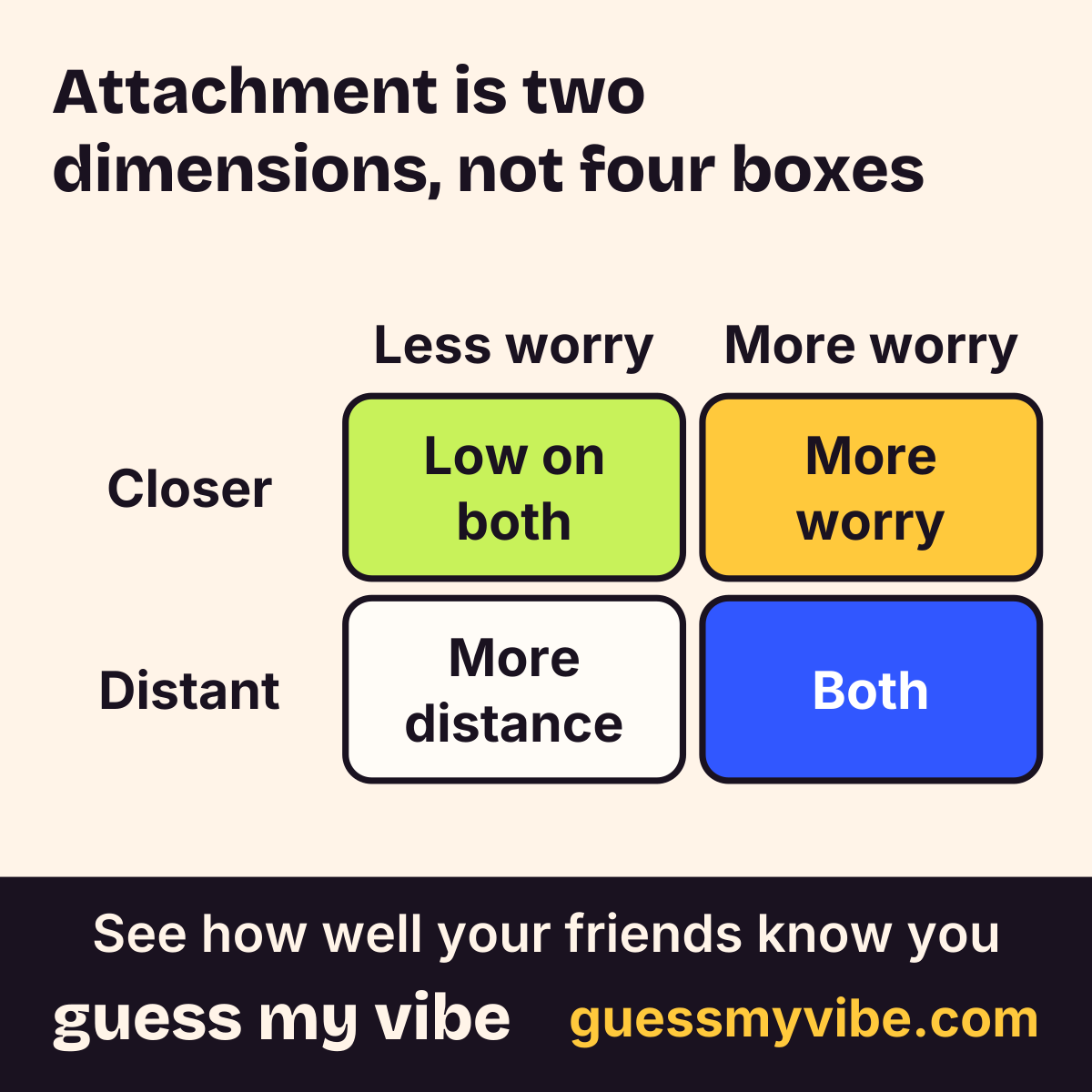
Attachment theory started with how children bond with caregivers. It suggests that early experiences with caregivers lay a foundation for the way people think, feel and behave in close relationships later in life [2]. Researchers who study adults usually measure two dimensions rather than sorting people into boxes. One is attachment anxiety, a tendency to worry about whether a close person will stay. The other is attachment avoidance, a tendency to keep emotional distance, which can mean staying more distant from friends. Each is a spectrum, so most people sit somewhere in the middle on both.
You may see the labels secure, anxious and avoidant online. Those are shorthand for where someone sits on the two dimensions, and the cutoffs are a choice. A person is not one type for all time, and as we will see, the same person can look different with a parent, a partner and a best friend.
Cite this figure
Figure: "Attachment is two dimensions, not four boxes." Guess My Vibe (guessmyvibe.com). https://guessmyvibe.com/learn/attachment-styles-in-friendship#figure-two-dimensions
Attachment with a best friend
The most direct friendship evidence comes from two studies of emerging-adult best friends, using samples where both friends took part (186 friend dyads in the first study, 118 in the second). In the first, people who felt more avoidance or anxiety in their relationship with their parents reported lower friendship quality, and this was explained by more avoidance or anxiety with their best friend. In the second study, more anxiety with the best friend was linked to lower friendship quality, and the route ran through support-seeking: anxious people disclosed less and sought less support. The authors found no effects of avoidance in that second study, and no effects of one friend's attachment on the other friend's reports [1].
Two cautions apply. These are correlations from questionnaires, so they cannot show that anxiety causes lower friendship quality. And friendship quality was rated by the people in the friendship, so how a person feels and how they rate the friendship are tangled together. What the result does suggest is an interesting pattern: worry about the friendship can go along with holding back the very openness and requests for support that tend to bring friends closer. That is a hypothesis fit, not a rule about anyone you know.
How attachment shows up across your whole friend circle
A different line of work looked at attachment and social networks. It examined whether attachment style relates to how people see their ties and to their skills at starting, keeping and ending relationships. In one experiment, the researchers raised a sense of attachment security with a priming task, and people became more likely to initiate social ties and less likely to dissolve them, the latter especially among people higher on avoidance or anxiety. Security priming also increased maintenance of ties, mainly for people higher on anxiety or lower on avoidance [4].
This is a lab manipulation, so it is not advice that you can talk yourself into feeling secure. But it fits the idea that how safe a person feels in relationships changes how willing they are to reach out and stick around. If you want the everyday version, it is why warm, reliable friends tend to make other people braver about reaching out too, although that last step is our own reading and not something this study tested.
Curious how your friends would answer?
Free. Answer 10 quick questions about you, then send your link. Friends play in their browser, no app needed.
Start freeWhere attachment comes from, and how much it explains
A long-running study followed 705 people and their families from infancy to about age 30. Early relationship quality with the mother was linked to differences in adult attachment anxiety and avoidance, both in general and in specific close relationships, including with best friends. Early levels and growth in the quality of childhood friendships were also linked to general adult attachment, and played a particularly important role in how adults thought, felt and acted in their friendships and romantic relationships. The authors report how much each explained, and it is not a lot: a median of about 3% of the differences for the mother-child link, and for childhood friendships, 2% to 4% for anxiety and up to about 10% to 11% for avoidance [2].
That is worth reading twice. Early experiences are linked to adult attachment, but they explain only a small share of why one adult differs from another. Most of the difference is likely down to other things, such as later experiences, temperament and how attachment is measured.
A twin study of 1,377 older adults, average age about 70, adds another piece. It estimated that attachment styles are partly heritable, about 36%, and partly due to experiences that twins do not share, about 64%. Heritability was higher for parent-specific attachment, about 51%, and experiences not shared between twins accounted for more of the variation in partner- and best-friend-specific attachment. Avoidance looked similar across relationships, as if one general factor sat behind it, while anxiety was more differentiated, which suggests a person can feel more worried in one relationship than another [3]. A heritability figure describes a group, not any one person, and this was an older sample, so it may not describe 20-year-olds.
What attachment can and can't tell you about a friendship
Attachment is one individual difference among many. Even in romantic couples, where it has been studied most, a large project pooling 43 longitudinal data sets from 29 labs found that attachment avoidance and anxiety were among the top individual differences linked to relationship quality, alongside life satisfaction, negative mood and depression. But relationship-specific factors, such as feeling appreciated and how much conflict there is, accounted for up to 45% of the variation at the start of the studies, and individual differences 21% [5]. That is a couples study, not a friendship one, but it supports the same humility: how a particular relationship goes matters more than a trait someone brings to it.
- It is not a diagnosis or a type. People vary on two dimensions, and the same person can feel differently with different people.
- It is not destiny. The friendship studies we found are correlational, and the long-term study above found that early experiences explain only a small share of adult differences.
- It does not tell you what a friend thinks of you. Your read of a friend's silence, a short reply or a canceled plan is easy to color with worry, and attachment is only one reason it might.
- It does not replace a conversation. If something about a friendship bothers you, asking the friend is better data than any label.
What to take from it for your own friendships
The studies don't test advice, so this is our own reading, offered as options. If you tend to worry about friends drifting, notice whether the worry is leading you to share less or ask for less, because the best-friend study links that very pattern to lower friendship quality. Saying one honest, specific thing is often easier than it feels. If you tend to keep your distance, the study found no avoidance effect for best friends, so there is no research reason to think you need to change; but if you want closer friendships, small amounts of sharing are a gentle place to start.
And if worry about relationships is taking over your days, or causing real distress, a licensed professional is the right person to talk to. A research summary like this one is not a stand-in for that.
How Guess My Vibe fits in
Guess My Vibe does not measure attachment. It asks your friends to guess how you would answer questions drawn from the Big Five, and then shows you how they see you next to how you see yourself. Seeing where friends read you differently is a gentle way to find out how you come across, without any label attached.
Key takeaways
- In the studies below, attachment is measured on two dimensions, anxiety and avoidance, so people can score anywhere on each instead of landing in one box [2].
- In studies of best friends (186 and 118 friend dyads), anxiety with the best friend went with lower friendship quality, partly because anxious people disclosed and sought support less [1].
- In a study that followed 705 people from infancy to about age 30, early relationships, including childhood friendships, were linked to adult attachment, but each explained only a small share of the differences [2].
- A twin study of older adults estimated that attachment styles are about 36% heritable, with the rest tied to individual experiences, and more of the friend-specific style was linked to experience than to genes [3].
- This isn't therapy, a diagnosis, or a substitute for professional care.
Questions people ask
Do attachment styles apply to friendships?
Yes, researchers measure attachment with best friends as well as with parents and partners. In studies of emerging-adult best friends, anxiety with the best friend went with lower friendship quality [1], and a twin study found that attachment anxiety in particular looks different across specific relationships, such as with a best friend, a partner or a parent [3].
What is an anxious attachment style in friendship?
In research terms, attachment anxiety is a tendency to worry about whether a close person will stay. In a study of best friends, more anxiety went with less self-disclosure and support-seeking, and lower friendship quality [1]. It is a dimension people score on, not a diagnosis.
What is an avoidant attachment style in friendship?
Attachment avoidance is a tendency to keep emotional distance. In the best-friend study, avoidance with parents was linked to avoidance with the best friend and lower friendship quality in the first study, but the second study found no effect of avoidance [1], so in these two studies the evidence for avoidance in friendship is less consistent than for anxiety.
Can your attachment style change?
The studies we opened don't directly test whether adults' attachment changes later in life. What they show is that early experiences are linked to adult attachment but explain only a small share of the differences [2], and that an experimental boost in felt security changed how willing people were to start and keep social ties for a short time [4].
Is attachment style the same as personality?
No. Attachment is about how you think and feel in close relationships, while Big Five personality traits describe broader patterns in how people think, feel and act. We did not use a study that maps one to the other, so we don't claim a link.
See how well your friends know you.
Free. Answer 10 quick questions about you, then send your link. Friends play in their browser, no app needed.
Start freeReferences
- [1] Oldeman, M. G., Cillessen, A. H. N., & van den Berg, Y. H. M. (2023). Friendships in Emerging Adulthood: The Role of Parental and Friendship Attachment Representations and Intimacy. Personality and Social Psychology Bulletin, 51(4), 514-529. PubMed: 37667812 (opens in a new tab)
- [2] Dugan, K. A., Kunkel, J. J., Fraley, R. C., Simpson, J. A., McCormick, E. M., Bleil, M. E., Booth-LaForce, C., & Roisman, G. I. (2026). A prospective longitudinal study of the associations between childhood and adolescent interpersonal experiences and adult attachment orientations. Journal of Personality and Social Psychology, 130(2), 260-290. PubMed: 41143788 (opens in a new tab)
- [3] Dugan, K. A., Kunkel, J. J., Fraley, R. C., Briley, D. A., McGue, M., Krueger, R. F., & Roisman, G. I. (2025). Genetic and environmental contributions to adult attachment styles: Evidence from the Minnesota Twin Registry. Journal of Personality and Social Psychology, 128(3), 639-669. PubMed: 39480283 (opens in a new tab)
- [4] Gillath, O., Karantzas, G. C., & Selcuk, E. (2017). A Net of Friends: Investigating Friendship by Integrating Attachment Theory and Social Network Analysis. Personality and Social Psychology Bulletin, 43(11), 1546-1565. PubMed: 28914161 (opens in a new tab)
- [5] Joel, S., Eastwick, P. W., Allison, C. J., Arriaga, X. B., Baker, Z. G., et al. (2020). Machine learning uncovers the most robust self-report predictors of relationship quality across 43 longitudinal couples studies. Proceedings of the National Academy of Sciences, 117(32), 19061-19071. PubMed: 32719123 (opens in a new tab)
How we find and check these sources: how we write. Spotted an error? Report a correction.
Related
Cite this article
- Title
- Attachment Styles in Friendship: What Research Shows
- Publisher
- Guess My Vibe
- Updated
- URL
- https://guessmyvibe.com/
learn/ attachment-styles-in-friendship
Copy this citation
Guess My Vibe. (2026, October 7). Attachment Styles in Friendship: What Research Shows. Guess My Vibe. https://guessmyvibe.com/
To point at one section, add that section's anchor (the # link on its heading) to the URL.