Ghosting is ending a relationship by cutting off all contact with no explanation, and researchers study it in both dating and friendships [1] [2]. It isn't mainly explained by one fixed "ghoster" personality type. It's more strongly linked to what someone believes about relationships in general, whether they're either meant to be or not (destiny beliefs) or something built through ongoing effort (growth beliefs) [3].
What ghosting actually means, in research terms
Ghosting is ending a relationship by suddenly cutting off all contact, with no breakup conversation, no explanation, and usually no warning. One of the field's working definitions comes from a qualitative study of 99 people who had both ghosted someone and been ghosted themselves. The researchers found several distinct reasons people gave for choosing to disappear instead of saying something directly, and a separate set of ways people realized, after the fact, that they'd been ghosted [1]. The term is newer than the behavior. Disappearing instead of having a hard conversation has probably always existed; what's changed is that texting and dating apps made it easy to do with zero friction, which is also why researchers started studying it as its own thing.
Why people ghost: it's about beliefs, not a fixed personality
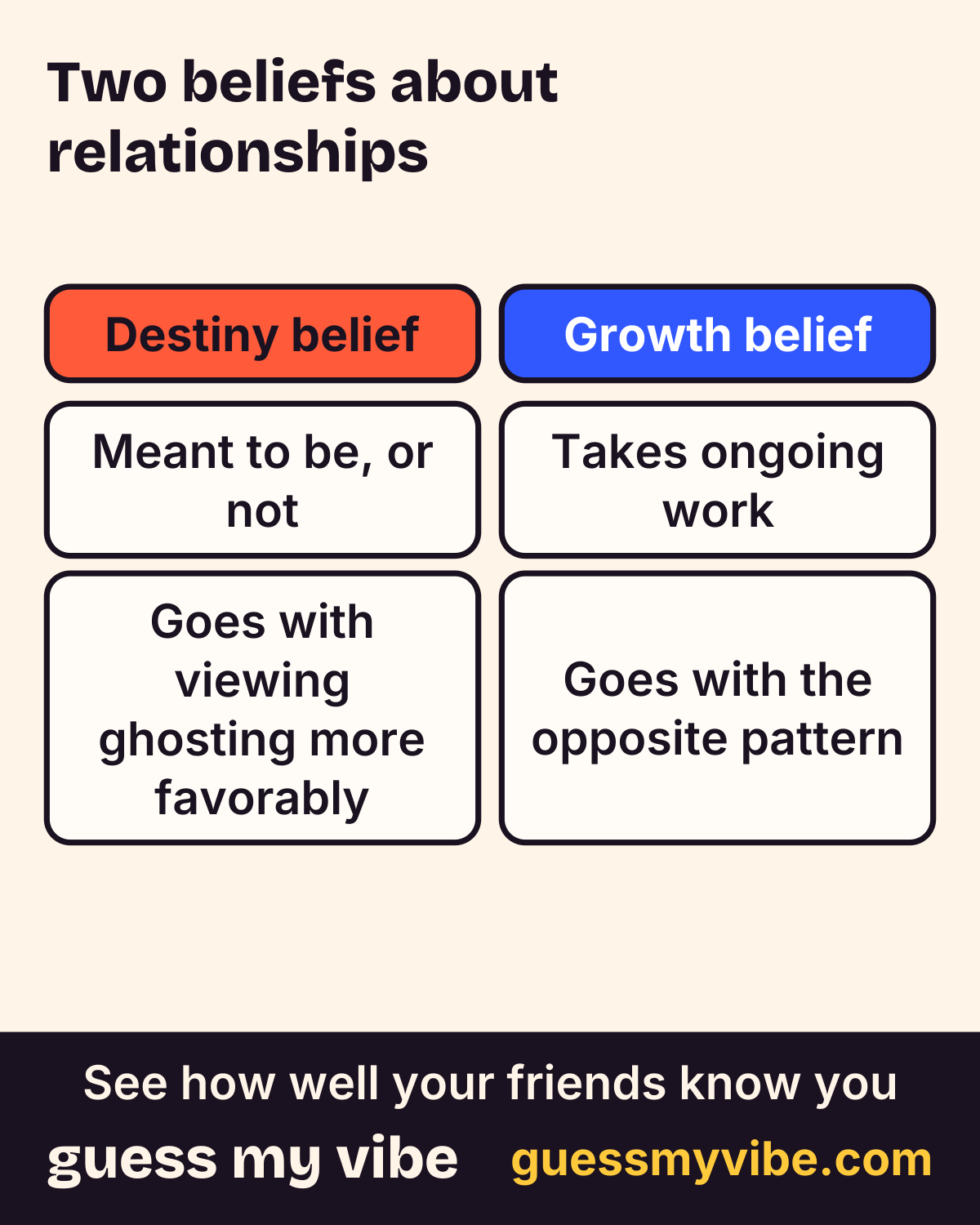
The most direct answer to "why do people ghost" doesn't come from personality research. It comes from research on what psychologists call implicit theories of relationships, the quiet beliefs someone holds about how relationships work in general, whether they're aware of holding them or not. Two studies, one with 554 people and a second with 747, measured two of these belief systems: "destiny" beliefs (a relationship is either meant to be or it isn't, and if it's struggling that's a sign it was never right) and "growth" beliefs (relationships take ongoing effort, and friction is normal and workable). Stronger destiny beliefs went with feeling more positively about ghosting, intending to use it more, and having actually used it before. Stronger growth beliefs showed the opposite pattern [3].
That reframes the question in a useful way. "Why did they ghost me" is less often answered by "because of who they are as a person" and more often by "because of what they believe a relationship is supposed to be." Someone who quietly believes relationships are either right or wrong from the start can experience ghosting as a reasonable response to something that "wasn't meant to be," not as an act of cruelty, even if it lands as exactly that on the other end.
Cite this figure
Figure: "Two beliefs about relationships." Guess My Vibe (guessmyvibe.com). https://guessmyvibe.com/learn/ghosting#figure-destiny-vs-growth-beliefs
Ghosting happens between friends too
Most ghosting research starts with dating, but it doesn't stop there. The same destiny-and-growth-beliefs study specifically extended its second sample to friendships and found a close to identical pattern to what it found in romantic relationships [3]. A later review of the whole research area put this plainly: ghosting is used to end romantic relationships, friendships, and other kinds of relationships alike, and what's linked to someone's willingness to do it looks like attachment style and the belief system above, not a simple personality-type explanation [2]. If a friendship has ever quietly faded into nothing, with no fight and no real reason given, that's the same behavior this research is describing.
The same qualitative study also looked at the other side: how people figured out they'd actually been ghosted in the first place. Most noninitiators didn't get a clean, single moment of realization. Instead it built gradually, through a string of unanswered texts, canceled plans, and a slowly growing gap between how often contact used to happen and how often it was happening now, until the pattern itself became the answer, even with nothing ever said directly [1]. The same study found that most people in its sample had played both roles at different points, as the one who disappeared and as the one left wondering, which is part of why the non-judgmental framing above matters: this isn't a story about two fixed kinds of people.
Curious how your friends would answer?
Free. Answer 10 quick questions about you, then send your link. Friends play in their browser, no app needed.
Start freeWhat happens to the person being ghosted
This is the part where the honest answer cuts against the easy narrative. A survey of 626 adults ages 18 to 40 who had been ghosted and/or "breadcrumbed" (kept on a string with occasional, half-hearted contact) by a dating partner measured life satisfaction, loneliness, and feelings of helplessness. Breadcrumbing, and the combination of being both breadcrumbed and ghosted, was linked to less life satisfaction and more loneliness and helplessness. Being ghosted on its own showed no significant link to any of the three [4].
That's one preliminary study, not a verdict that ghosting never hurts anyone. People's lived experience of being ghosted clearly varies, and this kind of cross-sectional survey can't rule out that it still stings in ways these three particular measures didn't catch. But it's a genuinely useful, honest finding: the uncertain in-between state, where someone keeps just enough contact alive to avoid a clean ending, looked worse in this data than a clean, if painful, disappearance did.
If you're the one thinking about doing it
None of this research is here to hand out a verdict on anyone who's ghosted or been ghosted; it's genuinely common on both sides. If the research above is useful for anything practical, it's this: the belief that a short, direct message costs more than it actually does is worth questioning. A line as plain as "I don't think this is working, and I'm going to step back" takes the same five seconds to send as silence, and it removes the guesswork the other person is often left sitting with. That's not a promise it will always go well. It's just the one lever this research actually points to, which is a belief about what a relationship owes the other person, not a trait someone is stuck with. Nothing here says ghosting is always the wrong call, either; some situations (harassment, feeling unsafe) are exactly when disappearing without warning is the sensible, protective option, not a failure of communication.
The same friend who can call your texting habits
A friend who's watched how you handle an awkward conversation before usually has a decent read on whether you're more likely to address it directly or let it go quiet. Guess My Vibe runs on exactly that kind of everyday behavior: a friend guesses how you'd actually act in a given moment, you see how close they got, and the questions pull from the same ordinary, observable habits this research is built on, not a one-time quiz result.
Key takeaways
- Ghosting means ending a relationship by cutting off all contact without explanation; the research studying it covers both romantic relationships and friendships [1] [2].
- A stronger belief that relationships are either meant to be or not (a "destiny" belief) goes with viewing ghosting more favorably and using it more; believing relationships take ongoing work (a "growth" belief) goes the other way [3].
- Ghosting isn't just a dating-app habit. The same research that studied romantic ghosting found a close to identical pattern once it looked at friendships [3].
- In one survey of adults who'd been ghosted or breadcrumbed by a dating partner, being ghosted alone wasn't significantly linked to lower life satisfaction or more loneliness; being kept on a string with occasional contact (breadcrumbing) was [4].
- This isn't therapy, a diagnosis, or a substitute for professional care.
Questions people ask
Why do people ghost instead of just saying something?
Research points less to a fixed "ghoster" personality and more to belief systems about relationships. Believing relationships are either meant to be or not (a destiny belief) is linked to feeling more okay with ghosting and using it more; believing relationships take ongoing work (a growth belief) is linked to the opposite.
Is ghosting only a dating thing?
No. The same research studying romantic ghosting found a nearly identical pattern once it looked at friendships, and a broader review describes ghosting as a way people end romantic relationships, friendships, and other relationships alike.
Does being ghosted actually hurt your well-being?
The one study that measured this directly found no significant link between being ghosted and lower life satisfaction, loneliness, or helplessness. Being "breadcrumbed," kept on a string with occasional contact instead of a clean ending, was the pattern linked to worse outcomes in that same study.
Is ghosting a sign someone has a personality disorder or is a bad person?
No, and the research doesn't support that framing. Ghosting is common on both sides and connects more to a person's beliefs about how relationships work than to any fixed character trait. This isn't therapy or a diagnostic tool, and it isn't a basis for labeling anyone.
What should I do if a friend ghosted me?
There's no study that hands out a guaranteed next step. What the research above does suggest is that it's rarely about you specifically; it's more often about what the other person quietly believes a relationship is for. A short, direct check-in is a reasonable option if you want an answer, with no guarantee you'll get one.
See how well your friends know you.
Free. Answer 10 quick questions about you, then send your link. Friends play in their browser, no app needed.
Start freeReferences
- [1] LeFebvre, L. E., Allen, M., Rasner, R. D., Garstad, S., Wilms, A., & Parrish, C. (2019). Ghosting in Emerging Adults' Romantic Relationships: The Digital Dissolution Disappearance Strategy. Imagination, Cognition and Personality, 39(2), 125–150. doi.org/10.1177/0276236618820519 (opens in a new tab)
- [2] Freedman, G., & Powell, D. N. (2024). Ghosting: A Common but Unpopular Rejection Strategy. Social and Personality Psychology Compass, 18(12). doi.org/10.1111/spc3.70026 (opens in a new tab)
- [3] Freedman, G., Powell, D. N., Le, B., & Williams, K. D. (2019). Ghosting and destiny: Implicit theories of relationships predict beliefs about ghosting. Journal of Social and Personal Relationships, 36(3), 905–924. doi.org/10.1177/0265407517748791 (opens in a new tab)
How we find and check these sources: how we write. Spotted an error? Report a correction.
Related
- Communication Styles and Personality: The Real Research
- Texting Personality: What Your Texts Say About You
- BFF Test: A Real One to Take With Your Best Friend
- Self-Perception vs. How Others See You
- Social Battery: The Science of Why Socializing Drains You
- Left on Read: Why We Overthink Reply Times
- Attachment Styles in Friendship: What Research Shows
Cite this article
- Title
- Ghosting: Why People Do It, According to Research
- Publisher
- Guess My Vibe
- Updated
- URL
- https://guessmyvibe.com/
learn/ ghosting
Copy this citation
Guess My Vibe. (2026, October 3). Ghosting: Why People Do It, According to Research. Guess My Vibe. https://guessmyvibe.com/
To point at one section, add that section's anchor (the # link on its heading) to the URL.