Being left on read stings because silence feels like a message, and research on written online communication suggests it can be treated as one. But response times follow a regular pattern: in three datasets with more than 150,000 responses to e-mails, course discussion posts and an online question site, at least 70% of responses came within the responders' average latency, and very few came much later [1]. Those studies are not about texting, so there is no research number for how fast you should text back. A gap on its own is a weak clue.
Left on read: why a seen message with no reply stings
Being left on read means you can see someone opened your message and has not replied. It stings because silence feels like an answer. Research on written online communication treats it that way too: one team describes response latency, the time it takes to reply, as a nonverbal cue in written communication, and proposes a norms-based definition of online silence [2]. But the same body of research shows that response times follow a regular pattern, with most replies quick relative to a person's average and only a few very late [1]. The honest short answer is that a gap in replies is a weak clue to how someone feels, and we are much better at imagining reasons for it than at knowing them.
One thing to say up front. Almost none of the studies we could verify were about text messages. They are about e-mail, online discussion groups and similar channels, and we will flag that each time. There is no study we could open that gives a figure for how fast you should text back, or one that tests whether double texting hurts a friendship. We would rather say that than invent a rule.
How long do replies actually take?
A study of response times in online communication looked at three datasets with more than 150,000 responses in total: e-mails written by corporate employees, replies by university students in course discussion groups, and answers to questions posted on a public online information market [1]. It found a common pattern. Response times followed a power-law distribution, which is a way of saying that most replies are quick relative to the average, and a few are very slow. At least 70% of responses were made within the responders' average response latency, and at most 4% came after more than 10 times the average [1].
The authors note that this pattern persisted across diverse user populations, contexts, technologies and average response latencies [1]. For anyone waiting on a reply, the practical meaning is simple, and it comes with a caution. Replies tend to arrive in a rush relative to each person's own pace, with an occasional very late one. A reply that is slower than a person's usual rhythm is, by definition, an unusual event, but unusual events happen. The caution is that these datasets were e-mail and online posts, not texts between friends, so they say nothing about what a good pace for a text would be. They do suggest that your friend's usual pace is the thing to compare against, not some universal clock.
Why silence feels like a signal
People do read meaning into delay. In one study, managers evaluated job candidates who had varied in how quickly they replied to an e-mail: after 1 day, after 2 weeks, or with silence for more than a month. The researchers also varied what they call the candidate's reward valence. As expectancy violations theory anticipates, reward valence moderated the effect of response latency on evaluation, credibility and attractiveness [2]. In plain terms, the same delay was not judged the same way for every candidate: it depended on the second factor the researchers varied.
This was a hiring scenario, with managers and job candidates, not a friend replying to a meme. We would not apply its specifics to friendships. What carries over is the broader idea: a delay is treated as a violation of what we expected, and that its effect can depend on other features of the situation [2]. Our own guess, not a finding, is that a text from someone you are anxious to hear from weighs more than the same gap from someone you are not.
Curious how your friends would answer?
Free. Answer 10 quick questions about you, then send your link. Friends play in their browser, no app needed.
Start freeA slow reply is not being shut out
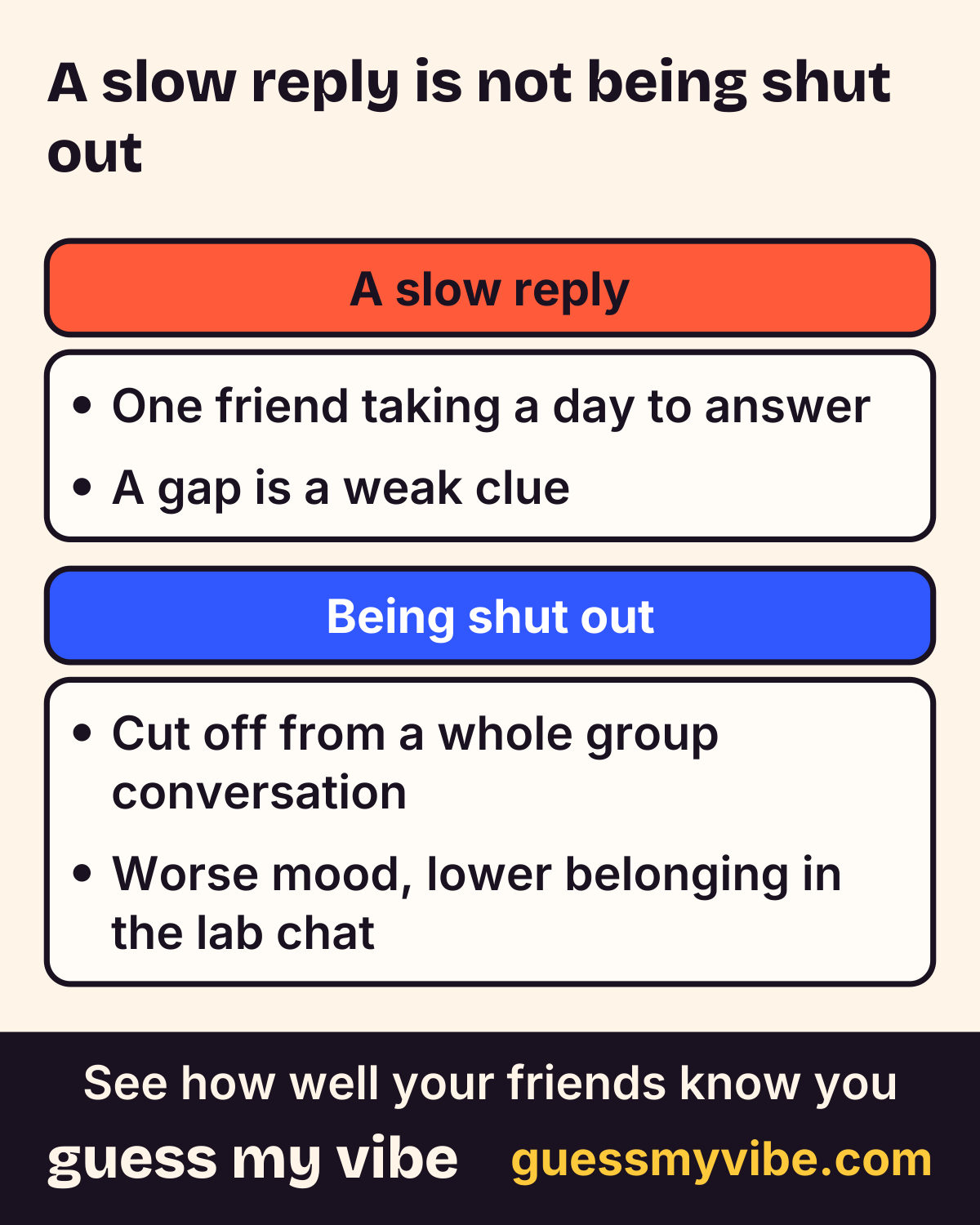
There is research on what total silence does, and it is worth reading carefully because it is easy to misapply. In a classic experiment using cell phone text messages, researchers set up a three-person chat. After participants were initially included in the conversation, some continued to be included, while others received no further messages from the others, and they saw no messages between the others either [3]. The ostracized participants reported worse mood, lower state levels of belonging, control, self-esteem and meaningful existence, and wrote more provoking messages [3].
The lesson is not that every slow reply hurts. In this study the researchers deliberately cut participants off from a whole group conversation they had been part of, which is a much stronger event than one friend taking a day to answer. What it does show is that even text-only exclusion can register as painful, which may be part of why a seen-but-unanswered message lands so hard. The feeling is real. The conclusion that you have been shut out is a separate step, and the evidence for that step usually is not in the screen.
Cite this figure
Figure: "A slow reply is not being shut out." Guess My Vibe (guessmyvibe.com). https://guessmyvibe.com/learn/left-on-read#figure-slow-reply-vs-shut-out
Why we over-read the gap
Part of the problem is that written messages carry less information than they feel like they do. Experiments on e-mail found that people tend to believe they communicate more effectively over e-mail than they actually can, and two of the studies suggested that overconfidence is born of egocentrism, the difficulty of detaching from your own perspective when judging someone else's [4]. The sender hears the tone they meant. The reader gets only the words, and, in the case of silence, not even that. It follows, though this is our reasoning and not something the study tested, that we fill a quiet screen with our own interpretation. (We cover the rereading side of this in [overthinking texts](/learn/overthinking-texts).)
There is a second, gentler reason to hold your worst guess loosely. Across studies of strangers getting acquainted, first-year college roommates and workshop participants, researchers found that people systematically underestimated how much their conversation partners liked them and enjoyed their company, an illusion they call the liking gap, which persisted in conversations of varying length and even lasted for several months among college roommates [5]. That research was about face-to-face conversations, not replies. But it suggests that we are, on average, a little too ready to assume other people think less of us than they do. A quiet phone is exactly the kind of situation where that habit could fill the gap.
What about double texting?
Double texting, sending a second message before the first has been answered, is a common search, and we could not find a study of it that we could open and verify. So we cannot tell you whether it is harmless or a mistake. What the verified research does offer is a way of thinking about it. In the e-mail and online-post data, most replies came within the responders' average time and a few came much later [1], so an unanswered message may be one that has just not been answered yet. And a second message from you is also read without your tone, by someone who may or may not interpret it as you meant [4]. Whether to send one is a judgment about you and that friend, not a research finding.
What the research suggests doing with a gap
None of this research tells you what to do, and we do not want to turn a few papers into a rulebook. But some practical thoughts follow, and you can take them or leave them.
- Most replies in the e-mail and online-post data came quickly relative to the average, with a few much later [1], so our suggestion is to compare a reply with that person's own usual pace, not with a universal clock.
- Separate the feeling from the conclusion. A seen-but-unanswered message can sting like exclusion [3] without being exclusion.
- Remember you may be reading the situation less generously than the other person would [5], and that written messages are easy to misread [4].
- If it matters, ask. A direct message or a call gives information that a read receipt cannot.
Some people have a faster, more constant texting rhythm than others, and some friendships run on slow replies without anyone minding. How comfortable you are with a gap is partly about how well you know the other person's habits. That is the kind of knowledge a friendship builds up over time, and it is exactly what a quick game of guessing each other's answers can test.
Check how well you read each other
Guess My Vibe is a quick way to see how well a friend actually reads you, with no read receipts involved. You answer honest questions about yourself, your friend guesses your answers, and you see where their picture of you matches yours. It will not tell you why someone took a day to reply, but it is a fun way to find out how well you know each other's habits.
Key takeaways
- Across more than 150,000 responses in three datasets of e-mail and online posts (not text messages), response times were uneven: most replies came within the responders' average time, and very few took more than 10 times the average [1].
- Researchers treat online silence as a nonverbal cue that people interpret. In a study where managers evaluated job candidates who replied to an e-mail after 1 day, after 2 weeks or not at all, the effect of reply time on judgments depended on the candidate's reward valence, a second factor the researchers varied [2].
- Being fully ignored is a different thing from a slow reply. When researchers set up a text-message chat in which a participant stopped receiving messages, those participants reported worse mood and lower belonging, control, self-esteem and meaningful existence [3].
- Reading tone and intent from written messages is harder than it feels: people tend to believe they communicate over e-mail more effectively than they actually can [4].
- People also tend to underestimate how much a conversation partner liked them [5]. We think that is a reason to hold your worst interpretation of a quiet phone loosely, though that is our inference, not a finding about replies.
- This isn't therapy, a diagnosis, or a substitute for professional care. It is a plain-English look at response-time research, not advice about any particular relationship.
Questions people ask
Why does being left on read hurt so much?
Silence reads as a message. Researchers describe online silence as a nonverbal cue that people interpret [2], and in an experiment where participants stopped receiving text messages in a group chat, they reported worse mood and lower belonging [3]. A slow reply from one friend is a much milder event than that study created.
How fast should you text back?
There is no verified research number for texting. In e-mail and online posts, most responses came within the responders' average latency and very few took more than 10 times the average [1], which suggests the other person's own usual pace is the best comparison.
Is double texting bad?
We could not find a study of double texting that we could open, so we do not claim it is good or bad. The research on written messages suggests tone is easy to misread [4], so how a second message lands depends on the friendship.
Does a delayed reply mean someone is upset with me?
Not on its own. In the e-mail and online-post data, most replies came quickly relative to the average but a few came much later [1], and in one hiring study the effect of a delay on judgments depended on a second factor the researchers varied [2]. People also tend to underestimate how much a conversation partner liked them [5].
See how well your friends know you.
Free. Answer 10 quick questions about you, then send your link. Friends play in their browser, no app needed.
Start freeReferences
- [1] Kalman, Y. M., Ravid, G., Raban, D. R., & Rafaeli, S. (2006). Pauses and Response Latencies: A Chronemic Analysis of Asynchronous CMC. Journal of Computer-Mediated Communication, 12(1), 1–23. doi.org/10.1111/j.1083-6101.2006.00312.x (opens in a new tab)
- [2] Kalman, Y. M., & Rafaeli, S. (2011). Online Pauses and Silence: Chronemic Expectancy Violations in Written Computer-Mediated Communication. Communication Research, 38(1), 54–69. doi.org/10.1177/0093650210378229 (opens in a new tab)
- [3] Smith, A., & Williams, K. D. (2004). R U There? Ostracism by Cell Phone Text Messages. Group Dynamics: Theory, Research, and Practice, 8(4), 291–301. doi.org/10.1037/1089-2699.8.4.291 (opens in a new tab)
- [4] Kruger, J., Epley, N., Parker, J., & Ng, Z. W. (2005). Egocentrism over e-mail: Can we communicate as well as we think?. Journal of Personality and Social Psychology, 89(6), 925–936. PubMed: 16393025 (opens in a new tab)
- [5] Boothby, E. J., Cooney, G., Sandstrom, G. M., & Clark, M. S. (2018). The Liking Gap in Conversations: Do People Like Us More Than We Think?. Psychological Science, 29(11), 1742–1756. PubMed: 30183512 (opens in a new tab)
How we find and check these sources: how we write. Spotted an error? Report a correction.
Related
Cite this article
- Title
- Left on Read: Why We Overthink Reply Times
- Publisher
- Guess My Vibe
- Updated
- URL
- https://guessmyvibe.com/
learn/ left-on-read
Copy this citation
Guess My Vibe. (2026, October 4). Left on Read: Why We Overthink Reply Times. Guess My Vibe. https://guessmyvibe.com/
To point at one section, add that section's anchor (the # link on its heading) to the URL.