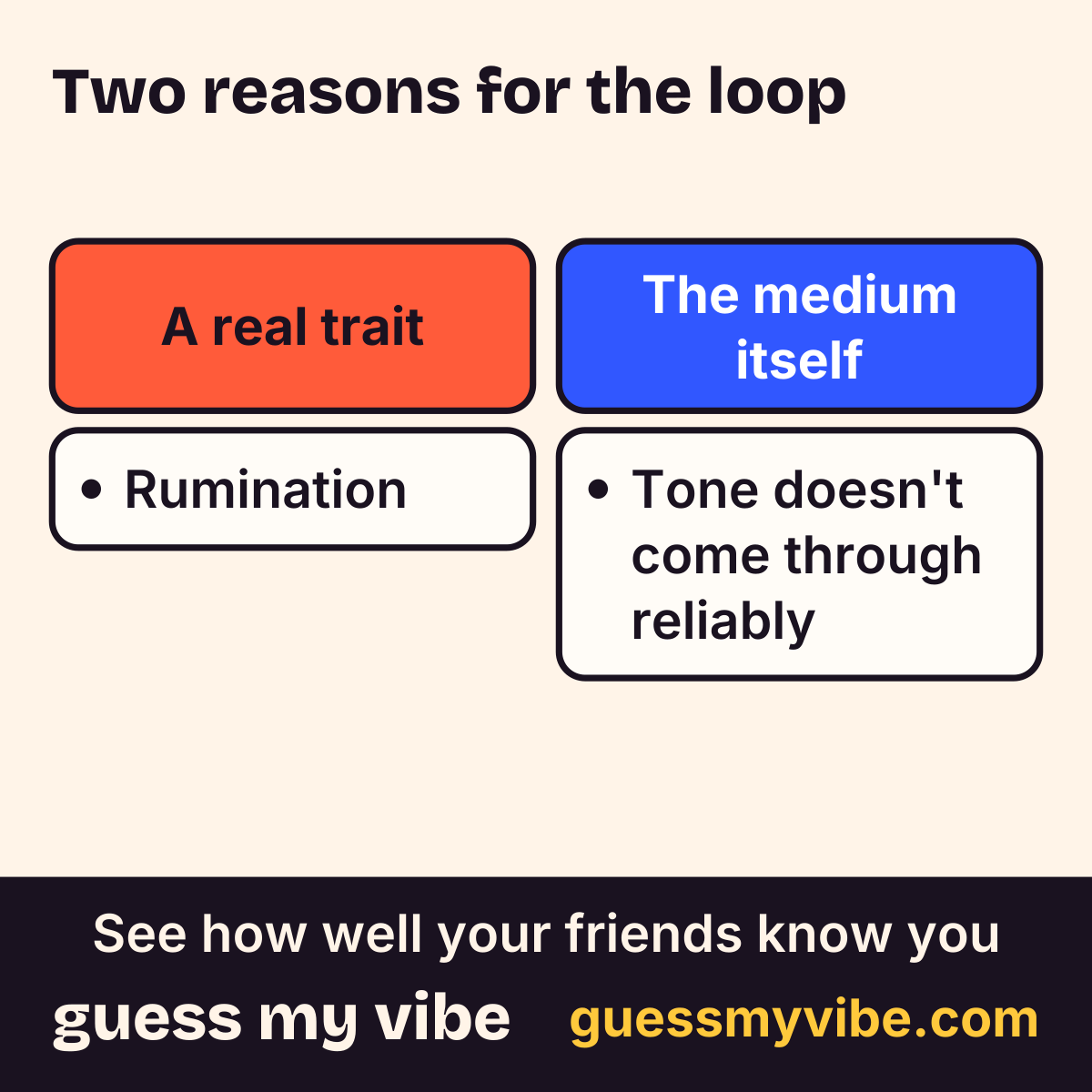
Overthinking texts (rereading a message before sending it, or rereading one you got, trying to decode a tone that isn't actually there) is a mix of two real things: a personality trait, rumination, that runs higher in more neurotic people [1], and an actual limitation of text itself. Writing strips out tone of voice and facial expression, and research on written communication finds people are overconfident about how clearly their tone comes through, which leaves readers filling in tone for themselves [2]. Some overthinking isn't you being irrational. It's a real gap in the medium that your brain is trying, understandably, to fill in.
Why overthinking texts feels so common
Overthinking texts, rereading a message five times before sending it, or rereading one you received trying to find a tone that may not even be there, is common enough to feel universal rather than personal. Research points to two separate, real reasons it happens, not one. The first is a personality trait called rumination: a tendency to go back over the same thought repeatedly instead of letting it settle. The second is a genuine limitation baked into text itself: writing has no tone of voice, no facial expression, no pause or raised eyebrow to clarify what's meant, which leaves more room for a reader's imagination to fill in than either person usually accounts for.
Neuroticism and rumination: the trait behind the loop
A study of 73 undergraduates (a non-clinical student sample, not a clinical population) examined how neuroticism connects to rumination and worry, and how those two connect to everyday anxious and low mood [1]. People higher in neuroticism reported more rumination and more worry, and rumination and worry in turn tracked with higher anxiety and depression scores on standard self-report measures. The researchers describe this as a mediating pathway: neuroticism doesn't skip straight to anxious feelings, it runs partly through these specific cognitive habits of going back over something repeatedly. That's a useful, non-alarming way to think about the texting version of this: someone who reads back over a sent message, worrying about how it landed, isn't behaving irrationally. They're showing a well-documented, ordinary trait pattern, the same one that shows up in a hundred other everyday contexts that have nothing to do with a phone.
Worth being precise about what this research doesn't say: it isn't a study of texting at all, and it isn't evidence that rumination is unhealthy in every case or that anyone who rereads a text has anxiety as a condition. It's evidence that neuroticism and a tendency to ruminate travel together, in an ordinary student sample, and that both relate to everyday mood. Applied honestly to texting, that explains why some people's brains default to "let me check that again" more than others, without turning that default into a label.
Text really is more ambiguous than it feels while you're writing it
The second piece is less about personality and more about the medium itself. A set of five experiments on written communication (conducted on e-mail, before texting was the dominant written channel, but testing the same core limitation text shares: no tone of voice, no facial expression) found that people tend to overestimate how clearly their own intended tone comes through in writing [2]. The researchers traced this to something they called egocentrism in this context: a specific difficulty separating your own perspective from someone else's. When you write something sarcastic or funny, you "hear" it in your head the way you meant it, complete with the imagined tone. Your reader doesn't get that audio track. They get the bare words, and they fill in a tone of their own, which may or may not match what you intended.
That's a real, structural reason overthinking a text isn't purely a personality quirk. If you've ever reread a sent message wondering "did that sound rude?" or stared at a reply trying to decide if a period at the end means someone's upset, you're responding to a genuine gap in the information text provides, not inventing a problem from nothing. The honest caveat is that the original research tested e-mail specifically, not text messages, and it predates today's texting conventions (read receipts, typing indicators, a culture of shorter and more fragmented messages). The underlying mechanism, stripped-down text leaving out the tone cues speech naturally carries, applies just as much to a text thread as it did to the e-mails in these experiments, even though the exact numbers come from a different, older medium.
Curious how your friends would answer?
Free. Answer 10 quick questions about you, then send your link. Friends play in their browser, no app needed.
Start freeIt shows up in the words themselves, not just the rereading
The link between neuroticism and texting isn't limited to private rereading; it shows up in the actual content of sent messages. A study that collected 224 college students' real text messages and ran them through a language-analysis tool found neuroticism was linked to more negative-emotion words appearing in the texts themselves, not just more worry about how a text would be read [3]. In a separate study of 200 university students, more neurotic (and, separately, more extraverted) people reported spending more time texting overall [4]. Put together, these findings suggest overthinking texts isn't an isolated habit happening only in someone's head before they hit send. It's one visible piece of a broader, modest but real pattern connecting neuroticism to how, and how much, someone texts in the first place.
What this means in practice
None of this research turns overthinking a text into something to fix, exactly, but it does offer a gentler frame than "I'm being irrational." Part of the loop is a real trait (rumination, more common in more neurotic people) and part of it is a real limitation of text as a medium (tone genuinely doesn't come through reliably, and everyone, not just ruminators, is overconfident about how well it does). That combination means a reread-worthy text often really is ambiguous, and a brain that flags that ambiguity isn't malfunctioning. The honest, modest takeaway from the research above is closer to "this is a known gap between what you meant and what text can actually carry," not "you're overreacting."
Cite this figure
Figure: "Two reasons for the loop." Guess My Vibe (guessmyvibe.com). https://guessmyvibe.com/learn/overthinking-texts#figure-two-reasons
Find out how your texts actually come across
Guess My Vibe turns some of this into a quick, low-stakes comparison instead of a private spiral: you answer honest questions about your own habits and personality, a friend guesses your answers, and you see where their read matches yours and where it doesn't. It won't settle whether one specific text sounded rude, but it's a genuinely fun way to see how well the people reading your messages every day actually know what you mean.
Key takeaways
- In a non-clinical sample of 73 undergraduates, neuroticism was linked to more rumination and worry, and rumination and worry in turn tracked with more everyday anxious, low mood, a pattern consistent with overthinking running through a specific, measurable trait rather than being random [1].
- Five experiments on written communication found people tend to believe they communicate tone over writing more effectively than they actually do, because a writer 'hears' their own message the way they meant it, which a reader can't do [2].
- Separately, a study of texting habits found more neurotic people's actual text messages contained more negative-emotion words, meaning the worry shows up in the writing itself, not just in private rereading [3].
- The same trait pattern shows up in texting frequency too: a study of 200 university students found more neurotic (and more extraverted) people reported spending more time texting overall [4].
- This isn't therapy, a diagnosis, or a substitute for professional care; it's a plain-English summary of research on personality and ambiguity in written communication, not an evaluation of anyone's mental health.
Questions people ask
Why do I reread my texts so many times before sending?
Partly personality: rumination, a tendency to go back over the same thought repeatedly, runs higher in more neurotic people and tracks with everyday worry [1]. Partly the medium: text strips out tone of voice, and research finds people are consistently overconfident about how clearly their tone actually comes through in writing [2].
Is overthinking texts a sign of anxiety?
Not necessarily, and this research doesn't diagnose anything. It links a personality trait (neuroticism) and a cognitive habit (rumination) to everyday worry in a non-clinical student sample [1], which is different from a clinical anxiety condition.
Why does a text seem ambiguous when I reread it?
Because it often genuinely is. Experiments on written communication found people overestimate how well their own tone comes through in writing, since a writer 'hears' their intended tone in a way a reader can't [2].
Do more neurotic people actually text differently?
In small but real ways. One study found more neurotic people's actual texts contained more negative-emotion words [3], and a separate study found more neurotic people reported spending more time texting overall [4].
Was this research done on text messages specifically?
The communication-ambiguity research was done on e-mail, not texting, and predates today's texting habits. The underlying mechanism, writing with no tone-of-voice cues, applies to texting too, but the exact numbers come from an older, different medium, worth holding a little loosely [2].
See how well your friends know you.
Free. Answer 10 quick questions about you, then send your link. Friends play in their browser, no app needed.
Start freeReferences
- [1] Muris, P., Roelofs, J., Rassin, E., Franken, I., & Mayer, B. (2005). Mediating effects of rumination and worry on the links between neuroticism, anxiety and depression. Personality and Individual Differences, 39(6), 1105–1111. doi.org/10.1016/j.paid.2005.04.005 (opens in a new tab)
- [2] Kruger, J., Epley, N., Parker, J., & Ng, Z. W. (2005). Egocentrism over e-mail: Can we communicate as well as we think?. Journal of Personality and Social Psychology, 89(6), 925–936. PubMed: 16393025 (opens in a new tab)
- [3] Holtgraves, T. (2011). Text Messaging, Personality, and the Social Context. Journal of Research in Personality, 45(1), 92–99. doi.org/10.1016/j.jrp.2010.11.015 (opens in a new tab)
- [4] Ehrenberg, A., Juckes, S., White, K. M., & Walsh, S. P. (2008). Personality and Self-Esteem as Predictors of Young People's Technology Use. CyberPsychology & Behavior, 11(6), 739–741. PubMed: 18991531 (opens in a new tab)
How we find and check these sources: how we write. Spotted an error? Report a correction.
Related
Cite this article
- Title
- Overthinking Texts: Why You Reread Every Message
- Publisher
- Guess My Vibe
- Updated
- URL
- https://guessmyvibe.com/
learn/ overthinking-texts
Copy this citation
Guess My Vibe. (2026, October 3). Overthinking Texts: Why You Reread Every Message. Guess My Vibe. https://guessmyvibe.com/
To point at one section, add that section's anchor (the # link on its heading) to the URL.