Trauma dumping is a social-media term for unloading something heavy on a friend without checking whether they have room for it, and no study has measured it under that name. The closest research is on co-rumination, friends going over the same problem again and again, which is linked both to closer friendships and to more low mood and worry, though the link to low mood and worry is small to moderate [1].
Trauma dumping is the name people online give to sharing something heavy with a friend with no warning, no pause and no question about whether they can take it in right now. It is a popular label, not a research term, so there is no study that measured trauma dumping itself. What researchers have measured is a close relative called co-rumination: two friends going over the same problem again and again. That research is a useful way to see why venting can feel like closeness in the moment and still leave both people feeling worse.
Everything below comes with one honest warning up front. Most co-rumination studies are on children, teenagers and young adults, and many measure people at a single point in time. They can show what goes with what. They usually cannot show what causes what. And none of them can tell you whether your friend is a bad person for venting a lot, which is not what this research is about.
What trauma dumping means, and what it doesn't
In everyday use, the phrase usually describes three things at once. The story is heavy, it arrives without consent (nobody asked whether you had room), and it tends to go one way, with the listener becoming a place to put feelings rather than a person in a conversation. Each of those parts is separate. Sharing something painful is normal and often a sign of trust. Asking a friend whether now is a good time is a small kindness. And a conversation where both people take turns is a different thing from a one-way unload.
That is worth saying because the label gets used loosely, sometimes as a way to shut down a friend who is simply struggling. The research below doesn't support treating every hard conversation as a problem. It points at something narrower: how problem talk is shaped, and how long it dwells on the bad feelings.
Co-rumination: the closest studied idea
Co-rumination was introduced in a 2002 study as extensively discussing and revisiting problems, speculating about them and focusing on negative feelings. The author's point was that two bodies of research seemed to disagree. Friendship research says that sharing personal things leads to close relationships, while coping research says that dwelling on negative topics leads to emotional difficulties. Co-rumination was proposed as one idea that holds both. In questionnaires from 608 children and teenagers, it was related to high-quality, close friendships and also to aspects of depression and anxiety. Girls reported more of it than boys, which helped account for girls' more positive friendship adjustment and also their greater symptoms [2].
Notice how mixed that is. The same habit goes with closeness and with distress. That is the central finding of the field, and it is why a flat verdict of good or bad doesn't fit.
Why venting feels like closeness
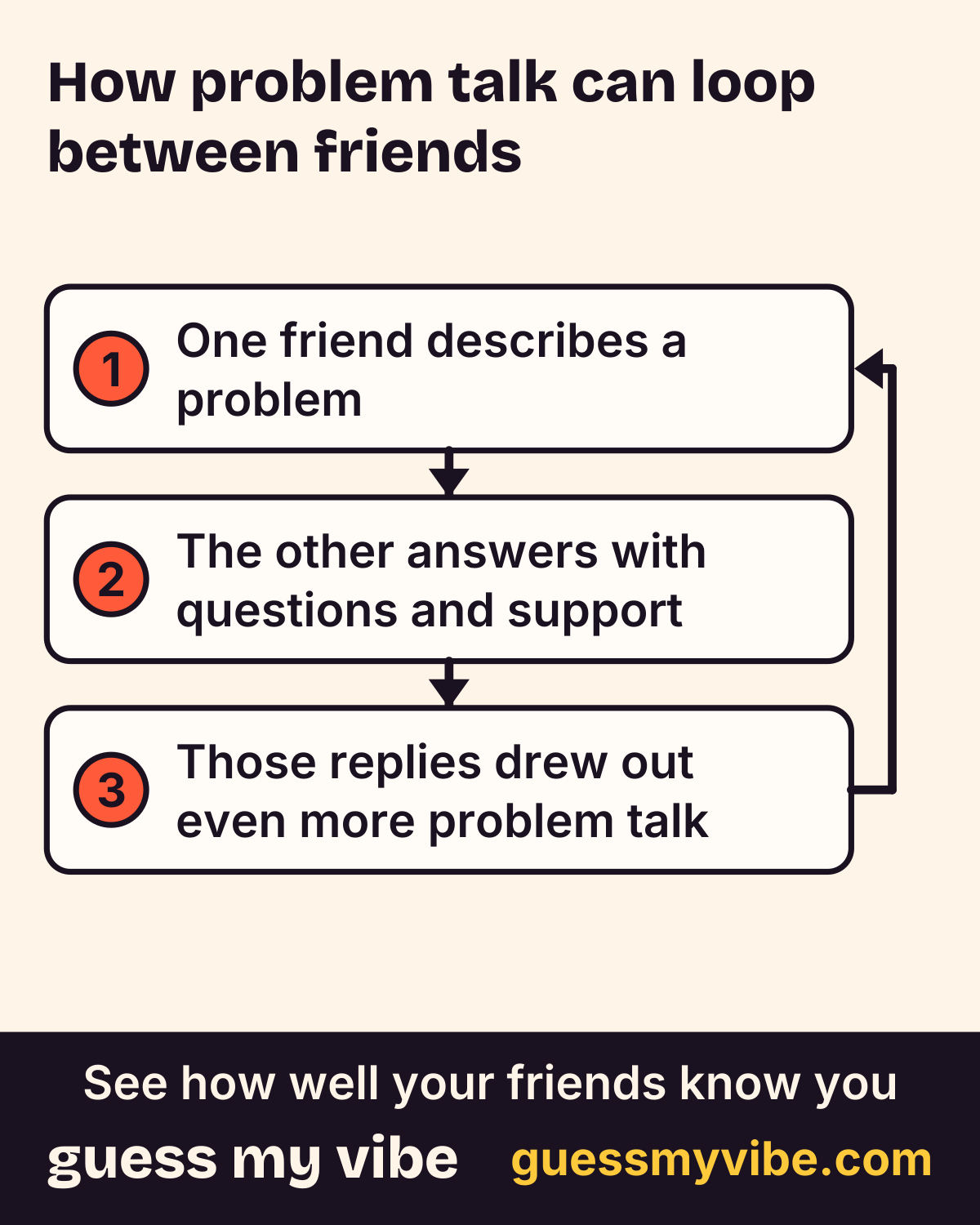
A later study watched 314 teenage friend dyads talk about problems. Co-rumination turned out to have a recognizable rhythm: one friend described a problem, the other answered with engaged statements such as questions and supportive comments, and those replies drew out even more problem talk [4]. In other words, the listener's kindness fed the loop. That is not a flaw in the listener. Asking questions and offering support is what a good friend does, and it is exactly why these conversations feel warm.
The same study split the behavior into parts. Extensively talking about problems, rehashing them, speculating about them and encouraging each other to keep going were linked to positive friendship adjustment. Dwelling on negative feelings was the part linked to internalizing problems [4]. If that holds up, the practical difference between a supportive vent and a draining one may be less about how much you share and more about whether the talk stays stuck in the feeling.
Cite this figure
Figure: "How problem talk can loop between friends." Guess My Vibe (guessmyvibe.com). https://guessmyvibe.com/learn/trauma-dumping-on-friends#figure-how-problem-talk-loops
Curious how your friends would answer?
Free. Answer 10 quick questions about you, then send your link. Friends play in their browser, no app needed.
Start freeWhat the trade-off looks like over time
A six-month study of children and teenagers followed the same people to see which way things ran. For girls, co-rumination went with both more depressive and anxious symptoms and better friendship quality later on, and better friendship quality in turn went with more co-rumination. For boys, co-rumination went with better friendship quality but not more symptoms. The authors added a warning that some girls at risk for emotional difficulties might go unnoticed because their friendships look supportive [5].
Two meta-analyses sum up the larger picture. One covered 38 studies and 12,829 community participants, all using cross-sectional data, and found small-to-moderate links between co-rumination and anxiety, depression and general internalizing problems, with mean corrected correlations between 0.14 and 0.26. Females scored higher on co-rumination than males (d = -0.55), and the authors read the overall pattern as a modest but significant association [1]. The other covered 66 studies and 27,794 children, teenagers and young adults and found a small positive correlation with depressive symptoms (r = 0.128). The link was weaker in teenagers than in college students and adults, and it did not differ by gender [3].
In plain words: across thousands of people, friends who co-ruminate more also tend to report somewhat more low mood and worry. The effect is small, the data are mostly one-time snapshots, and it is just as plausible that people who already feel low talk about their problems more as that talking about problems pushes mood down. The 2007 study hints that both directions happen. It does not settle it.
What this research can't tell you
- It cannot say whether a particular friend's venting is healthy. Averages from large samples don't describe one friendship.
- It cannot say that trauma dumping is a distinct behavior with its own harms. That label has no study behind it.
- It says little about adults. Most of the samples are children, teenagers and college-age adults, and age changed the size of the link.
- It does not cover people sharing serious trauma. Co-rumination research is about everyday problem talk, and it is not a guide for responding to someone in crisis.
Making problem talk work for both of you
The tips below are our own reading of the findings, not tested instructions. They follow from one idea in the evidence: the supportive parts of problem talk and the stuck parts can be pulled apart.
- If you are the one sharing, a one-line check helps: do you have room for something heavy right now? It gives the listener a real choice, and a yes means they are actually with you.
- If you are the one listening, it is fine to say how much you can take in today. Naming a limit is different from rejecting the friend, and a friend who hears it kindly can come back later.
- Notice when the conversation starts circling. Repeating the same facts a third time is the sign of dwelling. A question like what would help most this week turns the talk toward something that can actually change.
- Take turns. If one person always carries the heavy topics, the friendship can start to feel like a service. Sharing good news and small things keeps both people in the room.
- Some problems are bigger than a friendship can hold, and that is what counselors and other professionals are for. Pointing a friend toward that support is a way of caring, not of leaving.
How Guess My Vibe fits in
Guess My Vibe is a light way to see how your friends see you, and it will not tell you whether anyone is venting too much. It does give you something to talk about that isn't a problem: you each guess how the other would answer, and the gaps are easy to laugh about.
Key takeaways
- Trauma dumping is a popular label, not a scientific measure; the nearest studied idea is co-rumination, which means talking about problems at length, rehashing them and dwelling on the bad feelings [2].
- In a meta-analysis of 38 studies with 12,829 people, co-rumination was linked to anxiety and low mood with small-to-moderate effect sizes, and the same research also ties it to friendship satisfaction [1].
- A larger meta-analysis of 66 studies found a small link to depressive symptoms (r = 0.128), weaker in teenagers than in college students and adults [3]. Data like this can't show which came first.
- In watched conversations between teenage friends, the closeness-building parts of problem talk (discussing, speculating, encouraging) were separable from the part tied to worse mood, which was dwelling on the negative feelings [4].
- This isn't therapy, a diagnosis, or a substitute for professional care.
Questions people ask
Is trauma dumping a real psychological term?
No. It is a popular phrase, and no study has measured it under that name. The closest researched idea is co-rumination, which means extensively discussing and revisiting problems and focusing on negative feelings [2].
What is the difference between venting and trauma dumping?
The difference is mostly about consent, balance and whether the talk goes anywhere. In everyday use, venting is sharing with a friend who has room for it, while trauma dumping describes an unprompted heavy unload that goes one way. Research doesn't draw this line, so treat it as common usage, not a scientific category.
Does talking about problems with friends make you feel worse?
It can go both ways. Co-rumination research links it to closer friendships and also to somewhat more anxiety and low mood, with small-to-moderate effect sizes, and most of that data can't show which causes which [1]. The part tied to worse mood in one observational study was dwelling on negative feelings, not talking itself [4].
Do girls co-ruminate more than boys?
In the research, yes on average. A meta-analysis of 38 studies found females scored higher on co-rumination than males (d = -0.55) [1]. That is an average difference in studies of young people, not a rule for any one person.
How do I tell a friend I can't take in more right now?
Say it as a limit on today, not on them. Something like: I want to hear this, and I only have a little room tonight; can we talk Saturday? That is our own suggestion, not a tested script, and it keeps the door open.
See how well your friends know you.
Free. Answer 10 quick questions about you, then send your link. Friends play in their browser, no app needed.
Start freeReferences
- [1] Spendelow, J. S., Simonds, L. M., & Avery, R. E. (2017). The relationship between co-rumination and internalizing problems: A systematic review and meta-analysis. Clinical Psychology & Psychotherapy, 24(2), 512-527. PubMed: 27215974 (opens in a new tab)
- [2] Rose, A. J. (2002). Co-rumination in the friendships of girls and boys. Child Development, 73(6), 1830-1843. PubMed: 12487497 (opens in a new tab)
- [3] Dong, K., Qi, H., & Zhao, G. (2025). The relationship between co-rumination and depressive symptoms: A systematic review and meta-analysis. Journal of Youth and Adolescence, 54(6), 1551-1569. PubMed: 39891852 (opens in a new tab)
- [4] Rose, A. J., Schwartz-Mette, R. A., Glick, G. C., Smith, R. L., & Luebbe, A. M. (2014). An observational study of co-rumination in adolescent friendships. Developmental Psychology, 50(9), 2199-2209. PubMed: 25069053 (opens in a new tab)
- [5] Rose, A. J., Carlson, W., & Waller, E. M. (2007). Prospective associations of co-rumination with friendship and emotional adjustment: Considering the socioemotional trade-offs of co-rumination. Developmental Psychology, 43(4), 1019-1031. PubMed: 17605532 (opens in a new tab)
How we find and check these sources: how we write. Spotted an error? Report a correction.
Related
Cite this article
- Title
- Trauma Dumping on Friends: What Co-Rumination Research Says
- Publisher
- Guess My Vibe
- Updated
- URL
- https://guessmyvibe.com/
learn/ trauma-dumping-on-friends
Copy this citation
Guess My Vibe. (2026, October 7). Trauma Dumping on Friends: What Co-Rumination Research Says. Guess My Vibe. https://guessmyvibe.com/
To point at one section, add that section's anchor (the # link on its heading) to the URL.