On average, women report somewhat higher expectations than men for emotional closeness and self-disclosure in friendship, and men report somewhat higher expectations around status and physical fitness; expectations for simply spending time together turn out to be about equal between men and women. A meta-analysis of 37 studies and 8,825 people put real numbers on these gaps, and they're small to moderate, not absolute: plenty of individual men score higher on emotional closeness than plenty of individual women, and vice versa [1].
What female friendship research actually finds
Female friendship gets talked about in absolutes online: women do deep talks, men do side-by-side activities, end of story. The actual research is narrower and more interesting than that. A meta-analysis combining 37 studies and 8,825 people measured what men and women report expecting from a friendship, not what they actually do day to day, and found real average differences in two specific directions, alongside a lot of overlap between the two groups [1].
Communion: the biggest average gap, and what it actually measures
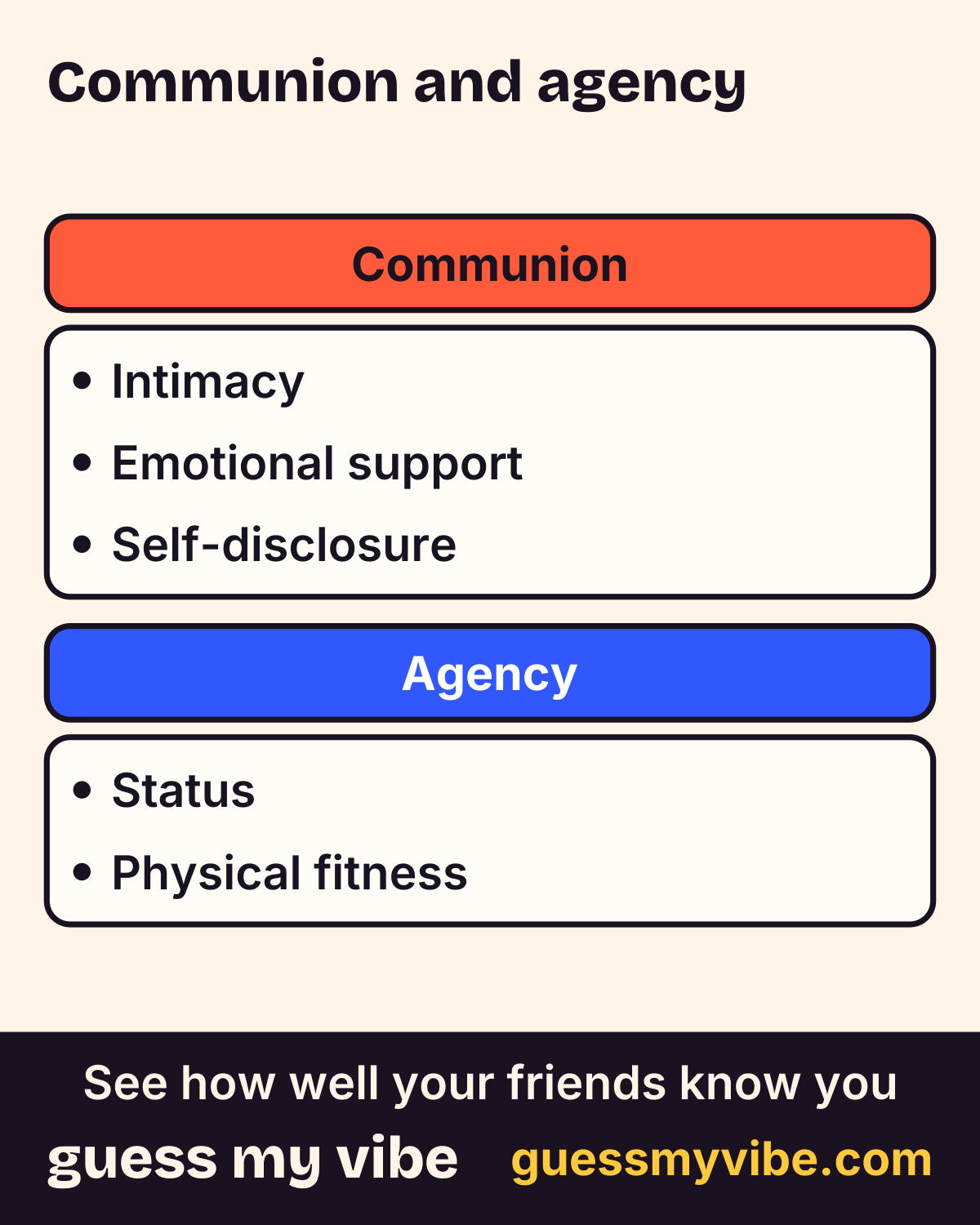
The meta-analysis grouped friendship expectations into a few categories, and the clearest gap showed up in what researchers call communion: intimacy, emotional support, and self-disclosure, the stuff people mean when they talk about "deep talks." Women reported meaningfully higher expectations here than men, at an effect size of d=.39 [1]. In plain terms, that's a real, moderate difference, not a small or questionable one. But it's also not an enormous gap. An effect size like .39 means the two distributions overlap substantially: a large share of men score above the average woman on wanting emotional closeness from friends, and a large share of women score below the average man. It's a difference in the average, not a difference in kind.
Agency: where men's expectations average higher
The same meta-analysis found the reverse pattern for what it calls agency: expectations around status and physical fitness within the friendship, not simply spending time together. Here, men's average expectations ran higher than women's, at d=-.34 [1]. That's a narrower finding than the flat "men do activities, women talk" stereotype suggests: a separate category the same meta-analysis measured, solidarity (mutual activities and companionship), showed almost no difference between men and women (d=.03). Men and women expect roughly the same amount of "just doing things together" from a friendship; what actually differs more, on average, is status and physical fitness on one side and intimacy and disclosure on the other. A fourth category, symmetrical reciprocity (loyalty, genuineness, being treated as an equal), also favored women slightly, but by a smaller margin (d=.17) than communion did.
Cite this figure
Figure: "Communion and agency." Guess My Vibe (guessmyvibe.com). https://guessmyvibe.com/learn/female-friendship#figure-communion-and-agency
How much overlap is there, really?
This is the part a headline usually drops. An effect size of .39, even the largest gap found here, still means the two bell curves for men and women mostly sit on top of each other. Picture two overlapping hills on a graph, shifted slightly apart: most of the area under both still overlaps. That means a man with high communion expectations and a woman with low communion expectations are both completely normal, unremarkable cases, not outliers. The honest summary isn't "men can't do emotional friendships" or "women don't value shared activities." It's that the average center of each group sits in a slightly different place, while most individuals from both groups fall somewhere in the wide, shared middle.
Why self-disclosure builds closeness for anyone
The mechanism behind the communion finding is well documented on its own, independent of gender. A meta-analytic review of self-disclosure and liking found three separate, reinforcing effects: people who disclose more intimately get liked more, people disclose more to people they already like, and people come to like someone more simply as a result of having disclosed to them [2]. That's not a female-specific finding, it's a basic mechanic of how closeness forms in any friendship. If women on average lean slightly more on this exact mechanism, that's one concrete, falsifiable reason their friendships would also, on average, run a little warmer on the specific "we talk about real things" axis the meta-analysis measured as communion.
Curious how your friends would answer?
Free. Answer 10 quick questions about you, then send your link. Friends play in their browser, no app needed.
Start freeWhat this means for male friendships
None of this means male friendships are a lesser or shallower version of female friendship; it means they're organized around a different average center of gravity, with somewhat more weight on status and physical fitness and somewhat less on disclosure. It isn't mainly about shared activity, since the research doesn't actually find men and women differing much on how much they value just doing things together. A friendship built mostly on showing up, doing things together, and being reliably present is a real, functioning friendship for people of any gender, not a deficient one waiting to become a "real" friendship once the talking starts. Separately, a review of personality and friendship found Agreeableness had the most consistent effects of the Big Five traits on how friendships form and get maintained [3], which is a reminder that personality, not gender alone, plays a part in who becomes close to whom and how.
What this research doesn't settle
A meta-analysis is a summary of the studies that exist, not a law of nature, and it's worth naming its real limits plainly. The 37 studies behind this meta-analysis measured what people say they expect from friendship on a survey, not what every friendship actually looks like day to day; a person's stated expectation and their lived friendship habits can drift apart. The sample also skews toward the kind of participants psychology studies traditionally draw from, so it's an honest summary of the evidence gathered so far, not a claim that every culture or every generation would show exactly the same two gaps at exactly the same size. Expectations about friendship also shift across a lifetime: what a group of college students says it wants from a friend isn't necessarily what the same people would say in their forties. None of that erases the finding. It just means "d=.39 for communion" describes a real, specific body of evidence, not an eternal fact about men and women.
What about friendships that don't fit the pattern?
Plenty of real friendships run against both averages at once: two men who talk through their feelings in detail, two women who bond mainly over a shared hobby and barely discuss their inner lives, a cross-gender friendship that doesn't map cleanly onto either pattern. None of that is a research anomaly. Given how much the male and female distributions overlap on both communion and agency, a friendship landing well outside its "expected" average is still a completely ordinary outcome, not a statistical fluke worth explaining away. The averages describe where the center of a large crowd sits. They were never built to describe any two specific friends, including yours and your closest friend's.
The one benefit that doesn't depend on style
Whatever shape a friendship takes, having real social relationships at all carries a well-documented benefit that doesn't split along these lines. A large meta-analytic review covering mortality data found stronger social relationships were linked to a substantially lower risk of death over the study follow-up periods, a protective link comparable in size to some well-known health behaviors [4]. That finding doesn't care whether the friendship leaned communal or activity-based; it cared whether the connection existed and held up.
Testing what your own friendships actually look like
Averages across thousands of people are a poor stand-in for any one specific friendship. The more useful question for you and a specific friend isn't "are women more X than men" but "does this particular friend actually know how much I value deep talks versus doing things together." Guess My Vibe scores Warmth and Social battery from real personality-science questions and has a friend guess your answers, which turns that question into an actual, checkable comparison instead of a guess based on gender averages that may or may not describe either of you.
Key takeaways
- Female friendship research finds a real but moderate average difference: women expect somewhat more intimacy and self-disclosure from friendship than men do [1].
- The gap is biggest for "communion" (talking, emotional support, disclosure) and reverses for "agency" (status, physical fitness), where men's average expectations run higher; a separate category for shared activities and companionship showed almost no difference between men and women [1].
- These are average differences with heavy overlap between the two groups, not a rule that applies to every man or every woman.
- Self-disclosure itself is one of the best-documented ways people come to like each other, though how strong that link is varied with things like the discloser's gender [2].
- This isn't therapy, a diagnosis, or a substitute for professional care; it's a plain-English summary of what personality and relationship research says about female friendship.
Questions people ask
Do women's friendships really involve more talking than men's?
On average, somewhat, yes. A meta-analysis of 8,825 people found women report higher expectations than men for intimacy and self-disclosure in friendship (d=.39), a real but moderate difference with substantial overlap between the groups [1].
Are male friendships less close than female friendships?
Not based on this research. Men's friendships average higher expectations around status and physical fitness (agency, d=-.34), while expectations for simply spending time together were about equal between men and women, suggesting a different organizing style, not a lesser one [1].
What's the difference between communion and agency in friendship research?
Communion covers intimacy, emotional support and self-disclosure. Agency covers status and physical fitness, not shared activities generally — a separate category for mutual activities and companionship showed almost no average difference between men and women. Women average higher on communion; men average higher on agency [1].
How big are these gender differences in friendship, really?
Small to moderate, with heavy overlap. An effect size of .39 (the largest found here) means a large share of men and women land on the same side of the average, so the finding describes group averages, not a rule for any one person.
Does self-disclosure actually make friendships closer?
Generally, yes. A meta-analysis found disclosing more intimately gets you liked more, and that disclosing to someone tends to increase liking for them too, though the strength of the link varied with things like the discloser's gender [2].
Does gender matter more than personality for how friendships form?
Research on friendship development points to Agreeableness as the Big Five trait with the most consistent effects on how friendships form and last [3], a reminder that personality matters too, not just gender averages.
See how well your friends know you.
Free. Answer 10 quick questions about you, then send your link. Friends play in their browser, no app needed.
Start freeReferences
- [1] Hall, J. A. (2011). Sex differences in friendship expectations: A meta-analysis. Journal of Social and Personal Relationships, 28(6), 723–747. doi.org/10.1177/0265407510386192 (opens in a new tab)
- [2] Collins, N. L., & Miller, L. C. (1994). Self-disclosure and liking: A meta-analytic review. Psychological Bulletin, 116(3), 457-475. PubMed: 7809308 (opens in a new tab)
- [3] Harris, K., & Vazire, S. (2016). On friendship development and the Big Five personality traits. Social and Personality Psychology Compass, 10(11), 647–667. doi.org/10.1111/spc3.12287 (opens in a new tab)
- [4] Holt-Lunstad, J., Smith, T. B., & Layton, J. B. (2010). Social relationships and mortality risk: A meta-analytic review. PLoS Medicine, 7(7), e1000316. PubMed: 20668659 (opens in a new tab)
How we find and check these sources: how we write. Spotted an error? Report a correction.
Related
- How to Be a Good Friend, According to Research
- One-Sided Friendship: What the Research Actually Finds
- Long Distance Friendship: Does It Actually Last?
- Friendship Psychology: What the Research Actually Says
- Agreeableness: The Trait Closeness Barely Helps Friends Read
- Can Men and Women Be Friends? What the Research Says
- Male Friendship: What Research Says About Men's Friends
Want to try it with your own friends? Make a friendship quiz to play with your friends
Cite this article
- Title
- Female Friendship: What the Research Actually Shows
- Publisher
- Guess My Vibe
- Updated
- URL
- https://guessmyvibe.com/
learn/ female-friendship
Copy this citation
Guess My Vibe. (2026, October 3). Female Friendship: What the Research Actually Shows. Guess My Vibe. https://guessmyvibe.com/
To point at one section, add that section's anchor (the # link on its heading) to the URL.