Male friendship is not shallow, but on average it looks a little different from women's friendship. A meta-analysis of 37 manuscripts found only a small overall difference in what men and women expect from a same-sex friend, with women valuing self-disclosure and intimacy more and men valuing agency, such as status and fitness, more [1]. Averages hide a lot of overlap between individuals.
Want to take it for real? Make a friendship quiz and see how your friends see you
Male friendship gets described in two lazy ways: either men do not really have close friends, or they show closeness only through jokes and activities. The research is more careful than either line. Men's friendships do differ from women's on average, in some measurable ways, but the differences are modest, the overlap between the two groups is large, and the one difference that stands out is about how closeness is built and shown, not whether it exists.
A note on method before the findings. These studies compare men and women as groups, usually by self-report, and usually in samples that were easy to recruit, such as students. A group average can't tell you anything about one man or one friendship. Treat everything below as a tendency, never a rule.
What men and women expect from a friend
The broadest evidence is a meta-analysis of 37 manuscripts (36 samples, N = 8,825) on friendship expectations, meaning the behaviors and qualities people highly value in an ideal same-sex friend. It found a small difference favoring women overall (d = .17). The detail is more interesting. Women's expectations were higher for communion, which covers self-disclosure and intimacy, and the effect was medium. They were slightly higher for symmetrical reciprocity, such as loyalty and genuineness. They were essentially tied for solidarity, meaning mutual activities and companionship. And men's expectations were higher for agency, such as physical fitness and status, again with a medium effect [1].
Two things stand out. First, the gap on shared activities and companionship was close to zero, so men did not expect less companionship from a friend. Second, expectations are what people say they want, not what their friendships actually deliver. The meta-analysis describes ideals, and ideals are only one piece of the picture.
Is male friendship less intimate?
It depends heavily on how intimacy is defined. A series of six studies asked what interaction patterns people think create intimacy in a same-sex friendship. Self-disclosure and emotional support were seen as more typical of intimacy than shared activities and practical support. Women rated the intimacy patterns higher than men did, especially the most typical ones. But women and men agreed on the ranking: both said that disclosure and emotional support signal more intimacy than activities and practical help do [2]. The author notes the implications for a long-running argument about whether women's friendships are more intimate than men's.
That agreement matters. If both sexes use the same yardstick and men's friendships score somewhat lower on it, one possible reading is that the yardstick favors a style of closeness more common in women's friendships, and that shoulder-to-shoulder closeness is measured poorly. That is a reading, not something the studies tested. A fair statement is that intimacy measures built around talk will tend to favor friendships built around talk.
Curious how your friends would answer?
Free. Answer 10 quick questions about you, then send your link. Friends play in their browser, no app needed.
Start freeHow male friendship builds and keeps closeness
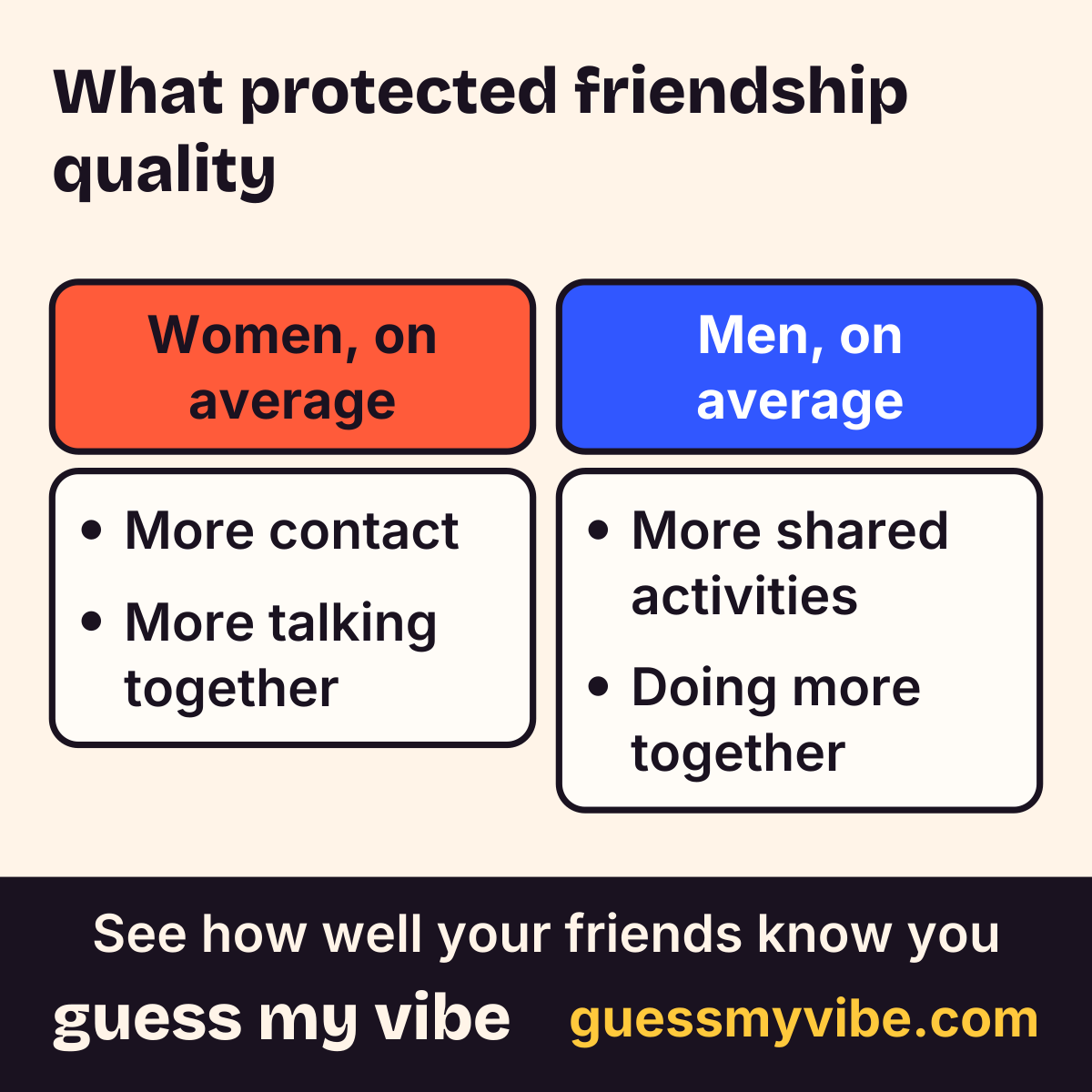
The most useful finding for everyday life comes from a study that tracked people's entire active social networks for 18 months across a major life transition. Family relationships and friendships differed strikingly, and friendship quality declined. The decline was mitigated by increased effort, but the kind of effort that worked differed by sex: for women, relationships declined least when contact frequency went up, meaning more talking together, while for men they declined least when the two did more activities together [3].
A separate set of three studies on friendship maintenance built a measure with four parts: positivity, supportiveness, openness and interaction. Best friends used more of these behaviors than close or casual friends, and women's same-sex friendships reported more supportiveness, openness and interaction than men's. The same work also found that friendships were equitable, meaning each friend's behavior tended to match the other's, and that both friends' behaviors were linked to satisfaction and commitment at the level of the two friends [4]. Those are self-reports, so they show how people describe their own friendships.
Another study looked at what shapes intimacy in best friendships and romantic partnerships, by sex. Best friendships were highly gendered for both sexes, and the factors that mattered differed. Intimacy in women's friendships was influenced by similarity on many more factors, notably dependability, kindness, mutual support and sense of humor, than in men's. Some factors even flipped: gift-giving had a negative effect on women's friendships and a positive effect on men's, while shared histories had the opposite pattern. The authors read these as differences in what the relationships are for [5]. That is their interpretation, and the abstract does not give sample sizes.
Cite this figure
Figure: "What protected friendship quality." Guess My Vibe (guessmyvibe.com). https://guessmyvibe.com/learn/male-friendship#figure-what-protected-friendships
What this means for male friendship in practice
The practical takeaway from the evidence is plain: closeness can be built through talk, through shared activity, or both, and what matters is that the effort keeps happening. These are suggestions drawn from the findings, not tested instructions.
- If your friendships run on activities, keep them regular. The network study suggests that doing things together is what best offset decline in men's friendships, so a standing game night or run counts as upkeep, not a substitute for it.
- If you wish a friendship were closer, try adding a little talk to the activity. The studies on intimacy agree that disclosure and emotional support read as intimate to both sexes, so a real answer to how are you actually doing sits inside the same hangout you already have.
- Don't read a friend's style as a verdict on the friendship. If a friend shows care by showing up, fixing your car or sending you a meme, that is a form of the same investment, and guessing otherwise can make a good friendship feel one-sided.
- If you are the friend who wants more conversation, ask directly instead of waiting. The research says people value disclosure on both sides, which suggests a friend may welcome the opening.
- After a big change such as a move or a new job, plan the effort on purpose. Friendship quality declined across a life transition in that study, and effort softened the decline, so this is when a recurring plan helps most.
Limits and open questions
The evidence has real limits. Much of it compares sexes as two groups, which hides everyone who doesn't fit the average. Most samples are students or from a few countries. Self-report depends on what people are willing and able to say about their own friendships, and men may be asked questions that were designed around women's friendships. The meta-analysis also covers expectations, not behavior. Nothing here shows that men are less happy in friendships or more at risk because of how they have them, and this article does not claim that.
How Guess My Vibe fits in
A guessing game is shoulder-to-shoulder by design. You and a friend do the same thing at the same time, and the talk comes out of the game. If you want a low-pressure way to learn how a friend sees you, it is a reasonable place to start.
Key takeaways
- Across 36 samples (N = 8,825), women's expectations of same-sex friends were slightly higher overall (d = .17), with a medium gap in communion (self-disclosure, intimacy) favoring women and a medium gap in agency (status, fitness) favoring men [1].
- Women and men agreed that talking about feelings and emotional support signal intimacy more than shared activities or practical help do, even though women rated intimacy patterns higher on average [2].
- In a study that tracked entire social networks through a life transition, friendship quality declined, and the decline was prevented most by talking together for women and by doing more activities together for men [3].
- Self-reported friendship maintenance behaviors (supportiveness, openness, interaction) were higher in women's same-sex friendships than in men's, and best friends did more maintenance than casual friends of either sex [4].
- This isn't therapy, a diagnosis, or a substitute for professional care.
Questions people ask
Do men have fewer close friends than women?
The research summarized here doesn't measure how many friends men have; it compares what men and women expect from friends and how they describe their friendships. On expectations, a meta-analysis found only a small overall difference, with the main gaps in communion (higher for women) and agency (higher for men) [1].
Are men's friendships less intimate than women's?
On average, women rated intimacy patterns higher than men in one set of studies, but both sexes agreed that disclosure and emotional support signal more intimacy than shared activities or practical help [2]. Measures built around talk may favor friendships built around talk, so be careful with the word less.
Why do men bond through activities?
One study found that doing more activities together best offset the decline in men's friendships over a life transition, while more talking did the same for women [3]. The study shows what worked, not why, so any explanation beyond that is speculation.
How can I make a friendship closer without it feeling awkward?
Add a small amount of real talk to something you already do together. Disclosure and emotional support were rated as signs of intimacy by both women and men [2], so a sincere question during an ordinary activity is a natural place to start. That is our suggestion, not a tested method.
Is this research about gender or about sex?
The studies compare self-identified men and women, which they usually treat as two groups. They can't speak for non-binary people or describe any single person, and the differences are averages with a lot of overlap.
See how well your friends know you.
Free. Answer 10 quick questions about you, then send your link. Friends play in their browser, no app needed.
Start freeReferences
- [1] Hall, J. A. (2011). Sex differences in friendship expectations: A meta-analysis. Journal of Social and Personal Relationships, 28(6), 723–747. doi.org/10.1177/0265407510386192 (opens in a new tab)
- [2] Fehr, B. (2004). Intimacy expectations in same-sex friendships: A prototype interaction-pattern model. Journal of Personality and Social Psychology, 86(2). doi.org/10.1037/0022-3514.86.2.265 (opens in a new tab)
- [3] Roberts, S. B. G., & Dunbar, R. I. M. (2015). Managing Relationship Decay: Network, Gender, and Contextual Effects. Human Nature, 26(4), 426-450. PubMed: 26489745 (opens in a new tab)
- [4] Oswald, D. L., Clark, E. M., & Kelly, C. M. (2004). Friendship maintenance: An analysis of individual and dyad behaviors. Journal of Social and Clinical Psychology, 23(3), 413–441. doi.org/10.1521/jscp.23.3.413.35460 (opens in a new tab)
- [5] Pearce, E., Machin, A., & Dunbar, R. I. M. (2020). Sex differences in intimacy levels in best friendships and romantic partnerships. Adaptive Human Behavior and Physiology. doi.org/10.1007/s40750-020-00155-z (opens in a new tab)
How we find and check these sources: how we write. Spotted an error? Report a correction.
Related
Cite this article
- Title
- Male Friendship: What Research Says About Men's Friends
- Publisher
- Guess My Vibe
- Updated
- URL
- https://guessmyvibe.com/
learn/ male-friendship
Copy this citation
Guess My Vibe. (2026, October 7). Male Friendship: What Research Says About Men's Friends. Guess My Vibe. https://guessmyvibe.com/
To point at one section, add that section's anchor (the # link on its heading) to the URL.