A warm person is someone read as caring, friendly, and well-intentioned toward others. Researchers treat warmth as one of two basic dimensions people use to size anyone up at a glance, the other being competence [1]. Warmth isn't the same thing as being outgoing: everyday warmth sounds closer to the Big Five trait agreeableness, which is one of the harder traits for even a close friend to judge accurately.
What makes someone a warm person, according to research
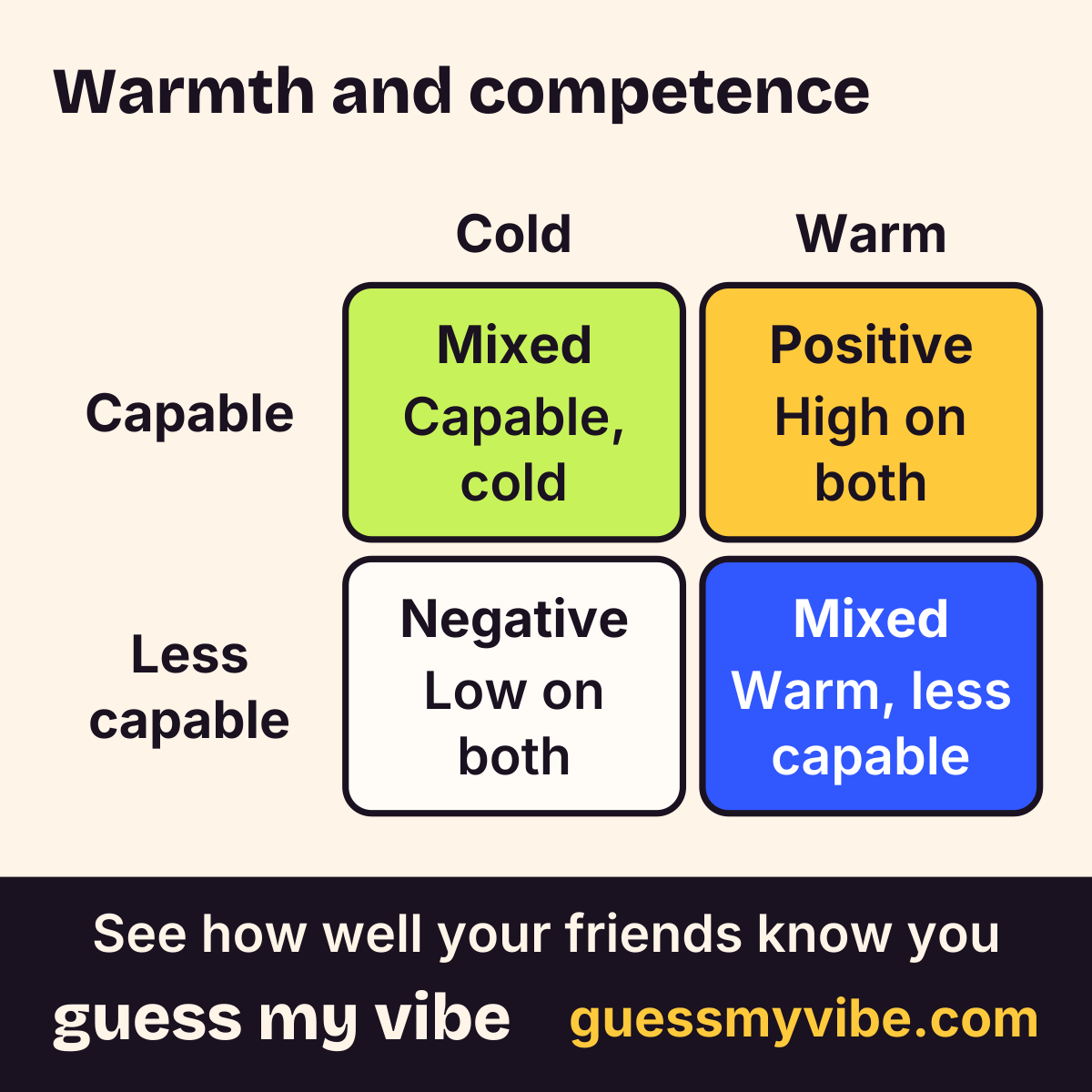
A warm person is someone other people read as caring, friendly, and genuinely well-intentioned, as opposed to cold, distant, or out for themselves. That everyday idea maps onto something researchers have studied directly: a review of social-perception research proposed warmth and competence as two universal dimensions people use, almost instantly, to size up anyone they meet. Warmth answers "does this person intend good or ill toward me," and competence answers "are they capable of acting on that intention." People judged high on both get uniformly positive reactions; people judged low on both get uniformly negative ones; a mix of the two (warm but seen as less capable, or capable but seen as cold) produces more mixed, complicated reactions [1]. Warmth, by this account, is one of the two most basic lenses anyone uses to read a stranger, not a minor detail.
Cite this figure
Figure: "Warmth and competence." Guess My Vibe (guessmyvibe.com). https://guessmyvibe.com/learn/warm-person#figure-warmth-and-competence
A warm person isn't the same as an outgoing person
It's easy to assume "warm" and "outgoing" describe the same kind of person, since both sound like positive, people-oriented traits. They're not the same thing. In Big Five terms, everyday "warmth" sounds closest to agreeableness (kindness, cooperation, consideration for others) and also borrows from the friendliness facet of extraversion, but it is not the same thing as sociability and energy, and the research cited here does not measure warmth directly. A quiet, reserved person can be deeply warm: attentive, kind, genuinely interested in the people they do talk to. A highly outgoing, talkative person isn't automatically warm; sociability and self-interest can travel together just as easily as sociability and warmth can. If you've ever met someone who lit up every room but left you feeling unseen once the conversation turned to you, that's exactly the gap between extraversion and warmth showing up in one person.
The famous warm-coffee study, and why it's more complicated now
One study made "warm person" briefly a literal, physical idea rather than just a figure of speech. In 2008, two widely covered experiments reported that briefly holding a cup of hot coffee (instead of iced coffee) led participants to rate a stranger as having a "warmer" personality, more generous and caring, and that holding a hot (versus cold) therapeutic pad made people more likely to choose a gift for a friend over themselves [2]. It's a memorable, almost poetic idea: physical warmth bleeding into a judgment about someone else's personality.
It's also a finding that hasn't held up well. A later team ran three separate, high-powered replications of the therapeutic-pad experiment, combining for a total of 861 participants. None of the three individual labs found the effect, and neither did the three combined. The replication team concluded there's no evidence that brief physical warmth increases this kind of prosocial choice [3]. That doesn't mean nothing about the original idea is real; it means this specific, famous demonstration of it is on much shakier ground than its initial media coverage suggested. The honest summary: warmth-as-metaphor (someone who "radiates warmth") is a real, well-studied social-perception idea [1]; warmth-as-literal-temperature-rubbing-off-on-judgment is a catchy finding that failed to replicate at scale [3]. Worth knowing before repeating either one as settled science.
Curious how your friends would answer?
Free. Answer 10 quick questions about you, then send your link. Friends play in their browser, no app needed.
Start freeWhy warmth is harder for friends to read than you'd expect
Given how central warmth is to how people judge each other, you'd expect it to be easy for a close friend to rate accurately. The research says the opposite. A meta-analysis covering 263 samples and more than 44,000 people compared self-ratings on each Big Five trait to ratings from the people who know them, and found agreeableness, the trait closest to warmth, had the lowest self-other agreement of all five traits studied, a corrected correlation of about .39 with a single other rater. Extraversion, by contrast, topped the list at about .51 [4]. In plain terms: the people around you are better at telling how outgoing you are than how genuinely warm and well-intentioned you are, even though warmth is arguably the more important thing to get right about someone.
One plausible reason, offered here as reasoning rather than a tested finding: warmth is partly about intentions,, and intentions are the part of a person nobody else can observe directly. An outside observer only sees behavior and has to infer the motive, which leaves room to get it wrong in both directions.
What makes someone read as a "cold person"
If warmth is read as good intent, "cold" is the read that someone doesn't mean well, regardless of how capable or impressive they otherwise seem [1]. That's worth separating from two things it often gets confused with: being quiet (a matter of extraversion, not warmth) and being blunt or direct (a matter of communication style, not necessarily intent). Someone can be soft-spoken and genuinely warm, or talkative and genuinely cold; the behaviors people use as shortcuts for "warm" and "cold" (a big smile, a lot of eye contact, enthusiastic small talk) are useful clues but not the thing itself, which may be part of why the trait is hard for outside observers to pin down precisely [4].
How to actually find out if you come across as warm
Since warmth is one of the harder traits for any single observer to call accurately, the same fix that helps with other hard-to-read traits applies here: ask more than one person, and ask about specific moments rather than a global impression. "Did I come across as genuinely interested in you during that conversation?" gets a more useful answer than "am I a warm person," since it points a friend at something they actually observed rather than asking them to summarize an intention they can only infer. Guess My Vibe is built around exactly that kind of specific, answerable question: a friend guesses your real answers to personality questions, including the agreeableness and warmth-adjacent ones that research says are genuinely the hardest to read, and the gap between their guess and your honest answer is where the real information is.
Key takeaways
- Warmth and competence are the two basic dimensions people use to judge anyone's intentions at a glance: warmth is about whether someone means well, competence is about whether they can act on it [1].
- Being a warm person isn't the same as being outgoing. Everyday warmth sounds closer to agreeableness than to extraversion, so a quiet person can be warm and a talkative person can come across cold.
- A famous 2008 study claimed holding a warm drink made people judge a stranger as a "warmer" personality [2]. Three high-powered replications of that paper's separate warm-pad experiment (about choosing a gift for a friend) found no effect, so this line of work is on shaky ground, though the coffee experiment itself wasn't among those replications [3].
- Of the Big Five traits, agreeableness (the trait closest to warmth) is the trait where other people's ratings agreed least with a person's own, the opposite of extraversion, where they agreed most [4].
- This isn't therapy, a diagnosis, or a substitute for professional care.
Questions people ask
What does it mean to be a warm person?
It means coming across as caring and well-intentioned toward others. Researchers treat warmth as one of two basic dimensions (alongside competence) that people use to judge anyone's intentions almost instantly [1].
Is being warm the same as being outgoing or extraverted?
No. Everyday warmth sounds closer to agreeableness (kindness, cooperation) than to extraversion (sociability, energy). A quiet person can be warm, and a highly outgoing person isn't automatically warm.
Does holding something warm really make you seem warmer to other people?
The famous 2008 study claiming this (warm coffee or a warm pad shifting judgments and choices) is on shaky ground. Three high-powered replications of its warm-pad experiment, totaling 861 participants, found no effect, so that finding is not well supported (the coffee experiment wasn't part of those replications) [2] [3].
Can my friends tell if I'm actually a warm person?
Less reliably than you'd think. Of the Big Five traits, agreeableness, the trait closest to warmth, has the lowest agreement between self-ratings and other people's ratings, a meta-analysis of over 44,000 people found, the opposite pattern from extraversion [4].
What's the difference between a cold person and a shy or quiet person?
Coldness is about perceived intent (not meaning well); quietness is about extraversion (not seeking out stimulation). They're different traits that often get confused, since both can look like someone "not engaging" from the outside.
See how well your friends know you.
Free. Answer 10 quick questions about you, then send your link. Friends play in their browser, no app needed.
Start freeReferences
- [1] Fiske, S. T., Cuddy, A. J., & Glick, P. (2007). Universal dimensions of social cognition: warmth and competence. Trends in Cognitive Sciences, 11(2), 77-83. PubMed: 17188552 (opens in a new tab)
- [2] Williams, L. E., & Bargh, J. A. (2008). Experiencing physical warmth promotes interpersonal warmth. Science, 322(5901), 606-607. PubMed: 18948544 (opens in a new tab)
- [3] Lynott, D., Corker, K. S., Wortman, J., Connell, L., Donnellan, M. B., Lucas, R. E., & O'Brien, K. (2014). Replication of "Experiencing Physical Warmth Promotes Interpersonal Warmth" by Williams and Bargh (2008). Social Psychology, 45(3), 216-222. doi.org/10.1027/1864-9335/a000187 (opens in a new tab)
- [4] Connelly, B. S., & Ones, D. S. (2010). An other perspective on personality: Meta-analytic integration of observers' accuracy and predictive validity. Psychological Bulletin, 136(6), 1092–1122. PubMed: 21038940 (opens in a new tab)
How we find and check these sources: how we write. Spotted an error? Report a correction.
Related
- Outgoing Personality: What It Actually Means
- Shy vs Introvert: Why They Get Confused
- How to Make Friends as an Introvert
- Agreeableness: The Trait Closeness Barely Helps Friends Read
- Self-Perception vs. How Others See You
- Dating an Introvert: What Research Actually Says
- Low Agreeableness: What It Means (and Doesn't)
- Charisma: What It Is and What Research Says Makes It
- Warmth and Competence: The Two Things People Judge First
Cite this article
- Title
- What Makes Someone a Warm Person?
- Publisher
- Guess My Vibe
- Updated
- URL
- https://guessmyvibe.com/
learn/ warm-person
Copy this citation
Guess My Vibe. (2026, October 3). What Makes Someone a Warm Person?. Guess My Vibe. https://guessmyvibe.com/
To point at one section, add that section's anchor (the # link on its heading) to the URL.