Warmth and competence are two dimensions people use to size up anyone they meet. Warmth is whether someone seems to mean you well, and competence is whether they seem able to act on it. Researchers propose that warmth is judged first, and that people seen as high on both get uniformly positive reactions [1].
What warmth and competence mean
When you meet someone, your mind runs two quick checks. The first is about intent: does this person mean me well or ill? The second is about ability: could they actually do anything about it? Researchers call these warmth and competence, and a review argues they are two universal dimensions of how people judge each other [1]. That is the short answer on warmth and competence: warmth is the "friend or foe" read, and competence is the "can they act on it" read.
The same review says the dimensions explain both interpersonal and intergroup social perception [1], which is why they also work as a lens for the individuals in your own life: the new coworker, the friend of a friend, the person across the table at a first dinner. Everyday words fit the two ends well. Warm people seem kind, friendly and well-meaning. Competent people seem capable, skilled and effective.
Why warmth tends to come first
The review frames the order like this: a social animal must determine, immediately, whether another is friend or foe, and then whether that other has the ability to enact its intentions [1]. The review says these dimensions promote survival [1]. Our own illustration: a capable stranger with bad intentions is a bigger problem than a clumsy one. The order is a theory, worth holding loosely, but it matches an everyday feeling. Before you decide whether someone is impressive, you decide whether you feel safe around them.
Our own reading is that this is also why warmth feels so personal. Competence is about what someone can do, and it shows up in results you can check. Warmth is about what someone intends, and nobody can observe an intention directly. An observer has to guess it from behavior. We come back to that gap in the last section.
The four combinations, and how people react
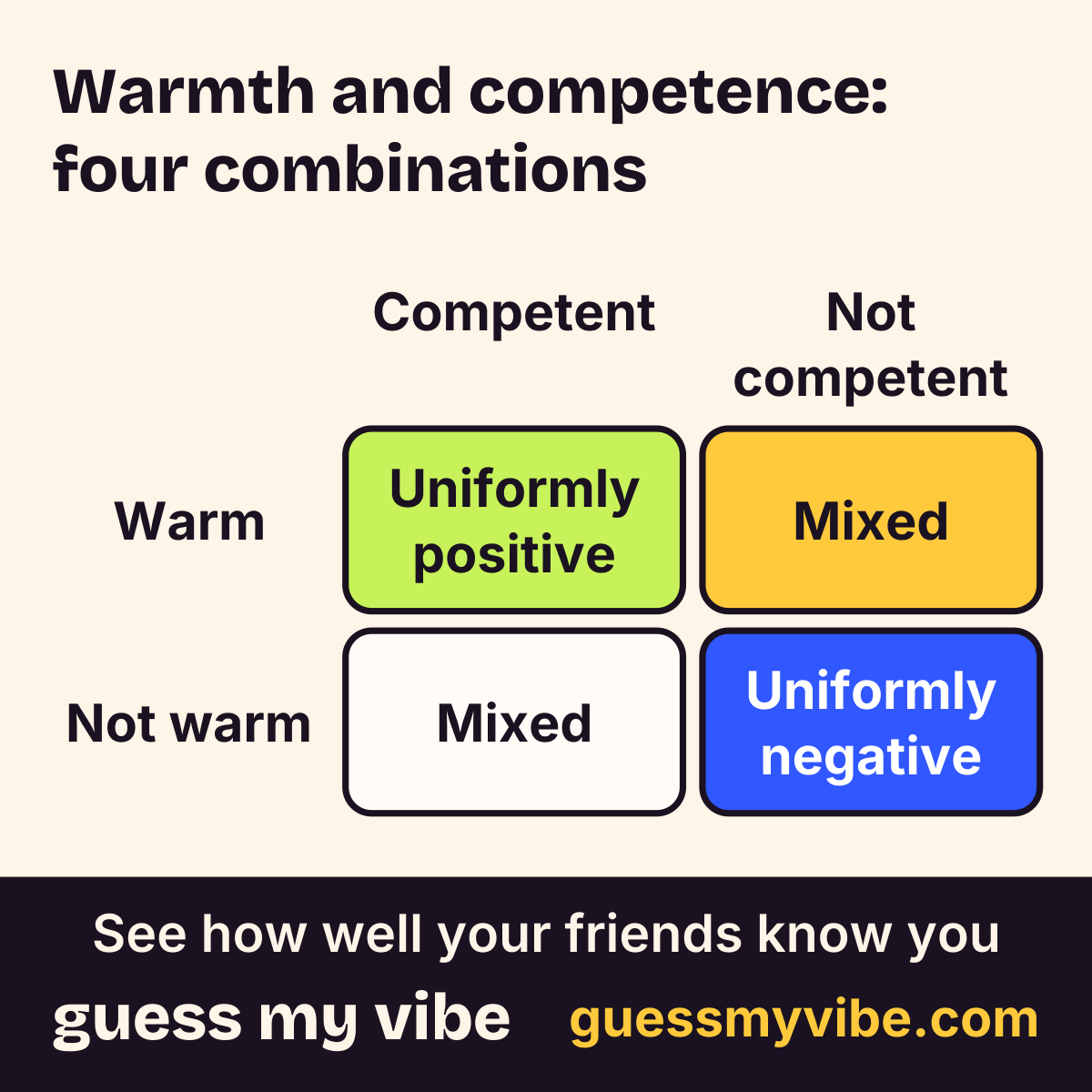
Because the dimensions are separate, you can be judged high on one and low on the other. The review lays out how people respond to each case. People perceived as warm and competent elicit uniformly positive emotions and behavior. People perceived as lacking both elicit uniformly negative reactions. And people classified as high on one dimension and low on the other elicit predictable, ambivalent affective and behavioral reactions [1].
Ambivalent is the key word. Think of the colleague who is lovely but seems out of their depth, or the one who is brilliant but cold. You may like one and respect the other, and the feelings don't line up neatly. Our own caution: this is a pattern about how reactions tend to go, not a rule about any single person you know, and real people land between the boxes.
Cite this figure
Figure: "Warmth and competence: four combinations." Guess My Vibe (guessmyvibe.com). https://guessmyvibe.com/learn/warmth-and-competence#figure-four-combinations
When warmth and competence pull in opposite directions
A useful example comes from smiling. In a set of consumer studies, a marketer showing a broad smile was more likely to be seen as warmer but less competent than one showing a slight smile. The warmth benefit was larger among promotion-focused consumers and in low-risk contexts, and the competence cost was more likely among prevention-focused consumers and in high-risk situations [2]. The judges were consumers looking at marketers, so this can't be dropped straight onto a friendship. But it shows the two dimensions can respond differently to the same behavior.
The practical point is gentle. If you want to be seen as both, there may be moments when leaning into one dimension quietly costs you a little on the other, and context decides which one matters more. We would not turn that into a rule. Our own advice, not a tested finding, is to notice which dimension a situation is asking about, and to remember that most people want to see both.
Curious how your friends would answer?
Free. Answer 10 quick questions about you, then send your link. Friends play in their browser, no app needed.
Start freeWhat the warmth and competence model leaves out
No two-dimension model covers everything. One line of work argues that moral character deserves its own place. In a seven-study paper, researchers found that moral character traits and social warmth traits are separable, and that in most contexts moral character information was more important than warmth information in forming impressions. In an archival study, moral character also appeared more prominently than warmth in obituaries [3]. So a person can be friendly in a casual way and still not read as someone you'd trust, and the second read may matter more.
Another paper, a set of four studies on trait words, found that a large number of trait names reduce to two broad dimensions, agency (roughly, getting things done) and communion (roughly, getting along with others). Communion carried more of the item variance, and agency was seen as more relevant and desired for the self, while communion was more relevant and desired for others. Agency became more important in a close friend than in an unrelated peer, a difference the authors link to how much we depend on that person's outcomes [4]. Put simply, what you want from yourself and what you want from other people are not quite the same list.
What the two dimensions mean for how you come across
If people judge you on both dimensions, it helps to ask which one you are signaling and which one you are leaving to chance. Some people put a lot of effort into looking capable, with a polished resume, a confident tone and a quick answer for everything, and forget to show that they mean well. Others are so focused on being kind that they never show what they can do. Neither is a flaw in character. Each is just one half of the picture, and the review's point is that observers use both halves [1].
A small, practical way to use this is to notice what you naturally lead with. In a first meeting, do you start with something that shows care, like a question about the other person or a thank-you? Or do you start with something that shows skill, like a fact or an achievement? Our own suggestion, not a finding, is to make sure the other half gets some airtime before the conversation ends. That is also a gentle way to avoid being read as only one thing.
Why reading warmth in people you know is harder than it looks
If warmth is the first thing we judge, you would hope we judge it well. The evidence is more modest. A meta-analysis of 263 samples and 44,178 people looked at how accurately other people rate someone's personality. It found that closeness with the person improved accuracy, and that it did so especially for traits low in visibility, such as emotional stability, but only minimally for traits high in evaluativeness, such as agreeableness [5]. The same analysis found that agreement between self-ratings and one other person's rating was lowest for Agreeableness of the five traits, a corrected correlation of about .39, against about .51 for extraversion [5].
Agreeableness is not the same thing as warmth, and that study did not measure warmth directly, so treat the link as a loose one. Still, it points to something worth taking seriously. For highly evaluative traits, closeness helped only a little in that meta-analysis, which may mean the "nice" side of a person is hard to see even from the inside of a friendship. Our own explanation, offered as reasoning and not a result, is that we tend to see people the way we want to, which makes warmth a trait where blind spots feel natural.
Using the model with friends
A simple way to use the model is to ask two questions of a friend instead of one. Instead of "what do you think of me?", try "do I come across as someone who means well?" and "do I come across as someone who can follow through?" Those split the two dimensions apart, so you can see which one carries your reputation. Guess My Vibe does a version of this with personality questions: a friend guesses your real answers, and the gaps show you where your read from the outside differs from the one you have on the inside.
Key takeaways
- Warmth is a quick read of whether someone intends good or ill, and competence is a read of whether they can act on that intention [1].
- Someone judged high on both gets uniformly positive reactions, someone low on both gets uniformly negative ones, and a split produces mixed feelings [1].
- The two dimensions don't always move together: a broad smile was seen as warmer but less competent than a slight smile in marketing studies [2].
- Warmth isn't the whole story of character: a seven-study paper found moral character information mattered more than warmth information in most contexts [3].
- This isn't therapy, a diagnosis, or a substitute for professional care.
Questions people ask
What is the warmth and competence model?
It's the idea that people judge others on two dimensions: warmth (does this person mean well or ill?) and competence (can they act on it?) [1].
Which comes first, warmth or competence?
The researchers behind the model propose that warmth, the friend-or-foe question, comes first, with the ability question following [1]. It's a theory about order, not a stopwatch measurement of every encounter.
Can someone be warm but not competent, or the reverse?
Yes. People judged high on one dimension and low on the other tend to produce mixed, ambivalent reactions, according to the same review [1].
Is moral character part of warmth?
Researchers argue it is separable: in a seven-study paper, moral character traits and warmth traits could be told apart, and character information mattered more for impressions in most contexts [3].
How can I find out how warm or competent I seem?
Ask a few people who know you well, and ask the two questions separately (does she mean well, can she follow through). In one meta-analysis, closeness helped only minimally for highly evaluative traits like agreeableness [5].
See how well your friends know you.
Free. Answer 10 quick questions about you, then send your link. Friends play in their browser, no app needed.
Start freeReferences
- [1] Fiske, S. T., Cuddy, A. J., & Glick, P. (2007). Universal dimensions of social cognition: warmth and competence. Trends in Cognitive Sciences, 11(2), 77-83. PubMed: 17188552 (opens in a new tab)
- [2] Wang, Z., Mao, H., Li, Y. J., & Liu, F. (2016). Smile big or not? Effects of smile intensity on perceptions of warmth and competence. Journal of Consumer Research. doi.org/10.1093/jcr/ucw062 (opens in a new tab)
- [3] Goodwin, G. P., Piazza, J., & Rozin, P. (2014). Moral character predominates in person perception and evaluation. Journal of Personality and Social Psychology, 106(1), 148-168. PubMed: 24274087 (opens in a new tab)
- [4] Abele, A. E., & Wojciszke, B. (2007). Agency and communion from the perspective of self versus others. Journal of Personality and Social Psychology, 93(5), 751-763. PubMed: 17983298 (opens in a new tab)
- [5] Connelly, B. S., & Ones, D. S. (2010). An other perspective on personality: Meta-analytic integration of observers' accuracy and predictive validity. Psychological Bulletin, 136(6), 1092–1122. PubMed: 21038940 (opens in a new tab)
How we find and check these sources: how we write. Spotted an error? Report a correction.
Related
Cite this article
- Title
- Warmth and Competence: The Two Things People Judge First
- Publisher
- Guess My Vibe
- Updated
- URL
- https://guessmyvibe.com/
learn/ warmth-and-competence
Copy this citation
Guess My Vibe. (2026, October 4). Warmth and Competence: The Two Things People Judge First. Guess My Vibe. https://guessmyvibe.com/
To point at one section, add that section's anchor (the # link on its heading) to the URL.