To be approachable, make it easy for people to read that you're friendly: let positive expressions show, and don't hold your face and posture stiff. Research finds that people who showed more positive emotion in photos were rated more favorably and expected to be more rewarding to talk to [1]. But a bigger smile isn't always better, and a first look is a guess, so the best check is asking people who know you.
How to be approachable: the short version
Being approachable means other people feel they can walk up to you, start a conversation, and not get a cold response. Research on first impressions suggests the practical version is simple: make your friendliness easy to see. People read a lot from expression, and people who show positive emotion get rated more favorably and are expected to be more rewarding to interact with [1]. That's the good news. The less comfortable news is that how approachable you look is partly outside your control, and it isn't always a fair read of how you actually are. Here is what the evidence says about each piece.
What a smile and positive expression signal to strangers
One classic study went through women's college yearbook photos and scored how much positive emotion each woman was showing. It then compared that score to what the women said about their personalities, to what observers made of the photos, and to how their lives went later. Women who showed more positive emotion described themselves as higher in affiliation and competence and lower in negative emotionality, and that pattern held across adulthood. Observers who only saw the photos rated those women more favorably on several personality dimensions, and they expected interactions with them to be more rewarding [1].
Two cautions belong right next to that result. First, this was one group (women photographed in college in an earlier era), and the study is correlational, so it can't tell you that putting on a smile will change your personality. Second, the authors report that controlling for physical attractiveness and social desirability had little impact on the findings [1]. Our own reading, hedged: positive expression is a signal strangers use, and it may carry some real information about the person showing it.
Being expressive makes you easier to read
Approachability is partly about being readable. Another study had strangers judge 10 personality traits from full-body photographs. When the people in the photos were told to hold a set pose and expression, observers were accurate for extraversion, self-esteem and religiosity. When people were photographed with a spontaneous pose and expression, observers were accurate for almost all of the traits. The authors conclude that both fixed cues, like clothing style, and expressive cues, like facial expression and posture, carry personality information [2].
For approachability, the useful reading is this. If you keep your face blank and your body closed off, strangers get less to work with, and they have to fill in the gaps themselves. That is a different thing from saying a particular expression makes you likable, which this study didn't test. It only shows that observers were accurate for more traits when the pose and expression were spontaneous. Our own reasoning, not a tested finding, is that a person who is easy to read feels safer to approach, because you can guess how the conversation will go.
Why a bigger smile isn't always better
It's tempting to conclude that you should smile as widely as you can. The research is more mixed. In a set of consumer studies, a marketer displaying a broad smile, compared with a slight smile, was more likely to be seen as warmer but less competent. The warmth boost was bigger among promotion-focused consumers and in low-risk settings, and the competence cost showed up more among prevention-focused consumers and in high-risk situations [3].
Keep the setting in mind: those judges were consumers looking at marketers, not friends meeting at a party, so the numbers don't transfer neatly to everyday life. But the idea behind it fits a wider body of work. Researchers describe warmth and competence as two basic dimensions people use to size someone up, and the two don't always rise together [5]. If you want to come across as both friendly and capable, a real, moderate smile may do more for you than the widest one you can manage. How that plays out will depend on the situation, which is why a single rule rarely works.
Curious how your friends would answer?
Free. Answer 10 quick questions about you, then send your link. Friends play in their browser, no app needed.
Start freeYour resting face is a guess, not the truth
Here is the part that surprises people. In one model of how we evaluate faces, judgments of emotionally neutral faces boil down to two dimensions: valence, roughly how trustworthy someone looks, and dominance. The authors found that the valence judgment is more sensitive to facial features that resemble expressions signaling whether a person should be approached or avoided. They argue that face evaluation overgeneralizes adaptive mechanisms for inferring harmful intent, which can produce rapid judgments that are not necessarily accurate [4].
Our reading of this: a neutral face that happens to resemble an avoid-type expression may be taken as unfriendly by a stranger. That doesn't mean the person is cold. It means the stranger's snap judgment is a guess. If this sounds like you, the fix is not to change your face. It is to add a clear signal on top of it, such as a quick hello or a genuine smile when you make eye contact, so the guess gets corrected.
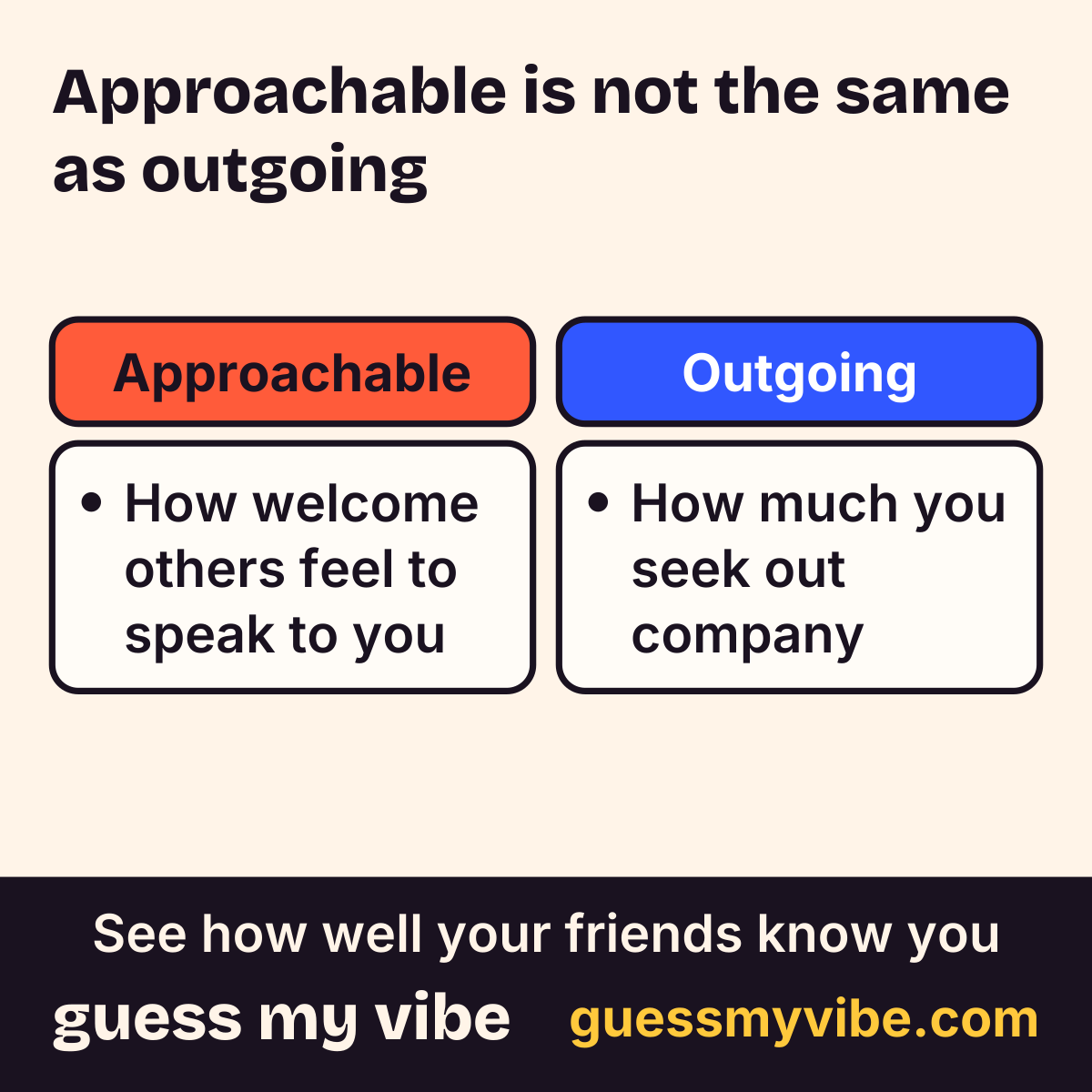
It also helps to separate approachable from outgoing. Approachability is about how welcome other people feel when they consider speaking to you. Being outgoing is about how much you seek out company. They overlap, but they are not the same thing, and plenty of quiet people are easy to talk to. If you tend to be reserved, you don't need to act like a different person. You only need to make your openness visible, for example with a relaxed face and a few words of greeting.
Context matters too. A friendly expression that works at a party may land differently in a meeting or on a quiet train, and what counts as a warm look can differ between groups of people. The studies here cannot tell you the right setting-by-setting rules, which is one more reason to ask people who see you in the places you care about.
Cite this figure
Figure: "Approachable is not the same as outgoing." Guess My Vibe (guessmyvibe.com). https://guessmyvibe.com/learn/how-to-be-approachable#figure-approachable-vs-outgoing
What you can actually do to seem more approachable
The research above doesn't test a list of tips, so treat these as reasonable ideas built on the findings, not proven rules. Let positive feelings show instead of masking them, since positive expression is a signal people use [1]. Let your posture and expression move naturally rather than holding them still, since observers were accurate for more traits when pose and expression were spontaneous [2]. Keep your smile real and fitted to the moment, since the widest smile is not always the one that works best [3]. And if your resting face looks serious, say hello first, because a first look is a rough guess [4].
What these ideas leave out is that being approachable is also about what happens after someone walks up. Whether you ask follow-up questions, listen well and make people feel liked is a separate topic, covered in our article on likability. Approachability gets the first sentence started. It doesn't carry the conversation.
How to find out how approachable you actually seem
You can't see your own face the way a stranger does, and you are not a neutral judge of your own vibe. That's where a friend helps. Ask someone who knows you well a specific question, like "If you saw me alone at a party, would I look like someone you could walk up to?" A specific question about one situation gets a more honest answer than "am I approachable?" Guess My Vibe works the same way. Friends guess your real answers to personality questions, and the gaps between their guesses and your answers show you where your vibe reads differently from how you feel inside.
Key takeaways
- Observers rated women who showed more positive emotion in college yearbook photos more favorably, and expected interactions with them to be more rewarding [1].
- Observers judging photos taken with a spontaneous pose and expression were accurate for almost all of 10 traits, while for photos with a fixed pose and expression they were accurate for extraversion, self-esteem and religiosity [2].
- A broad smile was seen as warmer but less competent than a slight smile in marketing studies, so approachable is not the same as maximum cheerfulness [3].
- People automatically evaluate even emotionally neutral faces, and the authors describe such judgments as rapid but not necessarily accurate, so a first look is a rough guess [4].
- This isn't therapy, a diagnosis, or a substitute for professional care.
Questions people ask
How can I be more approachable?
Let your positive expressions show and let your face and posture move naturally. Research found observers rated people who showed more positive emotion more favorably and expected more rewarding interactions with them [1]. These are reasonable ideas rather than guaranteed fixes.
Does smiling make you seem more approachable?
Often, yes, but how much depends on the situation. In marketing studies a broad smile was seen as warmer but less competent than a slight smile, so more is not always better [3].
Why do people think I look unfriendly when I'm not?
Judgments from a neutral face are rapid but not necessarily accurate, and one model finds that how trustworthy a face looks is sensitive to features resembling approach or avoid expressions [4]. A quick hello may correct the guess.
Is being approachable the same as being extroverted?
No. A quiet person can be easy to talk to, and a talkative person can seem hard to approach. Approachability is about how welcome others feel, not how outgoing you are.
How can I tell if I seem approachable?
Ask a few people who know you well about a specific moment, such as how you look when you arrive somewhere alone. You can't see your own face the way a stranger does.
See how well your friends know you.
Free. Answer 10 quick questions about you, then send your link. Friends play in their browser, no app needed.
Start freeReferences
- [1] Harker, L., & Keltner, D. (2001). Expressions of positive emotion in women's college yearbook pictures and their relationship to personality and life outcomes across adulthood. Journal of Personality and Social Psychology, 80(1), 112-124. PubMed: 11195884 (opens in a new tab)
- [2] Naumann, L. P., Vazire, S., Rentfrow, P. J., & Gosling, S. D. (2009). Personality judgments based on physical appearance. Personality and Social Psychology Bulletin, 35(12), 1661–1671. PubMed: 19762717 (opens in a new tab)
- [3] Wang, Z., Mao, H., Li, Y. J., & Liu, F. (2016). Smile big or not? Effects of smile intensity on perceptions of warmth and competence. Journal of Consumer Research. doi.org/10.1093/jcr/ucw062 (opens in a new tab)
- [4] Oosterhof, N. N., & Todorov, A. (2008). The functional basis of face evaluation. Proceedings of the National Academy of Sciences, 105(32), 11087-11092. PubMed: 18685089 (opens in a new tab)
- [5] Fiske, S. T., Cuddy, A. J., & Glick, P. (2007). Universal dimensions of social cognition: warmth and competence. Trends in Cognitive Sciences, 11(2), 77-83. PubMed: 17188552 (opens in a new tab)
How we find and check these sources: how we write. Spotted an error? Report a correction.
Related
Cite this article
- Title
- How to Be Approachable, According to Research
- Publisher
- Guess My Vibe
- Updated
- URL
- https://guessmyvibe.com/
learn/ how-to-be-approachable
Copy this citation
Guess My Vibe. (2026, October 4). How to Be Approachable, According to Research. Guess My Vibe. https://guessmyvibe.com/
To point at one section, add that section's anchor (the # link on its heading) to the URL.