How to make friends as an introvert starts with a fact worth knowing up front: more extraverted people tend to build bigger social networks, but not emotionally closer ones [1]. So the honest goal for an introvert isn't matching an extravert's friend count, it's building a smaller number of real connections, and extraverts weren't emotionally closer to the people in their networks.
How to make friends as an introvert: start with the real goal
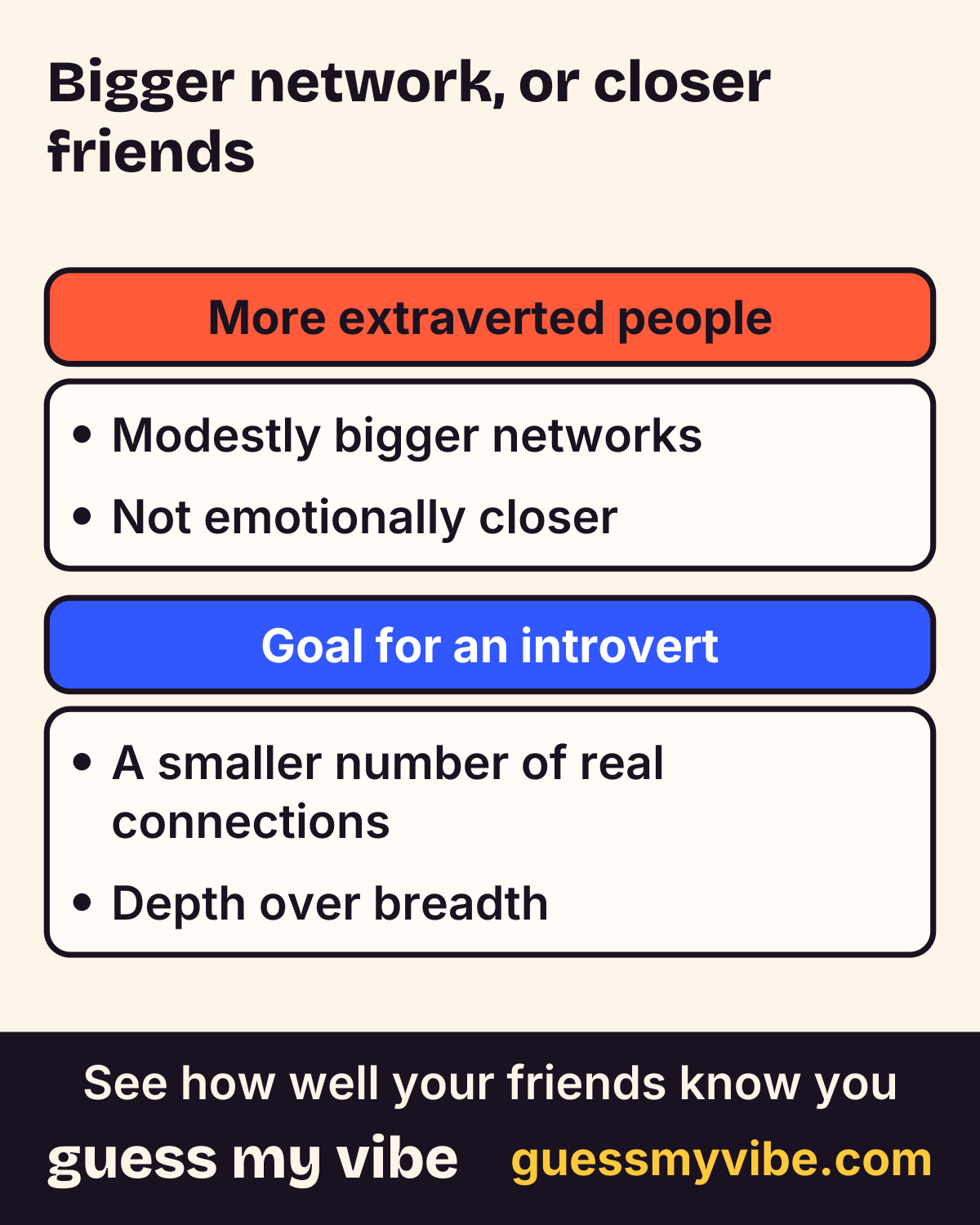
How to make friends as an introvert is a different question from how to make a lot of friends, and mixing up the two is where a lot of advice on this goes wrong. Research on extraversion and social networks found that more extraverted people really do build modestly bigger networks at every layer, from a close support group to a wider circle of acquaintances. But the same study found extraverts weren't emotionally closer to the people in those networks, even once network size was accounted for [1]. In plain terms: being more outgoing goes with more people, not deeper relationships with each one. If you're introverted and your friend group is smaller than an outgoing friend's, that's a real, expected pattern, not evidence that something's missing from the friendships you do have.
Cite this figure
Figure: "Bigger network, or closer friends." Guess My Vibe (guessmyvibe.com). https://guessmyvibe.com/learn/how-to-make-friends-as-an-introvert#figure-bigger-vs-closer
What actually goes with a friendship forming (hint: it's not extraversion)
A review of research on how Big Five traits shape friendship found something that cuts directly against the stereotype that outgoing people simply make friends more easily: agreeableness, not extraversion, has the most consistent effect on whether a friendship forms and holds up over time, with neuroticism (how easily someone is thrown off by stress) next. Extraversion, conscientiousness, and openness all influence friendship too, just less consistently across different studies [2]. Agreeableness, being easy to get along with, considerate, willing to compromise, isn't a trait that depends on how outgoing you are. A quiet, low-key person who's warm and easy to be around has exactly the trait profile the research says matters most for a friendship actually sticking.
What actually helps, based on the research
1. Pick depth over breadth, on purpose
Since a bigger network isn't the same as a closer one [1], a reasonable strategy for an introvert is to stop measuring progress by headcount. One or two people you can be fully honest with is a complete, successful outcome, not a consolation prize for not having a bigger group. Put effort into the one or two relationships that already feel easiest, rather than spreading thin trying to build a crowd.
2. Use small, repeating settings instead of one-off big events
A single loud party is a hard place to build a friendship from scratch, for reasons that have nothing to do with being unfriendly: it's high-stimulation, one-time, and full of strangers, which is close to the opposite of what suits lower extraversion. Repeating, smaller settings (a weekly class, a small group with the same people each time, a regular game night) give a real friendship time to form gradually, through several lower-stakes encounters with the same people, rather than needing to make a strong impression in one big one.
3. Know the short-term trade-off before you make it
Research that had people act more outgoing than usual over a week-long trial found it lifted positive mood and feelings of authenticity overall. But the benefit wasn't even: the more introverted participants had weaker mood gains and also reported more negative mood, more tiredness and feeling less like themselves [3]. That's not a reason to avoid initiating plans or conversations, since the average mood boost was real. It's a reason to try it in small doses and expect the cost honestly: saying yes to a hangout or starting a conversation with someone new can be worth it and still leave you wiped out afterward. Planning recovery time isn't a failure of effort, it's accounting for a real, measured pattern.
4. Separate nerves from disinterest
If the actual barrier is a knot of nerves before reaching out, not a lack of interest in having the friend, that's shyness, a different trait from introversion, and research separating the two found they're only moderately related [4]. Shyness often eases with familiarity more than with willpower: texting instead of calling, meeting one-on-one before a group, or picking an activity-based hangout (a walk, a show, a game) where conversation isn't the entire point tend to lower the nervousness without requiring you to become a different kind of person.
5. Let your accurate side do some of the work
One advantage worth knowing: extraversion, including the low end, is the trait where other people's ratings agreed most with people's own [5], and a separate study found others judged it about as well as people judge it in themselves [6]. That means a new acquaintance is likely to correctly pick up on roughly how outgoing or reserved you are without you needing to perform differently than you are. You don't have to fake being more outgoing than you feel for someone to understand roughly who you are early on; the signal often comes through on its own.
6. Starting over in a new place (college, a new city, a new job)
Making friends from scratch, in college, after a move, or starting a new job, is harder for everyone, not just introverts, because it strips away the repeating, low-stakes settings tip #2 relies on. The practical fix is to build one back on purpose: the same class, the same gym class, the same recurring team meeting, rather than treating every new social situation as a one-time audition. It takes longer to feel natural, and that's expected, not a sign you're doing it wrong. The research above still applies here: a smaller number of real connections, built gradually through repeated contact, beats trying to recreate an old, bigger friend group all at once in an unfamiliar place.
Curious how your friends would answer?
Free. Answer 10 quick questions about you, then send your link. Friends play in their browser, no app needed.
Start freeThe honest bottom line
Making friends as an introvert isn't about closing a gap with how extraverts do it. The research points to a different, achievable target: fewer relationships, built in smaller and more repeatable settings, with the trait most linked to whether those relationships hold up, being easy to get along with, having nothing to do with how outgoing you are [2]. Guess My Vibe is built around exactly the kind of friendship this approach produces: one real friend, or a couple, who you trust enough to let guess your honest answers to real personality questions, which is a far better test of a friendship's depth than how many people are in it.
Key takeaways
- Extraverts build modestly bigger social networks at every level (close friends, wider circle, acquaintances), but they aren't emotionally closer to the people in those networks than less extraverted people are [1].
- Agreeableness, not extraversion, has the most consistent effect on whether friendships actually form and last, according to a review of the friendship research [2].
- Acting more outgoing in a specific moment (starting a conversation, saying yes to an invite) lifted positive mood overall in a week-long randomized trial, though the more introverted participants got weaker lifts and also reported more negative mood and tiredness [3].
- If what's actually stopping you is nervousness rather than disinterest, that's shyness, not introversion [4], and it may call for a different approach: familiarity and smaller settings, not forcing more big social events.
- This isn't therapy, a diagnosis, or a substitute for professional care.
Questions people ask
Do introverts really have fewer friends than extraverts?
On average, yes, extraverts build bigger networks at every level, from close friends to a wider circle. But the same research found extraverts aren't emotionally closer to the people in those networks, so a smaller friend group isn't evidence of shallower friendships [1].
What personality trait is most linked to whether a friendship lasts?
A review of the research found agreeableness, being easy to get along with and considerate, has the most consistent effect on friendship formation and maintenance, more consistent than extraversion [2].
Is it bad for an introvert to force themselves to be more outgoing to make friends?
Not necessarily; a week-long trial found acting more outgoing lifted positive mood overall. But more introverted participants got weaker lifts and also reported more negative mood and tiredness, so it's worth planning for that cost rather than ignoring it [3].
I want friends but get nervous reaching out. Is that introversion?
That sounds more like shyness, the nervous, self-conscious feeling around people, which research finds is only moderately related to introversion, the lower drive to seek out social stimulation [4]. Shyness tends to ease with familiarity (smaller groups, repeat low-stakes contact) rather than needing you to act like someone you're not.
Where should an introvert actually try to make friends?
Smaller, repeating settings tend to work better than one large event: a class, a small regular group, or an activity-based hangout where conversation isn't the only thing happening. These give a friendship time to build gradually across several lower-stakes encounters with the same people.
See how well your friends know you.
Free. Answer 10 quick questions about you, then send your link. Friends play in their browser, no app needed.
Start freeReferences
- [1] Pollet, T. V., Roberts, S. G. B., & Dunbar, R. I. M. (2011). Extraverts have larger social network layers. Journal of Individual Differences, 32(3), 161-169. doi.org/10.1027/1614-0001/a000048 (opens in a new tab)
- [2] Harris, K., & Vazire, S. (2016). On friendship development and the Big Five personality traits. Social and Personality Psychology Compass, 10(11), 647–667. doi.org/10.1111/spc3.12287 (opens in a new tab)
- [3] Jacques-Hamilton, R., Sun, J., & Smillie, L. D. (2019). Costs and benefits of acting extraverted: A randomized controlled trial. Journal of Experimental Psychology: General, 148(9), 1538–1556. PubMed: 30489119 (opens in a new tab)
- [4] Cheek, J. M., & Buss, A. H. (1981). Shyness and sociability. Journal of Personality and Social Psychology, 41(2), 330–339. doi.org/10.1037/0022-3514.41.2.330 (opens in a new tab)
- [5] Connelly, B. S., & Ones, D. S. (2010). An other perspective on personality: Meta-analytic integration of observers' accuracy and predictive validity. Psychological Bulletin, 136(6), 1092–1122. PubMed: 21038940 (opens in a new tab)
- [6] Vazire, S. (2010). Who knows what about a person? The self-other knowledge asymmetry (SOKA) model. Journal of Personality and Social Psychology, 98(2), 281–300. PubMed: 20085401 (opens in a new tab)
How we find and check these sources: how we write. Spotted an error? Report a correction.
Related
- Shy vs Introvert: Why They Get Confused
- Introvert vs Extrovert: What the Research Actually Shows
- What Makes Someone a Warm Person?
- Outgoing Personality: What It Actually Means
- Dating an Introvert: What Research Actually Says
- How to Make Friends: What the Research Says
- Social Battery: The Science of Why Socializing Drains You
- Introvert Extrovert Friendship: Why It Works
- How to Make Friends in a New City (What Research Says)
Cite this article
- Title
- How to Make Friends as an Introvert
- Publisher
- Guess My Vibe
- Updated
- URL
- https://guessmyvibe.com/
learn/ how-to-make-friends-as-an-introvert
Copy this citation
Guess My Vibe. (2026, October 3). How to Make Friends as an Introvert. Guess My Vibe. https://guessmyvibe.com/
To point at one section, add that section's anchor (the # link on its heading) to the URL.