Learning how to make friends in a new city mostly means rebuilding the regular contact a move took away, on purpose. In a study of adults who had recently relocated, more hours spent with a new acquaintance went with a closer friendship [1]. It helps to expect a slow start, to assume new people like you more than you think [2], and to start small conversations, because in experiments with commuters, people expected solitude to feel better than talking to a stranger, and the people who connected reported a more positive commute [3].
If you've just moved and your phone has no one to text on a Friday, you're not doing something wrong. Knowing how to make friends in a new city starts with seeing what a move actually takes away. It doesn't just remove people. It removes the routine that made friendship easy: the same faces, in the same places, week after week. The research on moving, friendship and first conversations points to a plain plan: rebuild regular contact on purpose, give it more hours than feels reasonable, and don't read an awkward beginning as proof that nobody likes you.
What a move changes about friendship
Psychologists who study moving call it residential mobility, and one review pulled together what the field knows. It found that residential mobility, whether measured as the number of moves one person has made or the share of a neighborhood that recently moved, is associated with the personal self taking priority over the collective self. It's also associated with what the author calls "duty-free" friendships and group memberships, meaning ones that are chosen rather than obligatory. At the individual level, mobility was associated with lower well-being [4].
In plain words, and roughly: when you move, the ties that came with obligation, like family nearby, old neighbors or an inherited friend group, loosen, and what's left is the friendships you choose to build. That's a hard start, and it's also an opening. The review describes patterns across many studies, not a rule for any one person, and those patterns are associations, so they don't prove that moving causes the lower well-being. But they do back up the feeling that a move is a real social reset, not a personal failing.
If you're more introverted, put extra effort into a few close ties
There's one finding worth handling carefully. In a sample of 7,108 American adults followed for 10 years, people who had moved more often as children had lower well-being as adults. But that link showed up among introverts, not among extraverts, and it was explained by a relative lack of close social relationships among the introverts [6]. The same paper reports that introverts who had moved frequently as children were more likely to have died during the 10-year follow-up, while childhood mobility was unrelated to extraverts' mortality [6].
Please don't read that as a verdict on you. It's about childhood moves, not adult relocation, so it doesn't tell us what happens when a grown adult moves for a job. It's also an observational finding, so it can't prove that moves cause the differences. What it does suggest is that the missing ingredient was close relationships, not introversion by itself. The practical reading, which is our interpretation and not the paper's advice, is that if you're quieter, the goal worth aiming at is a couple of closer ties, not a huge crowd of new acquaintances. Our guide to making friends as an introvert goes deeper on that.
Give new friendships more hours than feels fair
How long does a new friendship take to get going? One paper tested this in two studies. In the first, 355 adults who had recently relocated estimated the time they'd spent with a new acquaintance, and more hours together was associated with closer friendships. Time spent on leisure activities together was also associated with closeness [1]. In the second, 112 first-year students reported hours spent with two new acquaintances three times over nine weeks; hours together was associated with changes in closeness between survey waves, and two types of everyday talk were associated with changes in closeness too [1].
The abstract doesn't give a magic number of hours, so be wary of any article that does. The usable idea is simpler: closeness tracked time together. For someone in a new city, that argues for choosing things you can repeat with the same people, like a weekly class, a standing run or a regular game night, rather than collecting one-off meetups. The one-off events are fine for meeting people, but the repeated ones are where the hours pile up. Our guide to making friends as an adult covers the repeated-contact idea in more depth.
Curious how your friends would answer?
Free. Answer 10 quick questions about you, then send your link. Friends play in their browser, no app needed.
Start freeNew people probably like you more than you think
A big obstacle in a new city is the worry that every conversation went worse than it did. Research on this gap is encouraging. Across studies of strangers getting acquainted in the lab, first-year college students meeting their dorm neighbors, and members of the public at a workshop, people systematically underestimated how much their conversation partners liked them and enjoyed their company. The researchers call it the liking gap, and it persisted in conversations of different lengths and even lasted for several months as dorm neighbors developed new relationships [2].
A related set of experiments found something similar about reaching out. Commuters on trains and buses who were told to connect with a stranger reported a more positive, and no less productive, commute than those who stayed disconnected. Yet separate participants guessed the opposite, expecting a better time in solitude. The authors traced part of this mistaken preference to underestimating how interested other people are in connecting [3]. For a newcomer, the lesson is to treat your gloomy forecast of a conversation with some suspicion. You might be underrating how it will go.
Count the small ties while the big ones form
In a new place, it's tempting to count only close friends, and to feel empty until you have one. Another line of research argues for counting more. In a study of students, people felt happier and had a greater sense of belonging on days when they interacted with more classmates than usual. In two further studies covering all daily interactions, weak ties, meaning acquaintances, were again related to social and emotional well-being [5]. That doesn't make acquaintances a substitute for close friends, and the study shows association, not cause. But it suggests the barista, the regulars at your climbing gym and the coworker you chat with are doing something for you while the deeper friendships take shape.
It also helps to keep your old friendships warm. A study that tracked entire personal networks across 18 months of a major life transition found that friendship quality declined, but the decline was lessened by more effort put into the relationship. For women in that study, more talking together protected a friendship most, while for men it was doing more activities together [7]. So a standing weekly call with someone back home isn't a way of avoiding your new city. It can help hold up the one set of relationships that already know you.
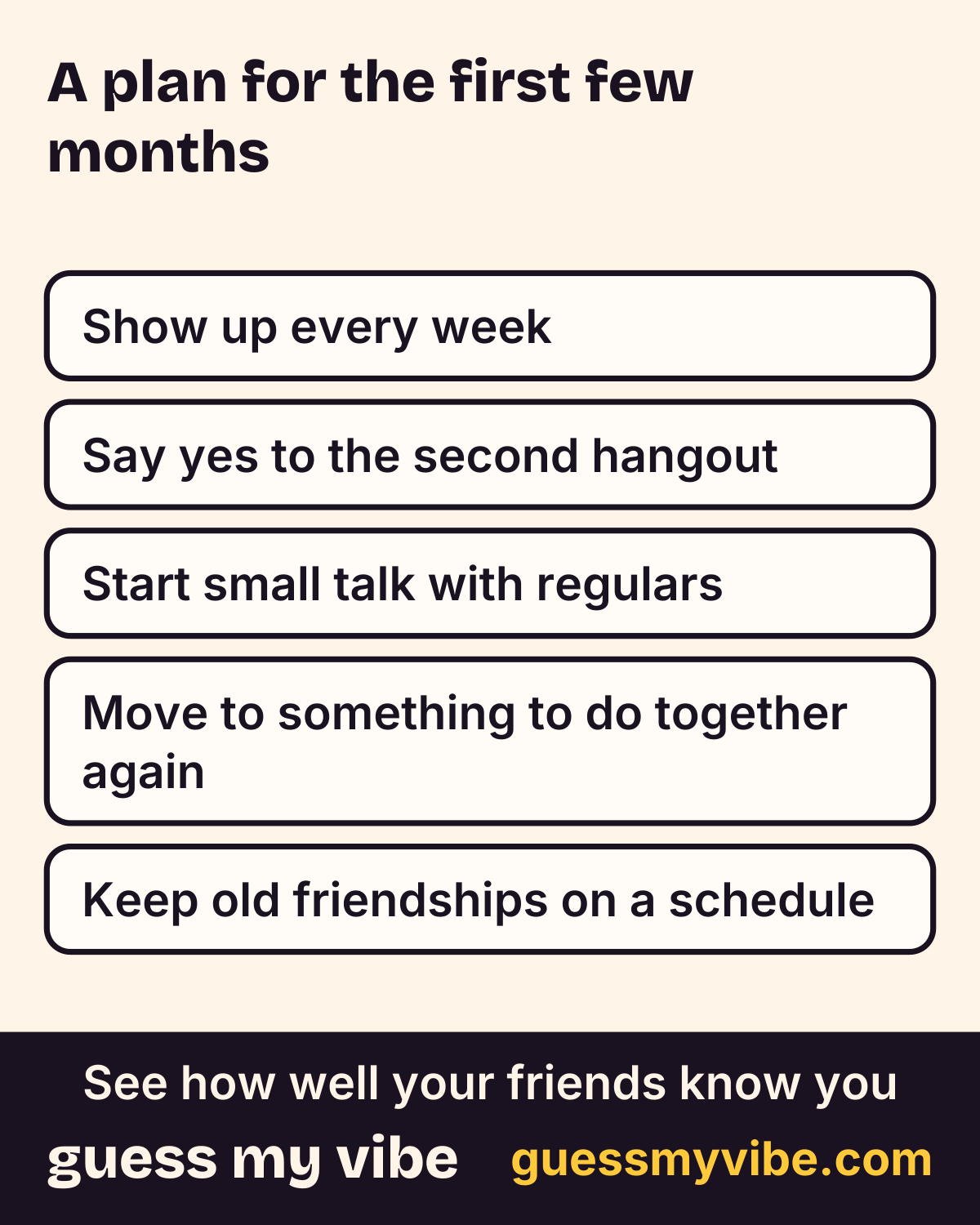
A simple plan for the first few months
Putting the research together (and adding a little common sense of our own), here's a plan you can actually run:
- Pick two or three recurring activities you'd enjoy even if you made no friends there, and show up every week.
- Say yes to the second hangout. Hours together are what the evidence points to, so follow up with the person you clicked with.
- Start small talk with neighbors and regulars, and assume it will go better than your forecast.
- Move a good conversation toward something you can do together again, not just "we should hang out sometime."
- Keep one or two old friendships on a schedule so you aren't starting from zero emotionally.
Once you've got a couple of people you see regularly, Guess My Vibe is a low-pressure way to deepen things. Each of you answers real personality questions and guesses the other's answers, which gives a new friendship something to laugh about and learn from beyond "what do you do for work." It works across distance too, so an old friend back home can play with you from there.
Cite this figure
Figure: "A plan for the first few months." Guess My Vibe (guessmyvibe.com). https://guessmyvibe.com/learn/how-to-make-friends-in-a-new-city#figure-first-months-plan
Key takeaways
- Moving is linked to changes in how people relate: a review found residential mobility is associated with "duty-free" friendships rather than obligatory ones, and with lower well-being at the individual level [4].
- In a study of recently relocated adults, more hours spent with a new acquaintance went with a closer friendship, as did time spent on leisure activities together [1].
- People systematically underestimated how much new conversation partners liked them, an illusion called the liking gap, and it showed up among first-year dorm residents for months [2].
- Students felt happier and more like they belonged on days with more interactions with classmates, and interactions with acquaintances were related to well-being in two further studies, which fits the idea that casual contacts matter while closer friendships form [5].
- This isn't therapy, a diagnosis, or a substitute for professional care.
Questions people ask
How long does it take to make friends in a new city?
There's no verified number. In a study of adults who had recently relocated, more hours spent with a new acquaintance went with closer friendship [1]. How fast that happens depends mostly on how often you see the same people.
Why is it so hard to make friends after moving?
A move removes the routine contact that made friendships easy. A review of residential mobility research found it associated with 'duty-free' friendships, chosen rather than obligatory, and with lower individual well-being [4]. These are associations across studies, not a rule for any one person.
Do introverts have a harder time after moving?
One study of 7,108 adults found that more childhood moves went with lower adult well-being among introverts but not extraverts, and that this was explained by fewer close relationships [6]. It was about moves in childhood, so it doesn't settle what happens with adult relocation.
What if I'm worried people won't like me?
Research suggests that worry is often too gloomy. After conversations, people underestimated how much their partners liked them, a pattern called the liking gap [2].
Do casual acquaintances matter when I'm new somewhere?
They seem to. People felt happier and more like they belonged on days with more interactions with classmates, and acquaintance interactions were linked to well-being in further studies [5]. It's an association, not proof of cause.
See how well your friends know you.
Free. Answer 10 quick questions about you, then send your link. Friends play in their browser, no app needed.
Start freeReferences
- [1] Hall, J. A. (2019). How many hours does it take to make a friend?. Journal of Social and Personal Relationships, 36(4), 1278–1296. doi.org/10.1177/0265407518761225 (opens in a new tab)
- [2] Boothby, E. J., Cooney, G., Sandstrom, G. M., & Clark, M. S. (2018). The Liking Gap in Conversations: Do People Like Us More Than We Think?. Psychological Science, 29(11), 1742–1756. PubMed: 30183512 (opens in a new tab)
- [3] Epley, N., & Schroeder, J. (2014). Mistakenly seeking solitude. Journal of Experimental Psychology: General, 143(5), 1980–1999. PubMed: 25019381 (opens in a new tab)
- [4] Oishi, S. (2010). The psychology of residential mobility: Implications for the self, social relationships, and well-being. Perspectives on Psychological Science, 5(1), 5–21. doi.org/10.1177/1745691609356781 (opens in a new tab)
- [5] Sandstrom, G. M., & Dunn, E. W. (2014). Social Interactions and Well-Being: The Surprising Power of Weak Ties. Personality and Social Psychology Bulletin, 40(7), 910–922. PubMed: 24769739 (opens in a new tab)
- [6] Oishi, S., & Schimmack, U. (2010). Residential mobility, well-being, and mortality. Journal of Personality and Social Psychology, 98(6), 980–994. doi.org/10.1037/a0019389 (opens in a new tab)
- [7] Roberts, S. B. G., & Dunbar, R. I. M. (2015). Managing Relationship Decay: Network, Gender, and Contextual Effects. Human Nature, 26(4), 426-450. PubMed: 26489745 (opens in a new tab)
How we find and check these sources: how we write. Spotted an error? Report a correction.
Related
Want to try it with your own friends? Make a friendship quiz to play with your friends
Cite this article
- Title
- How to Make Friends in a New City (What Research Says)
- Publisher
- Guess My Vibe
- Updated
- URL
- https://guessmyvibe.com/
learn/ how-to-make-friends-in-a-new-city
Copy this citation
Guess My Vibe. (2026, October 4). How to Make Friends in a New City (What Research Says). Guess My Vibe. https://guessmyvibe.com/
To point at one section, add that section's anchor (the # link on its heading) to the URL.