The propinquity effect is the finding that physical or functional closeness, simply being near someone often, is strongly linked to who becomes friends with whom. A classic field study of police trainees found that using place in alphabetical order, an arbitrary stand-in for proximity, lined up with who named each other as close friends more strongly than a wide range of other personal traits [1]. Proximity mostly explains who gets the chance to become friends in the first place; what happens after that chance appears is a separate question.
What the propinquity effect actually is
The propinquity effect is the finding that physical or functional closeness, how often your paths cross someone by sheer arrangement rather than by choice, is strongly tied to who you end up friends with. "Propinquity" just means nearness, and the research behind the term has a consistent punch line: who you become close with has a lot more to do with the floor you lived on, the seat you were assigned, or the desk you got stuck next to than most people assume. It's one of the more humbling findings in the friendship research, since it suggests a lot of friendship formation runs on logistics most people never consciously notice, rather than on deep compatibility discovered from scratch.
Where the term comes from
The term is usually traced to Festinger, Schachter and Back's 1950 book on friendships in student housing, a classic of social psychology. This article only describes research whose text or abstract was actually checked, and that book wasn't available to read, so it leans on the studies below instead.
The evidence: alphabetical order at a police academy
One of the clearest, most directly verifiable demonstrations of the propinquity effect comes from an unusual natural setting: a state police training academy [1]. The study looked at 44 state police trainees and used place in alphabetical order as an unobtrusive, and deliberately conservative, measure of propinquity. Alphabetical order has nothing to do with anyone's personality or interests, so it is a stand-in for closeness that people didn't pick for themselves. Proximity measured that way lined up with friendship choices more strongly than a wide range of other personal characteristics that earlier research had studied as drivers of who likes whom. The abstract doesn't give the size of the effect, so "stronger than the other characteristics studied" is as precise as this article can be.
Why mere closeness carries so much weight
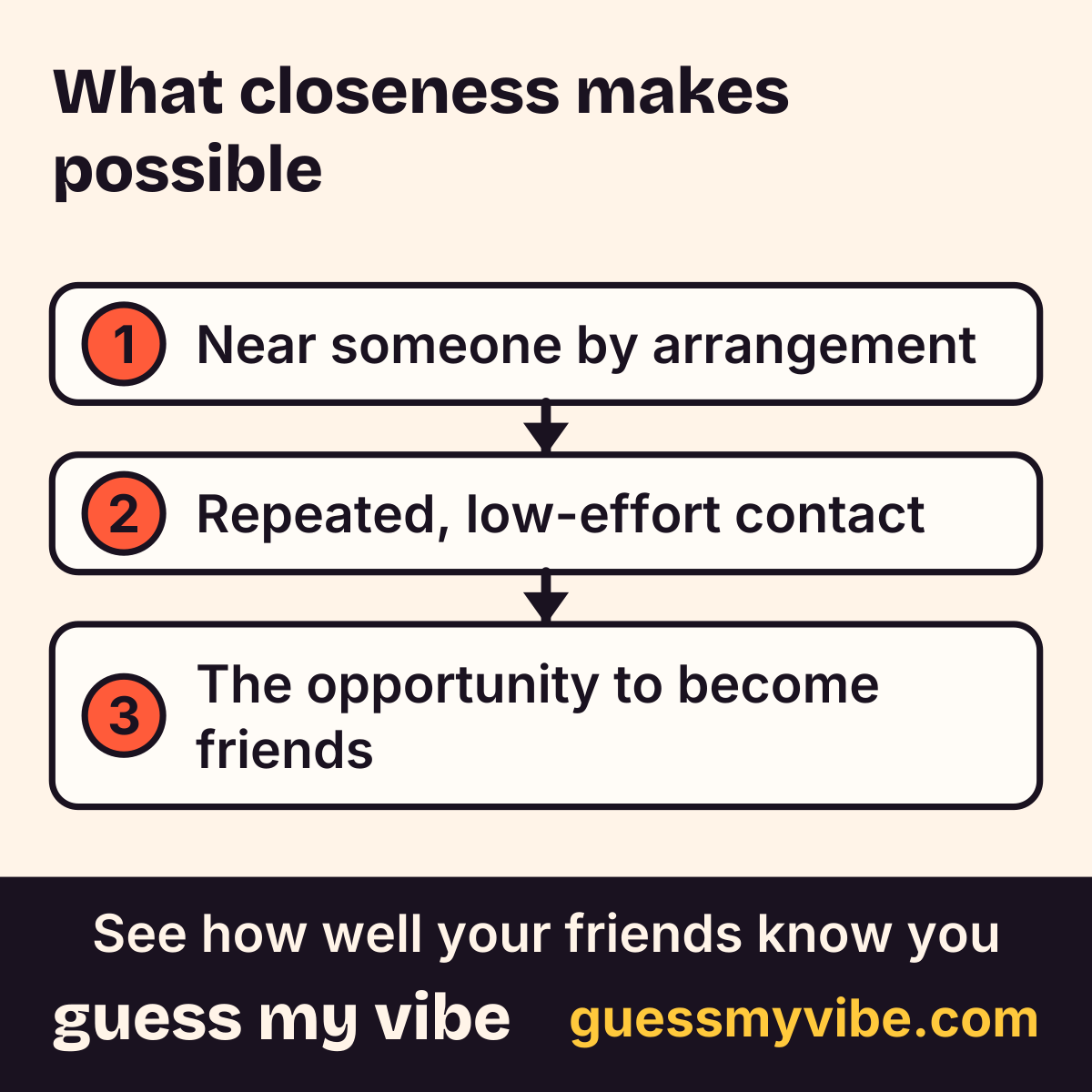
Proximity's outsized influence isn't really about distance itself. It's about what distance makes possible: repeated, low-effort contact that doesn't require either person to make a deliberate choice to seek the other one out. Friendship generally requires some number of interactions before it can really take hold, and proximity is one of the cheapest, most automatic ways to rack those interactions up. Sitting near someone, living on the same floor, or ending up in the same regular class or meeting means you'll likely cross paths with them dozens of times without ever having to plan it, which is a very different, much lower-effort path to friendship than deliberately seeking out a specific person based on their qualities. Those accumulated hours matter directly, too: two studies, one of 355 adults who had recently relocated and one following 112 first-year college students over nine weeks, found that hours spent together went with closer friendships and growing closeness, along with shared leisure time and certain kinds of everyday talk [3]. Proximity is one of the easiest ways to rack those hours up without ever having to plan for them. Repeated exposure may also raise liking on its own; the mere exposure effect article covers that separate idea.
Cite this figure
Figure: "What closeness makes possible." Guess My Vibe (guessmyvibe.com). https://guessmyvibe.com/learn/propinquity-effect#figure-closeness-to-friendship
Curious how your friends would answer?
Free. Answer 10 quick questions about you, then send your link. Friends play in their browser, no app needed.
Start freeWhat happens once the proximity goes away
Proximity is extremely good at explaining who gets the opportunity to become friends in the first place. It's much less useful for explaining which of those proximity-born friendships actually survive once the shared building, class, or seating chart disappears, which happens constantly: graduation, moving, changing jobs. A study that tracked high-school best friendships through the first year of college, when physical closeness for most of those friendships dropped sharply, found that physical distance itself wasn't what set apart the friendships that declined [2]. What did matter was the level of real communication two people kept up. People who kept making the effort to stay positive, supportive, and genuinely in touch were more likely to remain close friends, regardless of the physical distance now between them. Proximity got the friendship started for free; keeping it alive after proximity ended took real, ongoing effort that had nothing to do with distance.
Proximity gets you the friendship; it doesn't make you alike
It's worth being honest about something proximity doesn't do: it doesn't make two people more personality-compatible than they otherwise would be, it just increases the odds they'll find out whether they're compatible at all. Research on new college friendships found that actually sharing a similar personality had little connection to how close a new friendship became; what mattered more was believing you were similar (or being seen as similar by peers), not how similar your own personality ratings actually were [4]. Combine that with the propinquity findings above, and a fuller, more honest picture comes together: proximity decides who gets put in front of you, perceived similarity and real effort decide who you end up actually close with, and whether real personalities genuinely line up underneath all of that is, somewhat surprisingly, almost a separate matter.
What this research can't tell you
The police academy study involved 44 people in one training setting, so it shows propinquity can matter a lot there, not how strong it is in every group. Its abstract doesn't give an effect size, so this article can't say how much more likely nearby people are to become friends. It also can't say whether closeness works the same way when most contact happens by text or on social media. Treat propinquity as a strong, well-documented starting point for friendships, not as a rule that decides who you will end up close to.
What this means if you're trying to make friends
The practical version of all this research isn't mysterious: put yourself in front of the same people, repeatedly, on a schedule, since that's the single easiest lever for friendship formation that the research keeps confirming. The honest second half matters just as much: once the schedule that used to put you near someone disappears, proximity stops doing any of the work for you, and what takes over is the far more deliberate work of actually staying in touch. A friendship born entirely out of convenient seating or a shared dorm floor is a completely real friendship, not a lesser one; it just needs a different kind of maintenance once the convenience runs out.
Key takeaways
- The propinquity effect names a simple, repeatedly confirmed pattern: physical or functional closeness is strongly linked to who becomes friends.
- A field study of 44 state police trainees found place in alphabetical order, used as an unobtrusive stand-in for proximity, lined up with friendship choices more strongly than a wide range of other personal characteristics researchers had studied [1].
- The term is usually traced to a classic 1950 book on friendships in student housing; this article leans on studies whose abstracts or text were actually checked instead.
- Proximity explains who gets the opportunity to become friends; it doesn't explain which of those friendships actually last. A study tracking real friendships found physical distance didn't make the difference in whether they declined, but the level of real communication did [2].
- This isn't therapy, a diagnosis, or a substitute for professional care; it's a plain-English summary of what research says about proximity and friendship.
Questions people ask
What is the propinquity effect?
It's the finding that physical or functional closeness, simply being near someone repeatedly, is linked to who becomes friends with whom.
Is there real evidence for the propinquity effect?
Yes. A field study of police academy trainees found that place in alphabetical order, used as a stand-in for physical proximity, lined up with friendship choices more strongly than many other personal traits that had been studied [1].
Where does the term "propinquity effect" come from?
It's usually traced to Festinger, Schachter and Back's 1950 book on friendships in student housing. That book wasn't available to read for this article, so the evidence here comes from other studies.
Does a friendship built on proximity last once the proximity ends?
Not automatically. A study following high-school best friendships into college found physical distance itself wasn't what set apart the friendships that declined; ongoing real communication was [2].
Does the propinquity effect mean nearby people actually have similar personalities?
Not necessarily. Research on new friendships found that feeling similar to someone mattered more to a new friendship than actually being similar in personality [4]. Proximity creates the opportunity to meet; it doesn't guarantee a deep match underneath.
See how well your friends know you.
Free. Answer 10 quick questions about you, then send your link. Friends play in their browser, no app needed.
Start freeReferences
- [1] Segal, M. W. (1974). Alphabet and attraction: An unobtrusive measure of the effect of propinquity in a field setting. Journal of Personality and Social Psychology, 30(5), 654–657. doi.org/10.1037/h0037446 (opens in a new tab)
- [2] Oswald, D. L., & Clark, E. M. (2003). Best friends forever?: High school best friendships and the transition to college. Personal Relationships, 10(2), 187–196. doi.org/10.1111/1475-6811.00045 (opens in a new tab)
- [3] Hall, J. A. (2019). How many hours does it take to make a friend?. Journal of Social and Personal Relationships, 36(4), 1278–1296. doi.org/10.1177/0265407518761225 (opens in a new tab)
- [4] Selfhout, M., Denissen, J., Branje, S., & Meeus, W. (2009). In the eye of the beholder: Perceived, actual, and peer-rated similarity in personality, communication, and friendship intensity during the acquaintanceship process. Journal of Personality and Social Psychology, 96(6), 1152–1165. PubMed: 19469593 (opens in a new tab)
How we find and check these sources: how we write. Spotted an error? Report a correction.
Related
Want to try it with your own friends? Make a friendship quiz to play with your friends
Cite this article
- Title
- The Propinquity Effect: Why Nearby People Become Friends
- Publisher
- Guess My Vibe
- Updated
- URL
- https://guessmyvibe.com/
learn/ propinquity-effect
Copy this citation
Guess My Vibe. (2026, October 3). The Propinquity Effect: Why Nearby People Become Friends. Guess My Vibe. https://guessmyvibe.com/
To point at one section, add that section's anchor (the # link on its heading) to the URL.