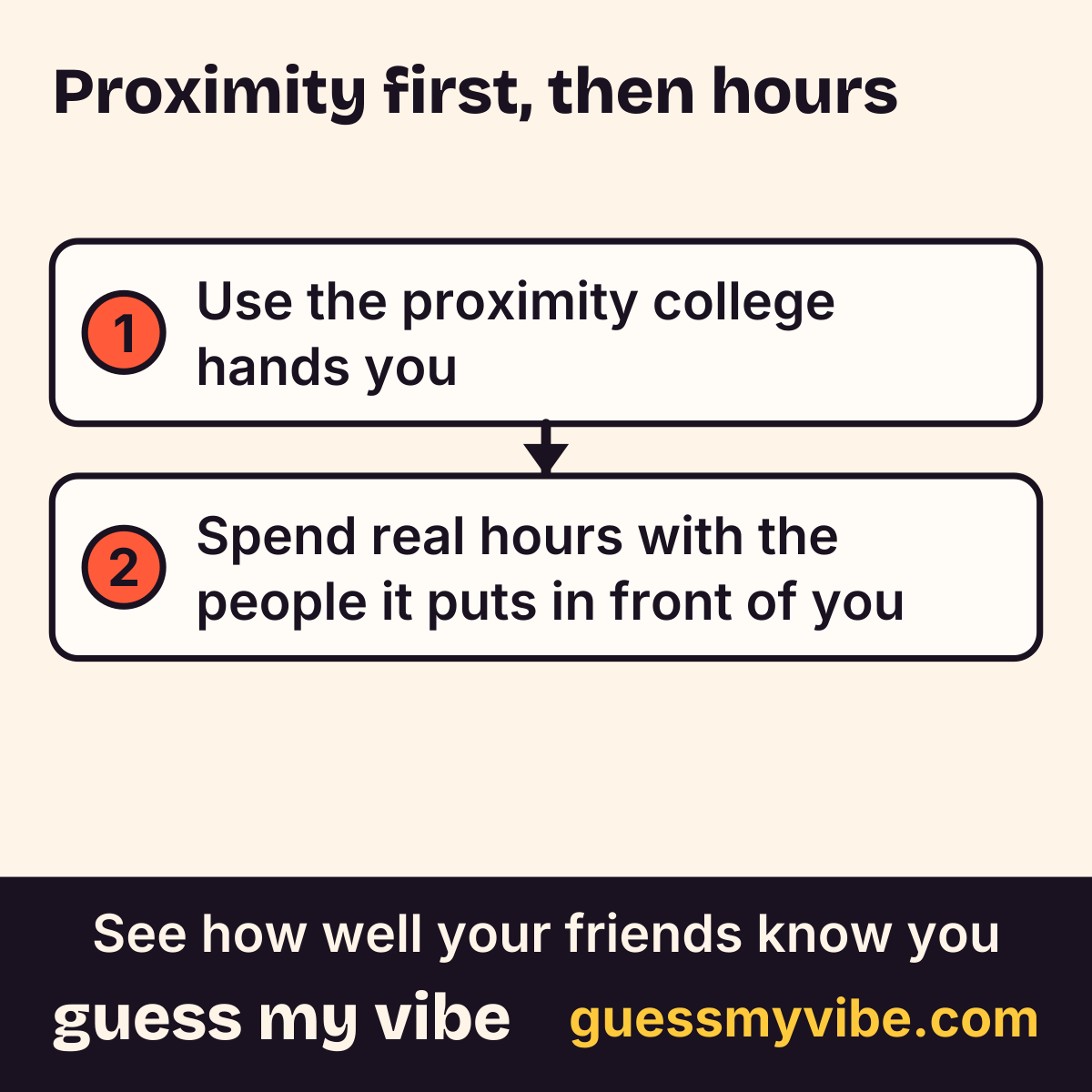
How to make friends in college comes down to using the proximity college already hands you (the same dorm floor, the same classes, orientation week) and then putting in real hours with the people it puts in front of you, since a study following first-year students found hours together tracked with how close new friendships became over their first nine weeks [1]. Liking who you spend time with tends to matter more than how similar you actually are to them.
How to make friends in college is a narrower, more answerable question than how to make friends in general, because college already does most of the hard structural work for you. The honest short version: use the proximity college hands you automatically, then spend real hours with the people it puts in front of you, since hours tracked with closeness in research following actual first-year students [1]. Who you end up closest to has less to do with being alike and more to do with simply showing up around each other enough.
College hands you proximity most adults never get again
A meta-analysis of two decades of research on the mere-exposure effect found that simply being exposed to the same person repeatedly raises how much you like them, even with no real interaction at all, with the size of the effect depending on things like how long and how often the exposure happens [2]. A dorm floor, a 9am lecture that meets three times a week, an orientation group stuck together for a week straight, these are about as concentrated a dose of repeated exposure as adult life ever hands anyone again. That's worth knowing on its own: if a hallmate or a lab partner is starting to feel like a possible friend, the plain fact that you keep seeing them is already doing real work, before either of you has said anything particularly memorable.
Proximity gets you in the room; hours do the rest
A study built specifically around this question followed 112 first-year college students, asking them about two new acquaintances three separate times across their first nine weeks on campus. Hours spent with a new acquaintance tracked with how much closer that friendship got between each check-in, and two specific kinds of everyday talk tracked with that growing closeness too [1]. You may have seen a specific number of hours floated online for exactly when an acquaintance turns into a real friend. That figure doesn't appear in this study's abstract or Crossref record, so it's left out here rather than repeated without being able to verify it. What the study does support, directly, is simpler: keep logging real hours with the same couple of people, not just headcount of who you've met.
Cite this figure
Figure: "Proximity first, then hours." Guess My Vibe (guessmyvibe.com). https://guessmyvibe.com/learn/how-to-make-friends-in-college#figure-proximity-then-hours
Your high school best friend might not stay your closest friend, and that's normal
A study that tracked high-school best friendships through the first year of college found they declined, on average, in satisfaction, commitment, and how rewarding they felt, with costs and alternatives rising at the same time. The part worth remembering: physical distance itself was not linked to which friendships declined. The level of communication people actually kept up was. People who kept doing the basic maintenance work, staying positive, staying supportive, sharing real things, talking regularly, were more likely to stay best friends, and holding onto that one friendship buffered against feeling socially lonely during the transition [3]. If a high school friendship is fading despite being far apart, distance usually isn't the actual cause.
Curious how your friends would answer?
Free. Answer 10 quick questions about you, then send your link. Friends play in their browser, no app needed.
Start freeFeeling alike matters more than actually being alike
One of the more useful, counterintuitive findings for college specifically comes from a year-long study of new college friendships. Researchers measured both actual personality similarity between new friends and how similar each person believed the other was to them, then tracked the friendship's closeness over time. Actual personality similarity had no meaningful link to how close the friendship became. Believing you were alike did track with closeness [4]. That's a useful thing to know walking into a dorm full of strangers: you don't need to find someone who happens to match your personality on paper. You need enough real conversation for a sense of "we get each other" to form, which is a different, more buildable thing than hoping the roommate lottery hands you your exact personality twin.
What if you don't live in a dorm?
Commuter students, transfer students, and anyone starting college later than everyone else around them lose a lot of the automatic proximity described above. There's no floor full of people you'll bump into at 2am, and orientation week may already be over by the time you arrive. The mere-exposure research still applies, it just doesn't arrive for free the way it does for a first-year dorm resident, so the task shifts closer to what making friends as an adult requires: picking a small number of recurring things on campus, a club that meets weekly, a study group for a specific class, a part-time campus job, and showing up to them consistently enough that repeated exposure can start doing its quiet work [2]. It's a real disadvantage worth naming honestly rather than pretending dorm life and commuter life start from the same place. It's not an unsolvable one. The same mechanism (showing up around the same people, on a schedule, more than once) still works; it just has to be built on purpose instead of handed to you by a housing assignment.
Practical starting points for the first semester
- Treat orientation week, your floor, and your recurring classes as the built-in exposure they are: show up, sit in the same spots, say yes to the group dinner even when you're tired.
- Pick one or two recurring things beyond class (a club that meets weekly, a gym class, a dining-hall group) rather than spreading thin across one-off events.
- Count real hours with a couple of people instead of collecting a wide list of names from the first week.
- Keep actively communicating with a high-school best friend if the friendship matters to you. The research says that upkeep, not the miles between you, is what decides whether it lasts.
- Stop screening new people for how similar they are to you on paper. A sense of "we get each other" tends to build from time spent, not from a personality match.
Once you've found your people, there's a way to track it
The research above is really about the first few weeks: showing up on the floor, logging real hours, keeping up the friendships worth keeping. Guess My Vibe is built for the stage right after that, once you've got a new college friend you see often enough to invite: a daily round where you each guess how the other would actually answer, turning the closeness you're building into something you can both see.
Key takeaways
- College creates unusually high built-in proximity (dorms, orientation, shared classes), and plain repeated exposure to the same people raises liking on its own, before a real conversation happens [2].
- A study following 112 first-year college students over nine weeks found hours spent with a new acquaintance tracked with how much closer that friendship became between check-ins [1].
- High-school best friendships tend to decline in satisfaction and commitment during the first year of college on average, and the level of communication kept up, not physical distance, was what separated the ones that survived from the ones that didn't [3].
- In new college friendships tracked over a year, actually being similar in personality had no real link to how close the friendship got, but believing you were alike did [4].
- This isn't therapy, a diagnosis, or a substitute for professional care.
Questions people ask
Will my randomly assigned roommate automatically become my best friend?
Not automatically, but proximity is doing real work in your favor. Plain repeated exposure to the same person raises liking on its own, even before a real conversation happens, so a roommate you see daily starts with an advantage over someone you'd only meet occasionally [2]. What happens next still depends on real hours and conversation, not the assignment itself.
How long does it take to make friends freshman year?
A study following first-year students over their first nine weeks found hours spent together tracked with how much closer a new friendship got at each check-in. There's no single verified hour count behind the exact figures sometimes quoted online, but more real time together, not just more people met, is what the research supports [1].
Should I still try to stay close with my high school best friend?
If the friendship matters to you, yes, and the research says how you do it matters more than how far apart you are. High school best friendships tend to fade in the first year of college on average, but distance itself wasn't behind the decline. Keeping up real communication was [3].
Does it matter if my new college friends are actually similar to me?
Less than you'd think. A year-long study of new college friendships found actual personality similarity had no real link to closeness, while simply believing you were alike did [4]. A sense of connection seems to matter more than a genuine personality match.
Can an app actually help me make friends in college?
An app can't replace the proximity or the real hours the research points to. What a game like Guess My Vibe can do is give a new college friendship a daily reason to keep showing up for each other, once you've already found someone worth spending that time with.
See how well your friends know you.
Free. Answer 10 quick questions about you, then send your link. Friends play in their browser, no app needed.
Start freeReferences
- [1] Hall, J. A. (2019). How many hours does it take to make a friend?. Journal of Social and Personal Relationships, 36(4), 1278–1296. doi.org/10.1177/0265407518761225 (opens in a new tab)
- [2] Bornstein, R. F. (1989). Exposure and affect: Overview and meta-analysis of research, 1968–1987. Psychological Bulletin, 106(2), 265–289. doi.org/10.1037/0033-2909.106.2.265 (opens in a new tab)
- [3] Oswald, D. L., & Clark, E. M. (2003). Best friends forever?: High school best friendships and the transition to college. Personal Relationships, 10(2), 187–196. doi.org/10.1111/1475-6811.00045 (opens in a new tab)
- [4] Selfhout, M., Denissen, J., Branje, S., & Meeus, W. (2009). In the eye of the beholder: Perceived, actual, and peer-rated similarity in personality, communication, and friendship intensity during the acquaintanceship process. Journal of Personality and Social Psychology, 96(6), 1152–1165. PubMed: 19469593 (opens in a new tab)
How we find and check these sources: how we write. Spotted an error? Report a correction.
Related
Want to try it with your own friends? Make a friendship quiz to play with your friends
Cite this article
- Title
- How to Make Friends in College
- Publisher
- Guess My Vibe
- Updated
- URL
- https://guessmyvibe.com/
learn/ how-to-make-friends-in-college
Copy this citation
Guess My Vibe. (2026, October 3). How to Make Friends in College. Guess My Vibe. https://guessmyvibe.com/
To point at one section, add that section's anchor (the # link on its heading) to the URL.