Group projects go wrong for two well-documented reasons: people reliably put in less effort working collectively than they would working alone, a pattern called social loafing [1], and in real teams (not lab experiments), having no team member low in agreeableness (the team's minimum) and a generally conscientious group tracks with better performance, while in lab tasks raw ability mattered more [2]. Who ends up doing the work is partly personality and partly how the project is structured.
Group projects go wrong in a pattern specific enough that researchers gave it a name decades ago: social loafing, the tendency to put in less effort on a shared task than you would on the same task alone. A meta-analysis of 78 studies found this effect holds up reliably across different kinds of tasks and different groups of people, which rules out the comforting idea that it's just your group, your major, or your specific teammates [1]. The second half of the story is about who the group is made of in the first place: research on real teams finds personality composition, not just who happens to be smartest, tracks with how well the group actually performs [2].
Why people put in less effort in a group than alone
The meta-analysis behind social loafing didn't just confirm the effect exists. It identified what makes it stronger or weaker. A few variables moderated how much loafing showed up: evaluation potential (whether anyone can actually tell what you individually contributed), expectations about how well your co-workers will perform, how meaningful the task feels, and culture all had especially strong influence [1]. Put plainly: the less visible your individual piece is, the more likely you are, and everyone else in the group is, to quietly do less than you would solo. This isn't really about laziness or character. It's a predictable response to a specific kind of structure, one that shows up across 78 separate studies of very different groups.
Who actually ends up doing the work
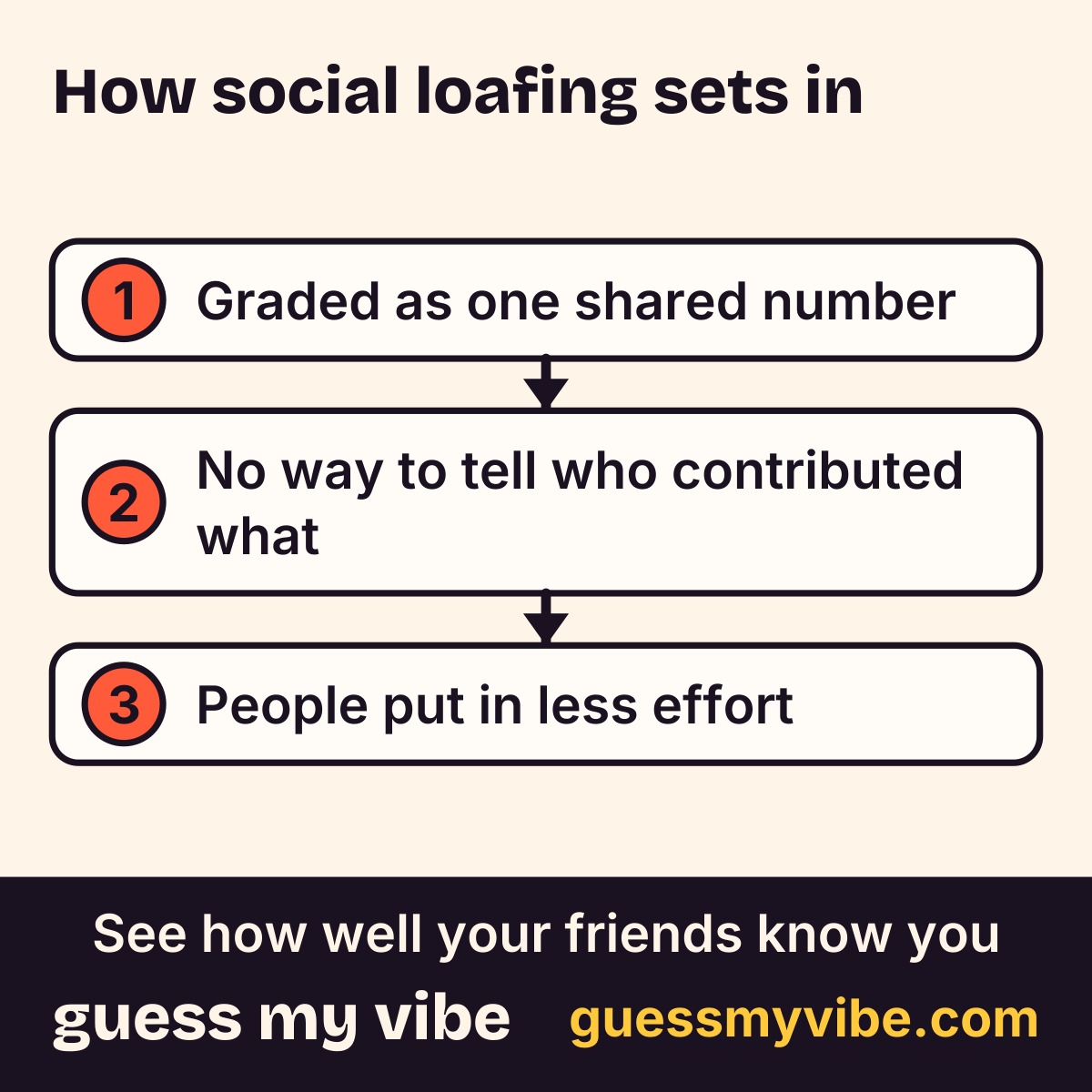
Evaluation potential is the lever most group projects already have access to, whether or not anyone pulls it. A project graded as one shared number, with no way to tell who contributed what, sets up exactly the condition social loafing research says produces the most loafing. A project where each person's specific piece is visible, even informally, tends to pull against it. This is also why the person who "always ends up doing everything" often isn't imagining it: in a structure with low evaluation potential, the group's total output tends to concentrate in whoever cares enough, or feels accountable enough, to compensate for everyone else's predictable pullback.
Cite this figure
Figure: "How social loafing sets in." Guess My Vibe (guessmyvibe.com). https://guessmyvibe.com/learn/group-projects#figure-how-loafing-happens
What actually tracks with a good team, according to the research
A meta-analysis pulling together the team-composition literature looked at how personality, values, and ability line up with team performance, and it found something worth knowing before you panic about who's on your roster: the setting mattered enormously. In lab studies, where strangers are assembled for a short, artificial task, personality composition barely mattered; the standouts there were team ability (the team's weakest and strongest members' general mental ability) and the team's average emotional intelligence. In field studies, meaning real, ongoing teams doing real work, the picture flipped: a team's minimum level of agreeableness and the team's average conscientiousness, openness to experience, collectivism, and preference for teamwork each emerged as strong predictors of performance [2]. A semester-long class project is much closer to a field setting than a lab experiment, which is one reason personality fit may matter more for a group project than people expect walking in.
The specific finding about minimum agreeableness is worth sitting with: it's not the team's average agreeableness that mattered most, it's whether the team had at least one member who was low in agreeableness. One difficult, low-agreeable teammate appears to be able to drag down a real team's performance more than having several highly agreeable members can lift it. If a group project is struggling and one person is consistently the source of friction, the research here backs up the instinct that it's that one relationship dragging on the whole group, not a diffuse group-wide problem.
Curious how your friends would answer?
Free. Answer 10 quick questions about you, then send your link. Friends play in their browser, no app needed.
Start freeAgreeableness is also what decides how conflict gets handled
Separate research on interpersonal conflict backs up why that one low-agreeable teammate matters so much. Using both hypothetical conflict scenarios and two weeks of diary records of real daily conflicts, agreeableness turned out to be the Big Five trait most closely tied to how people actually respond when disagreement shows up, more than extraversion, conscientiousness, neuroticism, or openness [3]. People lower in agreeableness also rated direct power assertion as a better conflict tactic than more agreeable people did (though both groups still rated negotiation as the better choice), and agreeableness differences also showed up in patterns of conflict in a smaller study of videotaped two-person conversations [5]. In a group project, that's the difference between a disagreement that gets talked through and one that escalates into someone pulling rank or going silent.
Why you usually can't tell who'll be difficult until the project starts
Here's the frustrating part: agreeableness, the exact trait that matters most for how a group project's conflicts play out, is also a trait that is hard to read accurately from the outside. A meta-analysis of more than 44,000 people across 263 samples found that closer relationships improved accuracy a lot for low-visibility traits like emotional stability but only minimally for highly evaluative traits like agreeableness [4]. That tracks with ordinary experience: you can usually tell who's going to be the loud, outgoing one in a new group within the first meeting. Whether someone's going to be reasonable, flexible, and willing to compromise under real deadline pressure is much harder to tell from a first impression, which is exactly why a group project with total strangers so often surfaces a personality clash nobody saw coming.
What actually helps, based on the research above
- Make individual contributions visible somehow, even informally (a shared doc with names attached to sections), since low evaluation potential is one of the strongest drivers of loafing.
- Assign specific, named roles instead of one shared, interchangeable task list.
- Don't assume a loafing teammate is lazy by nature. The same meta-analysis found loafing is a predictable response to structure, not a fixed trait, and it shows up for most people under the right conditions.
- If one teammate is consistently the source of friction, treat it as that specific relationship, not a group-wide failure. Research on team composition found one difficult, low-agreeable member can drag down a team's performance more than several agreeable members can offset.
- Expect it to take real conversation, not a first impression, to learn how a new teammate handles disagreement. Agreeableness is the trait people judge least accurately from the outside.
If your group project team happens to be friends too
None of the research above requires liking your teammates, just understanding the structure you're all working inside. But if a group project teammate is also a real friend, Guess My Vibe runs a daily round where you each guess how the other would actually answer, a lower-stakes way to find out how well you actually read each other before the next deadline makes it obvious.
Key takeaways
- A meta-analysis of 78 studies found social loafing, putting in less effort in a group than you would alone, is a robust pattern across tasks and groups of people [1].
- Whether your individual contribution can actually be seen and evaluated is one of the strongest things that reduces how much a person loafs in a group [1].
- In real-world teams, a team's minimum agreeableness and its average conscientiousness, openness, collectivism, and preference for teamwork tracked with team performance; in lab studies, these personality links were negligible and raw ability mattered more instead [2].
- Agreeableness is the Big Five trait most closely tied to how people handle real interpersonal conflict, and it's also a trait where getting to know someone better helps only minimally with judging it accurately from the outside [3] [4].
- This isn't therapy, a diagnosis, or a substitute for professional care.
Questions people ask
Why do some people always end up doing all the work in group projects?
Partly structure: when individual contributions aren't visible or graded separately, social loafing research finds people put in less effort, because evaluation potential is one of the strongest moderators [1]. Partly personality: a team's minimum agreeableness and average conscientiousness track with real team performance, so one difficult or low-conscientiousness member may matter a lot for how the group does [2].
Is social loafing just laziness?
Not according to the research. A meta-analysis of 78 studies found loafing is a predictable response to specific conditions, especially how visible your individual contribution is, not a fixed character trait. It shows up across most people under the right structure [1].
Does having a smarter team actually make group projects go better?
Less than people assume outside of short, artificial lab tasks. In real, ongoing teams, personality factors (a team's minimum agreeableness, its average conscientiousness, openness, and preference for teamwork) emerged as strong predictors of performance, while in lab tasks personality effects were negligible and ability mattered more [2].
Why does one difficult teammate seem to ruin the whole group?
Research on team composition found a team's minimum level of agreeableness (its least agreeable member) tracked with performance in real teams, which is why one low-agreeable member may matter more than the team's overall friendliness [2]. Agreeableness is also the trait most tied to how people handle conflict day to day [3].
Can you tell who's going to be a difficult teammate before the project starts?
Not reliably. Research on how accurately people judge each other's personality found that closeness helps only minimally with highly evaluative traits like agreeableness, which is exactly the trait that matters most for group conflict. A first meeting tells you who's outgoing, not who'll be flexible under deadline pressure [4].
See how well your friends know you.
Free. Answer 10 quick questions about you, then send your link. Friends play in their browser, no app needed.
Start freeReferences
- [1] Karau, S. J., & Williams, K. D. (1993). Social loafing: A meta-analytic review and theoretical integration. Journal of Personality and Social Psychology, 65(4), 681–706. doi.org/10.1037/0022-3514.65.4.681 (opens in a new tab)
- [2] Bell, S. T. (2007). Deep-level composition variables as predictors of team performance: A meta-analysis. Journal of Applied Psychology, 92(3), 595–615. PubMed: 17484544 (opens in a new tab)
- [3] Jensen-Campbell, L. A., & Graziano, W. G. (2001). Agreeableness as a moderator of interpersonal conflict. Journal of Personality, 69(2), 323–361. PubMed: 11339802 (opens in a new tab)
- [4] Connelly, B. S., & Ones, D. S. (2010). An other perspective on personality: Meta-analytic integration of observers' accuracy and predictive validity. Psychological Bulletin, 136(6), 1092–1122. PubMed: 21038940 (opens in a new tab)
- [5] Graziano, W. G., Jensen-Campbell, L. A., & Hair, E. C. (1996). Perceiving interpersonal conflict and reacting to it: The case for agreeableness. Journal of Personality and Social Psychology, 70(4), 820–835. PubMed: 8636901 (opens in a new tab)
How we find and check these sources: how we write. Spotted an error? Report a correction.
Related
- Friend Group Psychology: How Groups of Friends Actually Work
- Honesty in Friendship: Why It Hurts Less Than You Think
- Why Some People Are Always Late
- How to Make Friends as an Adult
- Social Loafing: Why People Slack Off in Groups
- Team Dynamics: How Personality Mix Shapes a Team
- Emergent Leadership: Who Becomes the Leader in a Group?
Cite this article
- Title
- Group Projects: Why They Go Wrong and Who Does the Work
- Publisher
- Guess My Vibe
- Updated
- URL
- https://guessmyvibe.com/
learn/ group-projects
Copy this citation
Guess My Vibe. (2026, October 3). Group Projects: Why They Go Wrong and Who Does the Work. Guess My Vibe. https://guessmyvibe.com/
To point at one section, add that section's anchor (the # link on its heading) to the URL.