Social loafing is the tendency to put in less effort when you work as part of a group than when you work alone. It was first measured in 1979 with clapping and shouting, and a later meta-analysis of 78 studies found it is robust across tasks and groups of people, and is tied to whether anyone can tell what each person contributed [1] [2] [3].
Social loafing is what happens when a task gets shared and each person quietly turns the effort down a notch. Researchers define it as putting in less effort when working collectively than when working alone, and the first experiments on it used a task about as simple as it gets: clapping and shouting as loud as you can [1]. Nearly fifty years of follow-up work has found that the pattern shows up well beyond that lab task, and that it responds to specific conditions, including whether anyone can evaluate your individual share [2]. It describes a situation more than a type of person, which is why it can catch hard workers too.
What the original social loafing experiments found
In 1979, Latané, Williams and Harkins asked people to perform two physically effortful tasks, clapping and shouting, either alone or in groups. In two experiments, people showed a sizable decrease in individual effort when they performed in groups compared with when they performed alone. The authors named this drop social loafing and made a point that is easy to miss. It was in addition to the losses that come from groups coordinating badly [1].
That second point is what made the finding interesting. It was already known that groups lose some output to friction: people talk over each other, get in each other's way or time things badly. The experiment showed a separate loss that comes from motivation. People were not just less coordinated. They were trying less.
The wording matters here. Social loafing is about collective work, where everyone's inputs are combined into a single group product, such as a shared grade or a team total. It is not about merely working near other people. In the research's own terms, working coactively means doing your own task in the presence of others without your inputs being combined, and loafing is defined as the drop in effort relative to working alone or coactively [2]. A study group where everyone works on their own practice problems is coactive. A group presentation with one grade is collective. The same room can be either one.
Why social loafing happens: the evaluation question
A key piece of the explanation is what researchers call evaluation potential. In the classic setup, when people work together their outputs are pooled, so nobody can evaluate any individual's output. A later study tested whether a different kind of evaluation would be enough to bring effort back. Across two experiments, when the experimenter could not evaluate people's outputs, the chance for participants to evaluate themselves reliably improved performance, and self-evaluation was the only motivation needed for people to try as hard as those the experimenter could evaluate [3].
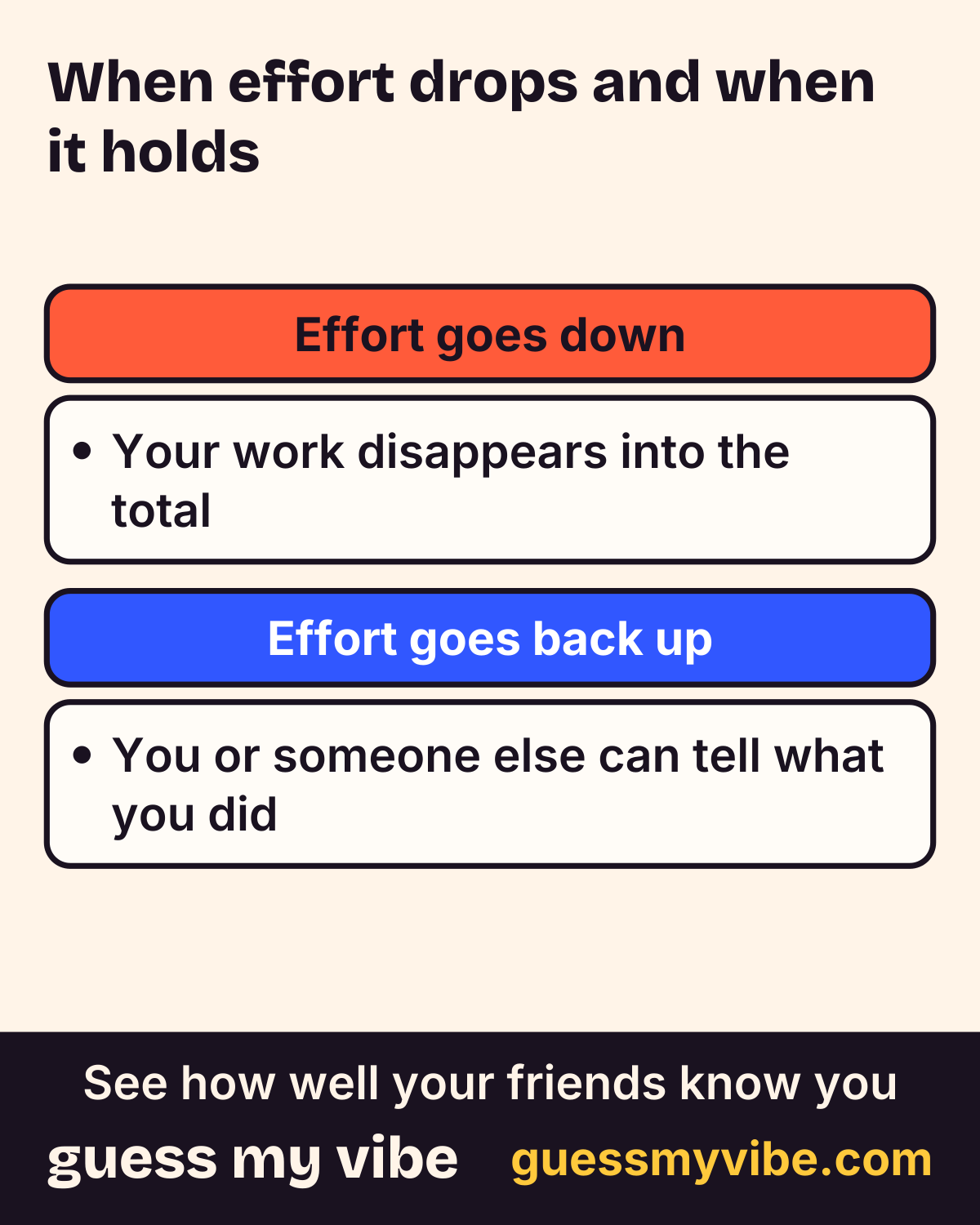
In plain words, effort goes down when your contribution disappears into the total, and it goes back up when you or someone else can tell what you did. That does not mean people loaf on purpose. In those experiments, being able to check your own output against a standard was enough to bring effort back up.
Cite this figure
Figure: "When effort drops and when it holds." Guess My Vibe (guessmyvibe.com). https://guessmyvibe.com/learn/social-loafing#figure-when-effort-drops
What 78 studies add: four things that move the effect
The most cited summary of the field is a 1993 meta-analysis of 78 studies. It found social loafing is robust and generalizes across tasks and populations. It also found that a large number of variables moderate it, with four having an especially strong influence: evaluation potential, expectations of co-worker performance, task meaningfulness and culture. The authors folded these into a Collective Effort Model that combines ideas from expectancy-value, social identity and self-validation theories [2].
One way to read that list is as a set of questions a person asks, usually without noticing. Will anyone know what I did? Will the others pull their weight, so my effort is not wasted? Does this task matter to me? And does the group I am part of matter to me? When the answers come back "no," effort drops. When they come back "yes," it tends to hold up. The abstract does not spell out the direction of each moderator in detail, so treat that reading as an interpretation of the model, not a quote from it.
Curious how your friends would answer?
Free. Answer 10 quick questions about you, then send your link. Friends play in their browser, no app needed.
Start freeSocial loafing versus free riding
People often use the two terms as if they meant the same thing, but researchers separate them. Free riding is about dispensability. In a set of three experiments with undergraduates, members put in less effort as their own effort felt less necessary to the group's success. The authors called these free-rider effects, and in one experiment motivation fell as groups got bigger even though every member was fully identifiable, which they said was not a social loafing effect [5].
The practical difference is useful. Loafing is mostly about being hidden in the total. Free riding is mostly about feeling that your effort will not change the outcome. A group can have one without the other, and they need different fixes. Making each person's piece visible addresses the first. Making each person's piece matter to the result addresses the second.
What it looks like in real teams
Lab tasks are short. A study of social loafing as a naturally occurring process in student project teams that worked together for three to four months looked at what was linked to who held back. People who saw the team's decision-making as fair loafed less. Whether the team's evaluation structure made individual input identifiable changed how much feeling dispensable led to loafing, though not how much fairness did. And some kinds of difference between teammates were linked with seeing oneself as more dispensable and the process as less fair [4].
The takeaway for an ordinary group is that two things matter at the same time, how visible each person's work is and whether the group feels fair. A team can have clear individual credit and still feel unfair, and it can feel friendly while hiding who did what. Either gap gives loafing room.
What actually reduces social loafing
The research does not hand out a checklist, but the findings above point in some clear directions. These are inferences from the studies, not rules the authors tested together.
- Make individual pieces visible. Split a project so each person has a named part, and share progress where everyone can see it. This targets evaluation potential, one of the four factors the meta-analysis found especially influential [2].
- Let people check their own work. The self-evaluation experiments suggest a person does not need an outside judge, only a way to see how they did against a standard [3].
- Keep the process fair. In student teams, perceived fairness went with less loafing, so how decisions get made matters as well as who does what [4].
- Say out loud what the group expects of each person. Expectations of co-worker performance were one of the strong moderators [2].
- Make sure the task means something to the people doing it. Task meaningfulness was another strong moderator [2].
It also helps to keep the explanation kind. When a teammate goes quiet, the finding that the pull is predictable under certain structures means the first move can be to change the structure, not to decide who they are. That keeps the conversation about the work.
What the research does not tell you
Several of the best-known studies used short lab tasks and undergraduate samples, and the 1979 tasks were physical. The meta-analysis shows the pattern generalizes across many tasks, but it cannot tell you why one specific teammate went quiet on one specific project. The research also describes patterns across many people, not any one person, so it is a reason to look at the setup first, not a way to read a teammate's character.
A lower-stakes way to see how visible you are
If a teammate is also a friend, Guess My Vibe is a low-pressure way to see how well you read each other. You each answer and guess on your own, then the reveal puts the two sets side by side, so each person's part is easy to see.
Key takeaways
- Social loafing means each person works less hard in a group than alone, and the original experiments found a sizable drop beyond what poor coordination would explain [1].
- A meta-analysis of 78 studies found the effect is robust, and that evaluation potential, expectations of co-workers, task meaningfulness and culture had especially strong influence [2].
- Loafing shrinks when people can judge their own output: in two experiments, the chance to self-evaluate raised effort to the level seen when the experimenter could evaluate people [3].
- In real student teams, people who saw the team's decision-making as fair loafed less [4].
- This isn't therapy, a diagnosis, or a substitute for professional care.
Questions people ask
What is social loafing in simple terms?
It is putting in less effort when you work with others than when you work alone. The original 1979 experiments, which used clapping and shouting, found a sizable drop in individual effort in groups, beyond any losses from poor coordination [1].
Is social loafing the same as being lazy?
Not according to the research. A meta-analysis of 78 studies found it is a robust effect across tasks and populations that depends on conditions such as evaluation potential, expectations of co-workers, task meaningfulness and culture [2]. The research frames it as something that depends on conditions, which is a reason to look at the situation before judging the person.
What is the difference between social loafing and free riding?
Loafing is mostly linked to your effort being hidden in the group total. Free riding is linked to feeling your effort is dispensable to the group's success. One set of experiments found motivation fell as groups grew even when every member was identifiable, and the authors described that as a free-rider effect, not social loafing [5].
How do you reduce social loafing in a group?
The findings point toward making each person's contribution identifiable, letting people evaluate their own work, keeping decisions fair and making the task meaningful. Self-evaluation alone raised effort to the level seen with outside evaluation in two experiments [3], and fairness went with less loafing in student teams [4].
Does social loafing happen in every culture?
The meta-analysis found culture was one of the factors with an especially strong influence on the effect, so the size of it is not the same everywhere [2]. The abstract does not say in which direction, so do not assume it from stereotypes.
See how well your friends know you.
Free. Answer 10 quick questions about you, then send your link. Friends play in their browser, no app needed.
Start freeReferences
- [1] Latané, B., Williams, K., & Harkins, S. (1979). Many hands make light the work: The causes and consequences of social loafing. Journal of Personality and Social Psychology, 37(6), 822–832. doi.org/10.1037/0022-3514.37.6.822 (opens in a new tab)
- [2] Karau, S. J., & Williams, K. D. (1993). Social loafing: A meta-analytic review and theoretical integration. Journal of Personality and Social Psychology, 65(4), 681–706. doi.org/10.1037/0022-3514.65.4.681 (opens in a new tab)
- [3] Szymanski, K., & Harkins, S. G. (1987). Social loafing and self-evaluation with a social standard. Journal of Personality and Social Psychology, 53(5), 891–897. doi.org/10.1037/0022-3514.53.5.891 (opens in a new tab)
- [4] Price, K. H., Harrison, D. A., & Gavin, J. H. (2006). Withholding inputs in team contexts: member composition, interaction processes, evaluation structure, and social loafing. Journal of Applied Psychology, 91(6), 1375–1384. PubMed: 17100491 (opens in a new tab)
- [5] Kerr, N. L., & Bruun, S. E. (1983). Dispensability of member effort and group motivation losses: Free-rider effects. Journal of Personality and Social Psychology, 44(1), 78–94. doi.org/10.1037/0022-3514.44.1.78 (opens in a new tab)
How we find and check these sources: how we write. Spotted an error? Report a correction.
Related
Cite this article
- Title
- Social Loafing: Why People Slack Off in Groups
- Publisher
- Guess My Vibe
- Updated
- URL
- https://guessmyvibe.com/
learn/ social-loafing
Copy this citation
Guess My Vibe. (2026, October 4). Social Loafing: Why People Slack Off in Groups. Guess My Vibe. https://guessmyvibe.com/
To point at one section, add that section's anchor (the # link on its heading) to the URL.